I am Not Looking For Love, I am Going to Work

not looking for love
It began yesterday at the government office, which was saturated with immigrants whose anxious stares alternated between the digital display boards and their tickets, a square piece of paper with a number printed on it. At the sound of the beep, everyone looked at their ticket, and then the display boards. Some sighed. Some continued talking. Others continued sleeping. One person rose to meet an official walled in by glass on the other side of the counter.

My wait was shortened by an acquaintance with whom I chatted until our conversation lulled to a comfortable stop.

“Excuse me, it seems you are from Nigeria.” A tall man sitting a few spaces away from my acquaintance smiled at her.

“No, I am not.”

“Ah, but I thought—”

“I am from Democratic Republic of Congo.”

With her thick Igbo accent, she delivered her last words with a finality that inspired no argument from the man. He fanned himself, and then pretended to read his letter from the belastingdienst.

Because I am slow to change the expression on my face, she saw it. The disbelief. The wonder. The perplexity.

“Don’t mind the idiot. If not for dis yeye tax people, where e for come see me? See as e dey talk as if e be my mate. E nor see im type?” she whispered for my benefit and his.

I nodded like her co-conspirator, as though I had been dissing guys for the last ten years. What else could I do?

Determined to be a better person, this incident is hovering at the back of my mind when a young man approaches me today as I wait for my tram.

“Hello, are you from Nigeria?”

Surely there must be a better opening line? I give nothing away as I nod and he introduces himself. I tell him my name.

“Ah, Timi. Timilehin? You are Yoruba?”

“I am Nigerian.”

“I know, from whose part?”

“We have left Nigeria. Let’s pretend ethnicity does not matter. I am a Nigerian; that is enough.”

He looks at me as though the sky has descended on my head and I am unaware. Undeterred, he forges on in pidgin English. I respond in proper English.

He ditches Pidgin in favour of a kind of English that is interspersed with incorrect tenses and Dutch words. This is a cross some of us bear. The effect of speaking Dutch with non-native proficiency is the tendency to forget English words and to adjust our tenses automatically to match the wrong grammar of English-speaking Dutch people.

I am aware of every mistake he makes. Like the freckles on my neighbour’s face, they are many.

“I saw you at this tramhalte iedere dag, I mean, every day. Are you going to work?”

“Yes.”

“Where?”

I tell him. And then I help him because he seems lost, “I haven’t seen you before?”

“I know, but I am seeing you. You are very mooi, beautiful.”

I take in his overalls. He does not look like Idris Elba in Tyler Perry’s Daddy Loves His Girls, but this is real life.

“Thank you, where do you work?”

He talks about his work, links that conversation to how long he has been in The Netherlands—fifteen years, and then ties it to his goals and dreams like a neat bow at the end of a string.

My eyes do not wander from his face while he speaks. But my mind does. I wonder if he can read, understand, discuss, and comment on my blog intelligently.

Then there is silence. The wind dies. The leaves sleep. The seagulls take their leave. It is just me and him. And the silence. Without my help, he stews in it for a while—scratching his chin, brushing dirt from his overalls, staring at something behind me—before he says, “I must goes to my work place. Can I have your number?”

“For what?” Honest words spill out before I can reel them in. What else do we have to say to each other?

I wan know you.”

I do not know why I did what I did next. Guilt—over what? My resolution to be a better person? Pity? Maybe, my thoughts had roamed to how he must have been eyeing me, calculating his approach. Religious fervour? Hardly.

“I would like to invite you to my church.” I fumble in my bag for the flyers the preacher says we should carry around for opportune moments, moments like this one I suppose.

He looks at me as though The Rapture has occurred and I am unaware.

“Ah, ah! Won’t you know me first before inviting me to your church? I already goes to church.”

It is as if he knows. That I am not very good at this. That church is a cop-out. That it is too late to tell him I am from the Democratic Republic of the Congo. That I do not have the heart to tell him he will not understand my blog, and therefore not understand me. He pounces on me like a wounded lion, as if to say, “This is for every man you ever dissed!”

“That’s the problem with you Nigerian girls! Church, church, church! Your mates don marry, you still dey here! Oya go and marry your God!”

He jumps on his bicycle in one swift motion and pedals away.

It is rare that I cannot express myself with words. But I am not writing a dissertation. This is life. This does not call for intellectual prowess.

I imagine that in a few moments, his bicycle chain would jam, forcing him to stop. I imagine him kneeling on the earth, humiliated, rattling the chains, while I watch from the elevated platform of my tram stop. Then the words that abandoned me would force their way out of my mouth, “I am not looking for love, I am going to work!”’

Nothing I imagine happens. He continues to ride and does not look back. But a curious thing happens. As I look, it is not him getting smaller in the distance, it is me!


© Timi Yeseibo 2013


Unauthorized use and/or duplication of this material without express and written permission from this blog’s author and/or owner is strictly prohibited. Excerpts and links may be used, provided that full and clear credit is given to Timi Yeseibo and livelytwist.wordpress.com with appropriate and specific direction to the original content.

I am Africa and No, You Cannot Touch My Hair

africa woman globe

“Can I touch your hair?”

How did we get to this point? How did this stranger get the nerve to ask this personal question?

You see, I am at the park, with a book I will not read because watching people is so much better. Behind my sunglasses, I can stare for as long as I want. No one will know, so no one will care.

When she arrived with her multi-coloured handbag, wearing a blue dress with little white daisy patterns, underneath a light green sport coat, a bright pink scarf around her neck, and navy tights in brown leather ankle boots, I thought of church on Sundays in Nigeria, the profusion of colours but without the gaiety.

She began looking at me not long after she sat on the bench opposite me, occasional stares, polite stares, with a small smile, the kind that invites conversation. I should have said something; maybe something about the weather, about how annoying it was that the sun chose to play peek-a-boo.  Instead, I averted my gaze. But I could not keep my eyes away because she has earrings all over her face—four earrings on her right ear, two on her left, two on her nose, and one on her lip.

If I did not look back perhaps, she might not have asked. I thought about one fallout of not being native Dutch as she kept staring, her curiosity shining through—being at the mercy of people’s assumptions about why you are here. I see it in their eyes, a self-indulgent kind look that presumes I know how lucky I am to be here, as if I had escaped starvation in Africa by the skin on my bones.

However, I could not dwell on the challenges of immigration. I could not analyse how racial prejudice swings back and forth from citizens to migrants like a bicycle that pedals forward and backward because that was when she walked towards me, looking at my cornrows in wonder as if they were listed in the Guinness Book of Records.

Maak ik uw haar aanraken?”

Ik spreek Engels.”

“Oh, is it your hair?  Please can I touch it? How long…”

I should be used to it. I am. I am not. I am … tired.

She continues to look. Looking is free.

Why have I never asked to touch the hair of any Caucasian woman including those who are my friends? I have a theory. I had many Barbie dolls growing up. I brushed and brushed the rubbery silkiness of their blond hair; twisted it, plaited it, wrapped it, pony-tailed it, cut it, washed it, pulled it, until I was “un”fascinated by it.

“Hello, I’m Africa, and no you may not touch my hair! If you had played with African dolls when you were younger, you would not need to touch my hair.”

The words are at the tip of my tongue, but I do not vocalize them.

How can I? How dare I sound indignant when I remember that some people in Nigeria stare at foreigners as though they have never watched TV? Others ask to touch their skin and there are those who solicit funds with their sad, sad, stories, as if every oyinbo is World Bank, willing to give aid to Africa.

I exhale deeply. “Yes, you may.”

We can recoil from what we do not know, we can pretend we know, or we can seek to know. Maybe understanding will foster peace. Maybe understanding will dispel superstitions. Maybe understanding will reduce stereotypes. Maybe understanding will bring acceptance. What do I know? I close my eyes as she touches my cornrows, lightly, hesitantly, and then with firmer motions as her confidence grows.

my cornrows

© Timi Yeseibo 2013

Image credit: Woman holding Earth globe by Microsoft

Photo credit: my cornrows © Timi Yeseibo 2013


Unauthorized use and/or duplication of this material without express and written permission from this blog’s author and/or owner is strictly prohibited. Excerpts and links may be used, provided that full and clear credit is given to Timi Yeseibo and livelytwist.wordpress.com with appropriate and specific direction to the original content.


Effizzy

Effizzy 1

Since I returned to Nigeria, I seem to be bumping into people I know from the past everywhere I go. It is a delight to cross the initial hurdles, “You look familiar. Which school did you attend? Where do you or did you work?” and finally make the connection.

Somewhere in between catching up and exchanging telephone numbers, they inevitably say something like, “You have not changed a bit; you look just the same!” That remark makes me wonder if they are blind or trying to be kind. Now, I admit that I am colour-blind to the shades of grey that should be painted on the canvas of friendly conversation. Trying to be truthful, but frantically digging into my shallow well of diplomatic graces, I guardedly reply, “Well your face has not really changed either,” forcing my wandering eyes to focus on the face and not the torso that shows telltale signs of a lingering love affair with food.

It is a thrill to hear what they have been up to or what they are currently involved in. I listen in child-like awe as they highlight past achievements, summarize current assignments, and state their aspirations with convincing conviction. If I bump into two or more male acquaintances, I am amused because their antics remind me of a book title I’d seen years ago, My Mercedes is Bigger than Yours. Nevertheless, I marvel at just how well people are getting on with their lives.

My bubble burst when I recounted my various run-ins to friends who were not impressed. “Effizzy, it’s all effizzy,” they replied. Responding to my blank stare, they informed me that effizzy encompasses a wide range of attitudes, mannerisms, and lifestyles that make one appear to be The Jones that others are keeping up with. I disagreed and commented that people have carved niches for themselves in consulting and others have resigned from well-paying jobs to become entrepreneurs.

“Ha!” they scoffed. “I consult for several schools, is effizzy for I take my portfolio round schools and try to convince them to buy my goods.” “I resigned from my job to start my company and we are into telecommunications, oil prospecting, you name it, is effizzy for I almost got fired so I quickly resigned. My office is in my living room and I am trying to swindle any unsuspecting!” I wondered if they were not being too cynical, after all, what is wrong with working hard to score a good impression?

I did not give our effizzy discussion any more thought until recently. I had gone to the salon to have my hair done and a smartly dressed young man introduced himself as the resident trichologist and chief stylist. He reeled off other credentials that I cannot remember and wanted to fix my hair. I declined preferring instead to have my usual stylist.

He commented on my eyebrows, which I had carefully tweezed that morning and thought looked great. He insisted that a beautiful woman like me needed to complete my look by having nicely arched brows. He wondered quite loudly if I had ever had them professionally done. I began to feel small and unsophisticated in this posh salon before this proficient beauty expert. Inwardly praying that he would stop the verbal harassment, which portrayed me as unglamorous, my voice dwindled to a whisper as I maintained that I was happy with my looks.

A few moments later, a client walked in. Mr. Trichologist wowed her with his resume and he proceeded to fix her hair. I was startled from my silent introspection over the arch of my brows by a scream from across the room. The new client was upset with Mr. Trichologist because he had damaged her hair and weave. Mr. Trichologist remained unapologetic while insisting that he knew what he was doing.

As I gazed at her over-processed, nearly burnt tresses, two words floated from my subconscious: articulate incompetent, oh I mean, effizzy!

Timi Yeseibo © 2009

image design: ©Timi Yeseibo 2013

Unauthorized use and/or duplication of this material without express and written permission from this blog’s author and/or owner is strictly prohibited. Excerpts and links may be used, provided that full and clear credit is given to Timi Yeseibo and livelytwist.wordpress.com with appropriate and specific direction to the original content.

Through the Eyes of a Child


Ferdinand Reus / Foter.com / CC BY-SA

Children are the future because they not only propagate generational lines but also improve on our legacy. Their simplistic view of the world combined with their unending well of curiosity, results in an incessant battery of questions.

During my children’s first visit to Nigeria, they oohed, aahed, and ouched because  everything was new. Growing up in Nigeria had given me some immunity to the culture shock they experienced. Yet, they challenged me to pause and look where I had previously thrown a careless glance because my eyes were glazed over with a heavy coating of the familiar.

Innocent and inquisitive, they kept asking questions. Even though I fielded their questions with the expertise of a savvy politician, I pondered these same questions long after I tucked them in bed and kissed them goodnight.

They asked about the madman who ate and slept naked under an abandoned trailer parked on a busy street. They asked, eyes round with amazement, about the paraplegic who was the unofficial traffic warden. He controlled traffic from his foot chair—so called by my children because he “sat” on what looked like a footstool with wheels underneath that gave him bullet-speed mobility. It was very useful as it enabled him to quickly collect the largesse from patrons without being crushed under the giant wheels of jeeps.

It seems as if everything is different and yet everything is the same. Our progress resembles a swinging pendulum—back and forth but still on the clock. So yes, this future generation asks simple questions about our beloved Nigeria.

“Are we in a war?” my eldest one asked.

“No, of course not, does it look like we are?” I queried, wondering if he was confusing Nigeria with another country he’d seen on TV.

“Then why are there policemen armed with assault rifles everywhere? Why do they hold up their guns and stop cars?” He demonstrated with his hands.

“Why indeed?” I replied playing for time, as I crafted my reply.

“Are there many bad people in Nigeria?” my youngest interrupted my train of thought.

“No not really, like anywhere else in the world, we have good people and bad people,” Annoyance swirled in my stomach and I inwardly blamed those foreign TV shows that depict Nigerians as a bunch of rogues.

“Then why are there so many prisons walls?”

“Where are the prison walls?” I asked because her serious tone belied any evidence of a joke.

“See that one over there, and another one over here,” she responded matter-of-factly, as she pointed to nearly every house on the street.

I said nothing but nodded in understanding.

I explained that crime and instability informed the manning of checkpoints, and necessitated the conspicuous display of guns by policemen. It also meant that people had to protect themselves hence the fences. I tried to remember a time when checkpoints were not a feature on our roads and high fences topped with barbed wire were not the norm. It was quite a long stroll down memory lane. I also tried to imagine a time when their presence would be unnecessary, it was rather hard to do.

Looking through their eyes, I perceived their reality. With my added insight, I saw a nation at war with different uniformed guerrillas fighting for supremacy while the rest of us walled ourselves in, in prisons of inertia letting the bad guys roam free.

Day after day, the questions continued but a simple incident caused me to laugh with hope.

“Look mummy!” my youngest one excitedly cried, waking me up from afternoon traffic siesta.

“Look at what?” I asked groggily forcing myself awake, and willing my eyes to focus.

“Look, over there!” She hit the window emphatically and pointed.

I followed her slim fingers and captivated gaze. I saw nothing out of the ordinary, certainly nothing to get excited about on this run of the mill day.

“I don’t see anything,” I yawned.

“There, there, over there … a banana hat!”

“A what?”

“A banana hat. It’s so cute and clever mummy!”

Finally, I saw it, through her eyes. A street hawker was carrying bananas on a tray on his head—a bonafide banana hat in green-yellow glory! He strode towards us at the prospect of a quick sale; a rather common sight I had become accustomed to.

It is my hope that this generation that sees what we do not see, will achieve what we have so far been unable to accomplish. A banana hat indeed, it was a very welcome respite from simple questions.

© Timi Yeseibo 2009

Photo credit: <a href=”http://www.flickr.com/people/72092071@N00″>Ferdinand Reus</a> / <a href=”http://foter.com”>Foter.com</a&gt; / <a href=”http://creativecommons.org/licenses/by-sa/2.0/”>CC BY-SA</a>

Unauthorized use and/or duplication of this material without express and written permission from this blog’s author and/or owner is strictly prohibited. Excerpts and links may be used, provided that full and clear credit is given to Timi Yeseibo and livelytwist.wordpress.com with appropriate and specific direction to the original content.
In the Beginning, God Created Nigeria

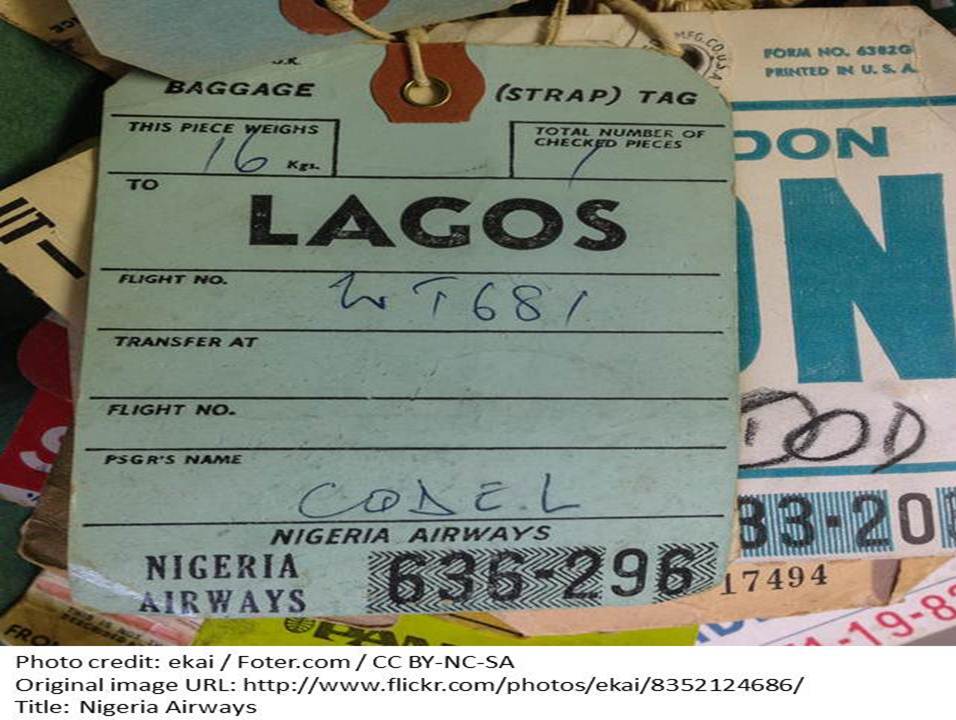
Lagos Nigeria 1

The threat of malaria, the gravity of the AIDS crisis, the restiveness of youths in the Niger Delta, religious and ethnic violence, corruption and the political class, and the collapse of basic infrastructure; these are some of the challenges that hamper Nigeria’s bold strides to rub shoulders with the league of developed nations. Headlines lament this deplorable state and street talk is awash with such stories.

While some of these concerns are interspersed in this blog, their attendant remedies are not always the primary focus. In this blog, I chronicle the struggles, adjustments, acceptance, and denial of a returnee trying to resettle in Nigeria.  In short, my life the way it hit me when I first arrived.

I grew up in Nigeria during the seventies oil boom, the middle child of a middle class family. I had a happy and sheltered childhood. Idyllic days were spent being chauffeured to and from school, and special evenings were reserved for watching Mickey Mouse on the giant screen at the country club. Life was good. The concept of a malnourished child, a picture that is synonymous with suffering in Africa, was foreign to me. I never saw that kind of child.

The early eighties was a period of rising prosperity for my family. We moved to a bigger house that had a large compound for our growing fleet of cars. Even today, these possessions remain indices of wealth in our country. However, by the nineties, galloping inflation caught up with my family. As our purchasing power dwindled, so did our fleet of cars. My siblings and I got jobs and joined the masses hustling for a living in the big cities of a Nigeria different from the one we grew up in.

2000 heralded a new dawn and I moved abroad. I took in another culture the way one chews on a new delicacy—cautiously at first and then voraciously as the sensory nerves on the taste buds heighten pleasure. Sojourning for nearly a decade, I grew to appreciate a system that seemed to work. Despite this, my fit was usually in question as if I was a hastily sewn fringe to a perfect garment.

Returning home, I was caught in a world that I could not fully define. Sometimes I embraced life in Nigeria and other times I rebuffed her advances. Here I was in the country I loved, with the people I missed, I was not a foreigner, but I was no longer as Nigerian as I used to be. This was my country, I understood the culture, I knew how the system worked, or did I?

I am not alone. Returnees deal with paradoxical feelings for their native country and the ugly or beautiful realities of global capitalism in their host country regularly. Children born in the diaspora experience varying degrees of curiosity for the land their parents moan about. Exile literature captures the passion, ambivalence, grandiose notions of the homeland, and disenchantment with their new society that those who left feel.

Consider an excerpt from David Diop’s Africa:

Africa my Africa
Africa of proud warriors in ancestral savannahs
Africa of whom my grandmother sings
On the banks of the distant river

I have never known you
But your blood flows in my veins …

An excerpt from Tanure Ojaide’s Immigrant Voice in When it No Longer Matters Where You Live,1 captures the conflicting cultural identity and world view of people scattered in the diaspora.

America na big photo-trick to me.

If say big thief no boku fo home

And they no give man chance to live softly,

America no be place to live for one whole day.

The streets de explode kpa-a like Biafra,

Dead body no de fear anybody:

You no know whether the person saying “Hi”

Want to shoot, rob or rape you.

Neighbour no de, friend no de except them dog.

You de for your own like craze-man de pursue dollar

Which no de stay for your hand – they say na capitalism

When dollar the circulate, circulate without rest.

…beggar, thief, poor poor, all dem de boku

sometimes I cry my eyes red for night in bed

Wetin my eye don see for here pass pepper

It is true that the Nigerian landscape offers many reasons for sober contemplation, but within the dim picture, I found moments of patriotic pride, quiet amusement, and downright hilarity.  Glimpses of our heydays managed to peek through ominous clouds, an indication that lost causes can be found.

I hope that as I take a poke at some of the unique challenges and joys of living in Lagos, Nigeria, my stories will tinkle your sensibilities and resonate with everyone—those who work tirelessly to keep Nigeria afloat and those who have come back home to make their mark.

It is also my desire that friends of Nigeria all over the globe can commiserate with us as we continue to take wobbly steps towards mature nationhood. Nigeria: the future is still pregnant …

©Timi Yeseibo 2013

1. Ojaide, Tanure, When It No Longer Matters Where You Live (Calabar: University of Calabar Press, 1999). http://www.tanureojaide.com/poetry.htm

Photo credit: <a href=”http://www.flickr.com/photos/ekai/8352124686/”>ekai</a&gt; / <a href=”http://foter.com”>Foter.com</a&gt; / <a href=”http://creativecommons.org/licenses/by-nc-sa/2.0/”>CC BY-NC-SA</a>

Unauthorized use and/or duplication of this material without express and written permission from this blog’s author and/or owner is strictly prohibited. Excerpts and links may be used, provided that full and clear credit is given to Timi Yeseibo and livelytwist.wordpress.com with appropriate and specific direction to the original content.