
Now that having some swagger has become as essential as having an education, Bellanchi’s tongue-in-cheek tips about how to step up your swagger, will perhaps leave your wallet intact but your sides aching. In his own words, “… Even I don’t agree with some of the irreverent stuff I write, but all in good fun.” Enjoy!
The Benevolent Dictator Theory
You’ve done it and I’ve done it too—huddled with friends and turned a debate on which way Nigeria into a prayer meeting. The kind of prayer meeting where one person declares, “Only God can save Nigeria!” and the others inwardly chorus amen. Weep no more; the Messiah we’re hoping for could be closer than we think…

When people gather to discuss the future of Nigeria, the consensus is usually 2-pronged. The first is that the brand of democracy we have now clearly is not working. The second is that we are probably screwed if we don’t address our fundamental deficiencies. The third (yes, I know I said two) is that we need a benevolent dictator to set us right.
The mind that proposes a benevolent dictator has probably considered that returning to military rule would not be a bad option, given how slowly we have moved since 1999. However, that is not a thought that we are allowed to entertain, as constitutional law jingoists insist on drumming it into our heads that “the worst civilian regime is better than the best military rule”.
I think we can agree that the evidence suggests to the contrary. The world’s oldest democracies are in the middle of economic…
View original post 552 more words
7 Annoying Things Nigerians do on airplanes
So, a friend tells me that on a recent flight from Lagos to Abuja, the pilot said, “We’ll be flying at 35,000 ft to Abuja. The weather is okay. Only light clouds, I will try and dodge them so there’s no shaking.” Is this the ninth annoying
humorousthing Nigerians do on airplanes—employing Akpos’ brother to fly the plane? Hmmm….

 Like me, I bet you’ve all run around with your bathing towels wrapped above your shoulders like a cape and pretended to be Superman (and if you haven’t then it’s never too late!). Ever since I was a little brat I wanted to take to the skies. Air travel is the next best thing and I’m always looking forward to having a
 glass plastic cup of ice-cold apple juice which always tastes better at 10,000 feet. What could possibly disrupt this moment of long-awaited bliss? Cue the Nigerians… On my recent return trip from New York alone I encountered 7 annoying things Nigerians did on the plane:
1. Securing beds…in Economy Class! There’s a game Nigerian passengers play whenever they’re on-board a semi-full airplane – It’s kind of similar to Musical Chairs…but without the music. Passengers snub the seats assigned to them and scout for a stretch of three to four empty…
View original post 778 more words
The Volume of Happiness
Nigerians are the happiest people in the world and you can measure the volume of our happiness. Now I know why people here stop and stare at me and my Naija friends—it isn’t because we are so fine! Oh no, we are Nigerians and we are loud.

 You know, I have heard this thing over and again. That Nigerians are the happiest people on the planet. And I’m wondering, really? If it’s happiness that gives us some of the traits which are universally now synonymous with Nigerians, then I would recommend that we take some dose of chill-pill and please calm down! At least, a little!
First off, why do Nigerians shout so much?
I know you have all experienced this. You see an old friend whom you haven’t seen in a while and he screams, “MY GUYYYYY!!!!!! THIS GUYYYY!!!! HOW FAR NAAHHHH!!!!!” The first thing you want to do is, “ooohh..kkk??? what is this serious?” But being a Nigerian, you totally understand and you respond in this same high pitch, “AH! I DEY O!!! WETIN DEY HAPPEN???” Then you would have to endure a huge SLAP of a handshake which usually leaves your hand smarting and red!
View original post 690 more words
Something New in October

I’m doing something different. I’m focusing on Naija life this October. Okay, don’t roll your eyes and go, “duh.” I know, I write about Nigeria, a lot! According to William Faulkner, a writer needs three things, experience, observation, and imagination, any two of which, at times any one of which, can supply the lack of the others. No apologies here, I’ve got Naija in my blood.
What’s different? I won’t be sharing my posts. I’ll reblog posts that made me laugh and cry and think, posts that mirror you and me and your neighbour and that man you’ve wondered about.
While you’re reading about Naija eccentricities, I’ll be back stage reading the novels that decorate my coffee table and writing a post for November. So, enjoy and remember to be as generous on the other blogs as you are on mine. Biko, share and leave a comment—they write their stuff because of you.
If you haven’t already, read Naija Movie Night, get a preview of what’s in store.
Take lemons & make life!

Photo credit: Sepia Film Strip clip art- http://all-free-download.com/free-vector/vector-clip-art/sepia_film_strip_clip_art_23195.html
design: ©Timi Yeseibo 2013
Unauthorized use and/or duplication of this material without express and written permission from this blog’s author and/or owner is strictly prohibited. Excerpts and links may be used, provided that full and clear credit is given to Timi Yeseibo and livelytwist.wordpress.com with appropriate and specific direction to the original content.
Naija in My Blood

A lot has been written about hazards such as driving in Lagos and on Nigerian roads. I do not mean to flog the issue, but it was this very thing that revealed some needed home truths.
You see, I am not one to allow my blood pressure levels rise over a little thing like another driver cutting into my lane without permission. The lack of simple courtesies that supply grease for smooth driving relations leaves me unruffled. Watching other tense drivers gripping their steering wheels for dear life as they struggle not to be outmaneuvered, provides witty relief from the unending traffic.
These hooligans—both the ones in black suits and the ones sooted from the ash heap of life—have shown me that aggression is the normal way of life here. The proximity of Lagos to the serene breeze from the Atlantic has done nothing to cool the pepper that burns in their veins.
On the roads, tempers edge dangerously close to boiling point, so, loud arguments and disputes settled with fistfights are not uncommon. No wonder I gave up eating pepper long ago, cucumber is more my style. But, I was soon to discover that the cherry does not fall far from the tree.
NAIJA
Nigeria, a place we all call home
Anger that constant simmering over decades of rape
Independence, a cherished hope; the impetus to rise again at 4 a.m.
Jaded after half a century of promises unfulfilled
Affection, a feeling that continually binds us to the Motherland
Two weeks ago, my driver was going nose to nose with another vehicle. Normally, I would have cautioned him and asked him to yield to the yeye driver, but that day was different. Whether it was the roaring inflation or soaring unemployment, I cannot tell. It may have been the cumulative effect of bumping my head against the car window as my driver navigated one pothole-ridden street after another. Perhaps it was the sinking feeling that yet another con artist promising much and delivering little had swindled me. Whatever, I was tired of being a fool. My redundant aggressive genes surfaced. “Do not give him any chance,” I warned.
Both their countenances showed strong determination. A mad rush of blood had made the veins visible on their hands and temples, a sign that neither wanted to lose this race for survival. As my driver and I struggled to gain supremacy, he from behind the wheel, and me a cheerleading accomplice from the owner’s corner, the inevitable happened.
An ugly screeching sound rent the air as metal kissed metal. I had a taste of nauseating reality as the beat of the ancient talking drums in my head ceased. My driver jumped out, his rage fuelled by the sudden remembrance of his N5, 000 accident-free monthly bonus.
As he sparred with the other driver, I realized that their loud voices were a mere whisper in the buzz of a Lagos that never pauses. My car had finally been baptized with the telltale marks around the fender that speaks of a skirmish or two in traffic. After both drivers traded sufficient insults, they unanimously agreed that the scratches were not worth coming to blows over.
Rhetorical questions swirled in my mind as I tried to make sense of what had just happened. What was it that made my blood boil? How could I have Naijanized so fast?
Back home, my resourceful driver applied a little brake fluid to the scratches and the car looked almost as good as new. I guess it was a little insurance to secure his bonus. It reminded me of the shoddy patch jobs on our roads that are exposed by heavy rains. Yes, Lagos is getting greener on the outside, but true redemption must go beyond skin-deep.
As for me, years on foreign soil only camouflaged my leopard’s spots. The power of Naija, as the large billboards scream, can never be underestimated.

Yeye: a derogatory term used for an annoying person, thing, or situation.
© Timi Yeseibo 2013
Photo credit: author- Darwinek
Title: Flag-map of Nigeria
Page URL: http://commons.wikimedia.org/wiki/File%3AFlag-map_of_Nigeria.svg
Image design: © Timi Yeseibo 2013
Photo credit: e.r.w.i.n. / Foter / CC BY-NC
Title: PRIDE POWER NAIJA
Original image URL: http://www.flickr.com/photos/eherrera/4950205845/
Unauthorized use and/or duplication of this material without express and written permission from this blog’s author and/or owner is strictly prohibited. Excerpts and links may be used, provided that full and clear credit is given to Timi Yeseibo and livelytwist.wordpress.com with appropriate and specific direction to the original content.
Reinventing Hope

Fifty-three years ago, Nigeria became independent of British rule. Since then, OFN, Green Revolution, MAMSER, Better Life for Rural Women, SAP, WAI, SFEM, Deregulation, June 12th, Privatisation, and The Seven Point Agenda, among others, have come and gone. They made their mark in the sands of our collective consciousness and then disappeared into the bottom half of the national hourglass. But, we have remained like a palm tree, flexible in the wind.
Although we are lacerated by stereotypes, propagated from within and without, and although bloody sweat drips from our brows as we bake the national cake, we have always found ways to sustain hope, to restore hope, and to reinvent hope as we grease the wheels of the nation’s locomotive.
In my post, In the Beginning God Created Nigeria, I wrote:
It is true that the Nigerian landscape offers many reasons for sober contemplation, but within the dim picture, I found moments of patriotic pride, quiet amusement, and downright hilarity. Glimpses of our heydays managed to peek through ominous clouds, an indication that lost causes can be found
I found a lost cause. I found hope one grey morning when rain fell at a steady pace.
A man struggled to open his umbrella as he stepped out of his car. Holding the yeye umbrella that refused to fully unfold above his head, he hurried into a building. Ten minutes later, he braved the rain with his spoilt umbrella and rushed to his car. Once inside, he flung the black umbrella in the middle of the road. It tumbled, unfolded properly, and gaped at the sky. He drove off, leaving a water receptacle and a trap waiting to bite other motorists.
Soon after, another man walked by. He looked left then right, and then left again before running to the middle of the road to snatch the umbrella. He closed it and set it neatly on the pavement.
Curious, I invited him into our office for a chat.
“Why did you pick up the umbrella?”
“Because it can cause accident.”
I didn’t need to ask because his shoes, shaved at the heels and curling to heaven in front, revealed the answer. But I asked anyway, “Is your car parked around here?
He laughed. We both laughed.
“I nor get car.”
We both laughed again.
“Then why did you….”
He shrugged his shoulders, “It can cause accident. Some drivers will not see on time.”
“Wow. Not many people will do what you did….”
He shrugged his shoulders again, “Make I begin go.”
“Hold on. Let me find something for you. We need more people like you in this country.”
“For what? Wetin I do? Please keep your money.”
“I just want to give you something to show appreciation. If more people were like you, this country will change.”
“No need. Make I begin go.”
When he stepped outside, he gauged the drizzle with the back of his palm, shut his umbrella, and kept walking.
Little hinges swing huge doors. Change will elude us as long as we only point fingers. When I look for a dustbin to dispose of the empty Mr Biggs take-away pack instead of dumping it on the road, change will come. When I wait in traffic instead of turning the pavement to a fast lane, change will come.
Light a candle of hope with me. Share your encounter with a Nigerian whether in Washington or Aba or Ogbomosho or Manchester, which defied the stereotype that we have come to know. Surely, for Nigeria, the future is still pregnant.
© Timi Yeseibo 2013
Photo credit: Zuorio / Foter / CC BY-NC-ND
Title: Nigeria – Elekoe Beach
Original image URL: http://www.flickr.com/photos/zuorio/282076831/
Unauthorized use and/or duplication of this material without express and written permission from this blog’s author and/or owner is strictly prohibited. Excerpts and links may be used, provided that full and clear credit is given to Timi Yeseibo and livelytwist.wordpress.com with appropriate and specific direction to the original content.
Why I Write

I write because I have something to say. I write with intention. I write to inform and to amuse. I write to inspire conviction that provokes movement, because words are not empty. I write because I can.
I do not write for fun. I watch romantic comedies for fun. I read a novel with a wicked plot for fun. I walk on the beach for fun. I cycle through the woody paths of the Veluwe for fun. I don’t write for fun, however writing can be so much fun.
I write because I like challenges, the challenge of taking something ordinary and giving it wings to fly like a kite in the wind. Watching it sail, I ooh and ah as its colours change. Then I ooh and ah again as I see through your eyes, the medley of colours in the comments you leave behind.
I write because I want you to read what I write. When people say that they write for themselves and not for others, and then publish the writing that they wrote for themselves on a blog for the world to see, the irony does not escape me. I write because it matters to me that you read what I write. If it did not matter to me, I would write in my diary.
I write because I enjoy reducing the tedious emails that nearly nobody reads and a few skim, to bullet points that everybody reads. I write because I love to k.i.s.s. (keep it so simple), and make up, that is, stretch a story to breaking point to test the limits of its elasticity. Snap! And start again.
I write to discover myself. As my thoughts change to words, I see who I have been, who I am becoming, and who I might be. I write because my interaction with the world makes sense when I draw it in word pictures. Blue means peace and green means fruit. If I could not write, I would paint. And if I could not paint, I would sing. I would croon ballads about the fact that I cannot write.
I write because I have time. I write because I make time. I write because I lose time when I write. Minutes tick and become hours and hours race into days. I write because it is easy for me to write. I write because I hear words and phrases in my mind. I write because I dream, lofty dreams about never-never land, perfect rag dolls, and vintage family portraits
I write because the gift chose me. I write because I discovered the gift when I wasn’t looking. I write because writing adds value to my life, turning my whispers into loud cries, enabling me to stand tall on crouched knees. I write because the gift continues to unfold with surprises in store.
Mostly, I write because I can. Why do you write?
© Timi Yeseibo 2013
Gosh, are you still here? Reading? For real? Okay, this one’s for you—three offbeat posts about writing:
Finished? Now, go get a life!
Image title: oilbased marker 02 vector
Original image URL: http://all-free-download.com/free-vector/vector-misc/oilbased_marker_02_vector_161610.
Image designs: © Timi Yeseibo 2013
Unauthorized use and/or duplication of this material without express and written permission from this blog’s author and/or owner is strictly prohibited. Excerpts and links may be used, provided that full and clear credit is given to Timi Yeseibo and livelytwist.wordpress.com with appropriate and specific direction to the original content.
No Longer a Piece of Meat

Theirs is a spacious car park unprotected from the glare of the sun and the noisy wind that ushers autumn in. Hers is the silver-grey Toyota Aygo, that ubiquitous city-car that cushions Europeans from the perils of economic recession, road tax, fuel costs, and ah yes, carbon emissions. His is the black Mercedes, that German beast that roars.
Having never seen him before, she wants to say hi, and make small talk, for the benefit of their mutual skin colour, if only for a few moments, so they can put up high walls against the cold and enjoy the warmth of solidarity.
Instead, she walks past him, and quickens her steps, the koi-koi of her heels, lost in the now harsh whispers of the wind, her mind replaying images she had thought long forgotten.
She is ten again and in the country club with her mother, in front of her soon-to-be swimming instructor, who took in her thin frame, and let his eyes linger, then wander, and then linger on the small mounds on her chest, which strained against her one-piece suit.
Her mother followed his gaze. What was supposed to be a conversation about swimming timetable, changed to a conversation about swimming lessons ending. The uneasy feeling that followed her relief and disappointment, which she could not define, she submerged in that room in children’s heads that they do not like to visit. Years later when she understood the term, dirty old man, she remembered the way he had moved his bushy eyebrows up and down in quick succession, as first her mother turned and then she turned to leave.
That thing that was in her swimming instructor’s eyes, she now sees in his. His eyes, they reduce her to a piece of meat. They touch her the same way that women and men haggling over meat in Lagos markets grab the meat from the wooden tables, slap the meat on the wooden tables, and push the meat on the wooden tables, wooden tables with fissures that are smooth with age and vegetable green at the edges.
Reflex causes her to tug at her skirt, to pinch the fabric in front of her thighs and try to drag it down, as though she can turn her mini skirt to maxi, as though her legs are not encased in black tights and boots.
His eyes drill holes in her back. She nearly misses her step. His laughter is low, but to her ears it is as loud as those of the traders who called her Shabba, and tried to grab her hands as she shopped at Tejuosho market long ago, wearing a long skirt with a thigh-high slit.
All the way to the traffic light where they encounter one another again, she thinks of his greedy eyes, his hungry smile, the shape of his gorimapa head, and the shiny darkness of his skin. She divides Africa into four: east Africa, south Africa, north Africa, and west Africa; he resembles her, but she cannot decide where he belongs.
She pulls up slowly beside his Mercedes and stiffens her neck. She wills herself not to look at him. But she does. You see, the force of his gaze, and everything intangible that had transpired between them is like a horse’s bit. His handsome features do not captivate her. His smile does not captivate her.
It is his left hand. The way he raises his shoulder and bends his elbow so his fingers rest on the steering wheel in the 12 ‘o clock position—that unmistakeable way Naija boys with new money driving new cars with shiny alloy wheels, hold the steering wheel—that is what captivates her.
So now, she knows where he belongs.
She begins to laugh and laugh and laugh some more as his brows furrow in consternation. She continues laughing as the traffic light turns green, and he speeds off. She laughs as the cars behind her pull out into the other lane and the drivers stare at her and shake their heads, before they zoom past. She laughs until the traffic light turns red. Then she stops. She is no longer a piece of meat.
Postscript
Chaos defines her Mondays, but the chaos lights her fire and adds purpose to her steps. The only thing that halts her fall is her desk, which is behind her. She feels its edge cutting into her thighs as she stumbles backwards for safety and support. Her gaze meets his and holds while they shake hands. When Ben gestures to another employee and whisks him away, Ben’s words hit home. With vast experience in mergers and acquisitions, he comes highly recommended from J.P. Morgan. He is her new manager.
© Timi Yeseibo 2013
If you loved the photo of the suya as much as my post or more than my post (how dare you?), if you miss suya and live where you can’t buy it, if you’re adventurous, if… if …, whatever, okay, read Kitchen Butterfly’s post about suya.
Photo credit: © Kitchen Butterfly
Original photo URL: http://www.kitchenbutterfly.com/2010/07/15/how-to-make-nigerian-suya/
Unauthorized use and/or duplication of this material without express and written permission from this blog’s author and/or owner is strictly prohibited. Excerpts and links may be used, provided that full and clear credit is given to Timi Yeseibo and livelytwist.wordpress.com with appropriate and specific direction to the original content.
Happy Friday
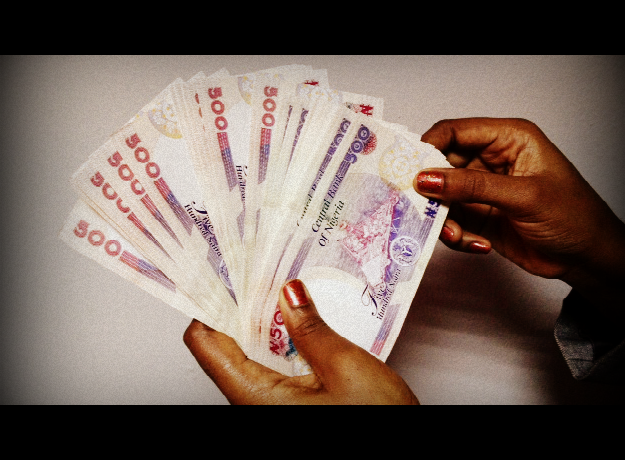
There is a man who stands at the entrance of the lift on the ground floor of your office building. He greets you with a broad smile as you approach the lift and lets you know that he has called the lift. “Oga, it is coming down,” he announces, as though looking at the numbers on the display changing in reverse order is a job for him alone.
He wears a pale blue shirt tucked into navy blue trousers with the seriousness of an employee on his first day at work. When he moves his cap slightly to scratch his head, you see that he is bald and his fingernails are long. You wince before you hear the sound and you are surprised that the sound is not as harsh as you expected. He taps his black baton, which hangs by his side, and you nearly forget that both of you have been waiting for a full sixty seconds.
In the lift, his shirt is not pale blue but faded blue, and the cracks which extend for a few millimetres from the buckle holes on his imitation leather belt, remind you of harmattan, of chapped lips in need of Vaseline.
“Oga, seven or ten?”
You are usually among the first to arrive at the office. Sometimes you get off on the seventh floor. Sometimes you get off on the tenth floor.
“Choose.”
“Ehn?”
“You choose the floor.”
His fingers hesitate at the control panel. “Ten sir. Ten, because the higher you go, de more money you go get.”
He smiles and some of the years roll off his face. You think of your late father and swallow a lump.
“Ten it is then.”
You no longer hold your breath when you ride with Joe. The smell of day-old perspiration has grown on you, just as the way his black shoes shine and reflect light, no longer fascinates you.
Joe clears his throat.
“Oga, today is Friday.”
“I know.”
You know because you woke up at 4 a.m. to complete the presentation for your meeting at ten. However, you can tell it is not the response Joe was expecting because he clears his throat again.
“Oga, happy Friday, sir.”
You think it is too early, but the weight of expectation that causes his words to land on your shoulders, the demands of communal responsibility that is thrust on you for earning a certain level of income, and the unspoken rules of this ritual, constrain you to respond.
“I’ll see you later.”
Joe clears his throat yet again. “Oga I will close early today.”
He has taken a gamble and he watches to see where the dice will roll. Only he does not let it stop. “It’s okay oga, I will wait.”
Your irritation vanishes.
“God bless you sir,” he calls as you walk out the lift.
When you close, he is there. On the ground floor. Saying, “Happy Friday,” to a colleague. He monitors you from the corner of his eyes, eyes that fill with indecision as you walk past. He must be aware of the foolishness of abandoning the fish in front of him, to dash and catch you. So he calls out, “Oga, abeg, I will soon finish!”
You almost laugh, in amusement, but check yourself. It is shameful that this culture dignifies begging and elevates it to an art form, complete with colloquialisms—How weekend sir? Anything for the boys sir? Oga we dey here o? Happy weekend, and so on.
An old man. A beggar. A corporate beggar. A beggar cushioned against the sun and the rain. A beggar in uniform. A professional beggar.
He catches up with you outside as you head for the car park.
Breathing hard, he declares, “Happy Friday sir!”
You hand over a couple of notes.
“God bless you sir! Your family will never suffer. Your wife will born plenty children, strong boys. Your children will become great ….”
You do not pay attention as you keep walking. What is his life like? What qualifications does he have? You turn to ask. But, Joe has resumed duty on the stairs leading to the entrance doors, his head bowed slightly and his hands outstretched.
You let your shoulders sag. “Happy Friday Joe,” you mumble, knowing that his praise-singing would have drowned out everything you intended to say.
In the car, before you turn on the ignition, you pull out a couple of notes from your wallet and leave them on the passenger seat. They are for Adamu and the others who man the security gate.
© Timi Yeseibo 2013
Photo credit: © Timi Yeseibo 2013
Unauthorized use and/or duplication of this material without express and written permission from this blog’s author and/or owner is strictly prohibited. Excerpts and links may be used, provided that full and clear credit is given to Timi Yeseibo and livelytwist.wordpress.com with appropriate and specific direction to the original content.
Running in the Airport

I came to your house out of a sense of duty. Although I told you I was late, you brought me a plate of beans, fried plantain, and chicken stew. While you shouted Sade’s name, and looked for change so she could buy cold coke from mama Kunle, I quickly made a phone call to Sista Kemi:
“Sista, e ma binu, I can’t eat it. You know I’m travelling—”
“Femi, just try. You are like a son to her.”
“Anything else. I will drop 50k for her instead of 25—”
“After everything I’ve done for you ….”
With those six words, Sista Kemi sealed my fate. I did not refuse a second helping of your beans because you cooked it with a little sugar and plenty onions. My big sister had slaved to send me to school in the U.S., so, I ate after I protested and you laughed.
I finally boarded my flight at 9:30 p.m. and dozed off shortly after take-off. I woke up to the smell of coffee and croissants, which I munched hungrily before we began our descent.
At Schiphol, jet-lagged passengers sprawled out on the black metal seats in a small lounge. Drawn like a magnet, I sat beside a striking lady with a small afro who was shaking her phone, tapping her phone, assembling her phone, and disassembling her phone.
“Hello, let me help?”
“Oh, do you know what to do? It fell and it won’t start—”
And just like that, we moved on to talk about our lives, our work, and our passion. My flight to Maryland was four hours away. Her flight to New Jersey was three hours away.
Her eyes glowed as she talked about the non-profit where she worked. Just then, the contents of my stomach lurched. I stylishly shifted and sat on only one bum. This attempt at bowel control thrust me forward, and I hoped she did not think I was trying to get a better view of what lay beneath her V neckline. I bit my lip and silently commanded my tummy to settle. I don’t know whether she paused or I imagined it. But I carried on talking.
“My company encourages employees to get involved in community service by giving donations to worthy causes and staff bonuses for participation. I see a win-win here.”
“Really?”
“Yes,” I replied, crossing my legs and shifting my weight to my other bum to stem the tide. I leaned backward. Her V neckline was high, not that I would have seen anything if it was plunging, for thoughts of white porcelain toilet bowls beclouded my vision.
I masked my pain by contorting my face in concentration. Her voice sounded farther and farther away, as if she was at one end of a tunnel and I was at the other end, stooping and shitting. Now and again, I scanned the lounge for the toilet icons, pretending to observe the passengers who were dragging luggage and crowding the seats. Then I returned my gaze to her face and flashed what I hoped was a charming smile. I don’t know whether she paused or I imagined it. But she carried on talking.
“So, let’s make it happen. How can we take this to the next level?”
“I need the toilet.”
“What?”
“Nothing. What did you say?” I blinked several times, and then moved so that both cheeks of my bum were in full contact with the seat. Now that the word toilet had escaped from my mouth, the pressure on my rectum doubled. I pushed my chest forward, the way I used to as a lanky teenager, and prayed that the noise in the lounge had muffled my words.
She frowned and watched me.
My anus took the heat.
“Okay go.”
“What?”
“Go to the toilet,” she said calmly, pointing the way.
He that is down, need fear no fall. I chucked mortification away, buried it in the recesses of my mind, and tried not to run. As soon as I turned the corner, I picked up speed.
Five men queued outside the toilet. I eyed the vacant women’s toilet. Dare I? I asked a cleaner if there was another toilet nearby.
“Downstairs, turn left, after about fifty metres.”
I started to go when I saw a young girl pushing an elderly lady in a wheelchair purposefully. I followed the trajectory of her eyes and changed my course. Nearing the doors of freedom, I saw the cleaner and began to limp.
I hit the toilet seat just in time. And finished after pushing twice. But I sat there. Because I heard the commotion at the door. The real disabled people were waiting and wondering aloud. Shame, hot and sharp, overtook my relief. Oh, the smell was one thing, but I was too embarrassed to “limp” out of the toilet.
As I moved my feet to alleviate the pins and needles, I heard directions being given. Then the voices receded. Satisfied, I opened the door slowly and looked in either direction. Although no one was there, I felt compelled to limp.
“Are you all right?” Miss Afro looked alarmed as I approached.
“Yes,” I corrected my limp, pushed my chest out, and walked tall.
“No, I mean your tummy?”
“Fine.”
Humiliation covered me the way caramel sauce covers ice cream, slowly, gradually, until I could not meet her eyes. But I sat like a real man, legs ajar and arms resting lightly on my thighs.
“Please write your number?” She dropped her card on the magazine which lay between us.
I patted my shirt pocket and shook my head. She frowned as she brought a silver fountain pen from her bag. When I finished writing, I handed her the card. She didn’t take it. Instead she used her white hanky to snatch her pen.
“Femi right?” she said as she stood, “why don’t you call me? It’s been a pleasure meeting you. I have to board.” She ignored my hand.
I smelled myself after she left. What was I sniffing for? Body odour? Beans? Shit?
I looked at her card. Busayo. What if I married her? What if you came to visit? What if you cooked beans, fried plantain, and chicken stew? What if I ate it? What if I went to the toilet twice at night? Would she tell me to face the wall while she slept with her back towards me at the edge of her side of the bed, like a lone matchstick in a giant matchbox, stiff like a bag of cement?
Nonsense! I tore the card to small pieces. Who cares about corporate social responsibility and employee participation in meaningful community development projects? I tore the small pieces to even smaller pieces, hurled it in the trash, as I limped to the disabled toilet for the fourth time that morning.
And now, you are calling me at 3 a.m. local time, asking why I am not yet married. Aunty e jo!
© Timi Yeseibo 2013
Photo credit: rhodes / Foter / CC BY-SA
Original image URL: http://www.flickr.com/photos/rhodes/2181258/
Title: well designed signage
Unauthorized use and/or duplication of this material without express and written permission from this blog’s author and/or owner is strictly prohibited. Excerpts and links may be used, provided that full and clear credit is given to Timi Yeseibo and livelytwist.wordpress.com with appropriate and specific direction to the original content.
A trip to Kaduna
A walk down memory lane… Love for my country and other drugs! I like the way ‘Dare recollects his Service Year and captures the freedom and optimism we feel as we stand on the threshold of hope and possibilities. I think you’d like it too…

I want to take a trip. In my mind, to places in a city l left three years ago.
I want to visit that big compound at the end of the street where I lived, in Abakpa, where the ancient locomotive chugged loudly in the morning, as I walked out to buy breakfast.
My regular breakfast was kosi or akara. I always called it akara, because I thought kosi was too bland a word to capture the delicious essence of the hot spongy brown akara. I remember how the lady would serve it out of the hot oil and package my usual fifty or sixty naira worth of akara into old newspapers and nylon bags. I was a regular customer, and I had earned her respect because of my almost daily patronage. Sometimes, I was rewarded with some extra balls of akara, other days, I was offered koko or pap…
View original post 858 more words
What’s Wrong With This Picture?

Nigeria is like a man with many wives who when not competing among themselves for his affection (read: oil wealth), sit together and complain about his lack of attention (read: dearth of infrastructure). I am married to Nigeria and this is my rant.
From time to time, I enjoy entertaining. Friends were coming over for a bite. Nothing fancy I was told, but I pulled out all the stops including the china and cutlery, which sit in their cartons gathering dust and only grace the table when I want to impress. Anyway, six hours later, I had a three-course meal fit for a king and no guests. What’s wrong with this picture?
Earlier, dark clouds warned of impending rain but since I was neither the bride nor the groom that had rented an open field for their wedding reception in the thick of rainy season, my only concern was for the temperature of the oil as I fried plantain. When, thunder and lightning announced the arrival of a torrential downpour, I shut my windows and began to wait.
It turned out that my guests were stuck in traffic caused by blocked drainage channels. With nowhere to go, the rain kissed the ground and its waters rose, higher and higher, turning the roads to knee-deep rivers. Their SUVs were no match for the floods. Maybe Toyota will seize first-mover advantages by developing a new type of hybrid for the Nigerian market—Toyota Transformer: part landcruiser, part speedboat. Then Nissan, Honda, Kia, and the rest will follow! Far-fetched? Hardly. Inverters flooded the market when investors rightly assessed the gap in the power sector.

Disappointed that my guests didn’t show, I decided to watch a movie on TV. That power supply disappears moments after the sky darkens, was not new to me. That I had to generate my power supply, did not take me by surprise. My inverter was humming quietly and my generator was on stand-by. However, thirty minutes into the movie, the TV went into a convulsion—white lines, static, beep-beep-beep, before sudden death. What’s wrong with this picture?
The rain, which had slowed to a slight drizzle, changed its mind and metamorphosed into a full-fledged downpour once again. I increased the volume of the TV to drown out the tap-tap-tap of falling rain and snuggled into my wrappa as the room became cooler. But nobody told me; you forgot to warn me about this before I packed my bags and returned to Nigeria, that like oil and water, rain and cable TV do not mix! When it rains, cable TV loses connection to the signal!

Rainy season equals more traffic jams and power outages, with attendant loss in manpower hours and business opportunities. Rainy season means more visits to the mechanic. Rainy season equals (avoidable) flooding which results in suffering for displaced persons. Rainy season means… need I continue?
So you see, I have come to dread rainy season because it is fraught with frustrations that make me rethink my move back to Nigeria.
It is easy to forget that rainy season has its advantages. Rain-fed agriculture increases the farmers’ prosperity, and rain provides water for domestic purposes in areas where running water is scarce. Also, during the rainy season, cooler temperatures bring some relief from the stifling heat.
Well, after another rain-induced frustration, my son asked about the duration of the rainy season. I said that rainy season begins in April and ends in October. He quickly did the math and sighed in disbelief and disappointment.
“Six whole months!” he cried.
I tried hard to sound convincing as I recounted the blessings of the rainy season. I explained that countries with diminishing water resources like Egypt, would welcome a lengthy rainy season, and scientists were experimenting with harnessing energy from raindrops. I told him tales about dancing in the rain, singing rain, rain, go away, but, he would not be won over.
He moped around like a solitary figure shrouded with disillusionment.
“Six whole months,” he muttered almost inaudibly.
Hey, what’s wrong with this picture? Go figure!
© Timi Yeseibo 2013
Related links: Read Diekola Onaolapo’s Rain, rain…go away here
Photo credit:
The City of Lagos
Author: OOT, The official website of the Office of Transformation
Original image url: http://oot.lg.gov.ng/beta/?p=315
Flooded Street
Author: Diekola Onaolapo
Original image url: http://ojogbon.wordpress.com/2011/07/17/rain-rain-go-away/
Vectors from Microsoft
Unauthorized use and/or duplication of this material without express and written permission from this blog’s author and/or owner is strictly prohibited. Excerpts and links may be used, provided that full and clear credit is given to Timi Yeseibo and livelytwist.wordpress.com with appropriate and specific direction to the original content.
WordPress 104… In Search of Content

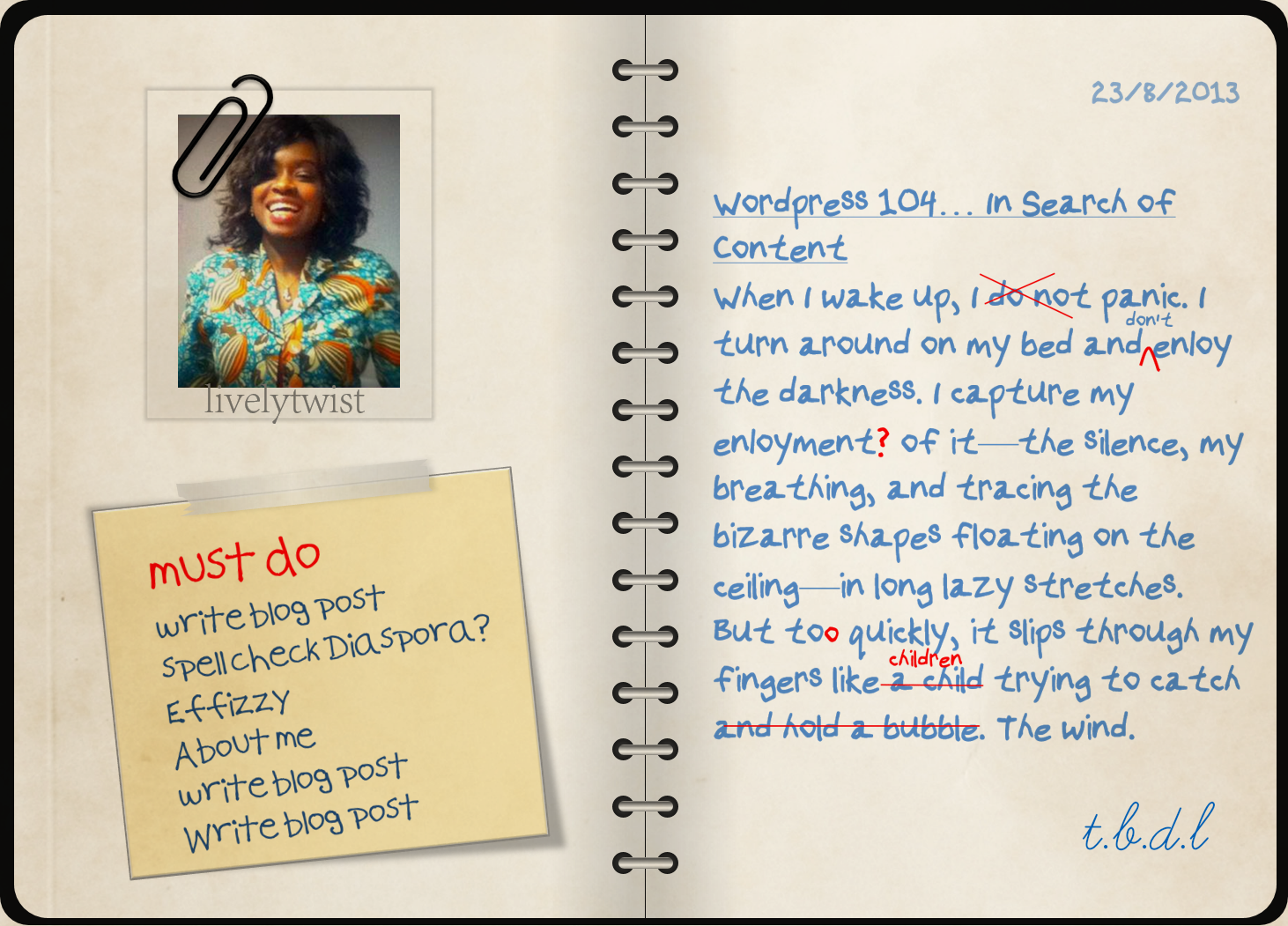
When I wake up, I do not panic. I turn around and enjoy the darkness. I capture my enjoyment of it—the silence, my breathing, and tracing the bizarre shapes floating on the ceiling—in long lazy stretches. But too quickly, it slips through my fingers like water in cupped hands.
Pop! And my brain takes over. It is 1 a.m. on Friday and I don’t have a post for Sunday, which is when I update my blog.
My idea book is filled with words, phrases, whole paragraphs even, written when inspiration caught me mid-cooking, mid-vacuuming, mid-driving, mid-praying, and mid-listening-to-the-C.E.O.-at-the-company-meeting. Each spree ends with the acronym T.B.D.L. (to be developed later). Words that I imagined would bring me fame, have lain there, on hiatus, waiting to be developed later.
This small exercise book is a contradiction of who I am, for I am as organised as the T that begins my name. However, here, my words begin inside the margin and jump the lines, leaping over the light blue boundaries that would suffocate my creativity. I recognise the frenzy of inspiration and the rush of words tumbling from my mind, in my illegible handwriting.
As I scan through, in the glow of my bedside lamp, nothing I read seizes my attention. I cannot strike the balance between what I want to write and what I think my readers want to read, so I power my laptop. If I read other blogs, perhaps I will find it.
Browsing is an apt term for what I do. Channel surfing paints a truer picture. I join the millions who roam the internet foraging for content. Too much choice is a bad thing. It can leave you undernourished instead of well-fed. Skimming headlines, clicking links, scanning blocks of text, skimming headlines again, I am a victim of “content anorexia”. I eat, but I do not digest, never able to hold anything down.
After a while, I see the word diaspora. It is spelt with a capital D in the middle of a sentence, a straight line and a curve that scream my name. Something doesn’t feel right. The pieces come together. Aha, I have spelt diaspora with a small d on my blog.
My weakness shows when my strength is magnified. It is painful to watch. Perfectionism drives me to find the post on my blog. Perfectionism drives me to start a Google search. Too much choice is a bad thing. I cannot cover the 3,647,400 results, which Google search engines deliver in 0.29 seconds, but I can try.
Diaspora from the Greek, meaning scattering, dispersion…. Diaspora, often initial capital letter…. Spell check the word diaspora on our website…. the body of Jews living in countries outside Israel…. African diaspora… the slave trade and its effects…. Diaspora cultures … the dispersion of communities throughout the world. The diaspora of English into several mutually incomprehensible languages…. The Polish diaspora amounts to 40 million… How to say diaspora in Swahili…
When my alarm goes off at 5:45 a.m., I think about three things:
One, that this is the alarm before the real alarm. It is the alarm that I “snooze” while I attempt a half-sleep, punctuated by thoughts of the real alarm.
Two, that I was right. I had spelt diaspora correctly with a small d, which was suitable for my context. This small victory does not bring elation.
Three, that I do not yet have a blog post for Sunday.
My eyelids now feel as though cement bags were dropped on them. And adrenaline departs from me in waves, rousing pain in my limbs. I know much more about diaspora than I ever intended to know. In secondary school, a teacher once said that no knowledge is ever wasted. What will I do with all this information I gathered about diaspora, information that is already fading away, slipping as I am, under my sheets?
The real alarm buzzes at 6:15 a.m., and I “dismiss” it without thinking, for nature exacts her pound of flesh.
When I wake up again, I panic. Light streams through the blinds and I know I need a miracle. 7:05 a.m., in the shower. 7:13 a.m., dressed. I have never put on make-up in the train, but there is always a first time. My black bag is big enough to hold my life, so I toss the things I need and the things I think I will need inside, and because I cannot remember if I brushed my teeth, I fling in my toothbrush and toothpaste for good measure.
7:19 a.m., I begin the sprint. I see a man walking his dog, shoulders hunched up, chin half-buried inside his coat, in contrast, my coat is open, its tails flapping in the wind. And for once the cold is my friend.
7:23 a.m., I stumble into the bus. So, what if people are staring at me? When I flop into my seat, I drink in gulps of air and think, Usain Bolt ain’t got nothing on me; no, nothing, except age! Up diaspora!
© Timi Yeseibo 2013
Image title: cartoon couple 04 vector
Original image URL: http://all-free-download.com/free-vector/vector-cartoon/cartoon_couple_04_vector_181443.html
Image credit: Center Spiral Notebook by Tom Kuhlmann http://community.articulate.com/downloads/p/667.aspx#
image designs: © Timi Yeseibo 2013
Unauthorized use and/or duplication of this material without express and written permission from this blog’s author and/or owner is strictly prohibited. Excerpts and links may be used, provided that full and clear credit is given to Timi Yeseibo and livelytwist.wordpress.com with appropriate and specific direction to the original content.
By God’s Grace

Religion divides; religion unites. Its symbols are seen everywhere here. In the big southern cities, churches clamour for prominence with their dizzying signboards on busy and quiet streets. While the western world wants to send God packing, we have him firmly entrenched in our society.
Having watched God’s role shrink in the west, I embraced his omnipresence back home. But my joy at luxuriating in unabashed religious freedom was marred by incident after incident with religious-sounding people.
Religious clichés form a huge umbrella where strange bedfellows meet. Christian choruses drip from the sweet mouths of juju practitioners and Holy-Ghost-power-wielding herbalists advertise their solutions in the newspapers. But it is in the language of everyday people that these clichés find unbridled expression, so much so that a simple yes or no response is as elusive as constant power supply.
In a culture where speeches are padded with verbosity and our elder’s words are peppered with flowery proverbs, perhaps it is fitting that our words are wrapped in religious foil and by God’s grace is the heavy-duty foil that covers every situation under our sun!
When I queried my handyman for a firm work commitment, he kept dodging under the grace of God. “By God’s grace I will come and do the work on Thursday.”
When I persisted, in exasperation he declared, “Madam, I will come on Thursday, God willing!”
Then he beamed like a monkey atop a tree that had escaped the canines of a hungry lion, daring me to challenge the will of God.
That he did not show on the said Thursday is symptomatic of a national ulcer.
Civil servants show up at work by believing and trusting God.
Political parties garner votes by the will of God.
The mechanic will fix your car by the grace of God.
Senators, stupefied by the challenges facing their constituents, hold press conferences where they proclaim, “It is only the grace of God that can save Nigeria!”
Like soap that glides through wet hands, we use religion to evade the grasp of accountability time after time. From Aso Rock to Ajegunle, religion is courted, invoked, and brandished as if it is a determinant of GDP and as if, according to Karl Marx, it is the opium of the people!

At the mall, a young man selling CDs from his début album politely accosted me. Recognising a fellow struggling artist hustling for survival, I decided to purchase one.
“What kind of music is this?”
“By God’s special grace, Christian music.”
I nearly walked away, but I kept hope alive. “Are you sure?”
“Of course madam,” he replied without hesitation, “what else would I record?”
“Look I want to encourage you. I’ll give you N300 anyway, what kind of music is this?”
I guess he must have thought that I imagined that he was born yesterday—a whole him—a scammer of scammers. Looking pained, he told of how other buyers had commended his efforts. He painted a picture of struggle and survival, in which the grace of God and the will of God had converged to give him a testimony, proving that no condition is permanent. Moved, I overlooked the shabby packaging and paid for the CD.
Later, I played the CD in my car. I strained my ears through the poor sound quality to make out the lyrics. The chorus rang:
Naija is where we are
Naija is where we belong
Naija is where we will die
My lips curved slightly as realisation shone through my eyes, of course it was a Christian song!
Since productivity hinges on how God is wielding his grace, I have come to certain conclusions about my day.
Will I go to work today? Ah, it’s in God’s hands.
Will I eat lunch during break? Yes, God willing.
Will I take a pee after lunch? Believing and trusting God.
And finally, can I draft a concluding paragraph for this blog post? By God’s grace!
© Timi Yeseibo 2013
Photo credit: dan mogford / Foter / CC BY-NC-SA
Original image URL: http://www.flickr.com/photos/dansflickr/272385799/
Title: scams upon scammers
Photo credit: MikeBlyth / Foter / CC BY-NC-SA
Original image URL: http://www.flickr.com/photos/blyth/152662733/
Title: Power of God bus (Chi Boy)
Unauthorized use and/or duplication of this material without express and written permission from this blog’s author and/or owner is strictly prohibited. Excerpts and links may be used, provided that full and clear credit is given to Timi Yeseibo and livelytwist.wordpress.com with appropriate and specific direction to the original content.
Who Will Tell Me Sorry?

Time stood still.
After she said, “Mummy I bumped my head against the window.”
Then moved slowly like a ticking bomb, tick-tock, tick-tock.
One irritated child, another crying child, an unhappy mother, and a grim-faced driver rode from Ikeja to Victoria Island. I wielded the power to change the sombre atmosphere in the car—one sentence, “Sorry, let me take a look at it,” was the magic wand that could banish sorrow to a faraway land.
Instead, I sat tight-lipped like a woman whose husband had asked, “What is the matter now?” after forgetting her birthday. The word sorry had become as precious to me as Silas Marner’s gold was to him. I did not have any more sorry to spare.
Our day had started innocently enough. The children wanted to visit The Fun Place, and I acquiesced. Undaunted by traffic, their incessant chatter filled the car before they succumbed to the go-slow and dozed off. They woke up just as we approached Opebi and bounced gently in their seats to the rhythm of their melodious voices.
So what went wrong? Nothing. Nothing really, except that from the moment they woke up, they had been running in my direction in ardent search for those precious words.
“Mummy, I stubbed my toe as I was coming down the stairs,” one complained and looked at me as if I conspired with the builder to build steep steps.
“Oh sorry dear, come closer, let me take a look.”
Then I gave the toe a gentle rub to soothe the pain. The pacified child retrieved his toe, announced that he felt better, and disappeared. As the day wore on, both kids took turns to seek this cure-all for life’s little mishaps.
“Mummy, I fell down.”
“Sorry, ….”
“Mummy, I bit my tongue.”
“Sorry, ….”
“Mummy, I cut my arm.”
“Sorry, ….”
“Mummy, my sister won’t play with me, the sun won’t shine, the dog won’t bark, the flowers won’t grow, there’s no light, there’s no water,” and on and on, and on and on.
To these and their array of mounting complaints, I have learnt to either feign concern or inject a sufficient amount of compassion in my voice, as I give an appropriate response by rote while multi-tasking!
It was the same story at The Fun Place. I opened my novel, read one paragraph and then said sorry. A little sorry here, a little sorry there. I read another paragraph before tales of being pushed and hit, tales of being unfairly treated, and tales of falling down, assaulted my ears. A big sorry here, a big sorry there, and in all, I had read four paragraphs of my novel by the time we determined to leave.
I eased into the car, looking forward to closing my eyes and dreaming of my bed. I wiped apple juice from my hands, mildly irritated by my sticky fingers, and dusted popcorn off my jeans. The gaping pothole that rocked the car from side to side, had caused everyone and everything to shift position, including my mood.
It was at this precarious time that my daughter pouted, “Mummy I bumped my head against the window.”
I folded my arms and pursed my lips.
It was time to count to fifty, but I would not.
I sighed.
Who will tell me sorry? Did I not also bump my head against the car window? Had I not also stubbed my toe last night in the NEPA-induced darkness? I had muttered, “ow,” rubbed my toe myself, and continued with life.
Who will tell me sorry for the fact that I could not stretch my monthly chop money to cover the whole month due to inflation?
Who will tell me sorry for my car shaft, which needed replacement because the road to my house had become a river?
I sighed.
No, I did not think I had any free sorry to dole out. Let her tell herself sorry for a change!
Her cries slowed to a whimper. A quick glance confirmed my suspicion—her eyelids were drooping in preparation for sleep. Something stirred within me. I reached out and caressed her head, “Sorry darling, does it feel better?”
She sagged against her seat belt, a contended smile barely breaking through tired lips, as everyone else visibly relaxed.
So, who will tell me sorry?
© Timi Yeseibo 2013
image design: ©Timi Yeseibo 2013
Unauthorized use and/or duplication of this material without express and written permission from this blog’s author and/or owner is strictly prohibited. Excerpts and links may be used, provided that full and clear credit is given to Timi Yeseibo and livelytwist.wordpress.com with appropriate and specific direction to the original content.
Dear Random-Guy-Who-Asked-If-He-Could-Share-My-Mini-Umbrella-At-The-Busstop
Because you enjoyed my, I am Not Looking For Love, I am Going to Work, post, and because guys aren’t hitting on me everyday (it’s true!), I know you’ll enjoy eurekanaija!’s post as much as I did. We’re doing life together, so I couldn’t bear to laugh alone…
I am Not Looking For Love, I am Going to Work

It began yesterday at the government office, which was saturated with immigrants whose anxious stares alternated between the digital display boards and their tickets, a square piece of paper with a number printed on it. At the sound of the beep, everyone looked at their ticket, and then the display boards. Some sighed. Some continued talking. Others continued sleeping. One person rose to meet an official walled in by glass on the other side of the counter.
My wait was shortened by an acquaintance with whom I chatted until our conversation lulled to a comfortable stop.
“Excuse me, it seems you are from Nigeria.” A tall man sitting a few spaces away from my acquaintance smiled at her.
“No, I am not.”
“Ah, but I thought—”
“I am from Democratic Republic of Congo.”
With her thick Igbo accent, she delivered her last words with a finality that inspired no argument from the man. He fanned himself, and then pretended to read his letter from the belastingdienst.
Because I am slow to change the expression on my face, she saw it. The disbelief. The wonder. The perplexity.
“Don’t mind the idiot. If not for dis yeye tax people, where e for come see me? See as e dey talk as if e be my mate. E nor see im type?” she whispered for my benefit and his.
I nodded like her co-conspirator, as though I had been dissing guys for the last ten years. What else could I do?
Determined to be a better person, this incident is hovering at the back of my mind when a young man approaches me today as I wait for my tram.
“Hello, are you from Nigeria?”
Surely there must be a better opening line? I give nothing away as I nod and he introduces himself. I tell him my name.
“Ah, Timi. Timilehin? You are Yoruba?”
“I am Nigerian.”
“I know, from whose part?”
“We have left Nigeria. Let’s pretend ethnicity does not matter. I am a Nigerian; that is enough.”
He looks at me as though the sky has descended on my head and I am unaware. Undeterred, he forges on in pidgin English. I respond in proper English.
He ditches Pidgin in favour of a kind of English that is interspersed with incorrect tenses and Dutch words. This is a cross some of us bear. The effect of speaking Dutch with non-native proficiency is the tendency to forget English words and to adjust our tenses automatically to match the wrong grammar of English-speaking Dutch people.
I am aware of every mistake he makes. Like the freckles on my neighbour’s face, they are many.
“I saw you at this tramhalte iedere dag, I mean, every day. Are you going to work?”
“Yes.”
“Where?”
I tell him. And then I help him because he seems lost, “I haven’t seen you before?”
“I know, but I am seeing you. You are very mooi, beautiful.”
I take in his overalls. He does not look like Idris Elba in Tyler Perry’s Daddy Loves His Girls, but this is real life.
“Thank you, where do you work?”
He talks about his work, links that conversation to how long he has been in The Netherlands—fifteen years, and then ties it to his goals and dreams like a neat bow at the end of a string.
My eyes do not wander from his face while he speaks. But my mind does. I wonder if he can read, understand, discuss, and comment on my blog intelligently.
Then there is silence. The wind dies. The leaves sleep. The seagulls take their leave. It is just me and him. And the silence. Without my help, he stews in it for a while—scratching his chin, brushing dirt from his overalls, staring at something behind me—before he says, “I must goes to my work place. Can I have your number?”
“For what?” Honest words spill out before I can reel them in. What else do we have to say to each other?
“I wan know you.”
I do not know why I did what I did next. Guilt—over what? My resolution to be a better person? Pity? Maybe, my thoughts had roamed to how he must have been eyeing me, calculating his approach. Religious fervour? Hardly.
“I would like to invite you to my church.” I fumble in my bag for the flyers the preacher says we should carry around for opportune moments, moments like this one I suppose.
He looks at me as though The Rapture has occurred and I am unaware.
“Ah, ah! Won’t you know me first before inviting me to your church? I already goes to church.”
It is as if he knows. That I am not very good at this. That church is a cop-out. That it is too late to tell him I am from the Democratic Republic of the Congo. That I do not have the heart to tell him he will not understand my blog, and therefore not understand me. He pounces on me like a wounded lion, as if to say, “This is for every man you ever dissed!”
“That’s the problem with you Nigerian girls! Church, church, church! Your mates don marry, you still dey here! Oya go and marry your God!”
He jumps on his bicycle in one swift motion and pedals away.
It is rare that I cannot express myself with words. But I am not writing a dissertation. This is life. This does not call for intellectual prowess.
I imagine that in a few moments, his bicycle chain would jam, forcing him to stop. I imagine him kneeling on the earth, humiliated, rattling the chains, while I watch from the elevated platform of my tram stop. Then the words that abandoned me would force their way out of my mouth, “I am not looking for love, I am going to work!”’
Nothing I imagine happens. He continues to ride and does not look back. But a curious thing happens. As I look, it is not him getting smaller in the distance, it is me!
© Timi Yeseibo 2013
Unauthorized use and/or duplication of this material without express and written permission from this blog’s author and/or owner is strictly prohibited. Excerpts and links may be used, provided that full and clear credit is given to Timi Yeseibo and livelytwist.wordpress.com with appropriate and specific direction to the original content.
 livelytwist
