In The Spirit of Love

In the spirit of love, I’m sharing one of my older posts, a crowd favourite, which elicits a smile or laugh from me whenever I reread. I hope you’ll enjoy it (again), as much as I do.

I am Not Looking For Love, I am Going to Work

It began yesterday at the government office, which was saturated with immigrants whose anxious stares alternated between the digital display boards and their tickets, a square piece of paper with a number printed on it. At the sound of the beep, everyone looked at their ticket, and then the display boards. Some sighed. Some continued talking. Others continued sleeping. One person rose to meet an official walled in by glass on the other side of the counter.

My wait was shortened by an acquaintance with whom I chatted until our conversation lulled to a comfortable stop.

“Excuse me, it seems you are from Nigeria.” A tall man sitting a few spaces away from my acquaintance smiled at her.

“No, I am not.”

“Ah, but I thought—”

“I am from Democratic Republic of Congo.”

With her thick Igbo accent, she delivered her last words with a finality that inspired no argument from the man. He fanned himself, and then pretended to read his letter from the belastingdienst.

Because I am slow to change the expression on my face, she saw it. The disbelief. The wonder. The perplexity.

“Don’t mind the idiot. If not for dis yeye tax people, where e for come see me? See as e dey talk as if e be my mate. E nor see im type?” she whispered for my benefit and his.

I nodded like her co-conspirator, as though I had been dissing guys for the last ten years. What else could I do?

Continue here …


A Tale of Two Cities

a tale of 2 cities

I was born in the USA and for as long as I can remember I’ve always felt like an alien who didn’t quite fit in. This is partly to blame, I suppose, on the fact that I was raised in a military family and was constantly pulling up roots and moving every year or so, while growing up. As an adult, I kept up this pattern. I’ve lived in or near some of the largest cities in the U.S.—Houston, Philadelphia, and the New York City area.

I feel comfortable in large cities because they afford me the anonymity that I, an alien, crave. No one looks at you “funny” and as long as you don’t hold a stare for too long, you are left alone.

I recently visited London and Paris. I had long dreamed of visiting these places as they have lived in my imagination for years from reading books. Using the subway systems of Philadelphia and New York City, primed me for the London Underground and the Parisian Metro system.

On one of my many excursions around London, I descended the steps into the underground, and encountered a smiling, red-faced uniformed attendant.

“Hello!” I said.

“Hello!” he returned.

I inquired about the best route to get to my destination.

“Take the Circle Line to Baker Street, transfer to the Jubilee Line. Get off at Southwark and it is only a short walk to the Globe.”

“Thank you!”

“Cheers!”

This was typical of my experience in the London Underground— easy to navigate with friendly attendants and patrons who were willing to answer questions.

When I arrived Paris, I approached a Parisian Metro booth and spoke to one of the attendants.

Bonjour, parlez-vous anglais?”

Un peu.”

Although I did not speak the language, I was able to communicate well enough to find my way using a few words and hand gestures. Perhaps the incongruity of being in a strange land made my existence in Paris somehow congruent. I felt at home at last.

On one of my last days in the city, I sat outside the Café de Flore on Boulevard Saint Germaine, enjoying a glass of red wine. A Frenchman, who took the table next to mine, lit up a cigar, and then glanced in my direction to ask if the cigar smoke offended me.

“Oh, no,” I said, “I understand that people who sit outside often smoke and I am not offended.”

He nodded and smiled. He puffed on his cigar a couple of times and we began chatting, he in perfect English. We talked for a long time about a wide range of events including the recent terrorist attacks. I mentioned the increased security around the metro. He shared that he had just spoken to his daughter who lives in the neighbourhood where the attacks occurred and she felt safe using the Metro System.

“Yes,” he cautioned, “but the police and soldiers cannot be everywhere. You have to be vigilant. In effect, we have to be responsible for our own security.”

While sitting outside, we watched many police vehicles drive by with sirens blaring.

“Something’s going on,” he said. “If a car were to pull up in front of us right now and gunmen alighted and started shooting, what could we do about it? Nothing!”

He was right of course. So I concluded that the French are a little fatalistic about such things.

C’est la vie?

I travelled to London and Paris by myself because I needed time to think about my life and my absurd existence. With only myself for company, I walked the cobblestone streets of Montmartre and the rain-swept pavement of Trafalgar Square in London The encounters I had helped me believe in the possibility of happiness and hope for humanity. A big smile and a hello or bonjour broke down the normal barriers humans erect, especially in urban areas.

You can be anonymous, but by using the universal language of a smile followed by a greeting, you can touch and be touched by the human heart.


A smile is a curve that sets everything straight.
– Phyllis Diller


©Benn Bell 2016 @ Ghost Dog


Unauthorized use and/or duplication of this material without express and written permission from this blog’s author and/or owner is strictly prohibited. Excerpts and links may be used, provided that full and clear credit is given to Timi Yeseibo and livelytwist.wordpress.com with appropriate and specific direction to the original content.

The Center of My Universe

hosiery

I looked up to find her staring at my leg. Her smile revealed crowfeet, which made her thick dark eyebrows seem relaxed, although in fact, they did not move. I glanced at my leg and smiled in return.

Earlier that afternoon, the zip on my boot snagged my tights. When I stood, my dress rushed down to my knees and swallowed the tear, which was determined to run anyhow. After searching for clear nail varnish around the office, I finally found red nail polish with which to halt the run.

When I sat down in the train, my dress rode inches higher exposing the long gash on my tights. Three red dots, bright as blood, marked the spots where the nail polish had tried in vain to heal the tear. I was tired and my vanity had expired so I adjusted my bag to hide the split. My bag must have slipped because I woke up from my nap to find my torn tights in her line of sight.

I wanted to ask her, haven’t you ever done the same thing too? A smile can be an invitation to talk, but even with eye contact, urban solitude—that unwritten code, which prescribes polite distance in communal spaces—prevailed. Her gaze remained on my tights.

We were four seated in our corner, two sets of seats facing each other with enough distance to keep knees from brushing. Still, feet touched whenever legs were stretched, even a little, resulting in both stretcher and stretchee mumbling, “Oh sorry,” before retreating into urban solitude.

The people crammed in the aisle, shuffled grumpily at each station where more passengers entered the train than exited. A few weeks ago, the Metro ran a story about frustrated passengers who felt cheated because they had to stand their entire journey. The NS had explained that werk aan het spoor meant fewer trains with shorter carriages. I thought it was unfair that passengers suffered discomfort while the NS took the public for a ride and cashed in on full fares.

Complaint can start conversation, but even those standing dulled their inconvenience behind earphones and displayed their perseverance by texting or reading on their handheld devices as the train lurched and swayed, speeding from city to city.

The woman next to me had timed the previous passenger’s exit to perfection and so became the lucky winner of a vacant seat. She was watching a movie on her phone and her eyes didn’t wander from the screen once. Sitting directly opposite me was a girl whose head bobbed at intervals as though she was listening to music but she was sleeping. The white wires of her earphones peeked out from her black hijab. The woman adjacent her, who kept looking at my tights, wore shiny grey tights and black high heels.

This woman broke into a delicate laugh all of a sudden. Could hosiery induce such delight? A faint whimper diverted my attention. I followed the sound and peered down. A red leather collar; how could I have missed it? She had not been smiling at me. All this time, it was the puppy in the raffia tote, which the woman next to me straddled.

Sometimes the best reminders come in small packages—I am not the center of the universe, only mine.

They say before you assume anything, try this crazy method called asking. But I could not have asked her, could I?


Don’t acknowledge fellow passengers or sustain eye contact beyond two seconds. Please respect urban solitude. – unknown


©Timi Yeseibo 2016

Unauthorized use and/or duplication of this material without express and written permission from this blog’s author and/or owner is strictly prohibited. Excerpts and links may be used, provided that full and clear credit is given to Timi Yeseibo and livelytwist.wordpress.com with appropriate and specific direction to the original content.


Measuring Time

time

Over the years, I have heard people say, I don’t do New Year resolutions, as if resolutions are an unfashionable item of clothing. Me? I have no grouse with New Year resolutions; they are not like mosquitoes singing in my ear that I need to slap away.

You know that Angus and Phil cartoon where the two dogs are having a conversation? The one where Angus asks, “What exactly is a New Year’s resolution?” and Phil replies, “It’s a ‘To Do’ list for the first week of January,”? It has me in stitches every New Year when I see it on my newsfeed on Facebook. What is it about New Year resolutions and un-stickability? Are we so spineless? Perhaps we resolve to do better without looking at why we failed the year before.

I have come to believe the saying that men fail because of broken focus. I do not think of my goals at the start of the year as resolutions. These goals, which span spirituality, character, vocation, and health, are work-in-progress, whose expiry date can spill over from a previous year because sometimes distractions pose as good intentions and obliterate my focus. Focus requires clear targets. Sustaining focus becomes easy when I strip down what I want to achieve to bullet points and then marry them to small chunks of time. Then, I can be a vigilante one day at a time

Mostly, I wake up without an alarm and not long after, I reach for time—a watch, phone, or clock. Even on days that I can do as I please and do not need to look at the clock; I still catch myself glancing out the window gauging time by the slant of the sun, degree of cloud cover, or pace of life on the streets, to make meaning of our world. In a sense, all of us are measuring time. But if we take casual cognizance of time, the days and weeks would blend into one another. It would be like defying gravity and just floating in space, fascinating at first and pointless in the end. 

A friend reminded me that in 2015, he counted the days. When he said it, I imagined him standing in front of a huge calendar, striking out the days written in black ink, with red crayon. I saw how fast he flipped the calendar from month to month, achieving little. He said that in contrast, in 2016, he would make the days count. I like his rhetoric. For me, this means before I lay my head on my pillow at night, I would have taken at least one step in the direction of my goals. Then 365 days later, I will measure time and come up full.

Whether we call our aspirations resolutions or goals, how we spend our days becomes how we spend our lives.


©Timi Yeseibo 2016

Unauthorized use and/or duplication of this material without express and written permission from this blog’s author and/or owner is strictly prohibited. Excerpts and links may be used, provided that full and clear credit is given to Timi Yeseibo and livelytwist.wordpress.com with appropriate and specific direction to the original content.


A Writer at Last?

writer

We arrive at my parent’s house to meet a party in full swing. I am surprised. We hug uncles and aunts we have not seen in ages, while the girls who assist my parents with running the house cart the food and drinks my sister, with foresight, had insisted we bring along.

“I’ve been waiting for you people,” my mother beams, “some people haven’t eaten.”

How did she know we would show up with food and drinks on her birthday? Had she not said, “No, I don’t want a party; I just want my family around me and my pastors to pray for me”?

I should have known. Family for my mum means at least 100 people.

“Are you the daughter from America? UK?”

“Yes,” I reply, discounting the value of correcting them, these people who comment on how I have grown and how when I was small like this—they gesture with their hands close to the ground—they had changed my nappy or carried me or brought me presents.

And so I let myself be passed from bosom to bosom and chest to chest, squeezing back lightly sometimes, pulling back determinedly sometimes. I lose myself in the maze of people whose stories intersect with mine on account of my mother.

When people cannot eat and drink anymore and chatter dithers like a misplaced comma, my aunt says to my sister, “You need to give the vote of thanks.” A Nigerian party without a speech is an anomaly. My sister replies, “Please meet Timi, she’s the writer in the family; she knows how to speak grammar.”

My aunt approaches me and I protest, “I am not a writer,” so, my sister gives the vote of thanks instead.

I have pondered this exchange for some years now. Why did I refuse to be called a writer?

I think I felt as though I had not earned the title. Because writing comes relatively easy to me and I had a real job, writing felt like a serious hobby. However, the more I wrote, the more I saw how much like my mother I was, insisting I did not want something when in fact, I did.

I had confused being an author with being a writer. Since I had not yet authored a book, how could I introduce myself as a writer and answer the question that inevitably follows; so what books have you written? Or maybe I was afraid; if I did not succeed at writing, no one could accuse me of failing at being something I never claimed I was.

A while back, I found a definition for writer that arrests my reluctance to accept the title: a writer is someone who writes. This description frees me to allow those like my sister who want to call out and celebrate my gift, to do so.

If I have come closer to embracing the title writer, it is in no small measure because of you; you, who read, comment, like, and share my words. Our Sunday-Sunday interdependence has grounded me.

Thank you.

timi


The writer must believe that what he is doing is the most important thing in the world. And he must hold to this illusion even when he knows it is not true. – John Steinbeck


Pretending to be a writer is easy… but genuinely being a writer is difficult, because you have to write something that will convince both yourself and readers. – Kim Young-ha


Shifting Gears [7]

Making Good Art

eyelash
After I shared the picture above with a friend, she asked, “How much does your mascara cost?”

I replied, “17.50.”

Then she said, “In that case, you can cry as long as you want.”

We both laughed because I needed to laugh.

I cried this year, silent tears and loud tears, in the privacy of my bedroom.

And I nearly gave up, although I had begun the year high on momentum.

In his 2012 keynote address at Philadelphia’s University of the Arts, author, Neil Gaiman, dispensed advice on a career in the arts. His advice transcends art and spills into life.


Life is sometimes hard. Things go wrong, in life and in love and in business and in friendship and in health and in all the other ways that life can go wrong. And when things get tough, this is what you should do.

Make good art.

I’m serious. Husband runs off with a politician? Make good art. Leg crushed and then eaten by mutated boa constrictor? Make good art. IRS on your trail? Make good art. Cat exploded? Make good art . . . Probably things will work out somehow, and eventually time will take the sting away, but that doesn’t matter. Do what only you do best. Make good art.


I cried in January, February, and March. My tears fell from April through September, like the rainy season in Nigeria, a deluge that began without warning. I determined to have an early dry season beginning in October. To ease my weariness, I planned to write short stories, flights of fantasy about love and technology. It worked. October looked promising until the mid-way point.

One Thursday, after a wailing session, I stopped deriving childlike pleasure from tasting the saltiness of tears and runny snot and reminded myself, I had a story to write. I shot an earnest plea to Heaven and brought out the notes I made as a friend recounted her experience on the train. Then I zoned out everything and entered the place where stories come to me.

Before I published Bluetooth Lottery, I gave it to a friend to read. I watched him chuckle while he read and stopped holding my breath. This story, I thought, might resonate with readers. My blog posts that create the most emotional resonance, going by likes and comments, are posts I wrote from places of desperate despair or posts about the tattoos in my soul.


The moment that you feel that, just possibly, you’re walking down the street naked, exposing too much of your heart and your mind and what exists on the inside, showing too much of yourself. That’s the moment you may be starting to get it right.


Are Gaiman’s words about making your art to be taken literally?

I heard someone say that when you speak from your head, you talk to people’s heads, but when you speak from your heart, you talk to people’s hearts. After a writer shared a heartbreaking ordeal with me, I asked her if she was going to write about it.

“No,” she shrugged, “but you know how these things work, right? Our experiences seep into our writing and wet the page.”

I nodded.

Tears became my friend this year and I did not resent her intrusion into small spaces. I realized firstly that the demons that troubled me were not new. They were conquered foes, old fears in shiny wrapping paper. Secondly, to borrow from the title of Binyavanga Wainaina’s memoir, one day I will write about this place, this field of tears. I will gather my tears and then I will sit and make good art.


As they pass through the Valley of Baca, they make it a spring; the early rain also covers it with pools.
– Psalm 84:6


©Timi Yeseibo 2015
Unauthorized use and/or duplication of this material without express and written permission from this blog’s author and/or owner is strictly prohibited. Excerpts and links may be used, provided that full and clear credit is given to Timi Yeseibo and livelytwist.wordpress.com with appropriate and specific direction to the original content.

Shifting Gears [6]

Marilyn Monroe

A Leggy Affair

As a teenager, I imbibed ideas about acceptable body shapes from the people around me. So, I believed that a girl’s legs were beautiful only if they were straight like bamboo stems from the knees to the ankles, with no protruding muscles aka yams interrupting the flow.

Well, I inherited my father’s footballer legs, so during my years at university and for years afterwards, I hid my legs underneath trousers and maxis to escape mockery. My insecurity over what I deemed a flaw was like a thing around my neck, choking self-approval out of me.

Like a child force-fed by her determined grandmother, I spent my twenties swallowing popular beauty ideals of the society where I lived. They became the yardstick for measuring myself. I felt inadequate whenever I spotted a pair of bamboo legs. I considered the owner a lucky winner of the anatomy lottery because to me, having straight legs made one outstanding, special even.

In retrospect, that was laughable because straight legs do not shield their owners from life’s troubles. It is not as though those with straight legs can flash their exclusive Bamboo Club gold membership card and Life would say, “Aww, perfect pins, move along then, no troubles for you today. Next!”

Bamboo legs conferred no special advantages that I could see.

Still, at my old gym, when someone complimented my well-defined calves, I had to stop myself from peering at my legs, with lips turned downwards and eyebrows arched, as if to ask, “Me?”

I don’t know how I finally adjusted my beliefs regarding what is acceptable or not acceptable as far as my body is concerned. I suppose that as I approached my thirties, I began to ponder the whys of life even more stubbornly. Moreover, I realized that my legs would never change their shape; in fact, they would become even more muscled due to my new-found love for exercise.

My epiphany hit me like a clap of thunder. I woke up one day and suddenly every leg-concealing piece of clothing seemed revolting. Out went the trousers and maxis, and in came the short girly dresses and skirts that I’d always looked at longingly but felt I shouldn’t wear.

Recently, the instructor at my new gym praised my toned leg muscles; he wished he could devote more time to Leg Day as he assumed I did. I stifled a cheeky chuckle and in my head I sang, baby I was born this way.

Does clarity come with age? Or is this delicious comfort I have found in my own skin, this assuredness, my way of sticking my middle finger at my overdependence on external validation? Perhaps, I now understand that my quest for courage to set my personal ideals begins with embracing the things I am powerless to change.

These days, when I walk into the gym I spend a few minutes at the mirror-panelled walls, looking at my legs and smiling. I’ve come to love my legs especially the yams, which lend character to them. Not unlike the multiple perspectives that the angled mirrors provide, I can see either flaws or two healthy limbs to walk and dance with. Gratefully, I choose the latter.

I have one life to live and only this body with which to live it. The warmth of the sun and fresh air brushing my legs is wonderful; the prospect of a Marilyn Monroe dress-flying-in-the-wind moment is even more wonderful.

© ’Nedu Ahanonu, 2015
’Nedu blogs @ Nedoux.com


Unauthorized use and/or duplication of this material without express and written permission from this blog’s author and/or owner is strictly prohibited. Excerpts and links may be used, provided that full and clear credit is given to Timi Yeseibo and livelytwist.wordpress.com with appropriate and specific direction to the original content.

Shifting Gears [5]

adrift

Adrift

For the most productive parts of my year, Marilynne Robinson’s words were my Mantra: “Frankly, you get to a certain point in your life where you can do unusual things with your mind. So then, I think, do them.”

What Marilynne doesn’t explain is that doing stems from being; that our being is tied, irrevocably, to our interactions, our relationships; that in reinvention, we shed our pasts and people in them to emerge into new forms of ourselves. There is something visceral, violent even, in leaving friends to gain new frontiers.

In August, I was added to a WhatsApp group of my secondary school classmates. My first comment was a rant. Someone asked why I was speaking as though I did not attend the same school like everyone else. Even I am a stranger to the boy they used to know.

It was easy to severe secondary-school ties. I used to be good at that. The secret is to avoid nostalgia, excise memories, and dull the mind with new experiences. I did this without guilt. I often say I am content in solitude and enjoy being an island, but when I entered university, I made new friends who showed me friendships are not just bridges that can be burnt at will and reconstructed. They are anchors that prevent me from drifting.

Trying to describe the loss of friendship, Murakami wrote of the titular character in Colorless Tsukuru Tazaki and His Years of Pilgrimage:

“The pain he felt was, if anything, more intense, and weighed down on him even more greatly because of distance. Alienation and loneliness became a cable that stretched hundreds of miles long pulled to the breaking point by a gigantic winch. And through that taut line, day and night, he received indecipherable messages. Like a gale blowing between trees, those messages varied in strength as they reached him in fragments, stinging his ears.”

Towards the end of the year, my life began to imitate art; Tsukuru’s story came alive with vivid intensity. In striving to be the kind of person who can do the things I now think my mind is capable of, I was drifting away from my friends.

Last month, I spoke to one of my best friends. I asked her about work.

“You are so out of date,” she said with laughter in her voice.

We spent hours trying to fill the yawning void between us, trying to get back to the way things were (the way they should be?).

Time is the tie of friendship, affection its strut, and these I do not possess in infinite quantities.  Having severed, at will, friendships in secondary school and anchored myself to friends in university, I’m learning as a young adult that it is okay to drift away from some friends without angst or guilt.  To build new bridges some of the old ones have to be dismantled.

I walk through the phantom space where bridges used to be, hoping there is enough muscle memory to take me past the awkwardness of encountering old friends; you know, matching faces to places and names to dreams. Nonetheless, I am grateful for friends—past, present, future—who anchor me to reality and to whom I owe bountiful debts of love.

© IfeOluwa Nihinlola, 2015

Ife blogs @ ifenihinlola


Unauthorized use and/or duplication of this material without express and written permission from this blog’s author and/or owner is strictly prohibited. Excerpts and links may be used, provided that full and clear credit is given to Timi Yeseibo and livelytwist.wordpress.com with appropriate and specific direction to the original content.

Shifting Gears [4]

unashamed

Unashamed

I was born under the twin towers of shame and pride.

My mother prided herself on rising up from the dilapidated shack on the Hudson River across from New York. Her rise from second-hand clothing and no running water was her badge of honor. My father hid with shame, the quiet emotional poverty of a childhood spent reacting to the mercurial moods of an alcoholic parent. He never thought he was quite good enough to take us to nice restaurants.

Before the age of three family members died one after the other and though I don’t remember any of them, the awareness of death and separation plagued my young mind. Inherited pride led me to believe I was captain of my ship, yet with shame, I noted how rudderless and shaky my travelling vessel was. All the while I asked myself was there any point. Death loomed.

Before I wrote my first novel, I drifted uninspired and crippled with doubt into many ports always with an eye on the storms that might lead to shipwreck. The novel grounded me. I thought I wanted to play the hipster author smug and ironic, but my characters had hearts and souls. How could they take grace, love, and redemption seriously? How could they believe in an un-hip God? They refused to be cool.

Fifteen years passed. The grounding was an illusion. I was still on a boat but no longer at the helm. Conversion stories abound on the internet. Mine happened searching scripture to put hypocritical words in my characters’ mouths.

Recently I realized I still live under the towers. My characters (and I suspect God), try leading me, but I tend to cry shipwreck and jump into the sea or hide deep in the hull of life.

A few weeks ago, a fellow blogger invited me to give answers to a Q&A series about reading habits. My shelves sag with history, literature, and how-to books (maybe I keep some to impress people), and for most of the questions I kept my head above water until I was asked which single book I would recommend to another.

I hesitated . . . for days. I considered lying. I had a hidden crutch, a new-found yet semi-secret belief in what some considered an offensive savior. When I hit the send button with my answered questions, I had a sinking feeling I’d lost all standing with this faraway internet acquaintance. I recommended the Bible. I suddenly realized how easy it was for Peter to deny Christ.

My hipster novelist thing shattered. I’d often sold my book as a story about a morphine addict because I wanted faraway people to think it was edgy—but I lied to get “likes.” The real story is about a family on a difficult journey, as we all are. In the end, they figure out who’s at the helm. There’s no shame in that any longer for me.

© Adrienne Morris, 2015

Adrienne blogs @ Middlemay Books


Unauthorized use and/or duplication of this material without express and written permission from this blog’s author and/or owner is strictly prohibited. Excerpts and links may be used, provided that full and clear credit is given to Timi Yeseibo and livelytwist.wordpress.com with appropriate and specific direction to the original content.

Shifting Gears [2]

Don't complicate your mind.


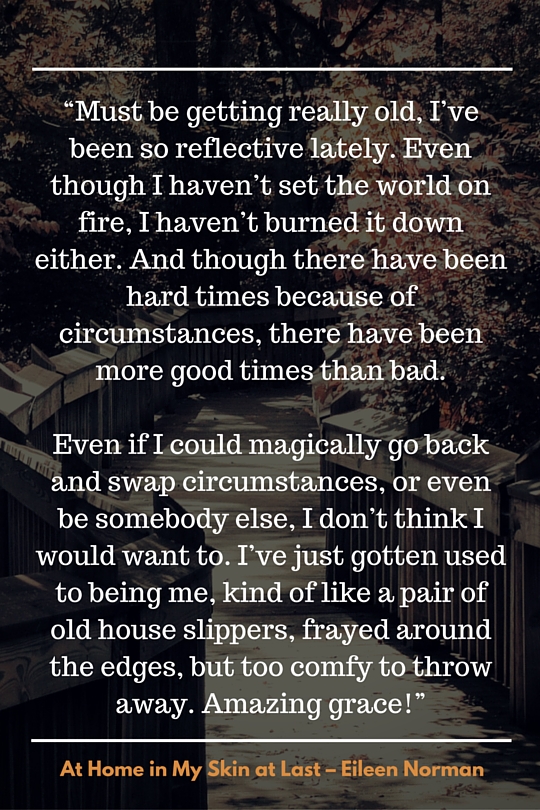
Eileen’s writings, laced with humour, candour, and common sense, inspired me to examine how what is important to me has changed over the years.

In Gifts of Age, she notes, “On the outside I’m a short, plump, white-haired old lady on a walker. But inside me still live all my younger selves. Dwindling energies and a sense of time passing at warp speed, force me to re-evaluate my priorities. Where do I want to focus my limited resources? On image? On possessions? On my aches and limits? On pleasure as a temporary distraction? On a past that I cannot change? On a future that may never come?

It seems more important now, to focus on recognizing the footprints of God in my daily life, on celebrating God’s presence in the small and ordinary, even in the heartbreak, and to share that awareness however I can.

No matter what our age is; today is the only day we actually have.  We can seize it, rejoice in it, and dance in our hearts.”

She invites us to laugh with her as she shares how growing older has caused her to shift gears. Hear her:

At night, as soon as you get your pillow nest arranged to support aching backs and knees and burrow gratefully into it, doubt enters the room.  Did I lock the doors?  Did I turn off the stove?  Did I switch the wet wash to the dryer? Did I take my pills? Yes, I think I did all that tonight. No, that was last night. Oh hell, I better go check.

Then, because your bladder is your only body part that’s more active with age, there are at least three trips to the john every night. And since your early warning system is now deceased, these are made at warp speed, even on a walker. Panic is a great motivator. There should be an Olympic competition for this. You wake up tired and wonder why.

The disconcerting end to what seemed like a reasonably nice day is realizing that you have gone all over town smiling today without your upper dentures.

When you express worry about some of the disasters being experienced by others your age, your children encourage you to be thankful that’s not you.  And you mentally add the word, yet.

When everyone’s talking about diets, you’re thinking, Sure. Like I’m going to give up my last pleasure in life, so I can look good in my casket.

Read More …

If you enjoyed what you read, please tell Eileen so on her blog.


©Timi Yeseibo 2015

Unauthorized use and/or duplication of this material without express and written permission from this blog’s author and/or owner is strictly prohibited. Excerpts and links may be used, provided that full and clear credit is given to Timi Yeseibo and livelytwist.wordpress.com with appropriate and specific direction to the original content.

Shifting Gears [1]

shifting gears


Human clay finds its moisture in relationships and will evaporate into dust without them  – Beth Moore


When I arrive at Tamali’s house, she holds my arm and turns me from side to side, and then she sighs.

“How do you do it?”

She knows how I do it. Her eyes sunken, her voice nasal, her walk without bounce; she coughs as she leads the way. The aroma of sautéed bell peppers and tomatoes hits me. On the gas hob sits a stainless steel pot. Underneath the glass lid, I spy something white; rice, pasta?

“Food?” she gestures towards the pot.

“No thanks, I’m good.”

She opens the fridge and brings out Amaris’ cake. I recognize it from the photo she sent me on WhatsApp. The Barbie doll, which sat atop is gone as is half of Barbie’s pink-layered flowing gown. She gets busy with her knife.

“Too much,” I protest.

She eyes me, “You don’t have to eat it all at once.”

Her neck is lean and last week was tough for her. So, I take the knife from her and halve the portion she set aside.

Back in the living room, she offers me the stubby bananas that Kwame brought from Uganda.

“Very sweet. Not like the ones from Costa Rica in Albert Heijn.”

“I’m full.” I bend and hug my stomach.

“You never eat! I can’t count how many of them I’ve had,” she spreads her arms and looks at her torso; “I’m always eating!”

She is not always eating. It is her frustration speaking.

“How did I get from there to here?” She points at a framed photo by the TV and then digs out more photos from the shelf next to the TV stand.

This is what you do for a friend with flu. You stop by her house after work with a packet of Day & Night Nurse and explain how to take the capsules. You eat cake when you’d rather not. You pull your chair closer to hers and hunch over hundreds of photos. You listen as she reminisces about her days at Makerere University and her time in London, the jauntiness of her late teens and early twenties—that period before we tell ourselves, I’ve got to get serious and settle down. You see a girl you did not know, who helps you understand the woman you now know. 

She appraises each picture by size, interrupting my flow.

“Oh, look at this one, I was slim here.”
“You think I look good there? No way, I resembled an elephant.”
“This one was taken earlier in the year. See me in the same dress later that year; the dress is bursting at the seams! What did I eat?”

And you mourn with her, the loss of youth. Because flu makes you delirious. It makes you want your mother who is 6000km away; although you left home at twenty and you are now in your early thirties. It chains your legs so you miss the gym, stay at home and raid the fridge, and feel fatter than you are.

A pathological nostalgia has seized her and you cure it with kindly indulgence, not once looking at the clock. 

I recently read an article about why female friendships are fraught with infighting. Sitting here with Tamali, I cannot relate. Have my friendships always been this supportive?

There was that time Ada stayed over and borrowed my jewelry while I was at work, leaving me a note to dispel panic in case I looked for it when I returned. I stayed mad for months and ignored her overtures and peace emissaries. My anger was toxic, contaminating anyone who would listen. One day she braved my rage and showed up at my doorstep.

“Yes?” I filled the door space, arms folded across my chest.

“I’m sorry. It broke. I couldn’t return it until I fixed it.”

I blocked her advance, spreading myself wider.

“For crying out loud Timi, it isn’t even 24-karat gold. It’s costume; that’s why nobody could fix it!”

“Beside the point! You shouldn’t have taken it without asking!”

She edged passed me, pushing me against the doorframe. She dropped the broken piece of jewelry on the dining table on her way to the kitchen.

“Do you have any food?” she asked one hand on the door of the fridge.

I sighed and smiled. You cannot poison food if you are going to eat and share it. That was twenty years ago. Ada and I are still smiling.

My girlfriends and I congregate around food. We eat; we do not eat. Thighs and hips feature in our extended conversations. Size is important and relative. Beneath this shallowness is affection, deep and strong, binding us as tomatoes cleave to meat in stew.

When I was younger, I made war. Now I’m older, I make peace. 


©Timi Yeseibo 2015

Unauthorized use and/or duplication of this material without express and written permission from this blog’s author and/or owner is strictly prohibited. Excerpts and links may be used, provided that full and clear credit is given to Timi Yeseibo and livelytwist.wordpress.com with appropriate and specific direction to the original content.


What Do I Look Like?

selfie

The mirror in an uncrowded elevator is an invitation to look at myself, as are the floor-to-ceiling display windows in the mall. Rarely do I say no. Ever notice that when presented with a group photograph, your eyes search for you first?  Is this vanity or normal self-absorption? I have sixty-one selfies on my phone. Perhaps I should not call them selfies. The Oxford Dictionary defines a selfie as a photograph that one has taken of oneself, typically one taken with a smartphone or webcam and shared via social media. Not one of my digital self-portraits is uploaded on my social networks.

My favourite ‘selfies’ are those where I employed the tricks my eighteen-year-old friend taught me to make a selfie not resemble a selfie. All that posing and angling, so I look as though my photo is the view from another’s lens, why?

Apart from a desire to pretend that I did not tilt my head, tuck in my chin, suck in my cheeks, and find the best lighting, before stretching my hand to click, I want to try to replicate an unguarded moment—what others see when I am unaware that they are looking at me, an honest picture of me. But a selfie is manipulation, a digitally enhanced, filtered, and cropped representation of how I want to see myself and how I want others to see me.

I find selfies useful as picture diaries to share privately with friends, but too subjective to tell me what I really look like. Sam Anderson captures this paradox in his New York Times‘ article. He begins by asking: What do you look like?

You are the world’s leading authority on the subject. You have studied your face for many years, with life-or-death intensity, in almost every mirror and tinted car window and unrippled pond you have ever passed. You are the Sir Isaac Newton of your own face: the one true discoverer of its laws of motion, its particular gravity.

You are also, simultaneously, the very least qualified person in the world to know what you look like. You have no idea. You have never actually seen your face — not truly, from the outside, the way other people see it. This is because of a nonnegotiable quirk of the human anatomy: You have to use your own face to look at your face. You are both observer and observed.

Is this why we ask others, “How do I look?”

As a child, my mother was the first yardstick I used to measure my looks by. When people called me little Gina, alluding to our resemblance, I realized I was beautiful. External validation aids self-perception. I have wished on occasion that I could step out of my body and see myself. The next best thing is my reflection in the eyes of those I trust, a realistic picture that transcends the selfies on my phone.


Related: Beauty, A First-Class Ticket
                A Fading Glory


©Timi Yeseibo 2015

Unauthorized use and/or duplication of this material without express and written permission from this blog’s author and/or owner is strictly prohibited. Excerpts and links may be used, provided that full and clear credit is given to Timi Yeseibo and livelytwist.wordpress.com with appropriate and specific direction to the original content.


Your Part of the Story

comprehension

In secondary school, my English teacher gave us a block of text to read followed by a series of questions to test our understanding. This exercise was called comprehension. Correct answers were based on the text. To extrapolate from our life experiences and make connections beyond the confines of the text, in order to interpret it, meant certain failure. This standardization of meaning complemented the marking scheme, I suppose, but we don’t approach life this way.

When we listen, we not only hear the words spoken, but also the manner in which they are spoken and all that it encompasses. How these elements affect our emotions, also influences our understanding.

At work, while implementing a strategy that we’d been briefed about, my colleague and I came to a gridlock because we interpreted the briefing differently. When we sought clarification, it turned out neither of us were right. So much for clear communication, which is why at the end of a talk, a speaker says, “Let me recap . . .” or an avid listener practices reflective listening, “If I’ve understood you correctly, you said . . .”

Someone said, “Write it to eliminate ambiguity,” as if inanimate words on a screen do not awaken and grow wings in the minds of those who read. Perhaps in business writing where clarity and conciseness are pivotal, this is true, except when the writing is convoluted to deceive.

But, in October, I wrote fiction. In fiction, we abandon some of the rules of comprehension I learnt in school. I think that a good writer invites us to create our own stories within the bigger narrative that he or she is telling. Writers do this by leaving a trail of white pebbles that readers instinctively follow to figure out what the story is about, when and where it is taking place, and why the characters act the way they do.

Somewhere along the journey, readers abandon the trail for a meandering path to interpretation. The writer takes a secondary seat, having provided the framework for readers to build by making associations based on their experience, belief, imagination, or needs even.

When I began publishing fiction here, I was fussy about readers’ interpretation. Did they get what I was trying to say? The comments showed me that readers don’t always perceive the story the way I do. And now I’m okay with that. For one thing, no one is writing a comprehension exam. Moreover, to see the story through a reader’s eyes is to see the story again.

I will agonize over words for days on end—do my words lead to logical inferences, are they coherent? But once I hit publish, I understand that the piece of writing, the baby I carried, has been delivered to the world. It is no longer mine. Comprehension is the reader’s part of the story.


©Timi Yeseibo 2015


Unauthorized use and/or duplication of this material without express and written permission from this blog’s author and/or owner is strictly prohibited. Excerpts and links may be used, provided that full and clear credit is given to Timi Yeseibo and livelytwist.wordpress.com with appropriate and specific direction to the original content.


Bluetooth Lottery

Bluetrooth Lottery

As the intercity train from Schiphol arrives at Leiden Central, we shuffle and readjust positions until we are standing on either side of the train doors. The twin doors heave and open with a sigh, letting rush-hour passengers out via the narrow aisle we’ve created. Once the last passenger gets off, we dash for the two cabins on the right. Each passenger holds the swinging glass cabin door for the next to catch as though passing the baton in a relay race, a perfunctory smile or nod in place.

I always sit in the upper deck. After I settle into my seat, my phone beeps. Martijn wants to share a song via Bluetooth. I crane forward and backward, rising from my chair, to catch a view of Martijn. Most people in the thirty-two-seater cabin have their eyes glued to the Metro newspaper, a tablet, or a smart phone. A few chat while one sips coffee from a paper cup. Our eyes meet and he smiles first.

This tall man with close-cut hair wearing blue jeans and brown lace-up shoes is a regular who waits for the train in outlier territory, at the end of Platform 4, way past the Kiosk shop. His glasses add seriousness to his good looks and he always has earplugs on. So, Martijn is his name.

I pair my phone with his and accept the song. Roy Orbison’s Oh Pretty Woman, fills my ears. I contain my laughter, cupping my lips with my hands and sneak another peek at Martijn. He is busy with his phone.

At Den Haag, passengers crowd the stairs leading down the doors. We sway left and right, holding the banister or resting on walls, as the train changes tracks to rest on Platform 8. On the platform and in the main hall, passengers move like a colony of soldier ants defending capitalism. I walk with unhurried steps to give Martijn a chance, but his long strides overtake mine as he rushes to chip out with his card.

On Tuesday, I check my phone several times and my disappointment mounts as we approach Den Haag. Since Martijn is sitting on the left side of the train like me, it is fruitless desperation to peep through the aisle. When we disembark, his long strides overtake mine just like yesterday.

On Wednesday, I arrive Platform 4 early, but he does not. He slips into the train seconds before the doors close and walks past our cabin to the next because it is full. I sigh and continue looking out the window. My phone startles me. Martijn has sent me 3 Doors Down’s, Here Without You. I smile and wonder about the range of Bluetooth technology before losing myself in the lyrics.


“Which song today?” my coworkers ask after I arrive at the office.

It is our game. Martijn has been serenading me for six days. The day I wore my red coat, they guessed, Chris de Burgh’s Lady in Red. My burgeoning romance story doesn’t impress all.

“Aren’t you afraid of viruses and him stealing your information?”

“If you have the latest Android update, you’re safe,” another colleague counters.

We google the answer and I continue accepting songs from Martijn.


Martijn’s ritual is unchanged. He gives a perfunctory nod at the cabin door if I am behind him and hurries away after we disembark.


“This is maddening!” a coworker declares.

“What kind of clown doesn’t speak to a girl?” another shakes his head.

“A shy one; a Dutch guy,” I reply.


One evening, after I get off the train on my return journey, someone calls my name, “Angela.”

I turn, “Do I know you?”

“I’m Martijn.”

I leave his hand hanging as my mind struggles to do the math. I feel as if all but the last number of my lottery ticket has been called and when the last number is announced, it is a two instead of my three.

“Martijn?”

“Yes.” He smiles, revealing gap teeth. He is a couple of inches taller than I am, a blur on our section of the platform.

“It w . . . was you?” Disappointment makes my voice husky.

“May I buy you coffee?” He points to the Kiosk shop.

It is the least I can do. “Sure,” I say still subtracting, adding, and rewinding the lottery winner announcement.

We sit on a bench outside the shop, letting the paper cups warm our hands and watching people chip out or in. The sum doesn’t make sense.

“But . . . how did you know my name . . . my phone?”

“I checked for discoverable devices, took a stab in the dark, and watched you plug your headphones.”

He laughs. His chest and belly join his face. I do not.

“Life is funny,” he begins.

Yes, and here I am sitting with the real Martijn. I almost won the lottery!

“We spend so much time chasing what’s ahead, when we could just look back.”

I don’t have time for pop psychology. I take a sip of my coffee and calculate the number of sips it will take to finish. Lottery is a game of chance, a thrill-seeker’s fantasy.

“Like you,” he gestures with his cup, “You’re reaching for someone; meanwhile, he’s probably reaching for someone else—”

“Pardon?”

“Tall, handsome guy on the train . . .”

My cheeks burn. I dislike his tone and express it with mine. “Your point being?”

“Turn around and take a chance on who’s pursuing you instead of pursuing elusive happiness.” His eyes dance like flames.

Does he think life is like Lotto? Maybe it is. A search for, which lottery numbers come up the most, fetches 50 million results under one minute.

I sigh. “You shouldn’t send stuff to strangers.”

“But you liked my songs—”

“I was curious . . .” I look at my boots. “You invaded my privacy.”

“No, you let me in; you accepted my songs.”

I watch the sky exchange hues, blue for pale orange and then reddish-orange. Streetlights come on and trains whizz past. On the train platforms, crowds thin out. The probability of picking a single correct number in Lotto depends on how many balls have already been chosen.

“Angela? Angela . . . here’s a free tip, turn off your Bluetooth and people will leave you alone!” He gets up and throws his coffee in the bin. “Ready?”

I look ahead until I hear his footfalls fade.

In the morning, I turn off my Bluetooth and then turn it on just before I enter the train. People play the lottery in the irrational hope of winning something. Nothing suspends logic and inspires hope and dreams like the love lottery.

I look around, but Martijn is not in my cabin. I want to go to the next cabin to check, but I’m afraid of losing my seat.

The first time my phone beeps, it’s an email notification. The second time, it’s a WhatsApp message. The third time, Martijn wants to share a song via Bluetooth. I wonder about the range of Bluetooth technology as strains of Lionel Richie’s, Hello is it me you’re looking for, fill my ears.


©Timi Yeseibo 2015


Unauthorized use and/or duplication of this material without express and written permission from this blog’s author and/or owner is strictly prohibited. Excerpts and links may be used, provided that full and clear credit is given to Timi Yeseibo and livelytwist.wordpress.com with appropriate and specific direction to the original content.


Oh Dolly

OH DOLLY


My affinity for conspiracy theories ballooned and adopted a sophisticated veneer when I first moved here. In 2012, I sold my lucrative practice and waited for the Mayan apocalypse and the downfall of Facebook and the internet to no avail. Reading the Conspiracy Times halted my dejection. Through the mag, I joined a classified mission.

After three years of training, it was time to recruit others. I asked Tyrone to help me set up a Facebook account. He arrived one October day, wearing a navy hoodie with UNLV emblazoned on it.

“Was it easy making your way here?” I asked as I led him to the study.

“Why do you live in this wasteland, surrounded by solar panels? He sighed, “This is beyond frugal, man.”

“UFO sightings, global warming. It is going downhill faster than we expect—”

“Bullshit!”

The teak bookshelf in the corner housed the latest statistics, which proved my point. But I needed my Facebook account more than I need to be right.

“A coat of paint never hurt anyone.” He grumbled and pulled his seat closer to the table. “Choose a password; think alphanumeric.”

“Done.”

“Time to connect to people you know. Friend me.”

“What?”

He showed me how to send a friend request.

“Okay. Let’s hook you up with old friends—”

“But I haven’t kept in touch—”

“That’s what Facebook’s for.”

I searched for friends and sent requests. I was excited when my requests were accepted and I messaged some buddies from long ago.

We took a break on the porch, eating sandwiches and swigging from cans of root beer. I asked him about the layoffs in his company since the merger.

He shrugged. “A man’s got to do what a man’s got to do.” He sprang from the bannister and the porch creaked. “What’s that,” he pointed.

“Satellite dish; they track Martian invasions—”

He shook his head. “Let’s go inside and connect you with some babes!”

I cleared our paper plates. He had created an uneven circular map on the bread slices leaving the bread crusts bereft. Earthlings were so wasteful.

Back in the study, he asked, “Names please?” and cracked his knuckles.

I looked away. “Just show me other things I can do.”

He whistled. “You don’t? . . . For your sake, I hope there are babes in your Mars.”

How could I explain transmutation? The world wasn’t ready for us yet. I hoped to build a small community on Facebook. I pointed to the screen.

“Oh that, look . . . find people you know. . . You can have up to 3000 or 5000 friends, I’m not sure—”

“I don’t want many friends.”

“This is Facebook. You don’t know what you want. Just add all the good-looking people . . .”

I examined each photo and then checked out the Timeline.

“You are too slow. A snail would have reached Utah and back!”

He took over from me and began to add friends at random. His definition of good-looking was at variance with mine. I winced.

“Wait a sec . . .” I placed my hands over his to stop the mouse.

“What?”

“That’s Dolapo!”

“Who’s she?”

“She . . . she . . .”

His impatience ruled. “Okay, I’ve added her.” And he continued adding. My mind journeyed back. What if?

He patted my back as he left, “You’re all set now. Facebook can be quite addictive. Maybe it’s what a hermit needs. ”

I thanked him and as soon as he drove off, I raced to Dolapo. Nothing on her Timeline indicated that she was married. She was still very pretty. But what was with her name, Yvonne Smith?

I kept checking to see if she’d accepted my friend request, reminding myself that I had joined Facebook to seek out fellow believers. The truth was, I had walked into Dolapo’s magnetic field and become her prisoner. She rewarded my two-week devotion by confirming my friend request. I wrote a message and deleted it.

I went to bed, but threw the covers after four hours of false sleep attempts.  She was online. My heart strained against its cage as I typed.

Hi

Hi there!

Dolapo? Is that Dolapo?

I am the artist formerly known as Dolapo. I’m called Yvonne now.

Are you related to Prince… who discovered the extraterrestrial bases on the moon?

???

Are you?

My performance gives me visibility and I accept many people as friends. No one has called me D for years. How are we connected?

Can’t you see my name?

I can, but it doesn’t ring any bells . . .

You’ve forgotten me so soon?

Pls I meet many people in my line of work…

Can’t you see my profile picture?


I waited. She had seen my message, but failed to reply. So, I went to bed and dreamt about asteroids colliding with the earth. A group of us from the classified mission worked with friendly aliens to rescue people. I scooped Dolapo in my arms and carried her to safety. She kissed me and called me her hero. 

The next day, I kept checking to see if she was online. The minute she was, I messaged her.

 Hi

Hi there? Dolapo?

It’s me David. Have I mistaken you for someone else? Is this not Dolapo? Dolapo Smith? Tani’s sister?


Her silence stung. I carried hope like deflated balloons. I still had not sought out other believers on Facebook. Two full days passed before her response came.

Hi David, please remind me again how we’re connected

My emotions unsettled me. Love was corrosive, reversing the effects of transmutation. But how could I let this opportunity pass? My hands trembled as I typed.

UI … set of ‘89


When she responded minutes later, I was still sitting in my study panting like a dog.

Ah, that was over 20 years ago. Please provide some context.

What more context do you want? Haven’t you seen my profile picture?

Is that how you looked 20 years ago?

Give me your number, let me call and tease you …


She didn’t respond. My joke had fallen flat. I was wondering how to remedy the situation, when I saw notification for a new message. I clicked greedily. She had sent a photo.
internet meme
Who did she think she was? A mere Earthling! 

Dolapo, I used to visit you in your hostel on campus. And during the holidays, I would buy suya and bring to your house in Ibadan.

David, thanks but I don’t remember.

What do you mean, you don’t remember? A man who came to your room every day and to your house many times? So all this while, I wasn’t even existing for you?

David, have a nice life, I’m out.

Look Dolapo or Yvonne or artist, a man can’t be after a girl for twenty-six years. Enough is enough. You too have a nice life!


I deactivated my Facebook account and picked up the latest copy of Conspiracy Times. The cover stole my attention: Uncovered D-Day 2016. I scanned the article, a familiar excitement racing through my veins. I pulled the receptor from the bookshelf and set it on the table. Then I tinkered with the transmitter. It took a while, but I found the frequency.

I ran outside and stood in the force field created by the satellite dishes. The dot of light in the black sky grew bigger. The grass swayed and plants shook. My legs quivered as the flying saucer hovered above. The blood moon prediction was a hoax, but 2016 was sure. Despite NASA’s denials, the pole shift had started.

I smiled, closed my eyes, and waited for the pull. That will show Mark Zuckerberg and Google and Dolapo. Yes!

The phosphorescent beam penetrated my being. I held my breath for as long as I could. My reflection in the giant eye of the alien who steered the saucer, shocked me. The outline of my human heart appeared first and then throbbed like a living thing. The verdict came through the speakers of the spacecraft. 

Abort Mission. All Systems Abort Mission.
Love Spell. Transmutation Unaccomplished.

The saucer rose and receded, twinkling in the night sky. I fell on the ground and cried, “Oh Dolly!”


©Timi Yeseibo 2015

Unauthorized use and/or duplication of this material without express and written permission from this blog’s author and/or owner is strictly prohibited. Excerpts and links may be used, provided that full and clear credit is given to Timi Yeseibo and livelytwist.wordpress.com with appropriate and specific direction to the original content.


Twice Played

twice played


I thought he was a nutter. But it was either him or the girl spooning rice from a white paper bag with wagamama embossed in black. The smell of fried rice caused the contents of my stomach to heave. I turned away from her and walked towards him.

He was leaning back, one shoulder edging the window. Two fingers formed a V beside his head, while his other hand went to work in rapid movements. He set his face this way and that.

“May I?” I looked at the rucksack on the seat.

His eyes met mine and blood rushed to his face. He mumbled something and gathered his rucksack.

I sat down and resisted the urge to judge. People take selfies all the time. Outside the window, the fields and rivers rushed by. I stretched my legs and closed my eyes.

“Cou . . . could you do me a favour?” he rubbed my arm.

I swallowed my irritation and produced a sitting-next-to-another-homo sapiens-in-the-train smile.

“Please can you take a selfie . . . with me?”

“What?”

“A selfie together . . . I . . . I just want to make me girlfriend jealous . . .”

Behind his glasses, his eyelashes were long and straight, reminding me of the fake lashes Sharon wore. Dark curly hair and full lips, a geek like the one I had once loved.

“Will you, please?”

“Eh . . . How old is your girlfriend?”

“I’m twenty-four and she’s your age, twenty-one.” He held out his phone and leaned towards me.

I leaned away. He looked twenty and I had guessed his girlfriend was eighteen. I am twenty-seven. Numbers mean nothing. I remembered twenty-one and pleasure stroked something inside me. That geek from long ago. I leaned in.

“But, why do you want to make her jealous?”

He put his head on my shoulder. Before I could blink, click.

“Ssssh!” A silver-haired woman sitting across us put one finger to her lips and gestured to the silence icon on the window. Her frown finished her sentence.

We muffled our laughter like teenagers reveling in our youthful secret. His right hand snaked along my shoulders, drawing me closer. I started to protest, but the woman looked up from her book and glowered at me. So I stuck out my tongue at her and mouthed, “Twenty-one forever.” His left hand worked faster—click, click, click.

As we disembarked, he said, “Thank you so much.”

“For the optics, right? Good luck!”

He smiled. I waved.

Two days later when I saw his friend request, I hesitated. Then confirmed. He messaged me immediately.

hi

hi…

it’s me

i know

how do u know?

ur photo? duh?  🙂

oh  🙂

how did you find me?

ur name on ur train card

oh hmmm. K. was she jealous?

ummm

?

change ur rship status

y?

so she’ll believe

believe what?

brb …

I tapped my foot, perused my news feed, liking this and that, willing the message icon to turn red. After forty minutes, I sighed and liked one more cat photo before going to bed. The next morning, I had 107 notifications; likes and comments on a photo I was tagged in. My heart raced as I clicked on the post. The caption: my girlfriend likes it hot. I screamed. Just then, one new message.

hi  🙂

WTF is wrong with you? Take down d photo now!!!!

y? u don’t like coffee?

that’s beside the point!

everyone likes starbucks.

I.Am.Not.Your.Girlfriend.

brb …

I called in sick and seethed through a day of brb-conversations; dead ends that made me curse. I fielded unhelpful comments in response to the disclaimer I put up on my Timeline. The Support Team recommended untagging myself, since the photos did not violate their community rules. Meanwhile, they would investigate. Every spare minute, I lived on his page. Five hundred and twenty-seven comments. Who the hell was this geek!

Sharon believed in shaping destinies. “Good things don’t come to people who wait. Sh*t does,” she said.

She asked around and found this guy from Serbia. People whispered that his large hands, which now tended roses, had done things during the war. We met him in the alley where the back doors of restaurant kitchens opened and rubbish bins stood in rows of twos, three figures bathed in darkness. When I handed him the cash, he didn’t count it.

“Just teach him a lesson . . . no more.” I looked up, but not at his eyes.

He didn’t reply.

That night, I slept sitting up in bed with my laptop on my thighs. By the next morning, the post had disappeared. I returned to work.

Two days later, my boss called me to her office. Two men in black suits sat at the small conference table. They introduced themselves before escorting me to the police station.

The man from Serbia was already there. He crossed his arms and wore a scowl. My tormentor stood a few feet away, a gash on his forehead and one eye swollen shut. I glanced away. The detectives offered me a seat.

“Wait here,” the taller one said.

I wondered if I would wake up to my life and tell Sharon about my dream, but someone tapped my shoulder. I shrieked and jumped. She was five feet two with slanted eyes under a black fringe bob. Twenty-two maybe, but numbers mean nothing.

“I, Anita,” she stretched her hand.

I paused and then took it. Could it get any worse?

She pointed with her chin to the man from Serbia. “You not his type. Why you do it?”

Who was she? Leather jacket, skinnys, knee-high boots—

“I writing a book. My life f**ked up now. Photo on internet and Instagram. Tell your story. We make book; sell to publisher. America publisher? Quick money. Or Kindle.” She shrugged. “Which you like?”

Wait; hang on, internet, Instagram? “Your photo is where?”

“Yours hot. More likes. Men like blonds.”

Images of my head photoshopped on a body with huge breasts and captioned, Date Girls from Russia, floated in my mind. No way!

She stretched her phone towards me and I grabbed it. Compared to this, the photo of me drinking coffee on geek’s lap was timid. I was lying in a bathtub. Red rose petals tried to make me decent, barely. I shook my head. The account belonged to one Don Serbia. Hang on, the profile picture. His f**king profile picture! I looked at the man from Serbia, rage seizing my heart.

“This one pretty. You see more?” She retrieved her phone and began scanning.

I backed her and called Sharon. Sharon listened and then said, “Don’t panic. I know of a guy from Armenia—”

“Very funny! Is he on Pinterest?”

I closed my eyes so my tears didn’t fall. My promotion was due in two weeks—the first person under thirty to make senior manager.

Slanted eyes tugged my sleeve. “Why you do it? Evly publisher want know . . . what’s your story?”

The detective returned and motioned to me. I stood and swept my hair to the side. She looked at my wool-blend coat and fingered the Armani label as though she had found gold.

“I wait for you. You smart; speak English like native. We make good team—coffee and cream. America publisher, yes?”


©Timi Yeseibo 2015

Unauthorized use and/or duplication of this material without express and written permission from this blog’s author and/or owner is strictly prohibited. Excerpts and links may be used, provided that full and clear credit is given to Timi Yeseibo and livelytwist.wordpress.com with appropriate and specific direction to the original content.

Hardwired For Sorry [conclusion]

One

The Power of One

I shook my head as I reviewed Ope’s first draft for the series. Her prose though beautiful did not resonate with me. This piece lacks heart I thought. It did not. The problem was me. I could not conceive that a girl would have insecurities about her height. That others brought them on was beside the point. How could she not see how lucky she is? Someone said that privilege is invisible to those who have it. I am the petite girl with graces, how could I know?

Aware of my bias, I reread Ope’s piece, processing her ideas and connecting them to my experiences.

Tall girls seem to be the norm where I live. I have watched little girls grow up to be gorgeous tall women and none has expressed any reservations about her height. But once when I asked one why she enjoys watching the TV series, Suits, she replied, “Because I look like Gina Torres, and she’s badass!” Was she looking for a role model to validate her six-foot frame? By questioning the premise of her heightend apologies, I see how Ope has become a lighthouse for tall girls and short boys too.

Stories are a way to share our humanity and reading stories is both a conscious and unconscious search for validation.

When Abi submitted her article, she mentioned that every sentence of her rant was factual and she had exceeded the set word count. In fact, every contributor to the series burst through the imposed word count to set their stories free and I, wielding the editor’s scissors, could find little to trim.

Abi’s article stemmed in part from people’s inability to see the pervasive misogyny in her society. Just as I could not connect with Ope’s story at first, they could find no basis for the Chimamanda Ngozi Adichie’s quotes, which Abi shared, tagging them mischievous.

Adichie says that gender is a difficult conversation to have and as Sheryl Sandberg notes, the subject itself presents a paradox, forcing us to acknowledge differences while trying to achieve the goal of being treated same. It seems Abi wanted to make gender visible to men and women.

Some dismissively brand articles like Abi’s feminist. Have you ever been in conversation where a word popped up that made you stop listening and start churning points in your mind to deconstruct what the other person is saying? Anything that reeks of feminism arouses this impulse in some. So, when Abi signed off as a feminist in her bio, I was tempted to remove it.

There are two jars of honey in my cupboard. One label says the honey is from wild flowers and the label on the second jar says the honey is from honeydew. Humans are too complex to categorize into neat labels like honey. This explains why feminism has many definitions and connotations as well as branches—socialist feminism, African feminism, free-the-nipple feminism, and so on.

Those who take this as a sign of confusion should remember all the other philosophies that are similarly ‘confused’: democrat, conservative democrat, republican, liberal republican, catholic, catholic charismatic, Christian, evangelical Christian—are you laughing yet? Wherever human agency exists, there will be divisions, sub-divisions, and further divisions of the sub-divisions. The challenge then is not to merely dismiss ideologies because of labels but to listen in spite of them.

When a woman shares her story, it should cause us to remember our own challenges. At the very least, it should broaden our understanding of our world and our place in it.

After I pitched the idea of the series to Ekpos, she replied, “My own issue is different; people are always saying sorry to me!” Other challenges like physical disability eclipse gender, but only partially. Ekpos relates an incident at the airport where a porter looked at her and exclaimed, “Kai, fine girl like you; wetin happen to ya leg?”

She notes that wit is often the bridge through awkward situations. We need to laugh at ourselves more and get the world to laugh and then see with us. Amy Schumer uses comedy to good effect in her I’m Sorry sketch. According to Schumer, her show has been likened to putting shaved carrots into brownies. Emancipation is a journey, smile you’re on camera!

Ekpos makes the distinction between things she could and could not control. Disability and gender were thrust upon her. The will to overcome these perceived limitations was hers to invoke. The external factors, which make women hardwired for sorry, will not change overnight. But women can take charge of themselves by rejecting the messages they have internalized.

Bel takes this approach in her article. Although she was invited to the table, as were the women in Schumer’s sketch, she tottered at the edge, self-doubt hampering her stride. Many women are echoing songs their parents and grandparents taught them, songs that romanticized a woman’s lowly place in society. They are unconsciously complicit in their disempowerment. Bel noticed that the same self-doubt that tortured her was also present in the minds of some very fine, intelligent women in her company.

By looking inwards with a view to understanding herself, she finally gave herself permission to stand. In her words, “Fortified with this knowledge, I set out to change my story . . . I have begun to tell myself, first, that I am bigger on the inside than I am on the outside.”

Amy Schumer’s sketch isn’t about semantics, in my view. Sorry is still a useful word. However, the characters in the sketch were really using sorry to: diminish their accomplishments so they could be likable, temper their requests for their entitlements with ‘humility’, register their opinion as though it isn’t worth hearing, take nurturing to the nth degree by assuming responsibility for things beyond their scope, and mask impostor’s syndrome. 

If you, man or woman, are concerned about the external and internal factors that predispose women to shrinking themselves, then you need to answer this question: what change or sacrifice do I make to ensure women are unapologetic about taking up space in the world? One thing. Then follow through. Ripples will occur. This is the power of one.

I can’t thank you enough for writing, reading, liking, sharing, and joining the conversation.

timi


©Timi Yeseibo 2015

Unauthorized use and/or duplication of this material without express and written permission from this blog’s author and/or owner is strictly prohibited. Excerpts and links may be used, provided that full and clear credit is given to Timi Yeseibo and livelytwist.wordpress.com with appropriate and specific direction to the original content.

Hardwired For Sorry [5]

apology

My Height-ened Apology

My uncles, aunts, the traders at Iwaya market, and the sales person at Wranglers boutique conspired to spit accusations at me. I burrowed the ground with my eyes and hid my lanky arms behind my back. They made me regard my elongating form with shame.

Ahan Ope, do you want to grow as tall as iroko?” People questioned me without expecting answers.

I wanted to die and on the days that I did not want to die, I wished God would shrink my height—who would marry me? They said I was tall for a girl and at the rate at which I was growing, it would be impossible to find a man taller than I was. Even when I pretended not to care, fury spread its wings on my face and at night, I buried my face in my pillow while crying away the pain.

And so, I learned to apologize. I apologized to the inconvenienced sales person who searched and searched for the right size of shoes for me. I apologized to the world, boys in particular, by slouching a little so that the measure of my stature did not intimidate. I apologized to petite girls, who would never have a problem when it came to marriage, by silencing my brewing envy and playing nice. I apologized to my older siblings by giving up my right to speak in their presence because I was told that I had stolen their right to be taller than me.

Like the women in Amy Schumer’s sketch, I say sorry when I do not need to. After I hit my head on the roof of a campus shuttle bus as I got off, my auto-response to the driver’s remark, “All these tall people eh,” was sorry. It was my defense for distracting the other passengers, by making them concerned about me. It was embarrassment for being five feet ten inches tall. It was martyrdom without the halo.

In the last scene of Schumer’s sketch, the male moderator inadvertently pours hot coffee on the third panelist’s legs. She falls down in pain, screaming, “Sorry!” Exaggerated for comic effect, her legs melt off and in agony, she moves with her splintered legs to the chorus of sorry from sympathizers. Her dramatic exit ends with these words, “I’m sorry, I’m dying, I’ve ruined everything. It’s all my fault.”

The moderator never says sorry. He says, “Oops!”


Until recently, I believed apologizing for my height was the polite thing to do. I have not unlearned this, but I have become more conscious of it and begun to question the premise of my apology.

Why should anyone have to apologize for the genes they received? Do I apologize for my father and mother too? Why should I be ‘conditioned’ for marriage as if it is the highest purpose I could aspire to? And is a woman who is taller than her husband an anomaly really? Really? Does my height mean I am likely to be more domineering than petite women with graces are? Can flat shoes and a small car truly alter my outcomes in life?

The message from my society is subtly clear: make yourself smaller so men can feel bigger, taller, and more powerful. My height is but a metaphor, which affronts obstinate traditional ideas about gender.

stand out where I come from. Perhaps I’m not supposed to fit in; I am to own and celebrate my uniqueness and be a lighthouse for tall girls and ‘short’ boys too.

This hardwiring for sorry cuts across cultures. My apology revolves around my height; what does yours spin around?


Ope Adedeji is a fourth year law student at the University of Lagos. She dreams about bridging the gender equality gap and working with the United Nations. Ope writes occasionally at artsandafrica.com and talesbycecile.wordpress.com.


©Timi Yeseibo 2015

Unauthorized use and/or duplication of this material without express and written permission from this blog’s author and/or owner is strictly prohibited. Excerpts and links may be used, provided that full and clear credit is given to Timi Yeseibo and livelytwist.wordpress.com with appropriate and specific direction to the original content.