Mommie Dearest

mommie dearest

Her eyes opened. Six o’ clock. Panic clouded her brain. She should have already started her round on Ajeleke Street where the drone of generators and echo of the muezzin’s call, did not compete with her megaphone. Into that serene place, Mommie’s voice had boomed nearly every morning for the past two years. She was not careful as she bounded from bed.

In the sitting room, Ejiro, Ufuoma, and Yoma sat with arms crossed over their chests. Their stare reminded Mommie that her head-tie sat on her head at a lop-sided angle threatening to fall. In the corner, Lucky stood like a wallflower not daring to meet her eyes. She smelt sabotage. No one offered her a chair to ease her discomfort. She steadied her head-tie with both hands.

Miguo Daddy,” she addressed Ejiro, her husband.


Miguo Mommie,” they all chorused.


“This has got to stop. It must stop today!” Ejiro spoke first.


“Mommie, we are tired of you embarrassing us with your microphone!” Ufuoma spoke second. She did not observe protocol; Yoma was older than she was.


“We are not saying you cannot preach,” Yoma relaxed his hands as he spoke, “but surely there must be a better way.”


“Hmmm, I see.” She folded her arms over her chest, spreading her legs.


The men knew when to retreat, but Ufuoma continued.


“Mommie, you are the wife of the honorable chief judge. We live in Effurun GRA. You drive a V-boot. You are supposed to be a society lady. Carrying a loudspeaker and preaching on the streets makes you a common, common—”


“Common what? Say it, I am waiting.”


Yoma looked at his mum who was now standing at akimbo and then at Ufuoma whose chest was rising and falling rapidly, “What she means is—”


“I know what she means! My ungrateful family! Ejiroghene when you wanted a promotion, you asked me to pray to the God that you are now ashamed of. Now that you have arrived, my serving God is an embarrassment enh?”


Ejiro pushed his glasses higher up on his nose. He regretted allowing the children persuade him to confront their mother.


Turning to face her only son, she spat out her venom. “Ogheneyoma who prayed and got you out of trouble time and time again? Who prayed until you finally got that Shell job?”


“You did.” Yoma sighed and stretched, he’d never liked waking early. He wished he had not come home for the holidays.


“Mommie, stop it. Stop it!” Ufuoma had had enough. “This isn’t about us!”


“Ufuoma, you, you? You of all people. Where do I even begin? Should I start with that useless boy Richard your—”


“Look, look, this is all getting out of hand. Mommie what we want to say is that we admire your fine Christian character, you are truly a virtuous woman; none would dare disagree. Your aggressive proselytizing with that thing,” Daddy gestured at the megaphone lying at Lucky’s feet, “only serves as a noise pollutant at a time when people are stealing the last vestiges of sleep. This militant evangelistic style coupled with your emotion-laden sales pitch is rather old. We are just saying that it’s time for new tactics.”


He stood and placed his hand on her shoulder, “Mommie, bikó.” Taking her right hand in his, he softened his voice, “You cannot browbeat people into accepting our faith since it is a work of grace, and grace is never more clearly demonstrated than in our actions. As Francis of Assisi said, ‘Preach the gospel all the time, and if necessary, use words.’”


“Ssssss! I thought you were going to say something constructive!” Mommie pulled her hand away and glared at him, “Ejiro, I don’t know which Bible you read that it has become our faith. The kingdom of heaven suffers violence, and the violent taketh it by force. The day that Muslims stop calling for prayer, Hare Krishnas stop dancing on the street, Jehovah’s Witnesses stop knocking on doors, and Cele start wearing shoes to church, that is the day I will stop preaching!”


She marched over to Lucky.

Miguo Mommie,” he curtsied.

Vre-ndo Lucky. Doh my pickin. Is everything set?”

“Yes Mommie.”

Let’s go!”


Lucky handed her the megaphone and followed behind.


“Repent for the kingdom of God is at hand!” Mommie’s voice rang out startling Lucky as he turned the lock and lifted the latch to open the gate. She looked at him with a half-smile, “Charity must always begin at home.”


Once outside the gate, Mommie began to lecture Lucky. “We must forgive our critics. The Bible says that a man’s enemies will come from his own household . . .”


Lucky turned and followed her eyes. Surprise registered in his. Richard was escorting a girl to the junction that led to the bus stop.


“Ufuoma! Ufu-oma o! Come see your boyfriend dey carry gonorrhea!” Aiming her megaphone in Richard’s direction, Mommie cried even louder, “Repent! If you die today, will you make heaven? Turn from your wicked ways!”


©Timi Yeseibo 2014


p.s. Happy Mother’s Day to you. After many false starts, I wrote this caricature, which isn’t about us, because the places I had to go to write the post I wanted seemed too far; the emotions, too raw, bleeding as they did only yesterday.

***


Unauthorized use and/or duplication of this material without express and written permission from this blog’s author and/or owner is strictly prohibited. Excerpts and links may be used, provided that full and clear credit is given to Timi Yeseibo and livelytwist.wordpress.com with appropriate and specific direction to the original content.


Image credit: curtain vector: zcool.com.cn

font: Christopher Hand by El Stinger: http://www.dafont.com/christopherhand.font

font: Acid Label by Billy Argel: http://www.dafont.com/acid-label.font


design: ©Timi Yeseibo 2014

Statistically Speaking

stats

I am drawn to my WordPress stats page at least once every day although the stats do not tell me things I am curious about like how old my readers are. I know a twelve-year-old girl who reads my blog occasionally and a man of fifty-one, who claims to have read everything on my blog. Are the rest of my readers older or younger? My stats do not also tell me if I have crossed gender barriers with my pen. Who reads my post more, men or women?

 
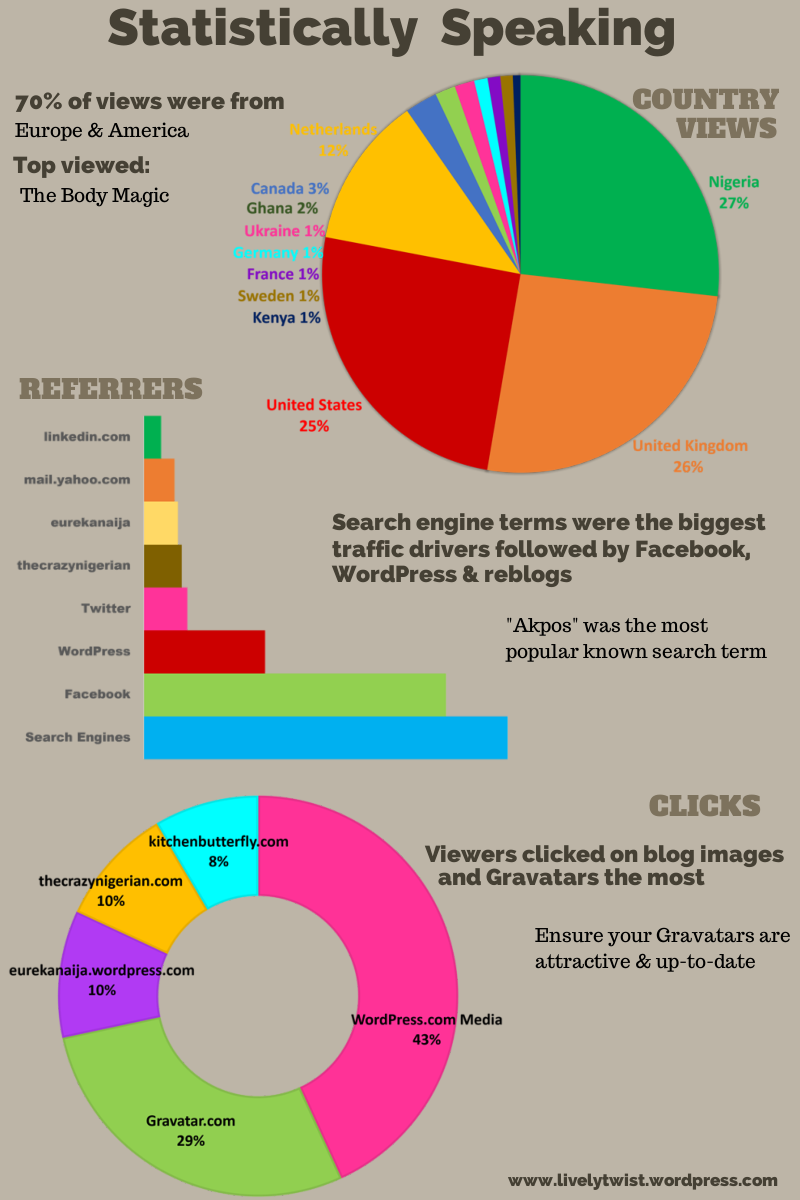
I know no one in Brazil and Azerbaijan is a place I must locate on a map, yet my words have gone where my legs could not go. My words have travelled over Congo, a place I visited in Wilbur Smith’s The Dark of the Sun, and touched down in the United Arab Emirates. At least one person in every continent, in 105 countries, has viewed my blog.

livelytwist country views

I have heard it said that Nigerians don’t read, and that the average Nigerian’s appetite for literature lies in entertainment (Nollywood gossip), politics, and religion. I think I have done my part to debunk that claim. My highest blog views are from Nigeria, closely followed by the United Kingdom and the United States. Mind you, nearly 5,000 views in a country of 150 million people is a drop in the ocean, but I’ll take that drop, thank you!

 
What brings people who I have never met to my blog? I’d like to think that although I don’t know what gnaws on your mind at night, my words do. More likely, search engine robots pull you to my blog when you search for words like Akpos or Body Magic. If Akpos is unique to Nigeria, then majority of the seventy percent of viewers from Europe and The Americas are Nigerians. It makes sense as my Naija experiences colour my metaphors, making me feel proud that I’m also exporting Naija culture to non-Nigerians.

 
Was it my smiling Gravatar or a comment I left on another blog that brought you here? If so, I’m never changing that photo! If Facebook brought you here, I am not surprised for people share my posts on Facebook more than on any other social media platform.

 
I wonder if you stay after you land on my blog or if you leave, bookmark the page, and return later. If you stay, what do you like to read most? When I read a book, I try to find someone I know or myself in its pages. Is the protagonist’s failure like mine or is his success worth aspiring to? Does he walk with a limp so I can catch up with him?

 
I think the best stories are about the human condition, which would explain why stories about my or another’s insecurities served with wit, are the most viewed, most shared, most commented, and most liked posts on this blog. Posts like The Body Magic, I am not Looking for Love, I am going to Work, The Measure of a Man, Any Comments, and Six Degrees of Separation. Perhaps vulnerability exposes authenticity that makes you stay beyond the polished prose.


statistically speaking

Now I know what drives traffic to my blog, do I write another Akpos post? Now I know which posts attract the most views, comments, likes, and shares, do I stop writing posts like, Grow Up Mikey and Our National Pastime, because they performed poorly at the box office?

 
I cannot confine myself to the prison of writing for stats; my mind is bigger than that. However, I realise that my stats are my friends and they are relevant to the degree that I can make right inferences, which affect my writing and ultimately enhance your reading pleasure. So please fill in the gaps and tell me what my stats page won’t: who are you, what brought you here, and what will keep you coming back?


©Timi Yeseibo 2014

 
Related posts from Livelytwist:
https://livelytwist.wordpress.com/2013/11/10/what-brought-you-here/
https://livelytwist.wordpress.com/2014/01/12/wordpress-106-writing-and-perception/


Image credit: illustration from Microsoft


Unauthorized use and/or duplication of this material without express and written permission from this blog’s author and/or owner is strictly prohibited. Excerpts and links may be used, provided that full and clear credit is given to Timi Yeseibo and livelytwist.wordpress.com with appropriate and specific direction to the original content.

This is How We Do It

queue

Life is a series of waiting. From the doctor’s office to the travel agency, from the dentist to the foreign embassy, we queue, tapping our feet, until we are served. Smart businesses turn waiting into a pastime. Forget glossies and car magazines. Forget coffee, tea, sweeteners, and creamers. Nothing like free Wi-Fi to eat up fifteen minutes of eternal boredom.

Yet, at supermarkets or self-service restaurants, Wi-Fi, and even 3G or 4G seldom come to our rescue for transaction speed is paramount.  We depend on tacit rules of queuing to bear our collective suffering and for smooth passage. For example, the loud disapproval of waiting-weary law-abiding citizens dispenses instant justice to queue-jumpers while attendants uphold the  people’s verdict. Those in a hurry don’t have to be doomed to sighing, hissing, time watching, and eye rolling. They just need to approach the Queue Court of Appeal comprising all or some of the people they intend to bypass.

I returned to Nigeria with this mindset. So, when I went to a fast-food takeout, I ignored the people milling at the counter and joined what seemed like a funnel-shaped queue. It didn’t move. This was what happened: people walked in, went straight to the counter, placed their orders, were served, and walked away. Did they have a smirk as they strode out with their prize or was that my waiting-weary imagination?

Anyway, I queued on in faith, ignoring my daughter’s tug on my wrist. I glared at my son for daring to suggest that I muscle my way to the counter. I counted tiles on the ceiling when I noticed people looking at me as if I had dyed my hair lime green. But, the toughest battle by far was drowning out the soundtrack spinning in my head, “Mumu, mumu. Mumu, mumu. You are a big mumu.”

queue culture

I wore my long-suffering like a green-white-green badge until somehow, I found myself at the counter. Before I opened my mouth, a lady appeared and started placing her order. I expected the attendant to ignore Queue-jumper but she took her order instead.

“Didn’t you see me on the queue? It’s my turn.” I eyed the attendant and Queue-jumper.

“How was I to know that it’s your turn?” Queue-jumper replied, looking at me, and then at the attendant, “add moi-moi, three moi-moi . . .” She faced me again, “You’ve just been standing there slacking; I don’t know what you’ve been waiting for.”

Anger rose slowly from my heart to my mouth.

I went into a tirade about how long I had been queuing and why. I expounded on the demerits of organised disorganisation, dragging the name of the management into my argument and stating that they enabled people like her frustrate the system thereby killing any hope of excellence.

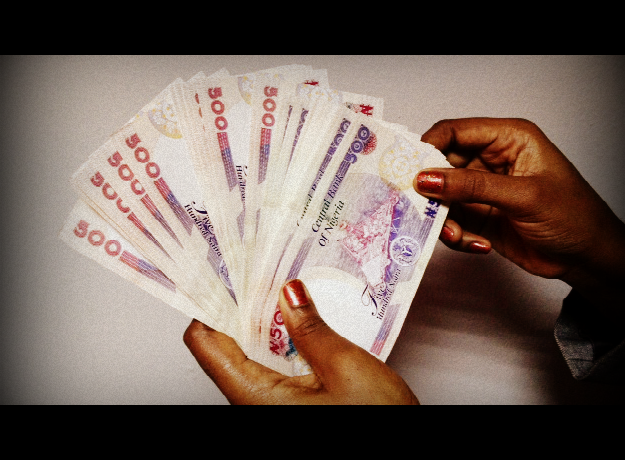
When I heard giggles behind me, I paused to view the effect of my words. Some people were snickering. My son was shuffling his feet and looking at the floor. My daughter was looking at me as if she didn’t know me. I forgave them instantly. What did they know about Nigeria besides the ogbono soup and poundo, which I regularly made while we lived abroad? And the objects of my wrath? One held a bag of fast food, the other, N500 bills, and an exchange was imminent.

Another attendant came to the counter, “Madam there’s no need to shout, if you want something, please just tell us.”

Anger left my mouth and lodged in my heart.

Days later, I saw a real queue in Shoprite at The Palms Mall, people waiting to buy bread. But a friend went to the corner and gave an attendant N200 to jump the queue. Holding his N200 loaf of bread, he winked at me and said, “This is how we do it.” As he sauntered to the till, he bumped into a trolley that crashed into an aisle, causing canned goods to tumble to the floor, while those on the queue shifted their weight, dodging rolling cans.

Is this how we do it?


©Timi Yeseibo 2014


Around the web: other perspectives

India: http://junaidkhalfay.wordpress.com/2014/01/29/indians-their-best/

Oh for the love of India: http://sunderv.wordpress.com/2014/03/07/the-ubiquitous-q-crashers/

Britain: http://prettyfeetpoptoe.com/2013/01/09/queuing-the-great-british-pastime/

Australia: http://infographiclist.com/2014/02/19/ever-lose-your-cool-in-a-queue-infographic-queue/

China: Hey! Can’t you see there’s a line here? Wait your turn! by Ryan Ulrich

http://www.globaltimes.cn/opinion/top-photo/2009-07/442510.html


Photo credits:

http://pixabay.com/en/bar-restaurant-feet-legs-people-238509/


Unauthorized use and/or duplication of this material without express and written permission from this blog’s author and/or owner is strictly prohibited. Excerpts and links may be used, provided that full and clear credit is given to Timi Yeseibo and livelytwist.wordpress.com with appropriate and specific direction to the original content.

Your Enemies Shall Never Succeed

Your enemies shall never succeed

“It’s a lie! Your enemies will never succeed!”

“So after the prayer meeting . . .”

“Yes?”

“I took the holy water to the office.”

Eh hen?”

“I didn’t take all. I poured some into La Casera bottle—”

“You washed it first—”

“No o! Is that bad?”

“Hmmm, it would have been better to sanctify it, but well, it is well.”

“So, I got to work very early, before people started coming . . .”

Eh hen?”

“I entered my oga’s office and I started sprinkling the holy water. Then his secretary came in—”

“Bloooood of Jesus! She saw you?”

“No. I quickly hid the bottle behind my back.”

“Good . . . good.”

“She asked me if I was looking for the leadership presentation printouts.”

“I said, ‘Yes.’ She told me to check the cabinet and left.”

“Thank God!”

“I continued sprinkling the holy water, on the desk, under the desk, on the chair, on the computer. I even sprinkled some on the pictures of his wife and children. When I finished, I started marching round the desk, then the secretary popped her head through the door—”

“Your enemies shall not succeed!”

“Amen!”

Eh hen, what did she want?”

“She asked me if I had found it. I said, ‘Not yet—’”

“And then?”

“She said she would help me.”

“The water?”

“She asked me what it was. I said, ‘Nothing. Just drinking water—’”

“Your enemies will never succeed!”

“She asked me why I’ve been pouring it around the office.”

“Jesus! Jeeesus! . . . What did you say?”

“I said I wasn’t pouring it. She said I was lying that she had been watching me on the CCTV”

“CCTV ke?”

“Yes!”

“So what did you do?”

“We started arguing.”

“Your enemies shall never ever succeed! Eh hen?”

“Then I got angry and stormed out—”

“The holy water?”

“I . . . I . . . I left it there . . .”

“Sh*t!”

“Anyway, when I stepped out of the office, I saw people gathered round her computer.”

“Who? The secretary?”

“Yes! Someone was saying, ‘Rewind, rewind . . . ’”

“What were they watching?”

Leave mata. I wanted to pass quietly. But she shouted, ‘Stop him!’ Then everybody looked up and started laughing.”

“Don’t worry; it is not the end of the world—”

“That’s what I thought. Until the security grabbed me—”

“What?”

“I tried to struggle—”

“Jesus!”

“The other one tackled me to the floor. Then my oga—”

“Your boss? Where did he come from?”

“I don’t know. He told me not to struggle. That I should respect myself and pack my things and leave.”

“Just like that?”

“Just like that. As I was packing, the security guards stood by me. They kept saying, ‘Oya hurry up!’”

“All hope is not lost. God works in mysterious ways. It is well.”

“As I was going to the lift, my oga was following me. He shouted, ‘Wait!’ So I turned.”

“Hmmm, what did he want again?”

“He said, ‘You are not the first and you will not be the last. My enemies shall never succeed!’ Then he pushed the holy water into my hands!”

“It’s a lie! Jesus!”

“What? What? . . . What is it?”

“Your enemies . . .  Osanobua! Your enemies, they have succeeded!”


©Timi Yeseibo 2014


Unauthorized use and/or duplication of this material without express and written permission from this blog’s author and/or owner is strictly prohibited. Excerpts and links may be used, provided that full and clear credit is given to Timi Yeseibo and livelytwist.wordpress.com with appropriate and specific direction to the original content.


Image credit: curtain vector: zcool.com.cn

font: Christopher Hand by El Stinger: http://www.dafont.com/christopherhand.font

font: Acid Label by Billy Argel: http://www.dafont.com/acid-label.font

design: ©Timi Yeseibo 2014

Urban Solitude: Eko o ni baje o!

Mainland Bridge Danfo

Hasn’t it always been this way? Isn’t this the drawback of metropolitan cities? That they teem with busy people who bury their conscience in the fortress that earphones and smartphones provide? Agitated people with tired eyes that look past others to admire the moving vision of success. Rush-hour people who hold their bodies tautly to avoid brushing against each other as if touch is an infectious disease.

Lagos is Nigeria’s biggest cultural melting point, a land of opportunity where I hope to make it big if I hustle right (not everyone returns to Nigeria with excess Pounds and Dollars). In spite of all the promise it holds, people warn that Lagos can be a dangerous place. I feel safe in our flat and the office, but the streets scare me, crowded as they are with worker ants motivated by the fear of poverty and beautiful homes on The Island.

At 04:45, my internal rooster crows and I use warm water to flush traces of sleep from my eyes. I leave our flat with my handbag and a waterproof bag that contains my office shoes, my feet in rubber slippers for the morning jostle on the streets.

“CMS, Lagos CMS, CMS!” the bus conductor’s call rouses the streets.

The driver whisks us away from The Mainland to The Island, where we’ll run laps chasing dreams, luck, and money. At CMS, Victoria Island beckons. Behind the bus stop, the ripples on the sea glitter like diamonds under the rising sun, while container ships dock at Apapa Port.

My jewellery lies scattered in crevices in my handbag. Unadorned with shiny objects, I am an unlikely target of pilferers. I hold my bag tight under my armpit as I board the bus to Victoria Island. I have not spoken to anyone since my journey began. My hair rests on the window and my eyes feast on luxury cars. One day, I will ride in one of them.

The day’s work is hard and my journey home long and silent. Small puffs of dust rise from where my flip-flops slap the earth. In five minutes, I will enter the haven of high walls and still warm air trapped between three-storey buildings that is our flat.

Ahead, a car burns slowly at first, and then with a feverish rush that epitomises the pulse of Lagos. I mean to walk past, but the fire is a magnet that draws others and me. I mean to just look and shrug and stand at the edge, as I am sure the others will do too, but this victim of sudden misfortune tugs at the heartstrings of calloused street people.

We pour water and sand alternately on the burning car. The fire mocks us; its flames lick our concerted effort. Commands fly left, right, and centre as raindrops escape from the sky. Unable to surmount the singleness of our vision, the fire sucks its last breath when a fire extinguisher emerges.

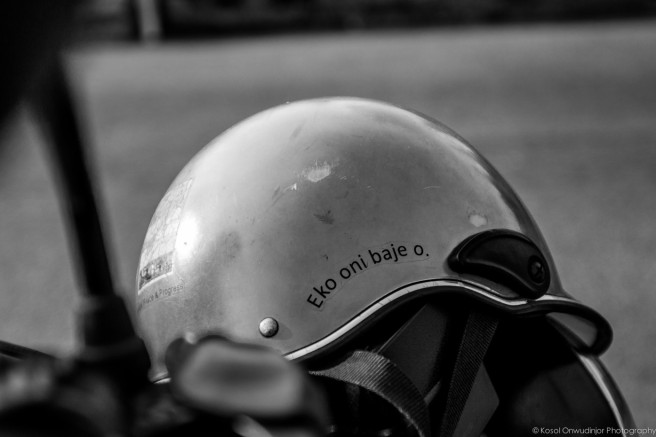
Smoke clouds shaped like ghosts sail across the sky. We, and our ghosts, our resurrected conscience, shout for joy. The rain plasters my hair to my skull and dripping water teases my ears. Eko o ni baje o, Eko o ni baje o, now, I believe the streets still hold promise.

protected helmet

When I open my bag in our flat, my purse is gone. Disappointment strikes blows at my gut as I calculate what I have lost. I embrace urban solitude, the definition that at first made me laugh because I thought it was relevant only in London.

“Don’t acknowledge fellow passengers or sustain eye contact beyond two seconds. Please respect urban solitude.”

And why not? On the streets a kind deed breeds mistrust that quickly turns to scorn. Asking for directions or providing them is a chore weighed with suspicion, and if death nearly claims a soul, the body that houses the soul stands no chance; it will be mangled in the stampede to “arrive” or survive.

This city bustles with life, yet there are fewer strangers to talk to. I long for human contact, not the obligatory type I receive when I walk into a shop, but the disarming type. The unexpected touch from a stranger whose smile meets my upward gaze as he hands me something that dropped from my bag, or the kinship in eye contact with a stranger, after a silly advert on a giant billboard has amused us both.

Eko o ni baje o!

©Timi Yeseibo 2014

Eko o ni baje: (Yoruba) Lagos will not spoil.

Read more about Lagos? These are snippets with photos worth seeing:

1. Yellow. Bright. Happy. Memories of Lagos:

KitchenButterfly memories of Lagos

http://www.kitchenbutterfly.com/2013/12/23/yellow-bright-happy-memories-of-lagos/

2. Eko The Musical

eko the musical@crea8ivenigeria

 http://www.creativenigeriaproject.com/ 

Credits

1. Beyond The Rules (Danfo on Lagos Bridge) by Kosol Owundinjor (Photo by Lagos)  http://photobylagos.wordpress.com/2012/11/08/beyond-the-rules/ 

2. Protected Helmet (eko oni baje helmet) by Kosol Onwudinjor (Photo by Lagos)  http://photobylagos.wordpress.com/2012/09/19/protected-helmet/

Unauthorized use and/or duplication of this material without express and written permission from this blog’s author and/or owner is strictly prohibited. Excerpts and links may be used, provided that full and clear credit is given to Timi Yeseibo and livelytwist.wordpress.com with appropriate and specific direction to the original content.

Cellphomania

mobile phone

I have three mobile phones, so what? Of course, I have all my papers. How could I live and work in The Hague otherwise?

These phones, ah, in Nigeria, they felt neither heavy nor out of place when I laid them on the table in a restaurant, side by side, as if to compare their sizes.

Things have changed since I left Nigeria, they tell me. But I can only tell you what I know. That when my conversation with a friend ended because of network wahala, he called back on another network, blaming the earlier bad connection on heavy rainfall. That when I lived in Nigeria, rain was one reason I had three phones.

So that if rain melted one provider’s “wireless” wires, I could turn to another who might not be that unlucky. So that if lightning set one provider’s telecom mast ablaze, I could turn to others who could get their fire extinguishers ready on time. So that if Sango, thundered against South Africa’s MTN, I could turn to Glo, owned by a son of the soil, who might have been spared.

Network problems are rare here. These three phones? It’s a Naija thing. I am yet to meet any Nigerian at home or abroad who has less than two phones.

My first phone is my “official” phone. Friends call me on this number, as well as my boss, the tax office, the gas company, the police, telemarketers, and King Willem-Alexander. This phone from network operators like Vodafone, KPN, and T-Mobile, suffers one major limitation, which my second phone overcomes.

Because I call family and friends in Nigeria and the African continent from my second phone, the SIM card must come from Lyca, Lebara, Vectone, or Delight, providers that offer discount call rates to Africa. Any smart phone that accommodates Viber, WhatsApp, and the almighty BBM, will do because every Nigerian chats on BBM. Moreover, in Nigeria, exchanging BlackBerry PINs follows introductions and handshakes. Your blue eyes are widening; don’t you know what hyperbole is?

My third phone is the cheapest brand in the market. It’s only purpose is to rescue me. Imagine, if you can, that one day, you are in the Open Market, buying oxtail, shaki, cow leg, and real beef, from of all people, that Dutchman who eats vlees  that you cannot eat, but has a stall where Africans troop.

This inability to acculturate, to do something as simple as buying and eating meat from Albert Heijn after twelve years in The Netherlands is your undoing for you bump into your distant cousin in this little corner of Africa.

He calls you by your Nigerian name, daring you to ignore him. You both register your surprise and long-time-no-sees. You dribble the chit-chat past where you live to you will call him. His protest drowns out the sound of the Moroccan fruit vendor calling, “Bananen, vijf voor maar een euro!” How can he expect you to call him when you are his senior—did you not come to Europe before him? His oyibo neva reach dat level, abegi! He will call you.

You give him your third phone number. The number your mother gives to your secondary school friends because she does not require your permission to do so. The phone that you switch on when you need to make obligatory calls to relatives who think you pick gold off European streets for a living.

My dear, the phones on the table are mine and mine alone. I am not a 419, na so life be. If you still don’t understand, I will explain in the morning. Switch off the light and snuggle close to me, I like to hold you when we sleep.

©Timi Yeseibo 2014

Wahala: (Nigerian Pidgin; perhaps of Hausa origin) Trouble or problem.

Sango: Yoruba god of thunder and lightning.

Vlees: (Dutch) Meat. Many African immigrants shun the “flat” meat in supermarkets, preferring the meat sold in Halal shops or the Open Market (oxtail, shaki, cow leg, etc.).

Albert Heijn: Dutch supermarket chain

His oyibo neva reach dat level, abegi: (Nigerian Pidgin) translates roughly to, living abroad has not made him forget his Nigerian roots or culture.

Open Market: Officially De Haagse Markt. It lies between Transvaal and Schilderswijk, districts populated mainly by Moroccan, Turkish, Antillean, Surinamese, and African immigrants. The market reflects the neighbourhood’s diversity.

Na so life be: (Nigerian Pidgin) translates roughly to, that’s just the way it is.

Photo credit: The Reboot / Foter.com / CC BY-NC

Original image URL: http://www.flickr.com/photos/70292973@N07/7197724426/

Title: Mobile Phone Hanging from a Tree

Unauthorized use and/or duplication of this material without express and written permission from this blog’s author and/or owner is strictly prohibited. Excerpts and links may be used, provided that full and clear credit is given to Timi Yeseibo and livelytwist.wordpress.com with appropriate and specific direction to the original content.

An Encounter with LASTMA

LASTMA

Like Mumbai, Moscow, and L.A., Lagos is well-known for traffic jams. The thorny maze of automobiles, motorcycles aka okada, and pedestrians, inspired the Lagos state government to create an agency to ease traffic congestion. Lagosians hailed LASTMA as innovative until LASTMA began contributing to the bottleneck.

“The fear of okada is the beginning of wisdom, and to avoid LASTMA is understanding,” said a friend, when I started driving in Lagos soon after my return. I had survived reverse parking into tight corners on narrow European streets, but here in Lagos, the challenge was different.

LASTMA
Acronym for Lagos State Traffic Management Authority

An initiative to reduce unemployment and sanitise Lagos roads. Commuters lament the actions of its officers, who are the “reason” for the growing number of ATM machines.

Do not confuse them with the:
Army (green uniform)
Police (black uniform)
Traffic wardens (orange and black uniform)
Theirs is a proud cream and maroon

They are not bad people but a reflection an endemic system.

Motto (of a few bad eggs): To bring insanity to Lagos traffic and lay ambush for mugus.

So, I drove very carefully. Too carefully, annoying Lagos drivers who attempted to terrorise me with their ear-splitting horns, dare-devil manoeuvres, condescending stares, and foul words as they overtook my snail-paced car.

Me? I refused to give them the satisfaction of looking at their faces when they pulled up to my car, moments before overtaking. I kept a straight face and commanded my neck not to turn. I could at least hold one ace, I could relish the silent knowledge that they may have won the battle, but I had won the war.

Once, at a junction, LASTMA officers caused commotion by waving go to adjacent lanes of traffic simultaneously. I drove a few meters and stopped in confusion. Maybe that was the mistake—stopping to make sense of chaos; pausing to take stock rather than forging ahead through the pandemonium. Seconds later, two officers headed my way. I apologised and explained that they had unwittingly caused the mayhem.

They insisted that I let the windows down. I was privy to this trick and refused. When they persisted, I relented and wound down a crack. The officer at the passenger-side window stuck his hand through the tiny space with the agility of a monkey and next thing I knew, he was sitting beside me.

Madam, park for side, you dey cause go-slow.”

I complied and the “usual” conversation followed.

My kids began to cry. My son asked, “Sir is our mum going to jail? Is she in trouble?”

I wished he had not spoken. How much is a child’s distress worth to a LASTMA officer?

Oya madam fast, do quick. See as you don make the children dey cry.” Poking his face in the space between the front seats, he said to my daughter, “Small girl, don’t cry. It’s okay.” Turning to my son whose cries were louder, “Tell your sister sorry. You’re a man, don’t cry.”

My son wailed, “I’m not yet a man.”

“Okay big boy, sssh, it’s okay.”

“I’m not a big boy, I’m only eight!”

Realising that conversing with my son was pointless, he turned to me. “Oya now, madam shake body, so you fit carry dem go Mr Biggs. E be like say dem dey hungry.”

I thought about many things but “settling” LASTMA was not one of them. I folded my arms for a long silent sit-in. With an exasperated hiss, officer one got out to engage in heated dialogue with officer two. I saw my chance and took it.

RAKING

The ability to bluff your way through anyone or anything that threatens you on the streets of Lagos.

Any dialogue that begins with, “Do you know who I am?” or in pidgin, “You no sabi me?” is raking.

A loud voice and threatening gesticulations add panache to the craft.

However, in cases of real emergency, access to a high- ranking military officer is a plus.

The next time I encountered LASTMA officers, my driver was negotiating a left turn on a road with no prohibiting signs. Two officers suddenly appeared.

They insisted that he wound down. I gave the driver a simple choice: your salary or the window, and secured his cooperation. They informed us that left turns are illegal. I welcomed the helpful information and the driver attempted to change direction.

They mounted a human roadblock. “Madam just tell am to wind down,” they threatened.

I assumed my best big man’s wife pose, squared my shoulders, and sat up higher. I was glad that for this all-important trip to Shoprite, I decked to the nines Naija-style with designer sunglasses to complete the look! But the officers didn’t budge. So, I pretended to call my imaginary military officer husband after all, power pass power. They backed off.

What is the purpose of LASTMA, to correct or to collect? I hope things have changed since I wrote this post a few years ago.

lagos state traffic laws

© Timi Yeseibo 2013

You may also like:

When in Trouble . . . Just Yell: http://ofilispeaks.com/when-in-trouble-just-yell/

LASTMA in the Eyes of the People: http://flairng.com/new/lastma-in-the-eyes-of-the-people/

Lagos the liquid wonder: http://bizzibodi.wordpress.com/2013/11/02/30-days-of-lagos-lagos-the-liquid-wonder-by-ferdinand-c-adimefe/

Photo credit: LASTMA website

Image URL: http://www.lastma.gov.ng/traffic_law.pdf

http://www.lastma.gov.ng/

Unauthorized use and/or duplication of this material without express and written permission from this blog’s author and/or owner is strictly prohibited. Excerpts and links may be used, provided that full and clear credit is given to Timi Yeseibo and livelytwist.wordpress.com with appropriate and specific direction to the original content.

What Brought You Here?

what brought you here

The WordPress Stats page is an invaluable tool for bloggers who want to track growth and progress of their blogs. Bloggers receive a summary of blog views by country, top posts and pages viewed, referrers, which are clicks from other sites that link to theirs, and search engine terms, among others.

So far, my biggest referrer is Facebook followed by search engine terms. Search engine terms are words or phrases that people searching the internet use to land on your blog. That search engines drive substantial traffic to my blog is a pleasant surprise because I don’t have an SEO strategy neither do I optimise my content for search engines. It would be too stifling. I would spend too many hours agonising over words. Of course I agonise over words so that what you read flows as effortlessly as rivers over boulders.

The most popular search term that brings people to my blog? Akpos, all things Akpos. Akpos is a fictitious character around whom many Nigerian jokes revolve. I wrote Open Letter to Akpos, a few months ago because I grew weary of multiple BlackBerry Messenger broadcasts of Akpos jokes. Little did I realise that my mini-protest would lift my blog to greater prominence on search engine radars.

Like water on a day when the sun’s heat can fry eggs on car bonnets, Akpos is the antidote to the hassles of Naija life. Unconvinced? Below are a few search terms that brought people to my blog.

Search Engine Terms                                     My Take

Long list of jokes about akpos                     – so you’re currently unemployed?

Akpos meaning?                                            – when you find out let me know

Sweet akpos jokes                                        – are there bitter ones?

Akpos I have a dream                                   – so did Martin Luther King… and                                                                                       Obama had the audacity to change

Akpos bbm pin only                                      – na becos of una I bin write Akpos                                                                                     letter

Akpos jokes of the day                                 – copycat! nor be so Basketmouth                                                                                      hammer; write your own jokes!

Akpos goodmorning jokes                           – for real? wouldn’t you rather have                                                                                     coffee?  

Akpos funny stories                                    – you nor enter molue this morning?

Googleakposjokes                                         – amebo, go find work                     

Best of Akpos at the top                              – please see “my Oga at the top”

Akpos funny love letters                              – run Ekaette, run!

Need story of Akpos                                     – ehnn, for what?

Naija loaded akpos comedy                         – there in four words, the problem with Nigeria!

Since I’ve written about life in Nigeria, I see why search engines referred these searches to my blog.

Search Engine Terms                                     My Take

the beginning of Naigeria                             – this is deep, really deep @Naigeria

God created Nigeria, discuss                       – required essay for secondary                                                                                               school leavers    

I am so glad to know you grew up in                                                                                                     Nigeria. I am from Nigeria                           – nice to meet you too

God of Nigerians                                               – god of corruption, tribalism &                                                                                               comedy

returning to live in Nigeria                           – abeg shine ya eye well well!

Exchange rate Nigeria baits to uk pound   – say what?

Is it legal to urinate in public in Nigeria?   – oyibo, is this your first visit to                                                                                             Nigeria?

I want to wash naija film                              – yes o! wash it clean of the ten-                                                                                           minute credit roll at the start of                                                                                        the movie!

Night+with+naija+full+movies                    – and what a night it shall be!

Don’t ask to touch my earrings                   – okay now! sme sme, I won’t

funny naija post to make my room lively   – sms AkposJokes N10/sms

Lively things to do with my blackberry      – hmmm….

Business woman rides on man                    – nothing and I mean nothing I’ve                                                                                         written on this blog should make                                                                                       anyone land here using this                                                                                               search term! I’m suing Google!

The Body Magic is the post with the highest views on my blog. Perhaps because I expose my insecurities about my weight? Go figure! Not surprisingly, people land on my blog when searching for:

Girl magic weight gain butt                          – need I say more?

Body magic not tight                                   – check the label; made in China?

Body magic won’t fit over hips                   – sis, I feel you

Body magic money                                       – yes, you can make money selling                                                                                     body magic                                                                                                                              #womenarevaincreatures

The body is magic                                     – *wink wink*

Magic in my body                                     – it’s called fat

Where can body magic bra be found                                                                                  in Nigeria                                                                  – send me your BB pin


So what brought you here? Search engine? Facebook? Twitter or WordPress Reader? And, what search engine terms drive traffic to your blog? Tell, o tell!

© Timi Yeseibo 2013

Image design: © Timi Yeseibo 2013

Unauthorized use and/or duplication of this material without express and written permission from this blog’s author and/or owner is strictly prohibited. Excerpts and links may be used, provided that full and clear credit is given to Timi Yeseibo and livelytwist.wordpress.com with appropriate and specific direction to the original content.

The ‘Forgotten’ Groundnut Pyramids Of Nigeria

Kitchen Butterfly

I am not a party girl; I’m a food and talk girl. Informal dinners with friends and conversations that go on and on, and on and on, way past dessert and midnight… hmmm, that’s what this post reminds me of, and I’m filled with nostalgia, a bitter-sweet longing.

Okay, so I’ve just romanticised epa (Yoruba for peanut), but that’s what Kitchen Butterfly has done also—weaving tales about how Nigeria was, in between telling us how to boil groundnut. Word connoisseurs, and lovers of history, photography, fine food (groundnut), would enjoy this as much I did.

“The past may hold treasures, still remembered but the future is bound in hope, in belief and in the knowledge that with life, all things are possible.” Continue…  http://www.kitchenbutterfly.com/2013/08/08/the-forgotten-groundnut-pyramids-of-nigeria/

Photo credit: © Kitchen Butterfly

gingering your swagger without tears

Now that having some swagger has become as essential as having an education, Bellanchi’s tongue-in-cheek tips about how to step up your swagger, will perhaps leave your wallet intact but your sides aching. In his own words, “… Even I don’t agree with some of the irreverent stuff I write, but all in good fun.” Enjoy!

The Benevolent Dictator Theory

You’ve done it and I’ve done it too—huddled with friends and turned a debate on which way Nigeria into a prayer meeting. The kind of prayer meeting where one person declares, “Only God can save Nigeria!” and the others inwardly chorus amen. Weep no more; the Messiah we’re hoping for could be closer than we think…

Scribe of the Tword's avatarThe Chronicles of Chill

When people gather to discuss the future of Nigeria, the consensus is usually 2-pronged. The first is that the brand of democracy we have now clearly is not working. The second is that we are probably screwed if we don’t address our fundamental deficiencies. The third (yes, I know I said two) is that we need a benevolent dictator to set us right.

The mind that proposes a benevolent dictator has probably considered that  returning to military rule would not be a bad option, given how slowly we have moved since 1999. However, that is not a thought that we are allowed to entertain, as constitutional law jingoists insist on drumming it into our heads that “the worst civilian regime is better than the best military rule”.

I think we can agree that the evidence suggests to the contrary. The world’s oldest democracies are in the middle of economic…

View original post 552 more words

7 Annoying Things Nigerians do on airplanes

So, a friend tells me that on a recent flight from Lagos to Abuja, the pilot said, “We’ll be flying at 35,000 ft to Abuja. The weather is okay. Only light clouds, I will try and dodge them so there’s no shaking.” Is this the ninth annoying humorous thing Nigerians do on airplanes—employing Akpos’ brother to fly the plane? Hmmm….


jollof's avatarThe Crazy Nigerian

sleeping on planesLike me, I bet you’ve all run around with your bathing towels wrapped above your shoulders like a cape and pretended to be Superman (and if you haven’t then it’s never too late!). Ever since I was a little brat I wanted to take to the skies. Air travel is the next best thing and I’m always looking forward to having a glass plastic cup of ice-cold apple juice which always tastes better at 10,000 feet. What could possibly disrupt this moment of long-awaited bliss? Cue the Nigerians… On my recent return trip from New York alone I encountered 7 annoying things Nigerians did on the plane:

1. Securing beds…in Economy Class! There’s a game Nigerian passengers play whenever they’re on-board a semi-full airplane – It’s kind of similar to Musical Chairs…but without the music. Passengers snub the seats assigned to them and scout for a stretch of three to four empty…

View original post 778 more words

The Volume of Happiness

Nigerians are the happiest people in the world and you can measure the volume of our happiness. Now I know why people here stop and stare at me and my Naija friends—it isn’t because we are so fine! Oh no, we are Nigerians and we are loud.


ojogbon's avatarÒjògbón

Fans cheer on the Nigerian team during their World Cup qualifier soccer match against Algeria in Ora..You know, I have heard this thing over and again. That Nigerians are the happiest people on the planet. And I’m wondering, really? If it’s happiness that gives us some of the traits which are universally now synonymous with Nigerians, then I would recommend that we take some dose of chill-pill and please calm down! At least, a little!

First off, why do Nigerians shout so much?

I know you have all experienced this. You see an old friend whom you haven’t seen in a while and he screams, “MY GUYYYYY!!!!!! THIS GUYYYY!!!! HOW FAR NAAHHHH!!!!!” The first thing you want to do is, “ooohh..kkk??? what is this serious?” But being a Nigerian, you totally understand and you respond in this same high pitch, “AH! I DEY O!!! WETIN DEY HAPPEN???” Then you would have to endure a huge SLAP of a handshake which usually leaves your hand smarting and red!

View original post 690 more words

Something New in October

coming soon

I’m doing something different. I’m focusing on Naija life this October. Okay, don’t roll your eyes and go, “duh.” I know, I write about Nigeria, a lot! According to William Faulkner, a writer needs three things, experience, observation, and imagination, any two of which, at times any one of which, can supply the lack of the others. No apologies here, I’ve got Naija in my blood.

What’s different? I won’t be sharing my posts. I’ll reblog posts that made me laugh and cry and think, posts that mirror you and me and your neighbour and that man you’ve wondered about.

While you’re reading about Naija eccentricities, I’ll be back stage reading the novels that decorate my coffee table and writing a post for November. So, enjoy and remember to be as generous on the other blogs as you are on mine. Biko, share and leave a comment—they write their stuff because of you.

If you haven’t already, read Naija Movie Night, get a preview of what’s in store.


Take lemons & make life!

timi signature wordpress


Photo credit: Sepia Film Strip clip art- http://all-free-download.com/free-vector/vector-clip-art/sepia_film_strip_clip_art_23195.html

design: ©Timi Yeseibo 2013


Unauthorized use and/or duplication of this material without express and written permission from this blog’s author and/or owner is strictly prohibited. Excerpts and links may be used, provided that full and clear credit is given to Timi Yeseibo and livelytwist.wordpress.com with appropriate and specific direction to the original content.

Naija in My Blood

naija

A lot has been written about hazards such as driving in Lagos and on Nigerian roads. I do not mean to flog the issue, but it was this very thing that revealed some needed home truths.

You see, I am not one to allow my blood pressure levels rise over a little thing like another driver cutting into my lane without permission. The lack of simple courtesies that supply grease for smooth driving relations leaves me unruffled. Watching other tense drivers gripping their steering wheels for dear life as they struggle not to be outmaneuvered, provides witty relief from the unending traffic.

These hooligans—both the ones in black suits and the ones sooted from the ash heap of life—have shown me that aggression is the normal way of life here. The proximity of Lagos to the serene breeze from the Atlantic has done nothing to cool the pepper that burns in their veins.

On the roads, tempers edge dangerously close to boiling point, so, loud arguments and disputes settled with fistfights are not uncommon. No wonder I gave up eating pepper long ago, cucumber is more my style. But, I was soon to discover that the cherry does not fall far from the tree.

NAIJA

Nigeria, a place we all call home

Anger that constant simmering over decades of rape

Independence, a cherished hope; the impetus to rise again at 4 a.m.

Jaded after half    a century of promises unfulfilled

Affection, a feeling that continually binds us to the Motherland

Two weeks ago, my driver was going nose to nose with another vehicle. Normally, I would have cautioned him and asked him to yield to the yeye driver, but that day was different. Whether it was the roaring inflation or soaring unemployment, I cannot tell. It may have been the cumulative effect of bumping my head against the car window as my driver navigated one pothole-ridden street after another. Perhaps it was the sinking feeling that yet another con artist promising much and delivering little had swindled me. Whatever, I was tired of being a fool. My redundant aggressive genes surfaced. “Do not give him any chance,” I warned.

Both their countenances showed strong determination. A mad rush of blood had made the veins visible on their hands and temples, a sign that neither wanted to lose this race for survival. As my driver and I struggled to gain supremacy, he from behind the wheel, and me a cheerleading accomplice from the owner’s corner, the inevitable happened.

An ugly screeching sound rent the air as metal kissed metal. I had a taste of nauseating reality as the beat of the ancient talking drums in my head ceased. My driver jumped out, his rage fuelled by the sudden remembrance of his N5, 000 accident-free monthly bonus.

As he sparred with the other driver, I realized that their loud voices were a mere whisper in the buzz of a Lagos that never pauses. My car had finally been baptized with the telltale marks around the fender that speaks of a skirmish or two in traffic. After both drivers traded sufficient insults, they unanimously agreed that the scratches were not worth coming to blows over.

Rhetorical questions swirled in my mind as I tried to make sense of what had just happened. What was it that made my blood boil? How could I have Naijanized so fast?

Back home, my resourceful driver applied a little brake fluid to the scratches and the car looked almost as good as new. I guess it was a little insurance to secure his bonus. It reminded me of the shoddy patch jobs on our roads that are exposed by heavy rains. Yes, Lagos is getting greener on the outside, but true redemption must go beyond skin-deep.

As for me, years on foreign soil only camouflaged my leopard’s spots. The power of Naija, as the large billboards scream, can never be underestimated.

Pride Power Naija

Yeye: a derogatory term used for an annoying person, thing, or situation.

© Timi Yeseibo 2013

Photo credit: author- Darwinek
Title: Flag-map of Nigeria
Page URL: http://commons.wikimedia.org/wiki/File%3AFlag-map_of_Nigeria.svg
Image design: © Timi Yeseibo 2013

Photo credit: e.r.w.i.n. / Foter / CC BY-NC
Title: PRIDE POWER NAIJA
Original image URL: http://www.flickr.com/photos/eherrera/4950205845/
Unauthorized use and/or duplication of this material without express and written permission from this blog’s author and/or owner is strictly prohibited. Excerpts and links may be used, provided that full and clear credit is given to Timi Yeseibo and livelytwist.wordpress.com with appropriate and specific direction to the original content.

Reinventing Hope

Nigeria-Elekoe Beach

Fifty-three years ago, Nigeria became independent of British rule. Since then, OFN, Green Revolution, MAMSER, Better Life for Rural Women, SAP, WAI, SFEM, Deregulation, June 12th, Privatisation, and The Seven Point Agenda, among others, have come and gone. They made their mark in the sands of our collective consciousness and then disappeared into the bottom half of the national hourglass. But, we have remained like a palm tree, flexible in the wind.

Although we are lacerated by stereotypes, propagated from within and without, and although bloody sweat drips from our brows as we bake the national cake, we have always found ways to sustain hope, to restore hope, and to reinvent hope as we grease the wheels of the nation’s locomotive.

In my post, In the Beginning God Created Nigeria, I wrote:

 It is true that the Nigerian landscape offers many reasons for sober contemplation, but within the dim picture, I found moments of patriotic pride, quiet amusement, and downright hilarity.  Glimpses of our heydays managed to peek through ominous clouds, an indication that lost causes can be found

I found a lost cause. I found hope one grey morning when rain fell at a steady pace.

A man struggled to open his umbrella as he stepped out of his car. Holding the yeye umbrella that refused to fully unfold above his head, he hurried into a building. Ten minutes later, he braved the rain with his spoilt umbrella and rushed to his car. Once inside, he flung the black umbrella in the middle of the road. It tumbled, unfolded properly, and gaped at the sky. He drove off, leaving a water receptacle and a trap waiting to bite other motorists.

Soon after, another man walked by. He looked left then right, and then left again before running to the middle of the road to snatch the umbrella. He closed it and set it neatly on the pavement.

Curious, I invited him into our office for a chat.

“Why did you pick up the umbrella?”

“Because it can cause accident.”

I didn’t need to ask because his shoes, shaved at the heels and curling to heaven in front, revealed the answer. But I asked anyway, “Is your car parked around here?

He laughed. We both laughed.

I nor get car.”

We both laughed again.

“Then why did you….”

He shrugged his shoulders, “It can cause accident. Some drivers will not see on time.”

“Wow. Not many people will do what you did….”

He shrugged his shoulders again, “Make I begin go.”

“Hold on. Let me find something for you. We need more people like you in this country.”

“For what? Wetin I do? Please keep your money.”

“I just want to give you something to show appreciation. If more people were like you, this country will change.”

“No need. Make I begin go.”

When he stepped outside, he gauged the drizzle with the back of his palm, shut his umbrella, and kept walking.

Little hinges swing huge doors.  Change will elude us as long as we only point fingers. When I look for a dustbin to dispose of the empty Mr Biggs take-away pack instead of dumping it on the road, change will come. When I wait in traffic instead of turning the pavement to a fast lane, change will come.

Light a candle of hope with me. Share your encounter with a Nigerian whether in Washington or Aba or Ogbomosho or Manchester, which defied the stereotype that we have come to know. Surely, for Nigeria, the future is still pregnant.


© Timi Yeseibo 2013


Photo credit: Zuorio / Foter / CC BY-NC-ND

Title: Nigeria – Elekoe Beach

Original image URL: http://www.flickr.com/photos/zuorio/282076831/


Unauthorized use and/or duplication of this material without express and written permission from this blog’s author and/or owner is strictly prohibited. Excerpts and links may be used, provided that full and clear credit is given to Timi Yeseibo and livelytwist.wordpress.com with appropriate and specific direction to the original content.


No Longer a Piece of Meat

Suya by KitchenButterfly

Theirs is a spacious car park unprotected from the glare of the sun and the noisy wind that ushers autumn in. Hers is the silver-grey Toyota Aygo, that ubiquitous city-car that cushions Europeans from the perils of economic recession, road tax, fuel costs, and ah yes, carbon emissions. His is the black Mercedes, that German beast that roars.

Having never seen him before, she wants to say hi, and make small talk, for the benefit of their mutual skin colour, if only for a few moments, so they can put up high walls against the cold and enjoy the warmth of solidarity.

Instead, she walks past him, and quickens her steps, the koi-koi of her heels, lost in the now harsh whispers of the wind, her mind replaying images she had thought long forgotten.

She is ten again and in the country club with her mother, in front of her soon-to-be swimming instructor, who took in her thin frame, and let his eyes linger, then wander, and then linger on the small mounds on her chest, which strained against her one-piece suit.

Her mother followed his gaze. What was supposed to be a conversation about swimming timetable, changed to a conversation about swimming lessons ending. The uneasy feeling that followed her relief and disappointment, which she could not define, she submerged in that room in children’s heads that they do not like to visit. Years later when she understood the term, dirty old man, she remembered the way he had moved his bushy eyebrows up and down in quick succession, as first her mother turned and then she turned to leave.

That thing that was in her swimming instructor’s eyes, she now sees in his. His eyes, they reduce her to a piece of meat. They touch her the same way that women and men haggling over meat in Lagos markets grab the meat from the wooden tables, slap the meat on the wooden tables, and push the meat on the wooden tables, wooden tables with fissures that are smooth with age and vegetable green at the edges.

Reflex causes her to tug at her skirt, to pinch the fabric in front of her thighs and try to drag it down, as though she can turn her mini skirt to maxi, as though her legs are not encased in black tights and boots.

His eyes drill holes in her back. She nearly misses her step. His laughter is low, but to her ears it is as loud as those of the traders who called her Shabba, and tried to grab her hands as she shopped at Tejuosho market long ago, wearing a long skirt with a thigh-high slit.

All the way to the traffic light where they encounter one another again, she thinks of his greedy eyes, his hungry smile, the shape of his gorimapa head, and the shiny darkness of his skin. She divides Africa into four: east Africa, south Africa, north Africa, and west Africa; he resembles her, but she cannot decide where he belongs.

She pulls up slowly beside his Mercedes and stiffens her neck. She wills herself not to look at him. But she does. You see, the force of his gaze, and everything intangible that had transpired between them is like a horse’s bit. His handsome features do not captivate her. His smile does not captivate her.

It is his left hand. The way he raises his shoulder and bends his elbow so his fingers rest on the steering wheel in the 12 ‘o clock position—that unmistakeable way Naija boys with new money driving new cars with shiny alloy wheels, hold the steering wheel—that is what captivates her.

So now, she knows where he belongs.

She begins to laugh and laugh and laugh some more as his brows furrow in consternation. She continues laughing as the traffic light turns green, and he speeds off. She laughs as the cars behind her pull out into the other lane and the drivers stare at her and shake their heads, before they zoom past. She laughs until the traffic light turns red. Then she stops. She is no longer a piece of meat.


Postscript

Chaos defines her Mondays, but the chaos lights her fire and adds purpose to her steps. The only thing that halts her fall is her desk, which is behind her. She feels its edge cutting into her thighs as she stumbles backwards for safety and support. Her gaze meets his and holds while they shake hands. When Ben gestures to another employee and whisks him away, Ben’s words hit home. With vast experience in mergers and acquisitions, he comes highly recommended from J.P. Morgan. He is her new manager.


© Timi Yeseibo 2013

If you loved the photo of the suya as much as my post or more than my post (how dare you?), if you miss suya and live where you can’t buy it, if you’re adventurous, if… if …, whatever, okay, read Kitchen Butterfly’s post about suya.

Photo credit: © Kitchen Butterfly

Original photo URL: http://www.kitchenbutterfly.com/2010/07/15/how-to-make-nigerian-suya/

Unauthorized use and/or duplication of this material without express and written permission from this blog’s author and/or owner is strictly prohibited. Excerpts and links may be used, provided that full and clear credit is given to Timi Yeseibo and livelytwist.wordpress.com with appropriate and specific direction to the original content.

Happy Friday

Happy Friday

There is a man who stands at the entrance of the lift on the ground floor of your office building. He greets you with a broad smile as you approach the lift and lets you know that he has called the lift. “Oga, it is coming down,” he announces, as though looking at the numbers on the display changing in reverse order is a job for him alone.

He wears a pale blue shirt tucked into navy blue trousers with the seriousness of an employee on his first day at work. When he moves his cap slightly to scratch his head, you see that he is bald and his fingernails are long. You wince before you hear the sound and you are surprised that the sound is not as harsh as you expected. He taps his black baton, which hangs by his side, and you nearly forget that both of you have been waiting for a full sixty seconds.

In the lift, his shirt is not pale blue but faded blue, and the cracks which extend for a few millimetres from the buckle holes on his imitation leather belt, remind you of harmattan, of chapped lips in need of Vaseline.

“Oga, seven or ten?”

You are usually among the first to arrive at the office. Sometimes you get off on the seventh floor. Sometimes you get off on the tenth floor.

“Choose.”

“Ehn?”

“You choose the floor.”

His fingers hesitate at the control panel. “Ten sir. Ten, because the higher you go, de more money you go get.”

He smiles and some of the years roll off his face. You think of your late father and swallow a lump.

“Ten it is then.”

You no longer hold your breath when you ride with Joe. The smell of day-old perspiration has grown on you, just as the way his black shoes shine and reflect light, no longer fascinates you.

Joe clears his throat.

“Oga, today is Friday.”

“I know.”

You know because you woke up at 4 a.m. to complete the presentation for your meeting at ten. However, you can tell it is not the response Joe was expecting because he clears his throat again.

“Oga, happy Friday, sir.”

You think it is too early, but the weight of expectation that causes his words to land on your shoulders, the demands of communal responsibility that is thrust on you for earning a certain level of income, and the unspoken rules of this ritual, constrain you to respond.

“I’ll see you later.”

Joe clears his throat yet again. “Oga I will close early today.”

He has taken a gamble and he watches to see where the dice will roll. Only he does not let it stop. “It’s okay oga, I will wait.”

Your irritation vanishes.

“God bless you sir,” he calls as you walk out the lift.

When you close, he is there. On the ground floor. Saying, “Happy Friday,” to a colleague. He monitors you from the corner of his eyes, eyes that fill with indecision as you walk past. He must be aware of the foolishness of abandoning the fish in front of him, to dash and catch you. So he calls out, “Oga, abeg, I will soon finish!”

You almost laugh, in amusement, but check yourself. It is shameful that this culture dignifies begging and elevates it to an art form, complete with colloquialisms—How weekend sir? Anything for the boys sir? Oga we dey here o? Happy weekend, and so on.

An old man. A beggar. A corporate beggar. A beggar cushioned against the sun and the rain. A beggar in uniform. A professional beggar.

He catches up with you outside as you head for the car park.

Breathing hard, he declares, “Happy Friday sir!”

You hand over a couple of notes.

“God bless you sir! Your family will never suffer. Your wife will born plenty children, strong boys. Your children will become great ….”

You do not pay attention as you keep walking. What is his life like? What qualifications does he have? You turn to ask. But, Joe has resumed duty on the stairs leading to the entrance doors, his head bowed slightly and his hands outstretched.

You let your shoulders sag. “Happy Friday Joe,” you mumble, knowing that his praise-singing would have drowned out everything you intended to say.

In the car, before you turn on the ignition, you pull out a couple of notes from your wallet and leave them on the passenger seat. They are for Adamu and the others who man the security gate.


© Timi Yeseibo 2013


Photo credit: © Timi Yeseibo 2013


Unauthorized use and/or duplication of this material without express and written permission from this blog’s author and/or owner is strictly prohibited. Excerpts and links may be used, provided that full and clear credit is given to Timi Yeseibo and livelytwist.wordpress.com with appropriate and specific direction to the original content.