Hard pressed on every side

To understand Nigeria, you must appreciate how religion colours every aspect of our lives and infiltrates nearly every conversation. There is a god of Nigeria, he is the carrot and the stick, and the final bs, that’s bus stop, by the way.

“Like soap that glides through wet hands, we use religion to evade the grasp of accountability time after time. From Aso Rock to Ajegunle, religion is courted, invoked, and brandished as if it is a determinant of GDP and as if, according to Karl Marx, it is the opium of the people!”

Tolu Talabi aka Naijarookie, doesn’t get enough credit for making me laugh. I hope you’ll laugh as well, and if you’re like me, untangle the many levels of ‘spirituality’ unfolding in his tale. Enjoy!


Originally posted on Nigerian Newcomer

Most of the businesses in Nigeria have an office gofer. Someone who can run errands for the staff, pick up food, clean a spill, make a cup of tea. Usually this person has an official designation, they might be the security guard or the cleaner. But when they aren’t opening gates, they hang around and wait to be summoned.

The person who does this at my office is a girl called Esther who is always taking days off to write exams. She would say, “I won’t be around next week, I’m travelling to Ibadan to do WAEC.” Or “I have JAMB on Saturday, I have to attend lesson.” You’ll see her sitting in the corner reading Literature-in-English past questions, or squinting at an Accounting textbook. One day it was a Chemistry practicals textbook, I had to ask.

She laughed, “Haha, all these subjects? It’s not for me, I’m doing the exam for other people.”

View original 628 more words.


Related Posts on Lively Twist:

By God’s Grace

Your Enemies Shall Never Succeed

Mommie Dearest

Others:

The Business of Worship by Jide Odukoya: It is hard to reflect objectively on the proliferation of Churches in Nigeria. View original photo commentary with 192 more words.

Gods Were to Blame by Samuel Okopi


Sango by Tobi 'Leftist' Ajiboye

All the lessons of history in four sentences: Whom the gods would destroy, they first make mad with power. The mills of God grind slowly, but they grind exceedingly small. The bee fertilizes the flower it robs. When it is dark enough, you can see the stars. – Charles A. Beard


“Who dares Oyo?”

Sango’s fingers quaked as he rose from his seat. A palace guard had come with news that frightened his household but angered him.

“Who dares my beloved Oyo?” Sango asked again with a louder voice, his face squeezed to a frown, his eyes eager to escape the prison that held them.

Everyone in the palace shifted back.

“I will destroy this oyinbo god!” said Sango, as he raced to the skies.

From the embrace of the lower clouds, Sango saw Poseidon, an oyinbo god so mighty that when he moved, the sea swirled around his body like wrapper shaking in the wind. Poseidon held a trident with which he guided the clouds above the sea into a thunderstorm easily uprooting palm trees outside the city walls. He advanced from the middle of the sea, lashing the waters with his massive frame.

Sango trembled. Where did such a god journey from? What does it desire?

Poseidon roared and the earth shook.

Olorun did not mold Sango with fear!” Sango spat out the words through trembling lips.

The upper clouds swirled faster around Sango’s outstretched double-headed axe. As the master of thunder, the knowledge that another being sought the obedience of heaven’s light and sound enraged him. Fear shrunk into a still prisoner bound by the shackles of his rage.

“White god, listen! You shall burn! The waters shall do nothing to stop your white skin becoming like the terrible blackness of night. You shall disappear as ash to the skies!”

When Poseidon’s eyes caught Sango, he roared all the more in the foreign tongue and mounted the sea horses formed of the tidal waves. Soon, he was by the beach. Poseidon had not crossed the palm forests by a man’s twenty paces when Sango swung his axe and struck him with a stream of lightning.

All of Oyo Kingdom and beyond heard the terrible groan of the oyinbo god as he crashed into the sea. Warriors ran into their huts ahead of their wives. Children bumped into themselves as they pursued their mothers’ loosening wrappers. The scent of death had never been this pungent in Oyo.

In the palace, Sango’s three wives, Osun, Oya, and Oba, huddled in the inner chamber, quivering.

“Olorun, spare us and our Kabiyesi o!” said Osun, whose beauty and excellent cooking kept Sango’s deep love for her aflame through all seasons. Wraps of amala she had prepared for him lay on the floor of the main chamber, their roundness deformed to the jaggedness of mountain ranges. The hot ewedu soup she had placed beside the amala stained the floor like stubborn patches of grass.

Every member of the royal household crouched in hiding, counting their heartbeat and the painful seconds before the oyinbo god’s groan would resound. Instead, the faint sound of Sango chanting praises of his exploits in battle, streamed in from the skies.

The palace guards rose first, following the distant sound, shedding their fear with each footfall. They moved into the courtyard and sighted Sango in the clouds, and then they shouted, singing the great victory songs of old. The palace drummer struck the batá twice, swung around, and then moved his hands faster and faster over the batá. Osun, Oya, and Oba’s legs received strength and their hips swung left, right, left, as they chorused with the guards.


Who amongst beasts and men can stand the fire in Kabiyesi’s eyes?

Will a god beside Olorun do battle with Kabiyesi?

Ah, Kabiyesi, master of thunder!

The god that brightens the earth with his eyes.

The one that chews iron and bathes with fire.

Our lord with eight eyes guiding heaven, eight more ruling earth.

Our king who makes Oyo people snore in a thunderstorm!

Kabiyesi, master of thunder, Olorun made you perfect!


Sango smiled as tributes from the lips of hundreds of thousands dwelling in Oyo kingdom ascended to his ears. He descended towards his people, his brown loincloth swaying in the wind as he danced to the intoxicating beat of the batá.

Midway between earth and sky, the earth began to tremble. Poseidon’s roar arose from the sea and saturated the skies, sucking in the joyful noise of victory swimming in the air. When Sango turned to behold Poseidon, a mighty ball of water hit his frame and flung him towards Egbaland where he crashed on Olumo Rock, the great rock revered all over Egbaland. It shattered at once into boulders that flew out and crushed many houses and people.

From where his swift flight ended, Sango pushed aside the tree trunk straddled across his torso and jumped to his feet.  His mouth was bitter from the memory of his humiliating crash. Seeing Poseidon advancing towards Oyo, even if with a burnt arm, turned Sango into a mad man. Wrath stole his words. Pain summoned his axe. When it came, he stuck it in the air and flashed his iron teeth at the sun.

Thunder knew its true master.

“Olorun! I am the greatest god after you!” Sango said, his eyes aflame as he channelled ten years of thunder towards Poseidon.

***

Poseidon’s ashes travelled as far as Timbuktu. The great walls of Oyo crumbled to dust. Not one living thing survived.

“Oloooooruuuuuuuuuun!” Sango cried to the heavens, the fire in his eyes humbled to tears streaking his cheeks.

“Oloooooruuuuuuuuuun!  Olodumareeeeeeeh! Why did you not tame my anger!”

Sango sank to his knees. Osun’s enchanting smile flashed before him and with it came the memory of the sweet-smelling amala and ewedu she had prepared for him.

“Aaaah!”

Sango bowed his head and wept like a man. For two days his knees remained with the ground and his lips did not part. When he stood to his feet, he walked for seven days never stopping until he vanished into the sea.

No god ever saw Sango again.


© Samuel Okopi 2014

samuelokopi.com


Oyinbo: Pidgin. Usually, a person of Caucasian descent.

Olorun: The supreme god of the Yoruba pantheon in its manifestation as the ruler of the heavens. http://en.wikipedia.org/wiki/Olorun

Kabiyesi: Majesty, Royal Highness. He whose words are beyond questioning.  http://en.wikipedia.org/wiki/Highness 

Batá: A double-headed drum shaped like an hourglass with one cone larger than the other. http://en.wikipedia.org/wiki/Batá_drum


Image Credit

Sango’s Rage by Tobi ‘Leftist’ Ajiboye

Twitter & Instagram: @leftistxx


Unauthorized use and/or duplication of this material without express and written permission from this blog’s author and/or owner is strictly prohibited. Excerpts and links may be used, provided that full and clear credit is given to Timi Yeseibo and livelytwist.wordpress.com with appropriate and specific direction to the original content.

Love for Country and Other Drugs

Love 4 Country & Other Drugs

Because of Nigeria, I’ve been accused of false optimism, “How can you hope for change when we keep doing the same things?” I’ve also been accused of Elitist Patriotic Syndrome, a type of patriotism that conveniently lives abroad and so doesn’t wash its hands in the muddy river of change. But how do you bury love for country? Where are its roots that I may pluck it?

Looking ahead to Nigeria’s Independence Day, three writers and I wonder if hope can be reinvented.

Education is Training the Mind to Think

Desmond Tutu, in one of his stories said, “When the missionaries came to Africa they had the Bible and we had the land. They said, ‘Let us pray.’ We closed our eyes. When we opened them we had the Bible and they had the land.” I wonder why we prayed with both eyes closed. And who helped the white man steal the slaves that crouched in the belly of the whale on the way to the plantations in America? Tell me who? The white man has gone and Africans stagger, drunk from the rich red of millions that flowed in Rwanda, Sierra Leone, Liberia, and Nigeria.

I am glad the white man came to Nigeria and brought education with him1. One day, a friend visited a motherless baby’s home to inform the administrators that he was committed to educating two kids as far as they wanted to go. Starved of funds, they greeted the news with glee and asked him to pick the two kids. As he looked at the kids, his heart ached because choosing one meant rejecting another, but his pocket was simply not wide enough. The administrators chose for him, they chose their brightest two. Two plus two equals eight. Four plus four equals thirty-two.

I have dreamt of the past. Show me the future that I may live the present.

Education can teach us to read and write, appraise and solve, question and answer, and chew and spit. It is why I want to write prose with the eloquence of Chimamanda Adichie and the humanity of Chimeka Garricks, that another generation can read stories of hope and redemption, and pray with both eyes open.

The secret of freedom lies in educating people, whereas the secret of tyranny is in keeping them ignorant. – Maximilien Robespierre –

Timi Yeseibo @ Livelytwist

  1. “History rediscovered – Emeka Keazor at TEDxEuston” YouTube video, posted by “TEDx Talks,” on February 21, 2014. https://www.youtube.com/watch?v=ZN3hCjbA_dw 


Humans of Nigeria

It was Christmas Eve, and we expected the roads to be free. We drove past Iyana Ipaja roundabout and entered one of those traffic jams that force you to turn off the AC, roll down the windows, and watch pedestrians cover distances you won’t in hours.

Suddenly the traffic began to melt as engines sprung to life. A tall man in combat trousers was swinging his arms and giving directions to relieved drivers. Sweat glued his muscles to his khaki t-shirt and outlined them. He had a broad smile on his face—an antithesis of Nigerian work culture.

On our roads, police officers pounce on naïve drivers who miss one-way road signs or waylay bus drivers for fifty Naira notes. The police are not alone. The prevailing mindset is that no matter how hard we try, we have nothing to gain from our jobs. We work without a sense of ownership, purpose, or dignity. Oga ta, oga o ta, owo alaaru o pe1. Na lie! Our work is a reflection of who we are, and the only place success comes before work is in the dictionary.

The exceptions are the Humans of Nigeria, like the soldier who volunteered as an impromptu traffic warden and the doctor whose diligence prevented a national Ebola tragedy. They worked with verve and took charge. Like pebbles thrown in water, the ripple effect transcended their original goals. The government may never give them national awards, but they are the reason Nigeria is not a complete hell.

IfeOluwa Nihinlola @ ifenihinlola.wordpress.com

  1. Oga ta, oga o ta, owo alaaru o pe: (Yoruba) whether the boss makes profit or not, the labourer’s wage will be intact.


A History of Industry

After World War II devastated Japan, the island country underwent a rapid industrialization that surprised the world. The Japanese Miracle happened because strong leadership inspired a diligent citizenry, the threat of scant natural resources notwithstanding.

Did something else influence this phenomenal comeback?

I discovered that the world’s oldest company is a Japanese construction company founded over 1400 years ago. Japan rules the list of world’s oldest companies, a sustainable culture of industry perpetuated in the soul of a nation for centuries.

A careful consumption of Nigerian history reveals a similar culture of industry. Gigantic groundnut pyramids once drew tourists and business tycoons from all over the world to northern Nigeria. These pyramids were the brainchild of Alhassan Dantata who became West Africa’s richest man. Generations later, his great-grandchild is one of the richest black men on the planet.

Stretching further back in time, beginning from around 800 A.D., powerful rulers of Benin Kingdom in southern Nigeria, successively oversaw the construction of what became the world’s longest earthworks; city walls that reached an astonishing 16,000 kilometres.

Nigeria can bring about her own miracle if we unify the legacies of industry spawned by our various cultures under strong and visionary leadership at all levels.  Moreover, we cannot forget that unlike Japan, we have an unbelievable wealth of resources waiting anxiously for a call to service. Will you give the call?

Samuel Okopi @  samuelokopi.com


The List

Four years ago, I moved back to Nigeria with many preconceptions that prevented me from being as happy as I could have been. I know now that I know nothing about Nigeria, but I also know that I know more than I did before and I will know more tomorrow. Everything I’ve learned is in this list, which I will patent as, Simple Rules for Visiting or Returning Nigerians, and Maybe Locals too.

1) No one wants to hear you complain

If you have a sob story after a month’s stay, how many sad stories do you think people who live here have? Twenty, fifty, uncountable?

2) You don’t have the magic solution

People who begin their sentences with, “You know what the problem with this country is . . . ,” make me roll my eyes. No I don’t know, eminent genius, tell me what the problem is!

3) You can’t be tired of this country

Nigeria has problems. You proved that by leaving. Don’t throw your hands up at every challenge you face. Remember when your mother embarrassed you in public and you thought, oh God, I need new parents? How did that work out for you?

Here like elsewhere in the world, your task is not complicated: be a decent person and be decent to other people, whether in molue or presidential motorcade. Good leaders come from caring people, and I now know I belong at the starting line.

If you find the list above disagreeable, you can opt for the Babalawo1 Price List (medicine man’s potions):

BUSINESSMAN  PACKAGE                              ₦60,000

Super Business boom

No double cross*

Success job contract

No more promise and fail

*Stops people from double-crossing you. Does not prevent you from double-crossing.


LANDLORD PACKAGE                                    ₦50,000

Command tone / Do as I say (tablet, grind into water or dissolve in mouth)

Win court case

Reveal enemy+

Silent Rich

+Only reveals enemy, does not destroy them. For complete, also buy Destroy enemy from A LA Carte menu. Can combine.


ROMANCE PACKAGE                                    ₦35,000

Love only me (potion)

Go all night

Easy to satisfy**

Avoid divorce***

**Do not combine with No more promise and fail.

List continues here

Tolu Talabi @ naijarookie.wordpress.com

  1. Babalawo: (Yourba) an Ifa priest, who ascertains the future of his clients via divination. Loosely used to refer to native doctors.


©Timi Yeseibo 2014


Unauthorized use and/or duplication of this material without express and written permission from this blog’s author and/or owner is strictly prohibited. Excerpts and links may be used, provided that full and clear credit is given to Timi Yeseibo and livelytwist.wordpress.com with appropriate and specific direction to the original content.

Forgive me Motunrayo, I Want to Sin

night

Sola remained quiet even though it was her turn to speak. As each second ticked away, I adjusted my expectations from support to understanding.

 
“It’s not done. Bimpe, it’s simply not done. Blood is thicker than water . . .”

 
“But we are not related by blood—”

 
“Who said anything about his blood? I’m talking about Motunrayo, your younger sister!”

 
She hissed the way our mothers used to. The way we said we would never do.

 
“Have you?” Her voice was soft. Her eyes were hard.

 
“No o! What kind of person do you think I am?”

 
“I don’t know. Love makes people do stupid things.” She spat the word love as though it was bitter kola.

 
“Well, I haven’t!”

 
“Keep your legs closed and run as fast as you can.”

 
I tried to make her see that love could be sweet like chilled ripe mango slices. For two hours her eyes remained hard, the way my father’s and mother’s had been two days ago.

 
Finally, Sola shook her head and said, “Bimpe, love is not enough. Are you forgetting where we come from?”


I returned to my flat at 10 p.m., took two tablets of Paracetamol, and whispered for sleep to come. My phone rang.

 
“So, what happened?”

 
“Segun, it didn’t go very well.” I fluffed my pillows, sat up, and took a deep breath. “She said I was there to look after my sister not look after her husband. That it might even look like we conspired to kill her—”

 
“God forbid! I’m sorry . . .”

 
“I’m tired.”

 
“We can’t let other people dictate our lives. What we have is real.”

 
“Is it?”

 
“You don’t mean that—”

 
“I don’t know again. I still think it’s too soon. She just died six months ago!”

 
“How long do we have to wait? One year, two years, ten years? What if they never come round? I survived cancer. I narrowly missed that plane crash. I survived the accident. I feel like I’ve cheated death ten times. Bimpe, life is short.”

 
“Hmmm . . .”

 
“Say something . . . please.”

 
“Some days I feel good. Some days I don’t. If Motunrayo is looking down on us, would she approve?”

 
“We’ve been through this a million times! She wanted me to remarry—”

 
“But did she want you to marry me?”

 
“Life is for the living. She wanted me to be happy. I’m happy. Aren’t you?”

 
“But everybody can’t be wrong!”

 
“Who is everybody? We don’t have to stay here. I told you I have an offer . . . we can move to—”

 
“Didn’t you hear my mother? She said it doesn’t matter where we go, bad luck will follow us and blow us like wind; we will never have roots!”

 
“Please stop crying.”

 
“I can’t. My father threatened to disown me! You don’t know what it’s like. Your parents are dead and your uncles worship the ground you walk on.”

 
“I’m sorry.”

 
“Let’s wait. I have so much to lose . . .”

 
“That’s not true.”

 
“Really? Listen to how it sounds, ‘He married his late wife’s sister’. Okay, what of, ‘She married her late sister’s husband’?”

 
Segun sighed, “Okay. How long?”


We waited another six months during which time, my father spoke to me twice, scowling as he did. Segun took the job abroad and relocated. I convinced him that we should cut off all communication to test the strength of our love. He did not like my gamble, but I needed to know if grief had masqueraded as love.

 
I waited for my feelings to go away. They left and returned with gale force. His absence made me weaker, made my love stronger, and my resolve tougher, so that when we finally reunited, l threw myself at him and he kissed me in the hotel lobby, not caring if any of the people shuffling through life might recognise us. I felt their eyes when I kissed him back. We broke away as we became conscious of their whistles.

 
He took my palm, “Feel my heart, it’s racing for you.”

 
I took his hand, “Feel mine too.”

 
We did not consult anyone after that. For the next three months, we made plans for me to join him like children whispering, “sssh, sssh,” in the dark. The day before I was to travel, I called my mother because she had said, “I don’t approve. If you marry Segun, your father will live as if he has no child left. As for me, I have lost one child. I cannot lose the other. I will always be your mother.”

 
I thought she would weep, but her voice trembled as she said, “Se je je oko mi.”

 
That evening, I ordered room service and pushed the omelette around the plate, then cut it to pieces. Nervous, I stood by the eleventh-floor window and watched ants clear the pool area for the live band. The first strains of the piano reminded me that my feet were cramping. I sat on the bed, leaned back on the headrest, pulled my knees to my chin, and wondered if black was an appropriate colour for darkness.

 
The twenty-four-hour wait seemed longer than the last two months of Motunrayo’s life. One day, when I visited her, I placed my mouth close to her ear as she dragged out the words, “After I’m gone, make sure he marries again. But not someone prettier than me.” I am prettier than my sister is and she grew up in the shadow of my beauty. Did she see Segun’s love for me and mine for him spark, although we did not, during the long days we spent waiting for hope and battling sadness?

 
One night I walked in on him keeping vigil by her side. I noticed how handsome he was and thought how lucky she was to have him. Because I have been unlucky in love, I wondered how it would feel to be loved by a man like him. Was that when I jumped off the diving board into the heart-shaped pool? I fell for Segun while Motunrayo was dying not after her death.

 
Crying, I called my mother again.

 
“Mummy, it’s me. Please soften the ground for me. Tell Daddy I have come to my senses. Tell him I am coming home.”

 
She said, “Ose oko mi!”


©Timi Yeseibo 2014


Se je je oko mi – be careful my child
Ose oko mi – thank you my child


Unauthorized use and/or duplication of this material without express and written permission from this blog’s author and/or owner is strictly prohibited. Excerpts and links may be used, provided that full and clear credit is given to Timi Yeseibo and livelytwist.wordpress.com with appropriate and specific direction to the original content.


Image credit:
City by Jenifer Cabrera@CreationSwap: http://www.creationswap.com/media/12111

This is How We Do It

queue

Life is a series of waiting. From the doctor’s office to the travel agency, from the dentist to the foreign embassy, we queue, tapping our feet, until we are served. Smart businesses turn waiting into a pastime. Forget glossies and car magazines. Forget coffee, tea, sweeteners, and creamers. Nothing like free Wi-Fi to eat up fifteen minutes of eternal boredom.

Yet, at supermarkets or self-service restaurants, Wi-Fi, and even 3G or 4G seldom come to our rescue for transaction speed is paramount.  We depend on tacit rules of queuing to bear our collective suffering and for smooth passage. For example, the loud disapproval of waiting-weary law-abiding citizens dispenses instant justice to queue-jumpers while attendants uphold the  people’s verdict. Those in a hurry don’t have to be doomed to sighing, hissing, time watching, and eye rolling. They just need to approach the Queue Court of Appeal comprising all or some of the people they intend to bypass.

I returned to Nigeria with this mindset. So, when I went to a fast-food takeout, I ignored the people milling at the counter and joined what seemed like a funnel-shaped queue. It didn’t move. This was what happened: people walked in, went straight to the counter, placed their orders, were served, and walked away. Did they have a smirk as they strode out with their prize or was that my waiting-weary imagination?

Anyway, I queued on in faith, ignoring my daughter’s tug on my wrist. I glared at my son for daring to suggest that I muscle my way to the counter. I counted tiles on the ceiling when I noticed people looking at me as if I had dyed my hair lime green. But, the toughest battle by far was drowning out the soundtrack spinning in my head, “Mumu, mumu. Mumu, mumu. You are a big mumu.”

queue culture

I wore my long-suffering like a green-white-green badge until somehow, I found myself at the counter. Before I opened my mouth, a lady appeared and started placing her order. I expected the attendant to ignore Queue-jumper but she took her order instead.

“Didn’t you see me on the queue? It’s my turn.” I eyed the attendant and Queue-jumper.

“How was I to know that it’s your turn?” Queue-jumper replied, looking at me, and then at the attendant, “add moi-moi, three moi-moi . . .” She faced me again, “You’ve just been standing there slacking; I don’t know what you’ve been waiting for.”

Anger rose slowly from my heart to my mouth.

I went into a tirade about how long I had been queuing and why. I expounded on the demerits of organised disorganisation, dragging the name of the management into my argument and stating that they enabled people like her frustrate the system thereby killing any hope of excellence.

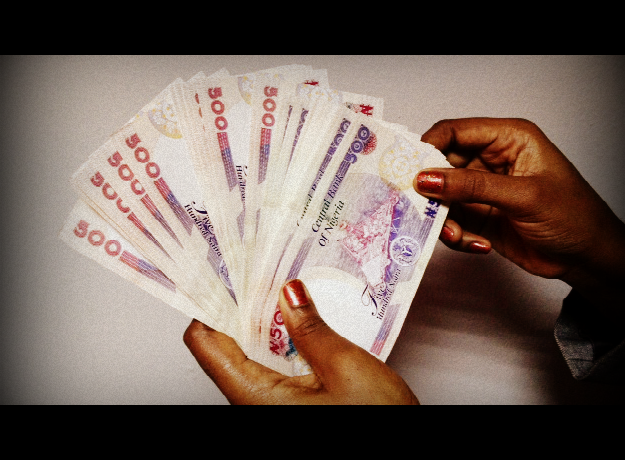
When I heard giggles behind me, I paused to view the effect of my words. Some people were snickering. My son was shuffling his feet and looking at the floor. My daughter was looking at me as if she didn’t know me. I forgave them instantly. What did they know about Nigeria besides the ogbono soup and poundo, which I regularly made while we lived abroad? And the objects of my wrath? One held a bag of fast food, the other, N500 bills, and an exchange was imminent.

Another attendant came to the counter, “Madam there’s no need to shout, if you want something, please just tell us.”

Anger left my mouth and lodged in my heart.

Days later, I saw a real queue in Shoprite at The Palms Mall, people waiting to buy bread. But a friend went to the corner and gave an attendant N200 to jump the queue. Holding his N200 loaf of bread, he winked at me and said, “This is how we do it.” As he sauntered to the till, he bumped into a trolley that crashed into an aisle, causing canned goods to tumble to the floor, while those on the queue shifted their weight, dodging rolling cans.

Is this how we do it?


©Timi Yeseibo 2014


Around the web: other perspectives

India: http://junaidkhalfay.wordpress.com/2014/01/29/indians-their-best/

Oh for the love of India: http://sunderv.wordpress.com/2014/03/07/the-ubiquitous-q-crashers/

Britain: http://prettyfeetpoptoe.com/2013/01/09/queuing-the-great-british-pastime/

Australia: http://infographiclist.com/2014/02/19/ever-lose-your-cool-in-a-queue-infographic-queue/

China: Hey! Can’t you see there’s a line here? Wait your turn! by Ryan Ulrich

http://www.globaltimes.cn/opinion/top-photo/2009-07/442510.html


Photo credits:

http://pixabay.com/en/bar-restaurant-feet-legs-people-238509/


Unauthorized use and/or duplication of this material without express and written permission from this blog’s author and/or owner is strictly prohibited. Excerpts and links may be used, provided that full and clear credit is given to Timi Yeseibo and livelytwist.wordpress.com with appropriate and specific direction to the original content.

Your Enemies Shall Never Succeed

Your enemies shall never succeed

“It’s a lie! Your enemies will never succeed!”

“So after the prayer meeting . . .”

“Yes?”

“I took the holy water to the office.”

Eh hen?”

“I didn’t take all. I poured some into La Casera bottle—”

“You washed it first—”

“No o! Is that bad?”

“Hmmm, it would have been better to sanctify it, but well, it is well.”

“So, I got to work very early, before people started coming . . .”

Eh hen?”

“I entered my oga’s office and I started sprinkling the holy water. Then his secretary came in—”

“Bloooood of Jesus! She saw you?”

“No. I quickly hid the bottle behind my back.”

“Good . . . good.”

“She asked me if I was looking for the leadership presentation printouts.”

“I said, ‘Yes.’ She told me to check the cabinet and left.”

“Thank God!”

“I continued sprinkling the holy water, on the desk, under the desk, on the chair, on the computer. I even sprinkled some on the pictures of his wife and children. When I finished, I started marching round the desk, then the secretary popped her head through the door—”

“Your enemies shall not succeed!”

“Amen!”

Eh hen, what did she want?”

“She asked me if I had found it. I said, ‘Not yet—’”

“And then?”

“She said she would help me.”

“The water?”

“She asked me what it was. I said, ‘Nothing. Just drinking water—’”

“Your enemies will never succeed!”

“She asked me why I’ve been pouring it around the office.”

“Jesus! Jeeesus! . . . What did you say?”

“I said I wasn’t pouring it. She said I was lying that she had been watching me on the CCTV”

“CCTV ke?”

“Yes!”

“So what did you do?”

“We started arguing.”

“Your enemies shall never ever succeed! Eh hen?”

“Then I got angry and stormed out—”

“The holy water?”

“I . . . I . . . I left it there . . .”

“Sh*t!”

“Anyway, when I stepped out of the office, I saw people gathered round her computer.”

“Who? The secretary?”

“Yes! Someone was saying, ‘Rewind, rewind . . . ’”

“What were they watching?”

Leave mata. I wanted to pass quietly. But she shouted, ‘Stop him!’ Then everybody looked up and started laughing.”

“Don’t worry; it is not the end of the world—”

“That’s what I thought. Until the security grabbed me—”

“What?”

“I tried to struggle—”

“Jesus!”

“The other one tackled me to the floor. Then my oga—”

“Your boss? Where did he come from?”

“I don’t know. He told me not to struggle. That I should respect myself and pack my things and leave.”

“Just like that?”

“Just like that. As I was packing, the security guards stood by me. They kept saying, ‘Oya hurry up!’”

“All hope is not lost. God works in mysterious ways. It is well.”

“As I was going to the lift, my oga was following me. He shouted, ‘Wait!’ So I turned.”

“Hmmm, what did he want again?”

“He said, ‘You are not the first and you will not be the last. My enemies shall never succeed!’ Then he pushed the holy water into my hands!”

“It’s a lie! Jesus!”

“What? What? . . . What is it?”

“Your enemies . . .  Osanobua! Your enemies, they have succeeded!”


©Timi Yeseibo 2014


Unauthorized use and/or duplication of this material without express and written permission from this blog’s author and/or owner is strictly prohibited. Excerpts and links may be used, provided that full and clear credit is given to Timi Yeseibo and livelytwist.wordpress.com with appropriate and specific direction to the original content.


Image credit: curtain vector: zcool.com.cn

font: Christopher Hand by El Stinger: http://www.dafont.com/christopherhand.font

font: Acid Label by Billy Argel: http://www.dafont.com/acid-label.font

design: ©Timi Yeseibo 2014

Urban Solitude: Eko o ni baje o!

Mainland Bridge Danfo

Hasn’t it always been this way? Isn’t this the drawback of metropolitan cities? That they teem with busy people who bury their conscience in the fortress that earphones and smartphones provide? Agitated people with tired eyes that look past others to admire the moving vision of success. Rush-hour people who hold their bodies tautly to avoid brushing against each other as if touch is an infectious disease.

Lagos is Nigeria’s biggest cultural melting point, a land of opportunity where I hope to make it big if I hustle right (not everyone returns to Nigeria with excess Pounds and Dollars). In spite of all the promise it holds, people warn that Lagos can be a dangerous place. I feel safe in our flat and the office, but the streets scare me, crowded as they are with worker ants motivated by the fear of poverty and beautiful homes on The Island.

At 04:45, my internal rooster crows and I use warm water to flush traces of sleep from my eyes. I leave our flat with my handbag and a waterproof bag that contains my office shoes, my feet in rubber slippers for the morning jostle on the streets.

“CMS, Lagos CMS, CMS!” the bus conductor’s call rouses the streets.

The driver whisks us away from The Mainland to The Island, where we’ll run laps chasing dreams, luck, and money. At CMS, Victoria Island beckons. Behind the bus stop, the ripples on the sea glitter like diamonds under the rising sun, while container ships dock at Apapa Port.

My jewellery lies scattered in crevices in my handbag. Unadorned with shiny objects, I am an unlikely target of pilferers. I hold my bag tight under my armpit as I board the bus to Victoria Island. I have not spoken to anyone since my journey began. My hair rests on the window and my eyes feast on luxury cars. One day, I will ride in one of them.

The day’s work is hard and my journey home long and silent. Small puffs of dust rise from where my flip-flops slap the earth. In five minutes, I will enter the haven of high walls and still warm air trapped between three-storey buildings that is our flat.

Ahead, a car burns slowly at first, and then with a feverish rush that epitomises the pulse of Lagos. I mean to walk past, but the fire is a magnet that draws others and me. I mean to just look and shrug and stand at the edge, as I am sure the others will do too, but this victim of sudden misfortune tugs at the heartstrings of calloused street people.

We pour water and sand alternately on the burning car. The fire mocks us; its flames lick our concerted effort. Commands fly left, right, and centre as raindrops escape from the sky. Unable to surmount the singleness of our vision, the fire sucks its last breath when a fire extinguisher emerges.

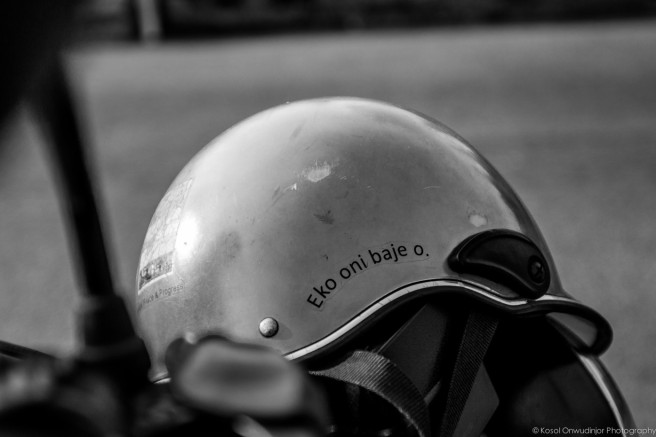
Smoke clouds shaped like ghosts sail across the sky. We, and our ghosts, our resurrected conscience, shout for joy. The rain plasters my hair to my skull and dripping water teases my ears. Eko o ni baje o, Eko o ni baje o, now, I believe the streets still hold promise.

protected helmet

When I open my bag in our flat, my purse is gone. Disappointment strikes blows at my gut as I calculate what I have lost. I embrace urban solitude, the definition that at first made me laugh because I thought it was relevant only in London.

“Don’t acknowledge fellow passengers or sustain eye contact beyond two seconds. Please respect urban solitude.”

And why not? On the streets a kind deed breeds mistrust that quickly turns to scorn. Asking for directions or providing them is a chore weighed with suspicion, and if death nearly claims a soul, the body that houses the soul stands no chance; it will be mangled in the stampede to “arrive” or survive.

This city bustles with life, yet there are fewer strangers to talk to. I long for human contact, not the obligatory type I receive when I walk into a shop, but the disarming type. The unexpected touch from a stranger whose smile meets my upward gaze as he hands me something that dropped from my bag, or the kinship in eye contact with a stranger, after a silly advert on a giant billboard has amused us both.

Eko o ni baje o!

©Timi Yeseibo 2014

Eko o ni baje: (Yoruba) Lagos will not spoil.

Read more about Lagos? These are snippets with photos worth seeing:

1. Yellow. Bright. Happy. Memories of Lagos:

KitchenButterfly memories of Lagos

http://www.kitchenbutterfly.com/2013/12/23/yellow-bright-happy-memories-of-lagos/

2. Eko The Musical

eko the musical@crea8ivenigeria

 http://www.creativenigeriaproject.com/ 

Credits

1. Beyond The Rules (Danfo on Lagos Bridge) by Kosol Owundinjor (Photo by Lagos)  http://photobylagos.wordpress.com/2012/11/08/beyond-the-rules/ 

2. Protected Helmet (eko oni baje helmet) by Kosol Onwudinjor (Photo by Lagos)  http://photobylagos.wordpress.com/2012/09/19/protected-helmet/

Unauthorized use and/or duplication of this material without express and written permission from this blog’s author and/or owner is strictly prohibited. Excerpts and links may be used, provided that full and clear credit is given to Timi Yeseibo and livelytwist.wordpress.com with appropriate and specific direction to the original content.

An Encounter with LASTMA

LASTMA

Like Mumbai, Moscow, and L.A., Lagos is well-known for traffic jams. The thorny maze of automobiles, motorcycles aka okada, and pedestrians, inspired the Lagos state government to create an agency to ease traffic congestion. Lagosians hailed LASTMA as innovative until LASTMA began contributing to the bottleneck.

“The fear of okada is the beginning of wisdom, and to avoid LASTMA is understanding,” said a friend, when I started driving in Lagos soon after my return. I had survived reverse parking into tight corners on narrow European streets, but here in Lagos, the challenge was different.

LASTMA
Acronym for Lagos State Traffic Management Authority

An initiative to reduce unemployment and sanitise Lagos roads. Commuters lament the actions of its officers, who are the “reason” for the growing number of ATM machines.

Do not confuse them with the:
Army (green uniform)
Police (black uniform)
Traffic wardens (orange and black uniform)
Theirs is a proud cream and maroon

They are not bad people but a reflection an endemic system.

Motto (of a few bad eggs): To bring insanity to Lagos traffic and lay ambush for mugus.

So, I drove very carefully. Too carefully, annoying Lagos drivers who attempted to terrorise me with their ear-splitting horns, dare-devil manoeuvres, condescending stares, and foul words as they overtook my snail-paced car.

Me? I refused to give them the satisfaction of looking at their faces when they pulled up to my car, moments before overtaking. I kept a straight face and commanded my neck not to turn. I could at least hold one ace, I could relish the silent knowledge that they may have won the battle, but I had won the war.

Once, at a junction, LASTMA officers caused commotion by waving go to adjacent lanes of traffic simultaneously. I drove a few meters and stopped in confusion. Maybe that was the mistake—stopping to make sense of chaos; pausing to take stock rather than forging ahead through the pandemonium. Seconds later, two officers headed my way. I apologised and explained that they had unwittingly caused the mayhem.

They insisted that I let the windows down. I was privy to this trick and refused. When they persisted, I relented and wound down a crack. The officer at the passenger-side window stuck his hand through the tiny space with the agility of a monkey and next thing I knew, he was sitting beside me.

Madam, park for side, you dey cause go-slow.”

I complied and the “usual” conversation followed.

My kids began to cry. My son asked, “Sir is our mum going to jail? Is she in trouble?”

I wished he had not spoken. How much is a child’s distress worth to a LASTMA officer?

Oya madam fast, do quick. See as you don make the children dey cry.” Poking his face in the space between the front seats, he said to my daughter, “Small girl, don’t cry. It’s okay.” Turning to my son whose cries were louder, “Tell your sister sorry. You’re a man, don’t cry.”

My son wailed, “I’m not yet a man.”

“Okay big boy, sssh, it’s okay.”

“I’m not a big boy, I’m only eight!”

Realising that conversing with my son was pointless, he turned to me. “Oya now, madam shake body, so you fit carry dem go Mr Biggs. E be like say dem dey hungry.”

I thought about many things but “settling” LASTMA was not one of them. I folded my arms for a long silent sit-in. With an exasperated hiss, officer one got out to engage in heated dialogue with officer two. I saw my chance and took it.

RAKING

The ability to bluff your way through anyone or anything that threatens you on the streets of Lagos.

Any dialogue that begins with, “Do you know who I am?” or in pidgin, “You no sabi me?” is raking.

A loud voice and threatening gesticulations add panache to the craft.

However, in cases of real emergency, access to a high- ranking military officer is a plus.

The next time I encountered LASTMA officers, my driver was negotiating a left turn on a road with no prohibiting signs. Two officers suddenly appeared.

They insisted that he wound down. I gave the driver a simple choice: your salary or the window, and secured his cooperation. They informed us that left turns are illegal. I welcomed the helpful information and the driver attempted to change direction.

They mounted a human roadblock. “Madam just tell am to wind down,” they threatened.

I assumed my best big man’s wife pose, squared my shoulders, and sat up higher. I was glad that for this all-important trip to Shoprite, I decked to the nines Naija-style with designer sunglasses to complete the look! But the officers didn’t budge. So, I pretended to call my imaginary military officer husband after all, power pass power. They backed off.

What is the purpose of LASTMA, to correct or to collect? I hope things have changed since I wrote this post a few years ago.

lagos state traffic laws

© Timi Yeseibo 2013

You may also like:

When in Trouble . . . Just Yell: http://ofilispeaks.com/when-in-trouble-just-yell/

LASTMA in the Eyes of the People: http://flairng.com/new/lastma-in-the-eyes-of-the-people/

Lagos the liquid wonder: http://bizzibodi.wordpress.com/2013/11/02/30-days-of-lagos-lagos-the-liquid-wonder-by-ferdinand-c-adimefe/

Photo credit: LASTMA website

Image URL: http://www.lastma.gov.ng/traffic_law.pdf

http://www.lastma.gov.ng/

Unauthorized use and/or duplication of this material without express and written permission from this blog’s author and/or owner is strictly prohibited. Excerpts and links may be used, provided that full and clear credit is given to Timi Yeseibo and livelytwist.wordpress.com with appropriate and specific direction to the original content.

The ‘Forgotten’ Groundnut Pyramids Of Nigeria

Kitchen Butterfly

I am not a party girl; I’m a food and talk girl. Informal dinners with friends and conversations that go on and on, and on and on, way past dessert and midnight… hmmm, that’s what this post reminds me of, and I’m filled with nostalgia, a bitter-sweet longing.

Okay, so I’ve just romanticised epa (Yoruba for peanut), but that’s what Kitchen Butterfly has done also—weaving tales about how Nigeria was, in between telling us how to boil groundnut. Word connoisseurs, and lovers of history, photography, fine food (groundnut), would enjoy this as much I did.

“The past may hold treasures, still remembered but the future is bound in hope, in belief and in the knowledge that with life, all things are possible.” Continue…  http://www.kitchenbutterfly.com/2013/08/08/the-forgotten-groundnut-pyramids-of-nigeria/

Photo credit: © Kitchen Butterfly

gingering your swagger without tears

Now that having some swagger has become as essential as having an education, Bellanchi’s tongue-in-cheek tips about how to step up your swagger, will perhaps leave your wallet intact but your sides aching. In his own words, “… Even I don’t agree with some of the irreverent stuff I write, but all in good fun.” Enjoy!

The Benevolent Dictator Theory

You’ve done it and I’ve done it too—huddled with friends and turned a debate on which way Nigeria into a prayer meeting. The kind of prayer meeting where one person declares, “Only God can save Nigeria!” and the others inwardly chorus amen. Weep no more; the Messiah we’re hoping for could be closer than we think…

Scribe of the Tword's avatarThe Chronicles of Chill

When people gather to discuss the future of Nigeria, the consensus is usually 2-pronged. The first is that the brand of democracy we have now clearly is not working. The second is that we are probably screwed if we don’t address our fundamental deficiencies. The third (yes, I know I said two) is that we need a benevolent dictator to set us right.

The mind that proposes a benevolent dictator has probably considered that  returning to military rule would not be a bad option, given how slowly we have moved since 1999. However, that is not a thought that we are allowed to entertain, as constitutional law jingoists insist on drumming it into our heads that “the worst civilian regime is better than the best military rule”.

I think we can agree that the evidence suggests to the contrary. The world’s oldest democracies are in the middle of economic…

View original post 552 more words

7 Annoying Things Nigerians do on airplanes

So, a friend tells me that on a recent flight from Lagos to Abuja, the pilot said, “We’ll be flying at 35,000 ft to Abuja. The weather is okay. Only light clouds, I will try and dodge them so there’s no shaking.” Is this the ninth annoying humorous thing Nigerians do on airplanes—employing Akpos’ brother to fly the plane? Hmmm….


jollof's avatarThe Crazy Nigerian

sleeping on planesLike me, I bet you’ve all run around with your bathing towels wrapped above your shoulders like a cape and pretended to be Superman (and if you haven’t then it’s never too late!). Ever since I was a little brat I wanted to take to the skies. Air travel is the next best thing and I’m always looking forward to having a glass plastic cup of ice-cold apple juice which always tastes better at 10,000 feet. What could possibly disrupt this moment of long-awaited bliss? Cue the Nigerians… On my recent return trip from New York alone I encountered 7 annoying things Nigerians did on the plane:

1. Securing beds…in Economy Class! There’s a game Nigerian passengers play whenever they’re on-board a semi-full airplane – It’s kind of similar to Musical Chairs…but without the music. Passengers snub the seats assigned to them and scout for a stretch of three to four empty…

View original post 778 more words

The Volume of Happiness

Nigerians are the happiest people in the world and you can measure the volume of our happiness. Now I know why people here stop and stare at me and my Naija friends—it isn’t because we are so fine! Oh no, we are Nigerians and we are loud.


ojogbon's avatarÒjògbón

Fans cheer on the Nigerian team during their World Cup qualifier soccer match against Algeria in Ora..You know, I have heard this thing over and again. That Nigerians are the happiest people on the planet. And I’m wondering, really? If it’s happiness that gives us some of the traits which are universally now synonymous with Nigerians, then I would recommend that we take some dose of chill-pill and please calm down! At least, a little!

First off, why do Nigerians shout so much?

I know you have all experienced this. You see an old friend whom you haven’t seen in a while and he screams, “MY GUYYYYY!!!!!! THIS GUYYYY!!!! HOW FAR NAAHHHH!!!!!” The first thing you want to do is, “ooohh..kkk??? what is this serious?” But being a Nigerian, you totally understand and you respond in this same high pitch, “AH! I DEY O!!! WETIN DEY HAPPEN???” Then you would have to endure a huge SLAP of a handshake which usually leaves your hand smarting and red!

View original post 690 more words

Something New in October

coming soon

I’m doing something different. I’m focusing on Naija life this October. Okay, don’t roll your eyes and go, “duh.” I know, I write about Nigeria, a lot! According to William Faulkner, a writer needs three things, experience, observation, and imagination, any two of which, at times any one of which, can supply the lack of the others. No apologies here, I’ve got Naija in my blood.

What’s different? I won’t be sharing my posts. I’ll reblog posts that made me laugh and cry and think, posts that mirror you and me and your neighbour and that man you’ve wondered about.

While you’re reading about Naija eccentricities, I’ll be back stage reading the novels that decorate my coffee table and writing a post for November. So, enjoy and remember to be as generous on the other blogs as you are on mine. Biko, share and leave a comment—they write their stuff because of you.

If you haven’t already, read Naija Movie Night, get a preview of what’s in store.


Take lemons & make life!

timi signature wordpress


Photo credit: Sepia Film Strip clip art- http://all-free-download.com/free-vector/vector-clip-art/sepia_film_strip_clip_art_23195.html

design: ©Timi Yeseibo 2013


Unauthorized use and/or duplication of this material without express and written permission from this blog’s author and/or owner is strictly prohibited. Excerpts and links may be used, provided that full and clear credit is given to Timi Yeseibo and livelytwist.wordpress.com with appropriate and specific direction to the original content.
Naija in My Blood

naija

A lot has been written about hazards such as driving in Lagos and on Nigerian roads. I do not mean to flog the issue, but it was this very thing that revealed some needed home truths.

You see, I am not one to allow my blood pressure levels rise over a little thing like another driver cutting into my lane without permission. The lack of simple courtesies that supply grease for smooth driving relations leaves me unruffled. Watching other tense drivers gripping their steering wheels for dear life as they struggle not to be outmaneuvered, provides witty relief from the unending traffic.

These hooligans—both the ones in black suits and the ones sooted from the ash heap of life—have shown me that aggression is the normal way of life here. The proximity of Lagos to the serene breeze from the Atlantic has done nothing to cool the pepper that burns in their veins.

On the roads, tempers edge dangerously close to boiling point, so, loud arguments and disputes settled with fistfights are not uncommon. No wonder I gave up eating pepper long ago, cucumber is more my style. But, I was soon to discover that the cherry does not fall far from the tree.

NAIJA

Nigeria, a place we all call home

Anger that constant simmering over decades of rape

Independence, a cherished hope; the impetus to rise again at 4 a.m.

Jaded after half    a century of promises unfulfilled

Affection, a feeling that continually binds us to the Motherland

Two weeks ago, my driver was going nose to nose with another vehicle. Normally, I would have cautioned him and asked him to yield to the yeye driver, but that day was different. Whether it was the roaring inflation or soaring unemployment, I cannot tell. It may have been the cumulative effect of bumping my head against the car window as my driver navigated one pothole-ridden street after another. Perhaps it was the sinking feeling that yet another con artist promising much and delivering little had swindled me. Whatever, I was tired of being a fool. My redundant aggressive genes surfaced. “Do not give him any chance,” I warned.

Both their countenances showed strong determination. A mad rush of blood had made the veins visible on their hands and temples, a sign that neither wanted to lose this race for survival. As my driver and I struggled to gain supremacy, he from behind the wheel, and me a cheerleading accomplice from the owner’s corner, the inevitable happened.

An ugly screeching sound rent the air as metal kissed metal. I had a taste of nauseating reality as the beat of the ancient talking drums in my head ceased. My driver jumped out, his rage fuelled by the sudden remembrance of his N5, 000 accident-free monthly bonus.

As he sparred with the other driver, I realized that their loud voices were a mere whisper in the buzz of a Lagos that never pauses. My car had finally been baptized with the telltale marks around the fender that speaks of a skirmish or two in traffic. After both drivers traded sufficient insults, they unanimously agreed that the scratches were not worth coming to blows over.

Rhetorical questions swirled in my mind as I tried to make sense of what had just happened. What was it that made my blood boil? How could I have Naijanized so fast?

Back home, my resourceful driver applied a little brake fluid to the scratches and the car looked almost as good as new. I guess it was a little insurance to secure his bonus. It reminded me of the shoddy patch jobs on our roads that are exposed by heavy rains. Yes, Lagos is getting greener on the outside, but true redemption must go beyond skin-deep.

As for me, years on foreign soil only camouflaged my leopard’s spots. The power of Naija, as the large billboards scream, can never be underestimated.

Pride Power Naija

Yeye: a derogatory term used for an annoying person, thing, or situation.

© Timi Yeseibo 2013

Photo credit: author- Darwinek
Title: Flag-map of Nigeria
Page URL: http://commons.wikimedia.org/wiki/File%3AFlag-map_of_Nigeria.svg
Image design: © Timi Yeseibo 2013

Photo credit: e.r.w.i.n. / Foter / CC BY-NC
Title: PRIDE POWER NAIJA
Original image URL: http://www.flickr.com/photos/eherrera/4950205845/
Unauthorized use and/or duplication of this material without express and written permission from this blog’s author and/or owner is strictly prohibited. Excerpts and links may be used, provided that full and clear credit is given to Timi Yeseibo and livelytwist.wordpress.com with appropriate and specific direction to the original content.

Happy Friday

Happy Friday

There is a man who stands at the entrance of the lift on the ground floor of your office building. He greets you with a broad smile as you approach the lift and lets you know that he has called the lift. “Oga, it is coming down,” he announces, as though looking at the numbers on the display changing in reverse order is a job for him alone.

He wears a pale blue shirt tucked into navy blue trousers with the seriousness of an employee on his first day at work. When he moves his cap slightly to scratch his head, you see that he is bald and his fingernails are long. You wince before you hear the sound and you are surprised that the sound is not as harsh as you expected. He taps his black baton, which hangs by his side, and you nearly forget that both of you have been waiting for a full sixty seconds.

In the lift, his shirt is not pale blue but faded blue, and the cracks which extend for a few millimetres from the buckle holes on his imitation leather belt, remind you of harmattan, of chapped lips in need of Vaseline.

“Oga, seven or ten?”

You are usually among the first to arrive at the office. Sometimes you get off on the seventh floor. Sometimes you get off on the tenth floor.

“Choose.”

“Ehn?”

“You choose the floor.”

His fingers hesitate at the control panel. “Ten sir. Ten, because the higher you go, de more money you go get.”

He smiles and some of the years roll off his face. You think of your late father and swallow a lump.

“Ten it is then.”

You no longer hold your breath when you ride with Joe. The smell of day-old perspiration has grown on you, just as the way his black shoes shine and reflect light, no longer fascinates you.

Joe clears his throat.

“Oga, today is Friday.”

“I know.”

You know because you woke up at 4 a.m. to complete the presentation for your meeting at ten. However, you can tell it is not the response Joe was expecting because he clears his throat again.

“Oga, happy Friday, sir.”

You think it is too early, but the weight of expectation that causes his words to land on your shoulders, the demands of communal responsibility that is thrust on you for earning a certain level of income, and the unspoken rules of this ritual, constrain you to respond.

“I’ll see you later.”

Joe clears his throat yet again. “Oga I will close early today.”

He has taken a gamble and he watches to see where the dice will roll. Only he does not let it stop. “It’s okay oga, I will wait.”

Your irritation vanishes.

“God bless you sir,” he calls as you walk out the lift.

When you close, he is there. On the ground floor. Saying, “Happy Friday,” to a colleague. He monitors you from the corner of his eyes, eyes that fill with indecision as you walk past. He must be aware of the foolishness of abandoning the fish in front of him, to dash and catch you. So he calls out, “Oga, abeg, I will soon finish!”

You almost laugh, in amusement, but check yourself. It is shameful that this culture dignifies begging and elevates it to an art form, complete with colloquialisms—How weekend sir? Anything for the boys sir? Oga we dey here o? Happy weekend, and so on.

An old man. A beggar. A corporate beggar. A beggar cushioned against the sun and the rain. A beggar in uniform. A professional beggar.

He catches up with you outside as you head for the car park.

Breathing hard, he declares, “Happy Friday sir!”

You hand over a couple of notes.

“God bless you sir! Your family will never suffer. Your wife will born plenty children, strong boys. Your children will become great ….”

You do not pay attention as you keep walking. What is his life like? What qualifications does he have? You turn to ask. But, Joe has resumed duty on the stairs leading to the entrance doors, his head bowed slightly and his hands outstretched.

You let your shoulders sag. “Happy Friday Joe,” you mumble, knowing that his praise-singing would have drowned out everything you intended to say.

In the car, before you turn on the ignition, you pull out a couple of notes from your wallet and leave them on the passenger seat. They are for Adamu and the others who man the security gate.


© Timi Yeseibo 2013


Photo credit: © Timi Yeseibo 2013


Unauthorized use and/or duplication of this material without express and written permission from this blog’s author and/or owner is strictly prohibited. Excerpts and links may be used, provided that full and clear credit is given to Timi Yeseibo and livelytwist.wordpress.com with appropriate and specific direction to the original content.


A trip to Kaduna

A walk down memory lane… Love for my country and other drugs! I like the way ‘Dare recollects his Service Year and captures the freedom and optimism we feel as we stand on the threshold of hope and possibilities. I think you’d like it too…


'Dare Akinwale's avatar'DARE AKINWALE

I want to take a trip. In my mind, to places in a city l left three years ago.

I want to visit that big compound at the end of the street where I lived, in Abakpa, where the ancient locomotive chugged loudly in the morning, as I walked out to buy breakfast.

My regular breakfast was kosi or akara. I always called it akara, because I thought kosi was too bland a word to capture the delicious essence of the hot spongy brown akara. I remember how the lady would serve it out of the hot oil and package my usual fifty or sixty naira worth of akara into old newspapers and nylon bags. I was a regular customer, and I had earned her respect because of my almost daily patronage. Sometimes, I was rewarded with some extra balls of akara, other days, I was offered koko or pap…

View original post 858 more words

What’s Wrong With This Picture?

City of Lagos

Nigeria is like a man with many wives who when not competing among themselves for his affection (read: oil wealth), sit together and complain about his lack of attention (read: dearth of infrastructure). I am married to Nigeria and this is my rant.

From time to time, I enjoy entertaining. Friends were coming over for a bite. Nothing fancy I was told, but I pulled out all the stops including the china and cutlery, which sit in their cartons gathering dust and only grace the table when I want to impress. Anyway, six hours later, I had a three-course meal fit for a king and no guests. What’s wrong with this picture?

Earlier, dark clouds warned of impending rain but since I was neither the bride nor the groom that had rented an open field for their wedding reception in the thick of rainy season, my only concern was for the temperature of the oil as I fried plantain. When, thunder and lightning announced the arrival of a torrential downpour, I shut my windows and began to wait.

It turned out that my guests were stuck in traffic caused by blocked drainage channels. With nowhere to go, the rain kissed the ground and its waters rose, higher and higher, turning the roads to knee-deep rivers. Their SUVs were no match for the floods. Maybe Toyota will seize first-mover advantages by developing a new type of hybrid for the Nigerian market—Toyota Transformer: part landcruiser, part speedboat. Then Nissan, Honda, Kia, and the rest will follow! Far-fetched? Hardly. Inverters flooded the market when investors rightly assessed the gap in the power sector. 

ojogbon.wordpress.com.rain-rain-go-away

Disappointed that my guests didn’t show, I decided to watch a movie on TV. That power supply disappears moments after the sky darkens, was not new to me. That I had to generate my power supply, did not take me by surprise. My inverter was humming quietly and my generator was on stand-by. However, thirty minutes into the movie, the TV went into a convulsion—white lines, static, beep-beep-beep, before sudden death.  What’s wrong with this picture?

The rain, which had slowed to a slight drizzle, changed its mind and metamorphosed into a full-fledged downpour once again. I increased the volume of the TV to drown out the tap-tap-tap of falling rain and snuggled into my wrappa as the room became cooler. But nobody told me; you forgot to warn me about this before I packed my bags and returned to Nigeria, that like oil and water, rain and cable TV do not mix! When it rains, cable TV loses connection to the signal!

tv

Rainy season equals more traffic jams and power outages, with attendant loss in manpower hours and business opportunities. Rainy season means more visits to the mechanic. Rainy season equals (avoidable) flooding which results in suffering for displaced persons. Rainy season means… need I continue?

So you see, I have come to dread rainy season because it is fraught with frustrations that make me rethink my move back to Nigeria.

It is easy to forget that rainy season has its advantages. Rain-fed agriculture increases the farmers’ prosperity, and rain provides water for domestic purposes in areas where running water is scarce. Also, during the rainy season, cooler temperatures bring some relief from the stifling heat.

Well, after another rain-induced frustration, my son asked about the duration of the rainy season. I said that rainy season begins in April and ends in October. He quickly did the math and sighed in disbelief and disappointment.

“Six whole months!” he cried.

I tried hard to sound convincing as I recounted the blessings of the rainy season. I explained that countries with diminishing water resources like Egypt, would welcome a lengthy rainy season, and scientists were experimenting with harnessing energy from raindrops. I told him tales about dancing in the rain, singing rain, rain, go away, but, he would not be won over.

He moped around like a solitary figure shrouded with disillusionment. 

“Six whole months,” he muttered almost inaudibly.

Hey, what’s wrong with this picture? Go figure!

© Timi Yeseibo 2013

Related links: Read Diekola Onaolapo’s Rain, rain…go away here

Photo credit:

The City of Lagos
Author: OOT, The official website of the Office of Transformation

Original image url: http://oot.lg.gov.ng/beta/?p=315

Flooded Street
Author: Diekola Onaolapo

Original image url: http://ojogbon.wordpress.com/2011/07/17/rain-rain-go-away/

Vectors from Microsoft

Unauthorized use and/or duplication of this material without express and written permission from this blog’s author and/or owner is strictly prohibited. Excerpts and links may be used, provided that full and clear credit is given to Timi Yeseibo and livelytwist.wordpress.com with appropriate and specific direction to the original content.