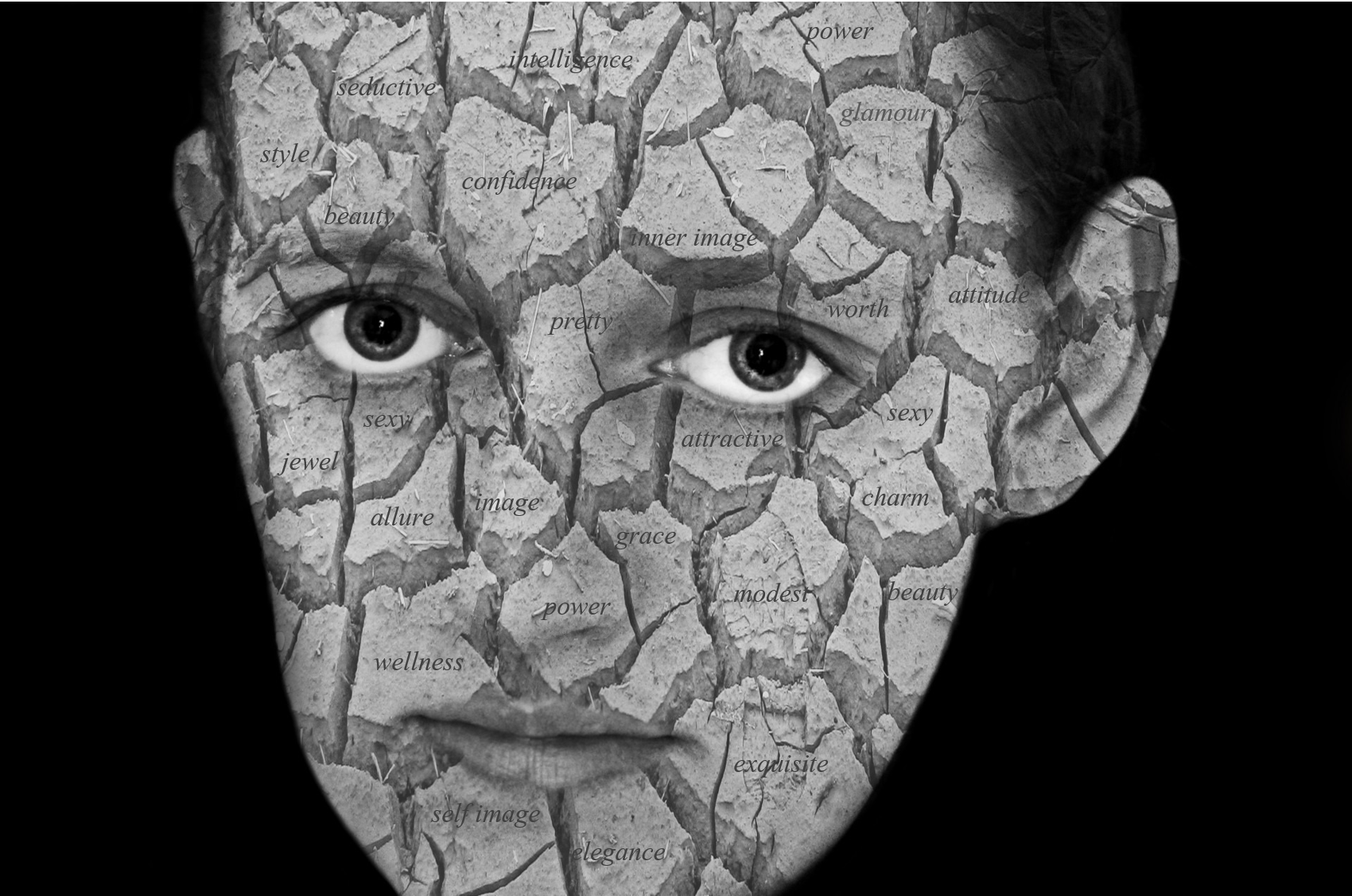
I am not What I Wear and Other Lies we Tell Ourselves

cracked face

“I want to be taken seriously dammit!”

Her skin is fair, her face, neck, and breasts, the same skin tone. If her blouse were cut any wider, her nipples would escape. Once, she told me with pride that she didn’t need a bra. I want to use my hands to verify, but I check this irrational impulse and listen to her instead.

“I mean who stumbles over cleavage, right? That’s just like . . .  soooo eighties!” She flicks her bangs and sucks her lemon ice tea, her every movement a pirouette in seduction.

“Right,” I reply, aware that almost every eye in the restaurant is on us, on her, as they have been ever since she walked in. Tall and lithe, like cat woman, could she be unaware of her magnetism? Or does her power lie in contrived innocence?

I let her lead, the conversation that is, but I don’t follow. If I say what I feel, she would think I’m like so eighties, anti-feminist, old–er, and sexually repressed by my sociocultural and religious background.

I let her lead, and then I come home and write this blog post.

***

 Whether you believe in evolution or creationism, gone are the days when humans roamed free and breeze cooled what hung bare for all to see. Fig leaves or animal skin no longer covers our “delicate” parts. Along the way, we discovered clothes, which define standards of decency in public. If you walk naked on the streets, people might consider you mad, and little children might giggle.

Imagine . . .

Nine o’ clock, Monday morning, you walk into the building and approach the counter. A man sporting dreadlocks, a cut-off denim vest, and three gold chains with huge dollar-sign pendants, rises to greet you.

“Good morning, how may I help you today?”

You shake his outstretched hand and look around the room: off-white walls, ficus plants at the corner, black straight-back reception chairs, display screens, ATMs, and the revolving door behind you.

“Sorry, I thought . . . where . . . is this the bank?”

You visit your doctor for a routine exam. An assistant ushers you in. The doctor has her back to you. When she turns, her wavy black hair bounces. Her smile is pleasant as she motions for you to take a seat. Your eyes fasten on her cleavage; the V of her blouse would make the Kaghan valley in Pakistan weep in envy.

“Is something wrong?” she asks politely.

“No,” you say as you swallow and drag your eyes to her face.

“How are you doing today?”

“Fine. But, I . . . I’m here to see the doctor.”

At the office, you hit your keyboard with the gentle force of your ideas. When your colleague stops over and says hi, you reply without taking your eyes off the monitor. He walks a few paces closer, so you look at him.

“Was there something I could help—”

You cannot complete your question because you are nearly eye level with his white boxers. Your eyes travel up past the narrow line of hair around his navel, which fans out like a bush on his chest. You spare a glimpse for his biceps before you take in the black bow tie on his neck. When you meet his eyes, his voice sounds distant. You have not been listening.

“I hope will you be done with your report on time. I need to put everything together for the presentation.” He turns and walks away.

Your yes response carries no conviction because you are staring at his boxers, the bit of fabric trapped in the crack of his buttocks.

Why are clothes important? Why do you wear what you wear?

Girls, we’ve come a loooong way! We’ve leaped from the bedroom to the boardroom, made sandwiches in the kitchen and laws in parliaments. We’ve flown beyond prep school all the way to Outer Space and signed cheques for weighty sums in our name too. But what more did my great, great, great, great, great-grandmother fight for? To see me strut almost naked on the red carpet, while my beau stands by my side fully clothed in a tux? Where is equality? Why isn’t he as naked as I am?

While the V’s on our dresses reach our navel and our hemlines tease our bums, men objectify us, fully clothed, they gawk at us, only human, they ogle “with style”. We are progressing regressing to an upscale version of cave woman.  It won’t be long before we’ll be swaying down the streets our breasts running free. We’ll hi-five each other in our Victoria Secret fig-leaves tong, “Power to you girl; we’ve come a long way baby!”

And the men? They’ll be walking down the streets too, savouring women’s liberation, hailing women’s empowerment, fully clothed of course.

© Timi Yeseibo 2013

Photo credit: Pixabay.com

Original image URL: http://pixabay.com/en/cracked-cracks-face-people-woman-164310/

Photo tags: Cracked Cracks Face People Woman Female Portrait

Unauthorized use and/or duplication of this material without express and written permission from this blog’s author and/or owner is strictly prohibited. Excerpts and links may be used, provided that full and clear credit is given to Timi Yeseibo and livelytwist.wordpress.com with appropriate and specific direction to the original content.

Bini Girl, Italy for Better Life: Revisiting Human Smuggling

Benin girl with leopard

It doesn’t matter what you say, it doesn’t matter how you say it. When I look at your face, I know. I know the years have not been kind to you.

I remember the rejoicing that followed your impending departure all those years ago. Poverty is cruel. Greed is crueller. It makes a man sell his daughter into prostitution and celebrate. The merriment that heralds your return surpasses the one that followed your father’s trek to Western Union in the beginning.

Siwo, siwo.        Siwo!

Wokhin?           Ọyemwen nor.

Urhuẹse, Baba o!

Urhuẹse Ijesu mwen!

Urhuẹse, urhuẹse,

Urhuẹse, Baba o!

Their celebration is valid for at one time, they did not expect your return. When the news of your neighbour’s daughter’s death reached iye a few years after you left, she clutched iye Osaretin’s blouse as though by so doing, the fear in her eyes would be transferred to iye Osaretin’s heart and not lodge itself in her own.

Osa sinmwin ovbimwen, ghẹ giẹ wu,” your mother cried.

It was your roommate who told us you had travelled on business. What business could keep you silent for two years they questioned, as if they did not know? As if the money they expected you to send to build your father a house in Upper Sakponba, would be earned in one place. As if they had not heard that competition was fierce. As if baba had not visited the shrine and iye gone for mass, three times a day, when news about Benin girls disappearing in Italy first broke out.

When they finally heard your voice, although iye’s relief was tangible, it did not override her scolding.

“Enough! Come home. Come back. I want to see you again before I die.”

But you could not. You were mortgaged up to the hair on your pubic regions and she knew it.

People said your mum became crazy after that. She carried on like a full-clothed mad woman, lips moving, sounds trapped. But when I stood close to her, I heard her praying for all of us, “Holy Mary, mother of God, pray for us sinners, now and at the hour of our death.” I chorused, amen, in my mind so I would not startle her out of her self-imposed dementia.

Seven years later, having fulfilled your obligations to all, you are free. I do not imagine the bed sheets were pretty pink or the mattresses soft. I cannot believe you are the same—your mind had to have taken a blow many times over.

I do not want your money. I am not proud. But I cannot receive money that you earned while losing your dignity. It would be a bigger crime than the one I committed when they sold you.

I was nineteen then, an object of shame, an ungrateful daughter, because I preferred to study, finish school, get a job, and then support my family. Your mother helped with my school fees. I know you didn’t know. Now you know why I stayed away from my home and why I was always in yours. To my family, I was a corpse, not much to look at, and I stank to Heaven.

That was why I was surprised iye acquiesced to your leaving to do work. That day, I opened my mouth, but her eyes said, “No, hold your peace.” Blackmail is not always explicit and my desire to escape from Benin through education was so strong. My silence was my crime.

And now you say, “It was my choice!” stamping your foot as if truth can enter the cement floor where we are standing.

What does a sixteen year old know about choice? How can you make a choice if there are no options —at least options that you know about? How could you make a choice when I who knew, who could show you how to say no or run away, kept quiet. And when you mingled the blood that flowed from the tiny incision on your hand with theirs, and drank from the calabash, your lack of choice was sealed.

I am glad that you are back. I never stopped chorusing amen to iye’s inaudible prayer, even after I moved to Lagos. I passed by your house in GRA on my way into town. Your younger brother, Lucky, insisted on showing it to me, pride filled his voice, filled the car, he did not hear me when I said, I had seen enough. So, I shook him as he inched the car nearer the gate. Bewilderment covered his face until he remembered I am a corpse, I stink to Heaven, and corpses don’t applaud.

Please don’t leave the money on the table, don’t insult me that way. If your money can erase your past, I would take it. Smile for everyone else. Let the gap in your front teeth show how strong you are. But now we are alone, forgive me and cry with me because in the thick of the night, I hear your tender cries, as I always did, even when distance separated us.

Notes:

1.             Any resemblance of the characters to persons living or dead is coincidental. This is a work of fiction.

2.             According to the Photographer’s Statement on socialdocumentary.net,

“The term trafficking of persons is restricted to instances where people are deceived, threatened, or coerced into situations of exploitation, including prostitution. This contrasts with human smuggling, in which a migrant purchases services to circumvent immigration restrictions, but is not a victim of deception or exploitation.”

View Pablo Patrizi’s documentary photography on the issue here.

3.            For more information, watch AlJazeera’s twenty-five-minute documentary, People & Power-The Nigerian Connection II . While I do not endorse the video in its entirety, it touches on some of the relevant issues.

4.            Read, The Girls from Benin City, The New Slave Trade from Nigeria to the Streets of Italy, a book from an insider about human trafficking/smuggling.

© Timi Yeseibo 2013

Photo credit: Girl with Leopard, plaque from Nigeria, Court of Benin, Edo people, c. 1600, bronze or brass, De Young Museum by Wmpearl (Own work) [CC0], via Wikimedia Commons.  http://commons.wikimedia.org/wiki/File%3A’Girl_with_Leopard’%2C_plaque_from_Nigeria%2C_Court_of_Benin%2C_c._1600.JPG


Unauthorized use and/or duplication of this material without express and written permission from this blog’s author and/or owner is strictly prohibited. Excerpts and links may be used, provided that full and clear credit is given to Timi Yeseibo and livelytwist.wordpress.com with appropriate and specific direction to the original content.