A Space Too Little Explored [2] No Scorecards

no scorecard

Every man is trying to either live up to his father’s expectations or make up for his father’s mistakes.

No Scorecards

My father married my mother after the death of his first wife. That marriage produced a son I would know as my senior brother later in life. My father and mother moved to Lagos from his village in Yenegoa around the late 1930’s. They lost their first son, who would have been my elder brother.

My father joined the army and participated in the second world war of 1939 to 1945. I was born around the beginning of the war. After he came back from the war in 1945, I came to know him as my father. My two junior sisters were born in quick succession. Arrangements were made for me to attend primary school. My left arm was raised over my head to see if it could touch my right ear to determine my readiness for school.

Sometime later, we moved to my father’s village. There, my father built a house for my mother and her children. He did not live with us. He married another woman and from that point on, he neglected my mother. She moved to her village with my sisters because she could not accept the situation. Since I was in school and my father was paying my fees, I could not leave with my mother. I stayed with my grandmother, who cared for me. During the holidays, I went to the farm with her and I went hunting with an uncle.

After a few years, my father said he could no longer pay my school fees, so I left his village where I lived with my grandmother and went to live with my mother. During this period, my uncle who worked at UAC in Burutu requested someone to assist him at his home. I was chosen as the only suitable candidate. However, once I arrived Burutu, he left me with his mistress who was a trader. I again attended school and went to her shop in the market after school. My uncle spent weekends with her, which were the only times I saw him.

He moved from Burutu to Sapele and then to Warri because of his job, and his mistress and I moved with him. When I gained admission to Government College Ughelli, my uncle said he could not afford my tuition. His mistress, who had now become his wife, persuaded him to continue paying. He did. However, when I reached class 3, he stopped. I looked for sponsors to no avail. I wrote the resident, as governors where then called, in Warri intimating him of my plight. Although I did not receive a reply from him, the school asked me to return. That was how I completed my schooling in 1958 without paying any further fees.

Is every man trying to either live up to his father’s expectations or make up for his father’s mistakes?

So much time has elapsed that it is not now easy to put in proper perspective what my reactions were at the time and how they may have affected decisions I have had to make subsequently. I did not see my father after I left home. My uncle with whom I spent most of my adolescent years was a disciplinarian who was not easy to please. He was relieved when I finished school and did not hesitate to mention that my training up to that point was the legacy he was bequeathing to me.

In those days, not educating a girl child was normal. So a father’s decision not to send his son to school was regarded as his business and not subject to any misgivings. Polygamy features in Nigerian society, even today.

Against this backdrop, I want to accept that those who raised me, particularly my uncle, did their best. Because we lived in close-knit communities, role models were not difficult to find. In the twilight of my life, I am not keeping any scorecard. From a young age, I meant to take my destiny in my hands. The challenges I faced served as vehicles en route my destination.

At the time my wife and I had children, it was the vogue for parents to train their children to whatever level they could attain. We were reasonably well-off and ensured our daughters received a good education. Although I do not see numbered dotted lines linking the trajectory of my life as in a colouring book, perhaps, subconsciously, for I do not remember thinking this way, I was trying to do better than my father had done. Posterity will tell.


Aeneas carried his aged father on his back from the ruins of Troy, and so do we all whether we like it or not, perhaps even if we have never known them. – Angela Carter.


A.C. Yeseibo is a retired banker. He makes his home in Port Harcourt with his wife and enjoys spending time with his children and grandchildren.

P.s. I am honoured to share my blog stage with my dad. Years ago, he wrote me a letter that has frayed at the ends and torn at the fold. Reading and rereading the letter through the years, his writing style became my own.


©Timi Yeseibo 2016

Unauthorized use and/or duplication of this material without express and written permission from this blog’s author and/or owner is strictly prohibited. Excerpts and links may be used, provided that full and clear credit is given to Timi Yeseibo and livelytwist.wordpress.com with appropriate and specific direction to the original content.

A Space Too Little Explored [1] When I’m Gone

When I'm gone

Every man is trying to either live up to his father’s expectations or make up for his father’s mistakes.

When I’m Gone

My father was not what my kids refer to as the African dad. By that, I mean he knocked before entering the room I shared with my older brother when we were growing up and he never opened any letters addressed to my siblings or me. He took us out to play football regularly. My father said please before he sent us on errands and thank you when we returned. He called me, young man and all of this made me feel respected.

He was a disciplinarian who stuck to his words. While playing football in the living room one day, I broke a glass frame. He calmly said, “You will not be going with us on the trip tomorrow,” referring to the family trip to Yankari Game Reserve, Bagauda Lake, and Tiga Dam, which I had looked forward to for weeks. Because of his summary judgements, which we could not appeal, we jokingly called him commander-in-chief-with-immediate-effect.

The memories of his many when I’m gone sayings eclipse all others. One time, my mother said, “You keep going on about, when I’m gone, when I’m gone, are you very keen to die?” But so focused was he that he did not relent. He replied, “You all will remember everything I said when I’m gone.” There it was again, another when I’m gone saying! He was right. As I prepared to leave my previous job, a colleague told me, “I will miss you, but I will miss the stories about your dad even more.” I was surprised, as I could not recall saying that much about my dad.

I realize now that my father was not obsessed with death; he cared deeply about his legacy. Like a good leader, he was raising successors to advance what he believed in. At every opportunity, he passed on the baton of leadership.

I do not recall my dad ever calling in sick; he worked hard all the time. I am the same way. Although I have always had jobs I enjoy and never experience Monday morning blues, I wonder if I am just being me or if I inherited his work ethic. Is work my way of saying watch me daddy, I’m being just like you?

I am running my section of the relay race. Sometimes doubts crowd my lane. My father always seemed to know what to do or say in a situation. Am I being a well of wisdom my children can drink from? Am I still holding the baton or have I let it slip as I race through life? I hope my children see me the way I saw my dad. I desire to pass the baton to them too.

Reacting to my pragmatism about life especially material things, my wife once said, “You are just like your dad.” She compared me to a father-in-law she had never met. Like my colleague, she had seen him come alive in the stories I had unconsciously woven into the fabric of my life. It remains the best (unintended) compliment I have ever received.

William Shakespeare said, “All the world’s a stage, and all the men and women merely players: they have their exits and their entrances; and one man in his time plays many parts, his acts being seven ages.” My father has never left my stage. He has been there all along.

Before he passed on, dad gave us the words he wanted inscribed on his headstone: Here lies M O O, who in his own life, tried to serve humanity and make a part of the world a better place. I pray my family says the same about me, when I’m gone.

Ayo Ogunsanlu makes his home in Essex, UK with his wife and three kids. He enjoys microbiology, running, and housework. On Facebook, he describes himself as a faithful and loyal friend.


©Timi Yeseibo 2016

Unauthorized use and/or duplication of this material without express and written permission from this blog’s author and/or owner is strictly prohibited. Excerpts and links may be used, provided that full and clear credit is given to Timi Yeseibo and livelytwist.wordpress.com with appropriate and specific direction to the original content.

In The Spirit of Love

In the spirit of love, I’m sharing one of my older posts, a crowd favourite, which elicits a smile or laugh from me whenever I reread. I hope you’ll enjoy it (again), as much as I do.

I am Not Looking For Love, I am Going to Work

It began yesterday at the government office, which was saturated with immigrants whose anxious stares alternated between the digital display boards and their tickets, a square piece of paper with a number printed on it. At the sound of the beep, everyone looked at their ticket, and then the display boards. Some sighed. Some continued talking. Others continued sleeping. One person rose to meet an official walled in by glass on the other side of the counter.

My wait was shortened by an acquaintance with whom I chatted until our conversation lulled to a comfortable stop.

“Excuse me, it seems you are from Nigeria.” A tall man sitting a few spaces away from my acquaintance smiled at her.

“No, I am not.”

“Ah, but I thought—”

“I am from Democratic Republic of Congo.”

With her thick Igbo accent, she delivered her last words with a finality that inspired no argument from the man. He fanned himself, and then pretended to read his letter from the belastingdienst.

Because I am slow to change the expression on my face, she saw it. The disbelief. The wonder. The perplexity.

“Don’t mind the idiot. If not for dis yeye tax people, where e for come see me? See as e dey talk as if e be my mate. E nor see im type?” she whispered for my benefit and his.

I nodded like her co-conspirator, as though I had been dissing guys for the last ten years. What else could I do?

Continue here …


A Man Like You and Me

dad

It’s only when you grow up and step back from him–or leave him for your own home–it’s only then that you can measure his greatness and fully appreciate it.
– Margaret Truman –


Becoming Dad

Ha, mo de ma’ngbe e jo gan o . . .” my father replied, after some silence; his voice strained with regret.

His eyes were misty and distant as the words fell from his mouth a second time, “Ha and I used to dance with you in my arms a lot.”

I had just asked my father why he never played with me when I was growing up. It was a warm Tuesday morning and the sun’s glow outlined the Welsh mountains. We scoffed a lovely breakfast at The Melting Pot, my wife’s café. While resting our food, we talked about the meaningfulness of things done and left undone. The mood felt safe enough for me to explore territory I should have outgrown but which sometimes dragged me back to youthful despair, hence my question.

You see, he was visiting my family again after several years. We spent more time together during this visit than we’d ever done before. In recent years, we’d begun to discuss matters, from the deep and trivial to personal and philosophical. Each subsequent discussion stretched us, not apart, but closer, as we better understood one another’s worlds.

He leaned forward in his seat and explained that he had no such upbringing or peer influence. Moreover, he was usually away because of work. He reassured me that he loved me, but given his background, he’d only danced and played with me in my very early years. We were both sad that he had neither seen nor met what had been a big need for me.

I am now a proud father of two wonderful children. Ours is a joyful story of love and affection expressed through banter, wrestling, singing, cuddling, debates, work, travel, and discipline.

However, as a young married man I had angst about having children though I relished the prospect. I wanted to be the beautiful father I had carefully conceived, but there was no one to walk me down that road. Because I’d heard that hurt people hurt people and you can become the worst of what you hate, I feared that I would wreck my children.

I studied and I prayed. A major answer came through friendship with our pastors Rob and Sue. The intimacy they shared with their kids freaked me out at first, but I soon realised it was what I longed for. My wounds began to heal as they mentored my wife and me.

I believe every man has a wound or two that may hamper his display of love or calcify his heart towards his children. I also believe each man has enough desire, courage, and capacity to love his children and show it in edifying ways that buoy them into robust futures.

I’m still on the road to becoming a beautiful dad. However, I’m confident that my children are not archiving questions they plan to ask me when they are forty-four and I’m visiting!

Later that evening, my father watched me battle my children on the carpet for what seemed an eternity to him. He exclaimed with delight, “Ha, joo, ma se awon omo yen l’ese o! Please, don’t injure those children o!”

My children and I are enjoying the life my father couldn’t have with me. He treasures our lives because he is part of the reason I found a happy intervention and started a different story.

OluFemi Ogunbanwo lives in North Wales with his wife Margaret and 2 kids aged 21 and 15. He is a Pastor, Family Mediator, and Parenting Coach.


Seeing Dad Through Daddy Eyes

My best time with my dad was when I was about eight or nine. Dad was always the disciplinarian. He gets a bad rap in my memory, which is unfairly coloured by that one attribute, except when I focus on this period of my life.

Several defining incidents jump to mind. First was when I told Dad that our dog, Ricky, was run over by a car. My strong, Nigerian, macho dad turned to mush. He was visibly upset and I thought he would cry. I witnessed a sensitivity that I had never seen before.

My fascination with science started early. Dad got me a chemistry set and I had fun with it. I also spent many hours shoving dad’s tester into live sockets for the fun of seeing the light come on. I tried to create my own lamp once; armed with bulb, bulb holder, electric cable, and plug obtained from Dad’s supplies drawer. I put it all together but since I hadn’t learnt about proper wiring, I ended up with a mini explosion rather than a lit bulb when I plugged in my contraption. My ingenuity was rewarded with a tanned bottom.

I remember riding my Chopper bicycle with stabilizers down our crescent-shaped driveway, which ran for about 100 metres linking the entry and exit gates of our house. One day, Dad decided the stabilizers were coming off. He came close, real close, supporting my bike and me, running down the driveway with me, and then suddenly letting go. I went through a mixture of emotions: enjoying his tenderness yet embarrassed at being the focus of attention. I was afraid of disappointing him if I fell, but I relished the adrenaline-fuelled exhilaration of riding unsupported with the wind in my face. I was riding! I was riding!

As I grew older, I felt Dad should have done more, been more loving, paid more attention to me, disciplined me less, and better prepared me for life ahead. So I withdrew from him and moved forward, leaning on myself.

I realise now that even though he looked so big and mature then, he was younger than I am now. A man with five kids in his early forties, he held a mid-management government job. He clawed his way out of poverty with a technical school qualification to insulate his own family from every trace of his earlier life in a polygamous home. He never experienced the love of a father yet he displayed more than he’d ever received.

Have I done better with my son and daughters even though I started out with much more? Would I have done half as much as Dad did if life served me with what he was given?

Faced with my own pressures, my son is being relegated in my thoughts, more often than I’d like to admit, to a day in future when I will have time to be the dad I swore I would be. Remembering my youth brings home the truth that life is only lived in the present.

Dad, I have come to appreciate you more than I did back then. Thank you for giving me more love than you ever received. I hope I honour your legacy by doing the same with my kids.

Carlton Williams lives in Lagos with his wife Anita and has four children. His life mission, expressed in Christian ministry and business, is to help people discover and demonstrate their God-given magnificence. 


Photo Credit: Wokandapix/ https://pixabay.com/en/dad-father-tie-father-s-day-798086/


Unauthorized use and/or duplication of this material without express and written permission from this blog’s author and/or owner is strictly prohibited. Excerpts and links may be used, provided that full and clear credit is given to Timi Yeseibo and livelytwist.wordpress.com with appropriate and specific direction to the original content.


Marinochka by Samuel Okopi

marinochka1

Lace

Faded pink

Rose-embossed writing paper

The scent of Old Spice

Handwritten love-letters before email & Google

Postcards and postage stamps

That’s what Samuel Okopi’s story reminds me of. And he’s clever too with personification, making me wonder if “Shostakovich” is a chair or a person. From Russia with love, what say you?


I am sad these days, Luke. Shostakovich doesn’t smile anymore. His hands are always cold. On the harsh nights when I snuggle into his embrace, warmth does not find me. Only a matching cold. Maybe it is because the night winds blowing from Nicolayevskaya into my little apartment here in Krasnoyarsk have become colder. The large familiar shadows cast by our samovar set have now shrunk to that of the wooden figure of St. Stolobensky, standing on the dining table. Maybe I feel sad because he was Zoya’s favourite saint. But the orange flames that float on the candles at night are as bright as they have always been. Maybe they want Shostakovich and me to be happy? Like forget the memory of the weird laughter of Zoya that scared us and amused us at the same time? I am sorry Luke for the silence. Really sorry. Continue here . . .


Image Credits:

Antique Jewel Box Victorian Pearls Lace Old Silver by JamesDeMers

http://pixabay.com/en/antique-jewel-box-victorian-pearls-72414/

Mutual ExChange

I laughed while reading this post, which without trying too hard, examines the nuances in the way men and women process ideas and think about relationships. I hope you will too.

naija rookie's avatarNigerian Newcomer

We are driving back from the movies. This is our third time together.
The talk is usually sparse, peppered with jokes, and ending with an ‘I had fun, we should do it again’. So we do it again.
Today the air feels different. The movie, a long drama ending with the sad unexpected death of the main character, has triggered something because we shared that experience.

About fifteen minutes into the drive, she cracks open. She says:
“You know what I am scared of? I am afraid of making the wrong decision especially when it comes to relationships. I see couples, some are happy and some are not. And I wonder, how do you know when to fight for something and when to give up on it?”

She takes a deep breath and continues:
“Even the simpler decision, whether to open up to someone or be friends with them, each…

View original post 397 more words

A Long Way Gone: Introspection and Tears

a long way gone

The photo on the cover—a boy on a dirt trail, hair uncombed, mortar cartridge behind his neck, and a gun with a bayonet hanging from his shoulders drew me to Ishmael Beah’s book. The green flip-flop on his right foot, useless and slanting in the wrong direction, a testament of happier times, sealed my fate. Reading the blurb was a formality as was thumbing Steve Job’s biography, which I had intended to buy in the first place.

I paid for the book and went home.

I read the book through one heart-wrenching weekend, stopping occasionally for the weight of sorrow to lift. It did not.

Beah tells his story, in my view, without an agenda or an axe to grind. It is as though he says, “This is my story. Jump to conclusions if you want. Ask questions if you care.” He narrates about his experience as a boy soldier in Sierra Leone, a boy flung into the throes of a war that consumes his family.

His memory is photographic, capturing detail in a way that helps you journey with him. The picture of him wandering in the forest haunts me still.

I walked for two days straight without sleeping. I stopped only at streams to drink water. I felt as if somebody was after me. Often, my shadow would scare me and cause me to run for miles. Everything felt awkwardly brutal. Even the air seemed to want to attack me and break my neck. I knew I was hungry, but I didn’t have the appetite to eat or the strength to find food. I had passed through burnt villages where dead bodies of men, women, and children of all ages were scattered like leaves on the ground after a storm. Their eyes still showed fear, as if death hadn’t freed them from the madness that continued to unfold. I had seen heads cut off by machetes, smashed by cement bricks, and rivers filled with so much blood that the water had ceased flowing. Each time my mind replayed these scenes, I increased my pace. Sometimes I closed my eyes hard to avoid thinking, but the eye of my mind refused to be closed and continued to plague me with images. My body twitched with fear, and I became dizzy. I could see the leaves on the trees swaying, but I couldn’t feel the wind.1

Reading this book almost upended my theology. Why do bad things happen to innocent people? If God is real and good, why doesn’t he stop it? What about ethnic cleansing and genocide in the Bible?

I have not found intellectually satisfying answers. I do not need them to believe, I only need them for debate.

After I closed the book, it took many days for sadness to leave me.

Is war like the Terminator movie? Does the good guy leave the epic fighting scene—usually a dark warehouse with chainsaws, spikes, naked wires, and bottles—limping into the light with the beautiful woman he rescued clinging to his arm, while we cheer and wait for them to kiss?

No.

I recall a scene from Machine Gun Preacher, where an orphan boy tells his story to Sam Childers, which unlocks my tears afresh.

I remember my parents in my sleep. My father was big like you. They shot him. The rebels told me, “If I do not kill my mother, they would shoot my brother and me.” And so, I killed my mother. If we allow ourselves to be full of hate, then they’ve won. We must not let them take our hearts2.

War leaves casualties as J.P. Clark describes in his poem, The Casualties3 (selected lines below).

The casualties are not only those who are dead;
They are well out of it.
The casualties are not only those who are wounded,
Though they await burial by instalment.

The casualties are not only those who started
A fire and now cannot put it out. Thousands
Are burning that had no say in the matter.

The casualties are many, and a good number well
Outside the scenes of ravage and wreck;
They are the wandering minstrels who, beating on
The drums of the human heart, draw the world
Into a dance with rites it does not know

We fall,
All casualties of the war
Because we cannot hear each other speak,
Because eyes have ceased to see the face from the crowd,
Because whether we know or
Do not know the extent of wrong on all sides
We are characters now other than before
The war began,

I have many questions, fewer answers, but I am at peace in the world as long as I do not let them take my heart.


©Timi Yeseibo 2014


1. Ishmael Beah, A Long way Gone, Memoirs of a Boy Soldier (New York: Sarah Crichton Books/Farrar, Straus and Giroux, 2007), 49.
http://www.alongwaygone.com

2. Machine Gun Preacher Movie.
http://www.machinegunpreacher.org/

3. J.P. Clark, The Casualties, Poems of Black Africa, ed. Soyinka Wole (London: Heinemann/AWS, 1975), 112.


Unauthorized use and/or duplication of this material without express and written permission from this blog’s author and/or owner is strictly prohibited. Excerpts and links may be used, provided that full and clear credit is given to Timi Yeseibo and livelytwist.wordpress.com with appropriate and specific direction to the original content.

Six is Just a Number

six is just a number

“Six?”

“Sweetheart, what’s wrong?”

“Oh my God, six!”

“I . . . I—”

“So six men have entered your pants! What kind of girl are you?”

“What do you mean? I don’t sleep around . . . I was in a relationship with all of them—”

“See the mouth you use to say ‘I don’t sleep around?’ What do you call f**king six guys? Ehn?”

“Hmmm.”

“You are quiet now abi? Answer me?”

“Look, I told you I didn’t want us to divulge this kind of information about our past—”

“So, you wanted to pretend I was the second ehn?”

“This is ridiculous! You knew I wasn’t a virgin when you married me?”

“Six? Haba six?”

“Stop shaking your head and treating me like a slut. What about you?”

“I’m a man o! You hear me I’m a man!”

“What about your younger sister?”

“Don’t you dare bring my sister into this discussion! We’re talking about you!”

“Double standards . . .”

“What did you say?”

“Nothing. Where are you going?”

“I’m coming.”

***

Oya start writing.”

“What?”

“The names of the guys!”

“You can’t be serious! No way!”

“Ha! I’ve never been more serious. I need to understand what I got myself into.”

“You must be joking!”

“I’m not.”

“Where’s your list?”

“Here. I’ve written mine.”

“Hisssss! Wonders will never end. I’m not interested!”

“Okay, It’s on the table. Any time you’re interested, you can look. I’m waiting.”

“I’m going to bed jo. I can’t stand your childishness anymore.”

“Nobody will sleep in this house until you write the list!”

“Is that a threat?”

“I didn’t go to law school, you can call it what you want.”

“And if I don’t? Are you going to beat it out of me?”

“I have never laid hands on a woman, and I will not start today. But you will pack your bags and go to your parent’s house tonight.”

“Hissss!”

***

“What’s all that noise? What do you think you are doing?”

“Helping you pack.”

“What?”

“You may want to consider changing from your nightie. I will soon call a cab.”

“You are crazy! Put my things back!”

“No. I will call your dad and tell him to expect you.”

“What demon has possessed you? What’s wrong with you?”

“Write.”

“Sit down, ehn. Let’s talk about this.”

“I don’t have anything left to say.”

“Sweetheart, have I ever been unfaithful to you? Have I ever given you a reason to doubt me? Haaa . . . Say something . . .”

“I don’t have anything to say.”

“Sweetheart—”

“Don’t touch me!”

“Baby, what’s really wrong? I love you. You’re the only man for me. I love you.”

***

“The cab is downstairs.”

“Seriously, you called a cab? Did you call my dad?”

“Not yet, but I will.”

“Hmmm. Tell the cab to go.”

“No. You go.”

“Six is just a number . . .”

“I disagree.”

“Where’s the paper? Okay, give me the pen.”

***

“Before I give you this paper, let me just say something. Don’t do this to us; things will never be the same between us after this . . .”

“Kola Shonekan? Number three, which Kola Shonekan?”

“He’s a lawyer I went out with when I was in law school—”

“Where does he live?”

“I don’t know; he used to live in Lekki.”

“He has an MBA from Wharton?”

“How did you know?”

“Jesus! You banged my boss!”

“Kola is your boss? He works for Accenture—”

“He’s my boss’s boss boss. He’s the head of legal!”

“It was a long time ago. We were almost engaged—”

“Which Kassim is this?”

“Isn’t his surname there?”

“Rufai’s younger brother—”

“You know Rufai?”

“How could you? That’s cradle snatching! He’s a small boy!”

“I’m tired of this your interrogation. You wanted list, I gave you list! I’m going to bed!”

“Kassim! Kai, I’m finished!”

***

“Where do you think you’re going?”

“To the guest room, so I can have some peace.”

“Kassim . . . Kassim that we used to send to buy Small Stout for us . . .”

“Get out! Leave me in peace! Do you hear me? I said, ‘Leave me in peace!’”

“How could you? Okay, just answer me, how could you?”

“He was nineteen, I was twenty-three; we were in love. Since when has that become a crime?”

“I’m disappointed in you!”

“Are you done now? Can I get some sleep now?”

“Yes. I leave you to your conscience.”

***

“What now? What time is it?”

“Wake up, wake up!”

“It’s not yet morning?”

“It’s 4:30. I thought you said there were six?”

“You’ve started again?”

“There are only five names?”

“The sixth one doesn’t count.”

“It does to me.”

“Well since you already have my sexual map . . . His name was Richard Morgan.”

“A white guy?”

“Yes?”

“So, this is what you went to London to do in the name of school? You were banging white guys enh?”

“I’ve had enough of your insults! For your information, he was my classmate. I was studying at his place. He made a move. I knew if I didn’t give in he’d rape me, so—”

“But what were you doing at his place so late?”

“You don’t get it do you? I was at his place in the morning! Anyway, you don’t need to worry about him being your boss’s boss boss boss! He’s dead!”

“Dead?”

“Yes! Complications of HIV, last year.”

“AIDS? My God! Oh my God! I’m finished!”

©Timi Yeseibo 2014

Unauthorized use and/or duplication of this material without express and written permission from this blog’s author and/or owner is strictly prohibited. Excerpts and links may be used, provided that full and clear credit is given to Timi Yeseibo and livelytwist.wordpress.com with appropriate and specific direction to the original content.
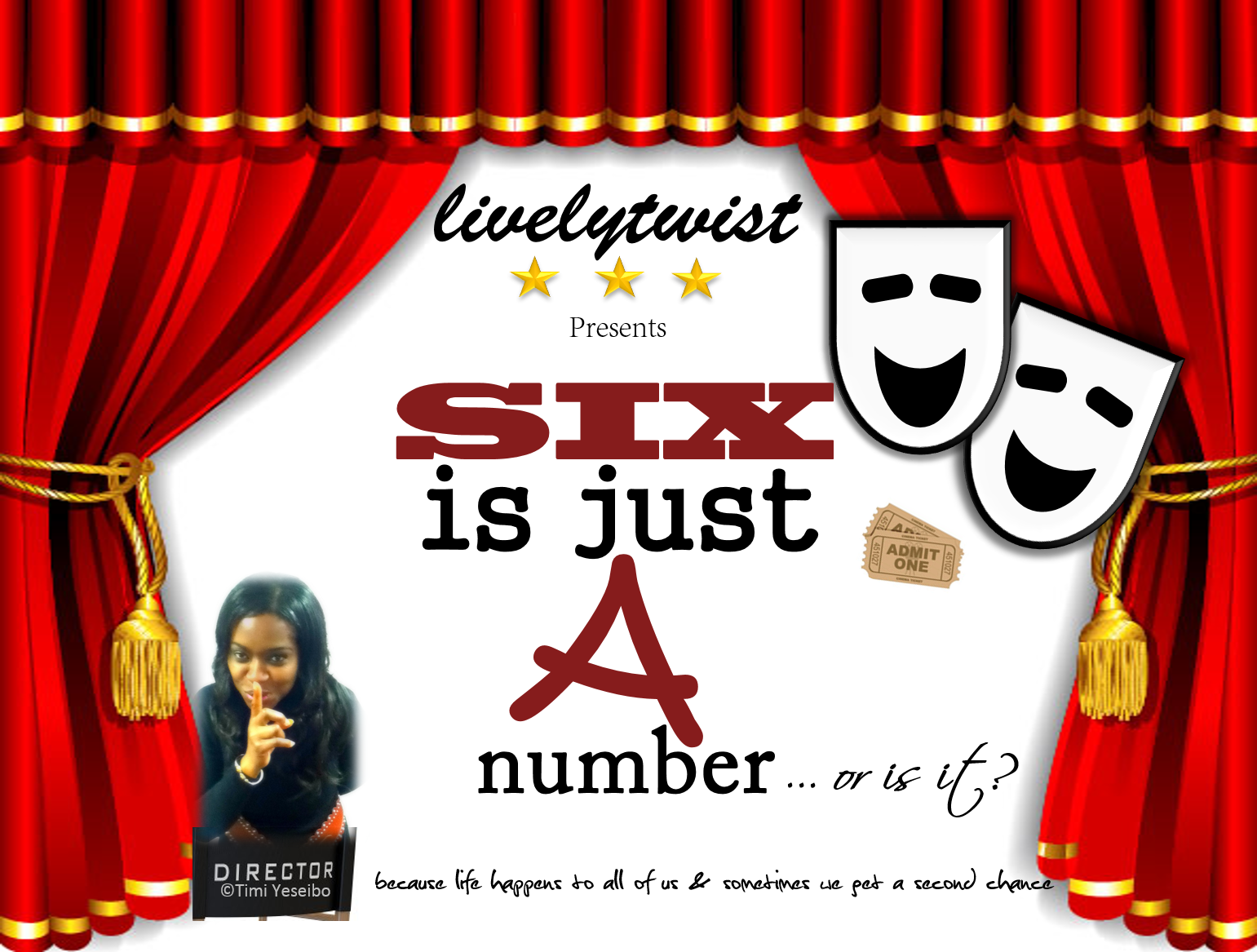
Image credit: curtain vector: zcool.com.cn

font: Scriptina by Apostrophe: http://pedroreina.net/apostrophiclab/0158-Scriptina/scriptina.html

font: Christopher Hand by El Stinger: http://www.dafont.com/christopherhand.font

design: ©Timi Yeseibo 2014

Happy New Love

An indiscretion. A small indiscretion.  A secret voiced. She buried her face in her hands. Then mustered courage to dial again. Things had started to go downhill after that night with Nengi.

“Who are you chatting with? What’s so funny?”

She had shown her the chat. That’s what friends do.

chat

Nengi and Soba giggled like little girls playing house.

“You like him?”

“Oh, he’s just a friend. We’ve been friends like forever–”

“But you like him?”

“Never really thought about it. Yeah . . . I think he likes me too.”

They giggled like little girls playing house. They had moved on to other important things like purple lipstick, Ankara tops, and fast food.

And then Nengi had told Ebiere. And Ebiere had told Ibinabo. And Ibinabo had told Sotonye. And Sotonye had told Miebi. And Miebi had told George. Like a Chinese whisper, by the time the story reached Karibi, she did not recognise the monster they had created.

“So you’re seeing someone else?”

Fear squeezed her heart as Karibi towered over her, three days later. His apartment had two rooms and no place to hide.

“No, you’ve got it all wrong.”

He whipped her with his words. Like a koboko, they left bruises in their wake. When he paused, they reverberated from the walls and lashed her from head to toe again.

Explanations followed. Mollifications came next. She stroked his ego until he purred. Then she brushed it, until it shone brighter than a brass plaque.

“I want you to cut off all contact with him.”

“Wh . . . what?”

“Three people can’t sleep on the same bed. I’ve never been comfortable with your closeness with  . . .”

“Dayo.”

“Whatever.”

Her wedding was three months away. Her friendship with Dayo had spanned twenty of her twenty-six years. The enormity of the files she would erase did not escape her. Her first bully. Her first Voltron, defender of her universe and her honour. Her first bicycle ride. Her first crush. Her first kiss. Her first relationship expert. Her first cigarette. Her first driving lesson. Her first interview. Her first job. Deleted.

Her marriage showed promise in the beginning before the accusations and jealous fits. He responded that way to her questions about his late nights, alcohol, and phone calls he would not answer in her presence. Then along came her baby girl and peace at last, peace brokered by her forbearance.

She was still in her pyjamas when war broke out. Every day, his rage churned like magma waiting to erupt. Two and a half years later, one black eye later, she closed the door quietly on that chapter of her life.

But fate is a wheel that seeks to make amends. Time is a bridge that links the dots of our lives. Nengi brought the news two days ago.

“You’ll never believe who I ran into today . . . Dayo!”

She was braiding Asikiya’s hair.

“Mummy, it’s too tight.”

She applied some hair lotion to the spot, “Better?”

“Soba, Soba, are you listening to me?”

“Yes I am. Please pass the beads.”

“Here, take. He looked sooo good and he’s doing well.”

She talked about school fees, house rent, and office politics, but Nengi wouldn’t let up.

“Do you want his number? No? Okay, his card is on the table.”

“Throw it in the bin.”

“What?”

“Throw it in the bin.”

After two days of wondering if Dayo had asked about her, if he wore a wedding ring, if, if, if, she dug in the bin through banana peel, slimy cereal, hair extensions, and day-old amala, to solve the riddle of her sleepless nights.

Would he forgive her four-year silence? He’d once told her that she was the only one who could listen to his silence—silent road trips to nowhere that she had not endured but enjoyed. However, her silence had been cruel. She had turned off the light and ripped the socket from the wall.

0-8-0-3-4-5-5-5-0-4

“Hello?”

Her heat beat so fast she thought her ears would explode.

“Hello?”

“Soba . . . Soba, is that you?”

She began to weep.

***

Dedicated to you.

Because your heart was broken. Because we ate popcorn and cried as we watched Dear John, and cheered as we watched Diary of a Mad Black Woman. Because even though we said good riddance to bad rubbish, your heart betrayed you with longing. Because at night you groped for a touch that you forgot was no longer there and when you remembered, you circled your pillow instead.

To all those who loved but had to let go of love, Happy New Love.

***

While we’re all in top gear shooting for the moon and beyond this new year, I’m mindful that our relationships can trip us on the way. Healthy relationships whether platonic or romantic, are a solid base for take-off, don’t you agree?

©Timi Yeseibo 2014

Design: ©Timi Yeseibo 2014

Unauthorized use and/or duplication of this material without express and written permission from this blog’s author and/or owner is strictly prohibited. Excerpts and links may be used, provided that full and clear credit is given to Timi Yeseibo and livelytwist.wordpress.com with appropriate and specific direction to the original content.

Grief: When Words are not Enough

grief

I am a strong woman and I let my tears fall as often as they like. However, when I pull up in front of his house, I repair my eye make-up and then smile twice to drive sadness away. Tears are not welcome here, I remind myself as I get out of the car.

I let myself in and grief meets me in the hallway. The post lies in a scattered pile on the doormat. Blue envelopes, white envelopes, shiny envelopes, and magazines and periodicals, he does not read. I sort them in three groups: the urgent I place on the console table, the trivial I put in the drawer underneath, where he keeps his car keys, and the rest, the magazines, periodicals, and shiny envelopes, I dump in the dustbin, in the kitchen.

Here, grief is loud coaxing me to chide. I clear dirty plates, a half-empty sardine tin, and stale bread in the semi-darkness.

In the living room, the curtains say no to the sun. The light from ESPN’s classic football on TV illuminates his form. Grief is quiet inviting me to converse. Grief is still but I am not one to fill the silence as if I am a child colouring with impatient hands that cannot stay within the lines. It has been two days since he heard the news.

When pain overwhelmed my reasoning, my sister sat beside me, squeezed my shoulders, and remained quiet. When disappointment visited me on a Monday morning, my cousin sat beside me, a box of tissues separating us. She hunched her shoulders in sync with mine, let me cry, and kept quiet. When I exhaled the last bit of hope in my heart, a friend sat beside me, numb we stared at CNN, and then he kept silent vigil as I channel surfed.

So, I sit on the settee, careful to maintain distance. I sit until my nose attunes to the smell of day-old perspiration and until I can breathe in the stuffy air circulating in the room. Grief is hypnotic calling me to sleep. I sit until I awake. His head lies heavy on my lap. My skirt is damp and the soft sounds are not from the TV. They are from a man beaten by life, his hopes shred by the finality of death.

“My father, my father, oh my father.”

Grief feels like roulette. Sometimes touch is enough. Sometimes presence is enough. I know he knows that if we pull open the curtains, sunlight will burst through and in the night, the moon will give us light. But right now, words are unnecessary. This is the first time I have observed a man cry.

I have only ever seen two men cry. The first time must have lasted less than five minutes. Ten years passed before I saw another man cry. Perhaps it is because this occurrence is rare that each time I glimpsed a man’s vulnerability, I loved him more.

If we show our weakness, we may lose the ground we have secured and the advantages it conferred, but if we don’t show that we are weak sometimes, we may lose much more. We may lose the opportunity for others to love us for our humanity.

I wonder, at what age does a boy “man up” and decide to stop crying?

© Timi Yeseibo 2013

Photo credit: Pixabay

Original image URL: http://pixabay.com/en/candles-tealights-soft-209157/

http://pixabay.com/en/clapping-hands-shadow-poor-light-189171/

Unauthorized use and/or duplication of this material without express and written permission from this blog’s author and/or owner is strictly prohibited. Excerpts and links may be used, provided that full and clear credit is given to Timi Yeseibo and livelytwist.wordpress.com with appropriate and specific direction to the original content.

The Measure of a Man

sorry

An apology that never came changed her view of life.

Bode and Chinyere met on WordPress. While working on his master’s thesis, Bode wrote retrospectively about the 2008 Financial Crisis when financial institutions fell like a deck of cards, one after another. The simple way he explained complex economic theories and the poetry he used to assign blame, in stanzas, inspired Chinyere to follow his blog. At the end of each blog post, he posed questions that drew comments from her. In responding to her comments, he stoked a friendship as though he was tending to embers in the fireplace.

When he wrote that post she didn’t agree with, she thought it best to send a private email. What started in public, mushroomed in private. Forty-four emails later, she knew his favourite food, sushi, the movie he never tired of watching, Schindler’s List, and that both his parents were professors. As they tangoed near the perimeters of their deepening friendship, she moved from being his favourite reader to his dear friend. The first time he referred to her as darling, she danced in tandem, placing a one-eyebrow-raised smiley next to the word sweetheart in her reply.

She imagined what darling would sound like if he said it; she envisioned a baritone, like her boss’s, whom she secretly admired. She felt safe in Nigeria, eleven hours away, from her Toronto sweetheart, Bode, whose handsome face smiled at her whenever she read his blog.

One Saturday, their email exchange, interspersed with LOLs and smileys, over the wonders of touch screen and autocorrect spelling, spanned the evening and spilled into the night. Joking about a political scandal that involved an elder statesman and nude photos of his beautiful mistress, he wrote, “I bet you’ve got a body to die for like hers.”

The half-smile, still on her face from their previous exchange, died and her lips closed into a straight line. Scrolling through the email thread, she searched desperately for it—that email or reply from her that gave him the nerve. She searched again. And again. Finally, she slept with a frown on her face, questions etched on her brow.

She did not reply the next day. Or the day after. She immersed herself in work like a zombie, neither feeling nor caring. How could he have written that? What had she done to encourage him? On the fourth day, he emailed. He had pined for her reply; he had grabbed his phone every time it beeped and driven his professor mad with error-strewn work. He guessed the joke had rubbed her the wrong way, but was it now a crime to joke with a dear friend? He was sorry even though he didn’t know what he was sorry for.

She read his email several times. He had written it in the same simple way he explained complex economic theories, using poetry to assign blame, in stanzas. But, it lacked the sincerity upon which people build great friendships. Two days it was before she fashioned a reply. Discarding the word sweetheart, she wrote:

Dear Bode,

Your joke was in bad taste. I have since evaluated the sixty-three emails we exchanged, and can find no reason why you would share a joke like that with me. Btw, I read your recent post and I agree that the bailout of banks by national governments should be a temporary measure only; it should not be the cure-all. I will share more on your blog later today.

His reply was swift. She had wondered if it would come. She had considered that the curtain had fallen on a friendship that spanned four months and she had already started mourning. Clutching her phone, hope fluttered in her heart and unsteadied her hands.

Dear Chinyere,

I am sorry. What I wrote was inappropriate and lacking better judgement. I offended you and I am sorry. If you can forgive me, I would like to continue being a friend.

That was not the reply she received; it is the one she wished she had. After two weeks, she knew his reply would never come. As weeks turned into months, she left fewer and fewer comments on his blog. She liked to think that his not responding to her comments did not influence her decision to stop altogether.

Today when Chinyere measures a man, she does not take into account the school where he acquired his MBA or the features that make him attractive. German or Japanese, his car keys hold no lure. It is his apology; the quality of his apology is the measure of a man.

© Timi Yeseibo 2013

Photo credit: primenerd / Foter.com / CC BY-NC-SA

Original image URL: http://www.flickr.com/photos/hiroic/8521967145/

Title: Stranger Nº 5/100 – Robbel

Unauthorized use and/or duplication of this material without express and written permission from this blog’s author and/or owner is strictly prohibited. Excerpts and links may be used, provided that full and clear credit is given to Timi Yeseibo and livelytwist.wordpress.com with appropriate and specific direction to the original content.

No Longer a Piece of Meat

Suya by KitchenButterfly

Theirs is a spacious car park unprotected from the glare of the sun and the noisy wind that ushers autumn in. Hers is the silver-grey Toyota Aygo, that ubiquitous city-car that cushions Europeans from the perils of economic recession, road tax, fuel costs, and ah yes, carbon emissions. His is the black Mercedes, that German beast that roars.

Having never seen him before, she wants to say hi, and make small talk, for the benefit of their mutual skin colour, if only for a few moments, so they can put up high walls against the cold and enjoy the warmth of solidarity.

Instead, she walks past him, and quickens her steps, the koi-koi of her heels, lost in the now harsh whispers of the wind, her mind replaying images she had thought long forgotten.

She is ten again and in the country club with her mother, in front of her soon-to-be swimming instructor, who took in her thin frame, and let his eyes linger, then wander, and then linger on the small mounds on her chest, which strained against her one-piece suit.

Her mother followed his gaze. What was supposed to be a conversation about swimming timetable, changed to a conversation about swimming lessons ending. The uneasy feeling that followed her relief and disappointment, which she could not define, she submerged in that room in children’s heads that they do not like to visit. Years later when she understood the term, dirty old man, she remembered the way he had moved his bushy eyebrows up and down in quick succession, as first her mother turned and then she turned to leave.

That thing that was in her swimming instructor’s eyes, she now sees in his. His eyes, they reduce her to a piece of meat. They touch her the same way that women and men haggling over meat in Lagos markets grab the meat from the wooden tables, slap the meat on the wooden tables, and push the meat on the wooden tables, wooden tables with fissures that are smooth with age and vegetable green at the edges.

Reflex causes her to tug at her skirt, to pinch the fabric in front of her thighs and try to drag it down, as though she can turn her mini skirt to maxi, as though her legs are not encased in black tights and boots.

His eyes drill holes in her back. She nearly misses her step. His laughter is low, but to her ears it is as loud as those of the traders who called her Shabba, and tried to grab her hands as she shopped at Tejuosho market long ago, wearing a long skirt with a thigh-high slit.

All the way to the traffic light where they encounter one another again, she thinks of his greedy eyes, his hungry smile, the shape of his gorimapa head, and the shiny darkness of his skin. She divides Africa into four: east Africa, south Africa, north Africa, and west Africa; he resembles her, but she cannot decide where he belongs.

She pulls up slowly beside his Mercedes and stiffens her neck. She wills herself not to look at him. But she does. You see, the force of his gaze, and everything intangible that had transpired between them is like a horse’s bit. His handsome features do not captivate her. His smile does not captivate her.

It is his left hand. The way he raises his shoulder and bends his elbow so his fingers rest on the steering wheel in the 12 ‘o clock position—that unmistakeable way Naija boys with new money driving new cars with shiny alloy wheels, hold the steering wheel—that is what captivates her.

So now, she knows where he belongs.

She begins to laugh and laugh and laugh some more as his brows furrow in consternation. She continues laughing as the traffic light turns green, and he speeds off. She laughs as the cars behind her pull out into the other lane and the drivers stare at her and shake their heads, before they zoom past. She laughs until the traffic light turns red. Then she stops. She is no longer a piece of meat.


Postscript

Chaos defines her Mondays, but the chaos lights her fire and adds purpose to her steps. The only thing that halts her fall is her desk, which is behind her. She feels its edge cutting into her thighs as she stumbles backwards for safety and support. Her gaze meets his and holds while they shake hands. When Ben gestures to another employee and whisks him away, Ben’s words hit home. With vast experience in mergers and acquisitions, he comes highly recommended from J.P. Morgan. He is her new manager.


© Timi Yeseibo 2013

If you loved the photo of the suya as much as my post or more than my post (how dare you?), if you miss suya and live where you can’t buy it, if you’re adventurous, if… if …, whatever, okay, read Kitchen Butterfly’s post about suya.

Photo credit: © Kitchen Butterfly

Original photo URL: http://www.kitchenbutterfly.com/2010/07/15/how-to-make-nigerian-suya/

Unauthorized use and/or duplication of this material without express and written permission from this blog’s author and/or owner is strictly prohibited. Excerpts and links may be used, provided that full and clear credit is given to Timi Yeseibo and livelytwist.wordpress.com with appropriate and specific direction to the original content.

Running in the Airport

well designed signage

I came to your house out of a sense of duty. Although I told you I was late, you brought me a plate of beans, fried plantain, and chicken stew. While you shouted Sade’s name, and looked for change so she could buy cold coke from mama Kunle, I quickly made a phone call to Sista Kemi:

“Sista, e ma binu, I can’t eat it. You know I’m travelling—”

“Femi, just try. You are like a son to her.”

“Anything else. I will drop 50k for her instead of 25—”

“After everything I’ve done for you ….”

With those six words, Sista Kemi sealed my fate. I did not refuse a second helping of your beans because you cooked it with a little sugar and plenty onions. My big sister had slaved to send me to school in the U.S., so, I ate after I protested and you laughed.

I finally boarded my flight at 9:30 p.m. and dozed off shortly after take-off. I woke up to the smell of coffee and croissants, which I munched hungrily before we began our descent.

At Schiphol, jet-lagged passengers sprawled out on the black metal seats in a small lounge. Drawn like a magnet, I sat beside a striking lady with a small afro who was shaking her phone, tapping her phone, assembling her phone, and disassembling her phone.

“Hello, let me help?”

“Oh, do you know what to do? It fell and it won’t start—”

And just like that, we moved on to talk about our lives, our work, and our passion. My flight to Maryland was four hours away. Her flight to New Jersey was three hours away.

Her eyes glowed as she talked about the non-profit where she worked. Just then, the contents of my stomach lurched. I stylishly shifted and sat on only one bum. This attempt at bowel control thrust me forward, and I hoped she did not think I was trying to get a better view of what lay beneath her V neckline. I bit my lip and silently commanded my tummy to settle. I don’t know whether she paused or I imagined it. But I carried on talking.

“My company encourages employees to get involved in community service by giving donations to worthy causes and staff bonuses for participation. I see a win-win here.”

“Really?”

“Yes,” I replied, crossing my legs and shifting my weight to my other bum to stem the tide. I leaned backward. Her V neckline was high, not that I would have seen anything if it was plunging, for thoughts of white porcelain toilet bowls beclouded my vision.

I masked my pain by contorting my face in concentration. Her voice sounded farther and farther away, as if she was at one end of a tunnel and I was at the other end, stooping and shitting. Now and again, I scanned the lounge for the toilet icons, pretending to observe the passengers who were dragging luggage and crowding the seats. Then I returned my gaze to her face and flashed what I hoped was a charming smile. I don’t know whether she paused or I imagined it. But she carried on talking.

“So, let’s make it happen. How can we take this to the next level?”

“I need the toilet.”

“What?”

“Nothing. What did you say?” I blinked several times, and then moved so that both cheeks of my bum were in full contact with the seat. Now that the word toilet had escaped from my mouth, the pressure on my rectum doubled. I pushed my chest forward, the way I used to as a lanky teenager, and prayed that the noise in the lounge had muffled my words.

She frowned and watched me.

My anus took the heat.

“Okay go.”

“What?”

“Go to the toilet,” she said calmly, pointing the way.

He that is down, need fear no fall. I chucked mortification away, buried it in the recesses of my mind, and tried not to run. As soon as I turned the corner, I picked up speed.

Five men queued outside the toilet. I eyed the vacant women’s toilet. Dare I? I asked a cleaner if there was another toilet nearby.

“Downstairs, turn left, after about fifty metres.”

I started to go when I saw a young girl pushing an elderly lady in a wheelchair purposefully. I followed the trajectory of her eyes and changed my course. Nearing the doors of freedom, I saw the cleaner and began to limp.

I hit the toilet seat just in time. And finished after pushing twice. But I sat there. Because I heard the commotion at the door. The real disabled people were waiting and wondering aloud. Shame, hot and sharp, overtook my relief. Oh, the smell was one thing, but I was too embarrassed to “limp” out of the toilet.

As I moved my feet to alleviate the pins and needles, I heard directions being given. Then the voices receded.  Satisfied, I opened the door slowly and looked in either direction. Although no one was there, I felt compelled to limp.

“Are you all right?” Miss Afro looked alarmed as I approached.

“Yes,” I corrected my limp, pushed my chest out, and walked tall.

“No, I mean your tummy?”

“Fine.”

Humiliation covered me the way caramel sauce covers ice cream, slowly, gradually, until I could not meet her eyes. But I sat like a real man, legs ajar and arms resting lightly on my thighs.

“Please write your number?” She dropped her card on the magazine which lay between us.

I patted my shirt pocket and shook my head. She frowned as she brought a silver fountain pen from her bag. When I finished writing, I handed her the card. She didn’t take it. Instead she used her white hanky to snatch her pen.

“Femi right?” she said as she stood, “why don’t you call me?  It’s been a pleasure meeting you. I have to board.” She ignored my hand.

I smelled myself after she left. What was I sniffing for? Body odour? Beans? Shit?

I looked at her card. Busayo. What if I married her? What if you came to visit? What if you cooked beans, fried plantain, and chicken stew? What if I ate it? What if I went to the toilet twice at night? Would she tell me to face the wall while she slept with her back towards me at the edge of her side of the bed, like a lone matchstick in a giant matchbox, stiff like a bag of cement?

Nonsense! I tore the card to small pieces. Who cares about corporate social responsibility and employee participation in meaningful community development projects? I tore the small pieces to even smaller pieces, hurled it in the trash, as I limped to the disabled toilet for the fourth time that morning.

And now, you are calling me at 3 a.m. local time, asking why I am not yet married. Aunty e jo!


© Timi Yeseibo 2013


Photo credit: rhodes / Foter / CC BY-SA


Original image URL: http://www.flickr.com/photos/rhodes/2181258/


Title: well designed signage


Unauthorized use and/or duplication of this material without express and written permission from this blog’s author and/or owner is strictly prohibited. Excerpts and links may be used, provided that full and clear credit is given to Timi Yeseibo and livelytwist.wordpress.com with appropriate and specific direction to the original content.

I am Not Looking For Love, I am Going to Work

not looking for love
It began yesterday at the government office, which was saturated with immigrants whose anxious stares alternated between the digital display boards and their tickets, a square piece of paper with a number printed on it. At the sound of the beep, everyone looked at their ticket, and then the display boards. Some sighed. Some continued talking. Others continued sleeping. One person rose to meet an official walled in by glass on the other side of the counter.

My wait was shortened by an acquaintance with whom I chatted until our conversation lulled to a comfortable stop.

“Excuse me, it seems you are from Nigeria.” A tall man sitting a few spaces away from my acquaintance smiled at her.

“No, I am not.”

“Ah, but I thought—”

“I am from Democratic Republic of Congo.”

With her thick Igbo accent, she delivered her last words with a finality that inspired no argument from the man. He fanned himself, and then pretended to read his letter from the belastingdienst.

Because I am slow to change the expression on my face, she saw it. The disbelief. The wonder. The perplexity.

“Don’t mind the idiot. If not for dis yeye tax people, where e for come see me? See as e dey talk as if e be my mate. E nor see im type?” she whispered for my benefit and his.

I nodded like her co-conspirator, as though I had been dissing guys for the last ten years. What else could I do?

Determined to be a better person, this incident is hovering at the back of my mind when a young man approaches me today as I wait for my tram.

“Hello, are you from Nigeria?”

Surely there must be a better opening line? I give nothing away as I nod and he introduces himself. I tell him my name.

“Ah, Timi. Timilehin? You are Yoruba?”

“I am Nigerian.”

“I know, from whose part?”

“We have left Nigeria. Let’s pretend ethnicity does not matter. I am a Nigerian; that is enough.”

He looks at me as though the sky has descended on my head and I am unaware. Undeterred, he forges on in pidgin English. I respond in proper English.

He ditches Pidgin in favour of a kind of English that is interspersed with incorrect tenses and Dutch words. This is a cross some of us bear. The effect of speaking Dutch with non-native proficiency is the tendency to forget English words and to adjust our tenses automatically to match the wrong grammar of English-speaking Dutch people.

I am aware of every mistake he makes. Like the freckles on my neighbour’s face, they are many.

“I saw you at this tramhalte iedere dag, I mean, every day. Are you going to work?”

“Yes.”

“Where?”

I tell him. And then I help him because he seems lost, “I haven’t seen you before?”

“I know, but I am seeing you. You are very mooi, beautiful.”

I take in his overalls. He does not look like Idris Elba in Tyler Perry’s Daddy Loves His Girls, but this is real life.

“Thank you, where do you work?”

He talks about his work, links that conversation to how long he has been in The Netherlands—fifteen years, and then ties it to his goals and dreams like a neat bow at the end of a string.

My eyes do not wander from his face while he speaks. But my mind does. I wonder if he can read, understand, discuss, and comment on my blog intelligently.

Then there is silence. The wind dies. The leaves sleep. The seagulls take their leave. It is just me and him. And the silence. Without my help, he stews in it for a while—scratching his chin, brushing dirt from his overalls, staring at something behind me—before he says, “I must goes to my work place. Can I have your number?”

“For what?” Honest words spill out before I can reel them in. What else do we have to say to each other?

I wan know you.”

I do not know why I did what I did next. Guilt—over what? My resolution to be a better person? Pity? Maybe, my thoughts had roamed to how he must have been eyeing me, calculating his approach. Religious fervour? Hardly.

“I would like to invite you to my church.” I fumble in my bag for the flyers the preacher says we should carry around for opportune moments, moments like this one I suppose.

He looks at me as though The Rapture has occurred and I am unaware.

“Ah, ah! Won’t you know me first before inviting me to your church? I already goes to church.”

It is as if he knows. That I am not very good at this. That church is a cop-out. That it is too late to tell him I am from the Democratic Republic of the Congo. That I do not have the heart to tell him he will not understand my blog, and therefore not understand me. He pounces on me like a wounded lion, as if to say, “This is for every man you ever dissed!”

“That’s the problem with you Nigerian girls! Church, church, church! Your mates don marry, you still dey here! Oya go and marry your God!”

He jumps on his bicycle in one swift motion and pedals away.

It is rare that I cannot express myself with words. But I am not writing a dissertation. This is life. This does not call for intellectual prowess.

I imagine that in a few moments, his bicycle chain would jam, forcing him to stop. I imagine him kneeling on the earth, humiliated, rattling the chains, while I watch from the elevated platform of my tram stop. Then the words that abandoned me would force their way out of my mouth, “I am not looking for love, I am going to work!”’

Nothing I imagine happens. He continues to ride and does not look back. But a curious thing happens. As I look, it is not him getting smaller in the distance, it is me!


© Timi Yeseibo 2013


Unauthorized use and/or duplication of this material without express and written permission from this blog’s author and/or owner is strictly prohibited. Excerpts and links may be used, provided that full and clear credit is given to Timi Yeseibo and livelytwist.wordpress.com with appropriate and specific direction to the original content.