Now that having some swagger has become as essential as having an education, Bellanchi’s tongue-in-cheek tips about how to step up your swagger, will perhaps leave your wallet intact but your sides aching. In his own words, “… Even I don’t agree with some of the irreverent stuff I write, but all in good fun.” Enjoy!
culture
7 Annoying Things Nigerians do on airplanes
So, a friend tells me that on a recent flight from Lagos to Abuja, the pilot said, “We’ll be flying at 35,000 ft to Abuja. The weather is okay. Only light clouds, I will try and dodge them so there’s no shaking.” Is this the ninth annoying
humorousthing Nigerians do on airplanes—employing Akpos’ brother to fly the plane? Hmmm….

 Like me, I bet you’ve all run around with your bathing towels wrapped above your shoulders like a cape and pretended to be Superman (and if you haven’t then it’s never too late!). Ever since I was a little brat I wanted to take to the skies. Air travel is the next best thing and I’m always looking forward to having a
 glass plastic cup of ice-cold apple juice which always tastes better at 10,000 feet. What could possibly disrupt this moment of long-awaited bliss? Cue the Nigerians… On my recent return trip from New York alone I encountered 7 annoying things Nigerians did on the plane:
1. Securing beds…in Economy Class! There’s a game Nigerian passengers play whenever they’re on-board a semi-full airplane – It’s kind of similar to Musical Chairs…but without the music. Passengers snub the seats assigned to them and scout for a stretch of three to four empty…
View original post 778 more words
The Volume of Happiness
Nigerians are the happiest people in the world and you can measure the volume of our happiness. Now I know why people here stop and stare at me and my Naija friends—it isn’t because we are so fine! Oh no, we are Nigerians and we are loud.

 You know, I have heard this thing over and again. That Nigerians are the happiest people on the planet. And I’m wondering, really? If it’s happiness that gives us some of the traits which are universally now synonymous with Nigerians, then I would recommend that we take some dose of chill-pill and please calm down! At least, a little!
First off, why do Nigerians shout so much?
I know you have all experienced this. You see an old friend whom you haven’t seen in a while and he screams, “MY GUYYYYY!!!!!! THIS GUYYYY!!!! HOW FAR NAAHHHH!!!!!” The first thing you want to do is, “ooohh..kkk??? what is this serious?” But being a Nigerian, you totally understand and you respond in this same high pitch, “AH! I DEY O!!! WETIN DEY HAPPEN???” Then you would have to endure a huge SLAP of a handshake which usually leaves your hand smarting and red!
View original post 690 more words
Naija in My Blood

A lot has been written about hazards such as driving in Lagos and on Nigerian roads. I do not mean to flog the issue, but it was this very thing that revealed some needed home truths.
You see, I am not one to allow my blood pressure levels rise over a little thing like another driver cutting into my lane without permission. The lack of simple courtesies that supply grease for smooth driving relations leaves me unruffled. Watching other tense drivers gripping their steering wheels for dear life as they struggle not to be outmaneuvered, provides witty relief from the unending traffic.
These hooligans—both the ones in black suits and the ones sooted from the ash heap of life—have shown me that aggression is the normal way of life here. The proximity of Lagos to the serene breeze from the Atlantic has done nothing to cool the pepper that burns in their veins.
On the roads, tempers edge dangerously close to boiling point, so, loud arguments and disputes settled with fistfights are not uncommon. No wonder I gave up eating pepper long ago, cucumber is more my style. But, I was soon to discover that the cherry does not fall far from the tree.
NAIJA
Nigeria, a place we all call home
Anger that constant simmering over decades of rape
Independence, a cherished hope; the impetus to rise again at 4 a.m.
Jaded after half a century of promises unfulfilled
Affection, a feeling that continually binds us to the Motherland
Two weeks ago, my driver was going nose to nose with another vehicle. Normally, I would have cautioned him and asked him to yield to the yeye driver, but that day was different. Whether it was the roaring inflation or soaring unemployment, I cannot tell. It may have been the cumulative effect of bumping my head against the car window as my driver navigated one pothole-ridden street after another. Perhaps it was the sinking feeling that yet another con artist promising much and delivering little had swindled me. Whatever, I was tired of being a fool. My redundant aggressive genes surfaced. “Do not give him any chance,” I warned.
Both their countenances showed strong determination. A mad rush of blood had made the veins visible on their hands and temples, a sign that neither wanted to lose this race for survival. As my driver and I struggled to gain supremacy, he from behind the wheel, and me a cheerleading accomplice from the owner’s corner, the inevitable happened.
An ugly screeching sound rent the air as metal kissed metal. I had a taste of nauseating reality as the beat of the ancient talking drums in my head ceased. My driver jumped out, his rage fuelled by the sudden remembrance of his N5, 000 accident-free monthly bonus.
As he sparred with the other driver, I realized that their loud voices were a mere whisper in the buzz of a Lagos that never pauses. My car had finally been baptized with the telltale marks around the fender that speaks of a skirmish or two in traffic. After both drivers traded sufficient insults, they unanimously agreed that the scratches were not worth coming to blows over.
Rhetorical questions swirled in my mind as I tried to make sense of what had just happened. What was it that made my blood boil? How could I have Naijanized so fast?
Back home, my resourceful driver applied a little brake fluid to the scratches and the car looked almost as good as new. I guess it was a little insurance to secure his bonus. It reminded me of the shoddy patch jobs on our roads that are exposed by heavy rains. Yes, Lagos is getting greener on the outside, but true redemption must go beyond skin-deep.
As for me, years on foreign soil only camouflaged my leopard’s spots. The power of Naija, as the large billboards scream, can never be underestimated.

Yeye: a derogatory term used for an annoying person, thing, or situation.
© Timi Yeseibo 2013
Photo credit: author- Darwinek
Title: Flag-map of Nigeria
Page URL: http://commons.wikimedia.org/wiki/File%3AFlag-map_of_Nigeria.svg
Image design: © Timi Yeseibo 2013
Photo credit: e.r.w.i.n. / Foter / CC BY-NC
Title: PRIDE POWER NAIJA
Original image URL: http://www.flickr.com/photos/eherrera/4950205845/
Unauthorized use and/or duplication of this material without express and written permission from this blog’s author and/or owner is strictly prohibited. Excerpts and links may be used, provided that full and clear credit is given to Timi Yeseibo and livelytwist.wordpress.com with appropriate and specific direction to the original content.
Reinventing Hope

Fifty-three years ago, Nigeria became independent of British rule. Since then, OFN, Green Revolution, MAMSER, Better Life for Rural Women, SAP, WAI, SFEM, Deregulation, June 12th, Privatisation, and The Seven Point Agenda, among others, have come and gone. They made their mark in the sands of our collective consciousness and then disappeared into the bottom half of the national hourglass. But, we have remained like a palm tree, flexible in the wind.
Although we are lacerated by stereotypes, propagated from within and without, and although bloody sweat drips from our brows as we bake the national cake, we have always found ways to sustain hope, to restore hope, and to reinvent hope as we grease the wheels of the nation’s locomotive.
In my post, In the Beginning God Created Nigeria, I wrote:
It is true that the Nigerian landscape offers many reasons for sober contemplation, but within the dim picture, I found moments of patriotic pride, quiet amusement, and downright hilarity. Glimpses of our heydays managed to peek through ominous clouds, an indication that lost causes can be found
I found a lost cause. I found hope one grey morning when rain fell at a steady pace.
A man struggled to open his umbrella as he stepped out of his car. Holding the yeye umbrella that refused to fully unfold above his head, he hurried into a building. Ten minutes later, he braved the rain with his spoilt umbrella and rushed to his car. Once inside, he flung the black umbrella in the middle of the road. It tumbled, unfolded properly, and gaped at the sky. He drove off, leaving a water receptacle and a trap waiting to bite other motorists.
Soon after, another man walked by. He looked left then right, and then left again before running to the middle of the road to snatch the umbrella. He closed it and set it neatly on the pavement.
Curious, I invited him into our office for a chat.
“Why did you pick up the umbrella?”
“Because it can cause accident.”
I didn’t need to ask because his shoes, shaved at the heels and curling to heaven in front, revealed the answer. But I asked anyway, “Is your car parked around here?
He laughed. We both laughed.
“I nor get car.”
We both laughed again.
“Then why did you….”
He shrugged his shoulders, “It can cause accident. Some drivers will not see on time.”
“Wow. Not many people will do what you did….”
He shrugged his shoulders again, “Make I begin go.”
“Hold on. Let me find something for you. We need more people like you in this country.”
“For what? Wetin I do? Please keep your money.”
“I just want to give you something to show appreciation. If more people were like you, this country will change.”
“No need. Make I begin go.”
When he stepped outside, he gauged the drizzle with the back of his palm, shut his umbrella, and kept walking.
Little hinges swing huge doors. Change will elude us as long as we only point fingers. When I look for a dustbin to dispose of the empty Mr Biggs take-away pack instead of dumping it on the road, change will come. When I wait in traffic instead of turning the pavement to a fast lane, change will come.
Light a candle of hope with me. Share your encounter with a Nigerian whether in Washington or Aba or Ogbomosho or Manchester, which defied the stereotype that we have come to know. Surely, for Nigeria, the future is still pregnant.
© Timi Yeseibo 2013
Photo credit: Zuorio / Foter / CC BY-NC-ND
Title: Nigeria – Elekoe Beach
Original image URL: http://www.flickr.com/photos/zuorio/282076831/
Unauthorized use and/or duplication of this material without express and written permission from this blog’s author and/or owner is strictly prohibited. Excerpts and links may be used, provided that full and clear credit is given to Timi Yeseibo and livelytwist.wordpress.com with appropriate and specific direction to the original content.
Happy Friday
There is a man who stands at the entrance of the lift on the ground floor of your office building. He greets you with a broad smile as you approach the lift and lets you know that he has called the lift. “Oga, it is coming down,” he announces, as though looking at the numbers on the display changing in reverse order is a job for him alone.
He wears a pale blue shirt tucked into navy blue trousers with the seriousness of an employee on his first day at work. When he moves his cap slightly to scratch his head, you see that he is bald and his fingernails are long. You wince before you hear the sound and you are surprised that the sound is not as harsh as you expected. He taps his black baton, which hangs by his side, and you nearly forget that both of you have been waiting for a full sixty seconds.
In the lift, his shirt is not pale blue but faded blue, and the cracks which extend for a few millimetres from the buckle holes on his imitation leather belt, remind you of harmattan, of chapped lips in need of Vaseline.
“Oga, seven or ten?”
You are usually among the first to arrive at the office. Sometimes you get off on the seventh floor. Sometimes you get off on the tenth floor.
“Choose.”
“Ehn?”
“You choose the floor.”
His fingers hesitate at the control panel. “Ten sir. Ten, because the higher you go, de more money you go get.”
He smiles and some of the years roll off his face. You think of your late father and swallow a lump.
“Ten it is then.”
You no longer hold your breath when you ride with Joe. The smell of day-old perspiration has grown on you, just as the way his black shoes shine and reflect light, no longer fascinates you.
Joe clears his throat.
“Oga, today is Friday.”
“I know.”
You know because you woke up at 4 a.m. to complete the presentation for your meeting at ten. However, you can tell it is not the response Joe was expecting because he clears his throat again.
“Oga, happy Friday, sir.”
You think it is too early, but the weight of expectation that causes his words to land on your shoulders, the demands of communal responsibility that is thrust on you for earning a certain level of income, and the unspoken rules of this ritual, constrain you to respond.
“I’ll see you later.”
Joe clears his throat yet again. “Oga I will close early today.”
He has taken a gamble and he watches to see where the dice will roll. Only he does not let it stop. “It’s okay oga, I will wait.”
Your irritation vanishes.
“God bless you sir,” he calls as you walk out the lift.
When you close, he is there. On the ground floor. Saying, “Happy Friday,” to a colleague. He monitors you from the corner of his eyes, eyes that fill with indecision as you walk past. He must be aware of the foolishness of abandoning the fish in front of him, to dash and catch you. So he calls out, “Oga, abeg, I will soon finish!”
You almost laugh, in amusement, but check yourself. It is shameful that this culture dignifies begging and elevates it to an art form, complete with colloquialisms—How weekend sir? Anything for the boys sir? Oga we dey here o? Happy weekend, and so on.
An old man. A beggar. A corporate beggar. A beggar cushioned against the sun and the rain. A beggar in uniform. A professional beggar.
He catches up with you outside as you head for the car park.
Breathing hard, he declares, “Happy Friday sir!”
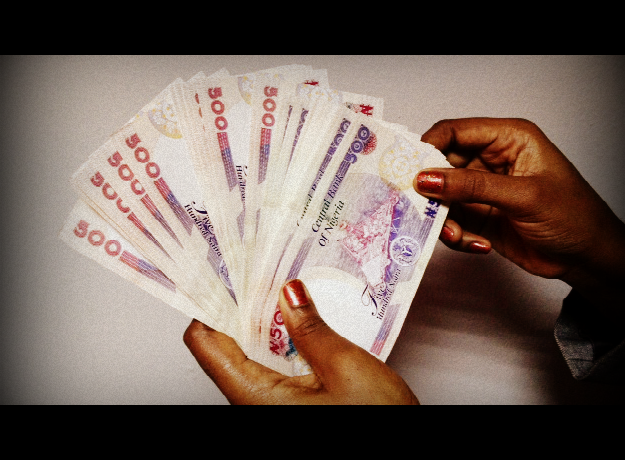
You hand over a couple of notes.
“God bless you sir! Your family will never suffer. Your wife will born plenty children, strong boys. Your children will become great ….”
You do not pay attention as you keep walking. What is his life like? What qualifications does he have? You turn to ask. But, Joe has resumed duty on the stairs leading to the entrance doors, his head bowed slightly and his hands outstretched.
You let your shoulders sag. “Happy Friday Joe,” you mumble, knowing that his praise-singing would have drowned out everything you intended to say.
In the car, before you turn on the ignition, you pull out a couple of notes from your wallet and leave them on the passenger seat. They are for Adamu and the others who man the security gate.
© Timi Yeseibo 2013
Photo credit: © Timi Yeseibo 2013
Unauthorized use and/or duplication of this material without express and written permission from this blog’s author and/or owner is strictly prohibited. Excerpts and links may be used, provided that full and clear credit is given to Timi Yeseibo and livelytwist.wordpress.com with appropriate and specific direction to the original content.
By God’s Grace

Religion divides; religion unites. Its symbols are seen everywhere here. In the big southern cities, churches clamour for prominence with their dizzying signboards on busy and quiet streets. While the western world wants to send God packing, we have him firmly entrenched in our society.
Having watched God’s role shrink in the west, I embraced his omnipresence back home. But my joy at luxuriating in unabashed religious freedom was marred by incident after incident with religious-sounding people.
Religious clichés form a huge umbrella where strange bedfellows meet. Christian choruses drip from the sweet mouths of juju practitioners and Holy-Ghost-power-wielding herbalists advertise their solutions in the newspapers. But it is in the language of everyday people that these clichés find unbridled expression, so much so that a simple yes or no response is as elusive as constant power supply.
In a culture where speeches are padded with verbosity and our elder’s words are peppered with flowery proverbs, perhaps it is fitting that our words are wrapped in religious foil and by God’s grace is the heavy-duty foil that covers every situation under our sun!
When I queried my handyman for a firm work commitment, he kept dodging under the grace of God. “By God’s grace I will come and do the work on Thursday.”
When I persisted, in exasperation he declared, “Madam, I will come on Thursday, God willing!”
Then he beamed like a monkey atop a tree that had escaped the canines of a hungry lion, daring me to challenge the will of God.
That he did not show on the said Thursday is symptomatic of a national ulcer.
Civil servants show up at work by believing and trusting God.
Political parties garner votes by the will of God.
The mechanic will fix your car by the grace of God.
Senators, stupefied by the challenges facing their constituents, hold press conferences where they proclaim, “It is only the grace of God that can save Nigeria!”
Like soap that glides through wet hands, we use religion to evade the grasp of accountability time after time. From Aso Rock to Ajegunle, religion is courted, invoked, and brandished as if it is a determinant of GDP and as if, according to Karl Marx, it is the opium of the people!

At the mall, a young man selling CDs from his début album politely accosted me. Recognising a fellow struggling artist hustling for survival, I decided to purchase one.
“What kind of music is this?”
“By God’s special grace, Christian music.”
I nearly walked away, but I kept hope alive. “Are you sure?”
“Of course madam,” he replied without hesitation, “what else would I record?”
“Look I want to encourage you. I’ll give you N300 anyway, what kind of music is this?”
I guess he must have thought that I imagined that he was born yesterday—a whole him—a scammer of scammers. Looking pained, he told of how other buyers had commended his efforts. He painted a picture of struggle and survival, in which the grace of God and the will of God had converged to give him a testimony, proving that no condition is permanent. Moved, I overlooked the shabby packaging and paid for the CD.
Later, I played the CD in my car. I strained my ears through the poor sound quality to make out the lyrics. The chorus rang:
Naija is where we are
Naija is where we belong
Naija is where we will die
My lips curved slightly as realisation shone through my eyes, of course it was a Christian song!
Since productivity hinges on how God is wielding his grace, I have come to certain conclusions about my day.
Will I go to work today? Ah, it’s in God’s hands.
Will I eat lunch during break? Yes, God willing.
Will I take a pee after lunch? Believing and trusting God.
And finally, can I draft a concluding paragraph for this blog post? By God’s grace!
© Timi Yeseibo 2013
Photo credit: dan mogford / Foter / CC BY-NC-SA
Original image URL: http://www.flickr.com/photos/dansflickr/272385799/
Title: scams upon scammers
Photo credit: MikeBlyth / Foter / CC BY-NC-SA
Original image URL: http://www.flickr.com/photos/blyth/152662733/
Title: Power of God bus (Chi Boy)
Unauthorized use and/or duplication of this material without express and written permission from this blog’s author and/or owner is strictly prohibited. Excerpts and links may be used, provided that full and clear credit is given to Timi Yeseibo and livelytwist.wordpress.com with appropriate and specific direction to the original content.
I am Africa and No, You Cannot Touch My Hair

“Can I touch your hair?”
How did we get to this point? How did this stranger get the nerve to ask this personal question?
You see, I am at the park, with a book I will not read because watching people is so much better. Behind my sunglasses, I can stare for as long as I want. No one will know, so no one will care.
When she arrived with her multi-coloured handbag, wearing a blue dress with little white daisy patterns, underneath a light green sport coat, a bright pink scarf around her neck, and navy tights in brown leather ankle boots, I thought of church on Sundays in Nigeria, the profusion of colours but without the gaiety.
She began looking at me not long after she sat on the bench opposite me, occasional stares, polite stares, with a small smile, the kind that invites conversation. I should have said something; maybe something about the weather, about how annoying it was that the sun chose to play peek-a-boo. Instead, I averted my gaze. But I could not keep my eyes away because she has earrings all over her face—four earrings on her right ear, two on her left, two on her nose, and one on her lip.
If I did not look back perhaps, she might not have asked. I thought about one fallout of not being native Dutch as she kept staring, her curiosity shining through—being at the mercy of people’s assumptions about why you are here. I see it in their eyes, a self-indulgent kind look that presumes I know how lucky I am to be here, as if I had escaped starvation in Africa by the skin on my bones.
However, I could not dwell on the challenges of immigration. I could not analyse how racial prejudice swings back and forth from citizens to migrants like a bicycle that pedals forward and backward because that was when she walked towards me, looking at my cornrows in wonder as if they were listed in the Guinness Book of Records.
“Maak ik uw haar aanraken?”
“Ik spreek Engels.”
“Oh, is it your hair? Please can I touch it? How long…”
I should be used to it. I am. I am not. I am … tired.
She continues to look. Looking is free.
Why have I never asked to touch the hair of any Caucasian woman including those who are my friends? I have a theory. I had many Barbie dolls growing up. I brushed and brushed the rubbery silkiness of their blond hair; twisted it, plaited it, wrapped it, pony-tailed it, cut it, washed it, pulled it, until I was “un”fascinated by it.
“Hello, I’m Africa, and no you may not touch my hair! If you had played with African dolls when you were younger, you would not need to touch my hair.”
The words are at the tip of my tongue, but I do not vocalize them.
How can I? How dare I sound indignant when I remember that some people in Nigeria stare at foreigners as though they have never watched TV? Others ask to touch their skin and there are those who solicit funds with their sad, sad, stories, as if every oyinbo is World Bank, willing to give aid to Africa.
I exhale deeply. “Yes, you may.”
We can recoil from what we do not know, we can pretend we know, or we can seek to know. Maybe understanding will foster peace. Maybe understanding will dispel superstitions. Maybe understanding will reduce stereotypes. Maybe understanding will bring acceptance. What do I know? I close my eyes as she touches my cornrows, lightly, hesitantly, and then with firmer motions as her confidence grows.

© Timi Yeseibo 2013
Image credit: Woman holding Earth globe by Microsoft
Photo credit: my cornrows © Timi Yeseibo 2013
Unauthorized use and/or duplication of this material without express and written permission from this blog’s author and/or owner is strictly prohibited. Excerpts and links may be used, provided that full and clear credit is given to Timi Yeseibo and livelytwist.wordpress.com with appropriate and specific direction to the original content.
Our National Pastime

Returning to live in Nigeria after nearly a decade away, the influence of another culture makes me observe life through a different set of lenses. Like a black face in a sea of white faces, our national pastime immediately stood out to me. In the past, this hobby did not elicit a raised eyebrow from me since it blends seamlessly with the landscape.
On the streets, behind magnificent edifices, under bridges, at the corner of dream castles, and even in front of crude, hand-painted signs that expressly forbid it, men and women, boys and girls, and goats and dogs all rollick in this pastime. I dare say that you or someone you know has been involved in it.
Being a showy people, we engage in this activity openly, without shame, and no thought of decorum. Have you guessed what it is? No, it is not football; it is urinating in public!
Urine pours like libation all across the land and there is no hallowed ground. Any gutter, wall, bush, or piece of land will do. Smart-looking men disembark tinted-glass Lexus jeeps mid-street to relieve themselves beside school-aged boys turned vendors. Women, though in the minority, refuse to be outdone. Whether standing astride, or crouching low with bunched-up skirts, they contribute their quota to this swelling, smelling river that threatens to overflow its banks.
Are people in such dire need that they cannot wait until they get to a toilet? Does a dearth of facilities fuel this activity?
I observed a security guard having a go on a neighbour’s fence, so I made enquiries about the gatehouse in front of the estate where he worked. There was a toilet and yes, there was running water.
Pray tell, what should I conclude? That old habits die-hard? That the satisfaction derived from relieving oneself in the open is out of proportion to that obtained in the confines of a cubicle? That borderline exhibitionism is pervasive? That, that … the, Do Not Urinate Here By Order-sign, which stands at attention in front of the fence, is an open invitation to do so?

All this has given me a new perspective on handshaking. Fortunately or maybe unfortunately, hugs are more commonplace in my setting. Friends, however, remind me that worse things have not yet killed a man.
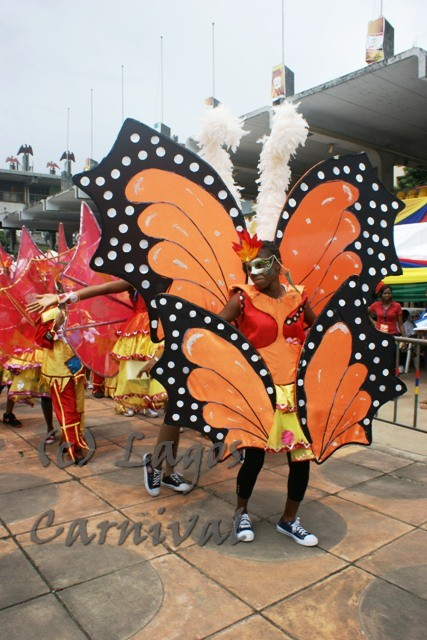
Sometime ago, my family and I were caught in traffic occasioned by the Lagos Carnival, for several hours. We missed the warnings about roadblocks thanks to our habit of predominantly watching foreign TV channels. Anyway, we killed time by enjoying a hot but decent view from a bridge on Lagos Island. The heat from the sun was momentarily diverted to my brain when my son asked to use the toilet. I calmly explained that there were no nearby facilities all the while crossing my fingers.


After trying to contain his distress for a few moments, he approached me again and again and again. With no alternative in sight, I got off my high horse and encouraged him to just do it on the kerb by the bridge. Reminding me of my stand, he vehemently protested. Nature won the battle eventually, and I escorted him to a less conspicuous corner while eating my humble pie.

Photo credit: alvez / Foter.com / CC BY-NC-SA
Original image URL: http://www.flickr.com/photos/alvez/4697340832/
Title: nigerianos
Photo credit: Darren Taylor [Public domain], via Wikimedia Commons
http://commons.wikimedia.org/wiki/File%3ANigerian_fans_at_2009_World_Cup_qualifying_match.jpg
Photo credit: nova3web / Foter.com / CC BY-SA
Original image URL: http://www.flickr.com/photos/niyyie/2212649832/
Title: Ghana 2008: Nigeria Vrs Cote d’Ivoire in Sekondi
Photo credit: shawnleishman / Foter.com / CC BY-SA
Original image URL: http://www.flickr.com/photos/shawnleishman/2348430420/
Title: Project Nigeria : Day 2 : The Law.
Photo credit: ©Ifeanyi Ukoha Facebook Timeline
Photo credit: Lagos State Government Carnival
http://www.lagoscarnival.com/galleries/index.html
Unauthorized use and/or duplication of this material without express and written permission from this blog’s author and/or owner is strictly prohibited. Excerpts and links may be used, provided that full and clear credit is given to Timi Yeseibo and livelytwist.wordpress.com with appropriate and specific direction to the original content.
Naija Movie Night

I am at The Palms Shopping Mall, Lagos, buying popcorn and a drink before I proceed to the cinema theatre. My popcorn, a warm mixture of sugar, salt, and butter, sends my taste buds to heaven with every crunch. This is the preamble to a wonderful evening.
Friendly and professional staff check our tickets and wave us in. We make our way to the last row at the top of the theatre, a vantage spot for viewing pleasure, and sit mid-row. The easy banter of friends, shuffling feet, and polite excuse-mes, set the mood in the theatre before the lights go out.
Panic erupts from my left side. Stampede follows.
“ Rat! Rat! Big rat!”
We scamper in a radius of confusion. Questions hang like clothes left to dry in the sun: “Where?” “Did you see it?” Eventually we regroup at our row. Some people brave the popcorn-littered floor and the “invisible” rats to collect their belongings, while others take our places. My popcorn sits intact in its paper carton, but I decide to donate it to the rats.
We settle for another row of seats. Governor Fashola’s message hits home. Kate Henshaw tells us to park our cars at home and ride the BRT buses like her. Funke Akindele tells us to pay our taxes so green Lagos can extend beyond Alausa. Eko o ni baje o.
The movie begins. It is fast-paced. I like it. Soon, a bluish light amplified by the darkness, irritates my vision. It emits from the row in front of us. Ping, silence, ping; a BlackBerry in motion. It must be important. Ping, ping, ping. Maybe her mother is dying. Silence at last, but the light keeps harassing my eyes. I ignore the luminescence the way I ignore a stubborn particle in my eye that refuses to leave after a thousand blinks.
A phone rings from the row above us—someone who forgot about silent mode. I commiserate inwardly. My phone has rung at inopportune moments too, like laughter at a funeral service. I imagine him quickly switching off his phone and apologising.
“Tunde! My man, I dey Palms.”
A relaxed conversation ensues, as if he is sitting in his living room drinking Guinness Stout with his mates. I wait for the reprimand that surely must come. Instead, another phone rings from a row several levels below us.
Quiet resumes as the movie draws us into a web of suspense. The actors are clueless. People shout hints so the actors can hear them. I am not perturbed enough to proffer solutions. Don’t they know that the leading actor never dies?
The action scene over, calm replaces the excitement of moments before. A holy hush descends as both the leading actor and all of us recover. A baby’s cry pierces the quiet, followed by a mother’s insistent, “Sssh, sssh!” A baby in the cinema? What were the mother and father thinking? What were the staff at the entrance not thinking?
I expect the Occupy Baby movement to arise. I am not disappointed.
“Madam, abeg give de pickin breast!”
Not long after, the baby’s cry teeters to a stop.
I give up watching the movie on the screen. Real life offers colours and sounds that Technicolor and Dolby Surround cannot match. The sporadic flash of cellphone cameras blinds me. Babies protest against the ludicrousness of being in the cinema theatre. Cell phones ring in programmed sequence, one after another, as when you snooze your alarm, it startles you out of sleep fifteen minutes later. I drown in the conversations and debates floating up from below and drifting down nonchalantly from above.
How can I describe the cooing in sync when the leading actor achieves a milestone? This is it. He typifies our lives, the relief that washes over us when we cross difficult hurdles. It is a Kodak moment. We coo without cue, a sound so tender, goose bumps chase prejudice away. The fantasy that we came to revel in for ninety minutes is over. We applaud, burying our irritation underneath a shared experience.
Outside, my friends apologise for the people’s behaviour. I ponder their apology. Dutch people do not apologise for being Dutch. French people do not apologise for being French. English people do not apologise for being English.
I take their advice and return the next morning to watch the film in peace. The theatre is empty save for about ten other people. A man slips into the seat next to mine.
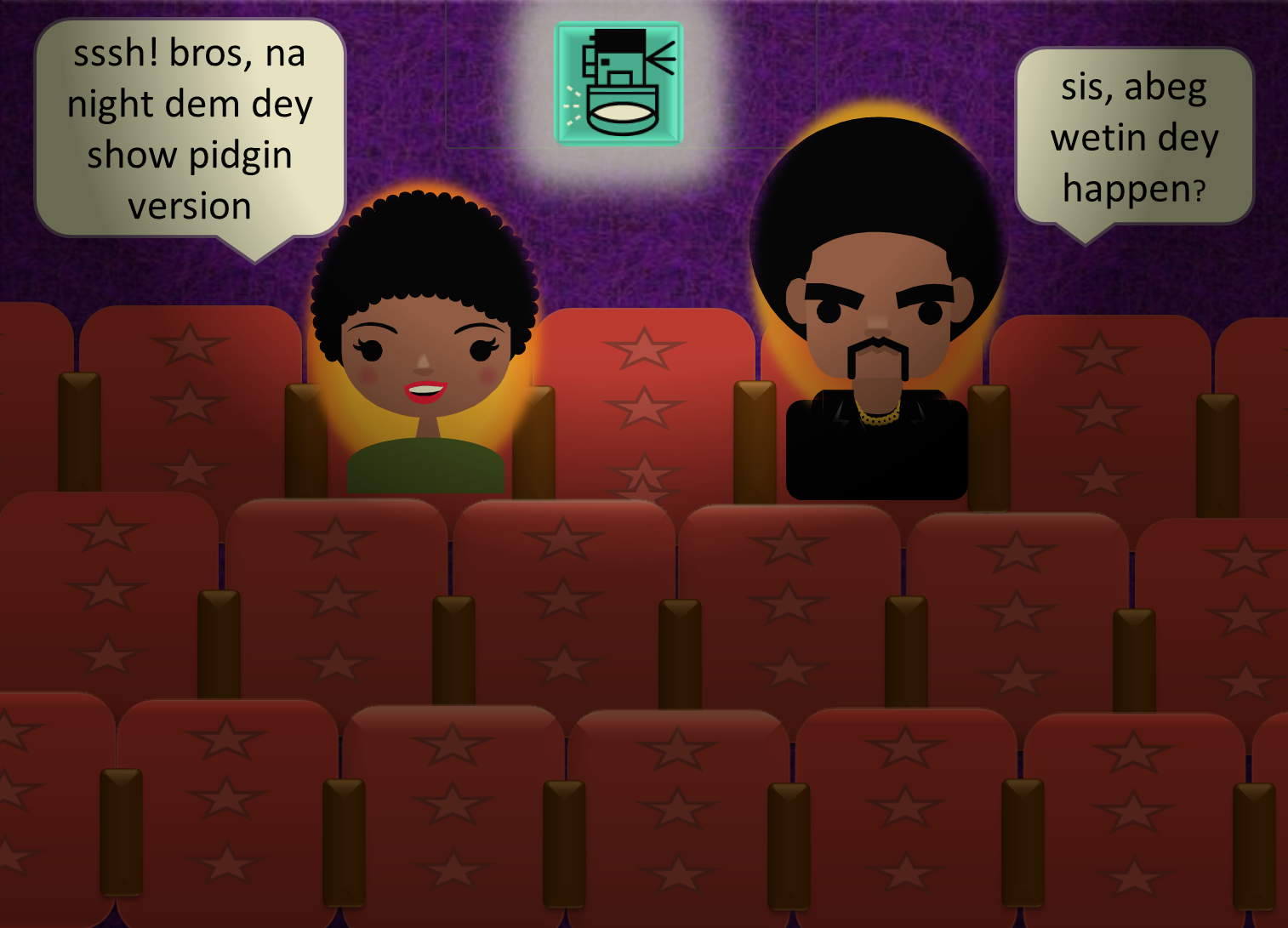
In the dark, confidence buoys his voice, “Wetin dey happen? Wetin de man talk?”
I smile, “Make you come watch for night; dem dey show de pidgin version for night.”
I watch movies in the morning. Then I return in the night to watch the same movies again because I cannot get enough of the beauty, the diversity, and the insanity that is Nigeria.
©Timi Yeseibo 2013
Unauthorized use and/or duplication of this material without express and written permission from this blog’s author and/or owner is strictly prohibited. Excerpts and links may be used, provided that full and clear credit is given to Timi Yeseibo and livelytwist.wordpress.com with appropriate and specific direction to the original content.
Image credit: curtain vector: zcool.com.cn
font: Carpenter Script: http://fontzone.net/font-details/Carpenter+Script/
font: Disco Diva by annyluswonderland: http://fontstruct.com/fontstructions/show/668749
All people illustrations, animes, avatars, vectors by Microsoft
design: ©Timi Yeseibo 2013
Open Letter to Akpos
Dear Akpos,
You do not know me. I am a Nigerian living in the diaspora. I know you unlike my friend who continues to speak funéh after we have left the office. Even Nigerians in Antarctica have heard of you, so great is your renown like Britain’s legendary Mr. Bean. As you yab Nigerians living abroad temper your jokes with mercy because after six months in oyinbo land, we forget that we went to Burukutu Primary School and Agbaridion Secondary School—the winter makes us talk through our noses and freezes brain function.
Since 2012 when I started reading your jokes on BBM and Facebook and Twitter, I have become more convinced that no condition is permanent. The way that you have metamorphosed and become as entrenched in our national consciousness as surely as Nollywood is synonymous to Nigeria is “amazing”. As you increase, may all those elements that want to take us down as a nation decrease!
Talking about BlackBerry, every day, I receive several Akpos jokes on BBM. The coloured text informs me that it is a yet another viral broadcast message. I know that a response beyond LOL is oversabi; however, I cannot restrain myself. I punch my screen to reply and let the sender know that I was the one who sent him the joke first; after all, I am not a goat regurgitating cud!
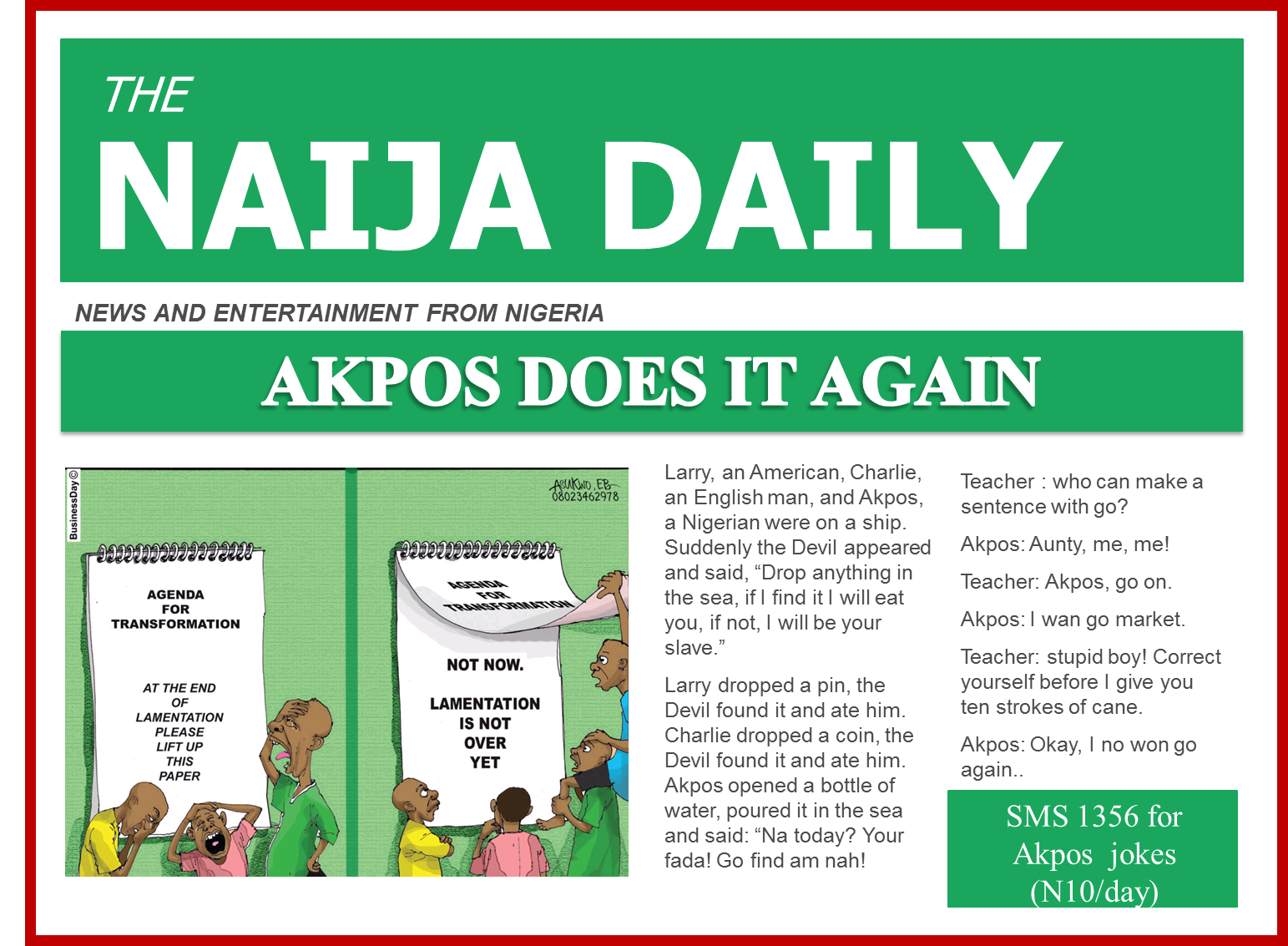
Akpos, I take God beg you, stop “doing it again and again” because:
One Akpos a day keeps the doctor away
Two Akpos a day chases the blues away
Three Akpos a day causes temporary amnesia
Four Akpos a day is like mosquito bite, sweet to scratch until you bleed
Five Akpos a day is like eating dodo every day; e no go tey before you shout, “Ekaette, na only plantain dey house?”
In spite of this, I want to thank you for the great work you are doing in Nigeria. These days, it seems as if you are the only one working hard to make us forget our problems. Can you imagine that Nigeria was ranked 20th saddest country in the world on the 2013 Legatum Prosperity Index? Dem dey craze? Even if oil reserves finish, we go laugh. Make dem flare gas troway, we go still laugh. Akpos, don’t mind them jare. If they had met you, we would not have had such a low ranking.
I still do not know who you are Akpos. Everywhere I turn, I see another Akpos, so tey I have headache that only Paracetamol from India can cure. On Facebook, I found: Original Akpos, Akpos The Comedian, Akpos, Akpos (The Comedian), and Akpos Jokes. Space will not allow me list the number of Akposes I found on Twitter and the spin-offs from your vast business empire: Akpos apps for BlackBerry, Akpos android apps on Google Play, Akpos jokes from the Ovi store, and so on.
This proliferation of your brand reminds me of when my mother started Pure Water business. Before we could finish tying all the cellophane bags of our Pure Water, three of our neighbours had sunk their own boreholes and started calling out on the street, “Buy Pure Water, original Pure Water!” Akpos, your enemies shall never succeed! We are counting the days till you go hammer and your Hummer go land.
I will stop here before your eye begin close like newborn pickin. By now you for don release another five hundred jokes.
BTBY (be the best you)
LLNP (long life & prosperity)
OHGSL (Our Hummer go soon land)
BNFKU (Boko Haram no fit kidnap us)
PIND (peace in Niger Delta)
PFE (pray for EFCC)
LKH (love, kisses & hugs)
TGBTG, (to God be the glory)
Timi
So what do you think? Does Akpos symbolise something deeper about our national psyche—perhaps a variant of the freedom songs sung by oppressed people through the centuries? Or is Akpos a platform to show that Naija’s got talent, comic relief, pure and simple?
©Timi Yeseibo 2013
Image Credits:
Cartoon by Mike Asuquo: http://asukwo.blogspot.com
Design: ©Timi Yeseibo 2013
Unauthorized use and/or duplication of this material without express and written permission from this blog’s author and/or owner is strictly prohibited. Excerpts and links may be used, provided that full and clear credit is given to Timi Yeseibo and livelytwist.wordpress.com with appropriate and specific direction to the original content.
Effizzy

Since I returned to Nigeria, I seem to be bumping into people I know from the past everywhere I go. It is a delight to cross the initial hurdles, “You look familiar. Which school did you attend? Where do you or did you work?” and finally make the connection.
Somewhere in between catching up and exchanging telephone numbers, they inevitably say something like, “You have not changed a bit; you look just the same!” That remark makes me wonder if they are blind or trying to be kind. Now, I admit that I am colour-blind to the shades of grey that should be painted on the canvas of friendly conversation. Trying to be truthful, but frantically digging into my shallow well of diplomatic graces, I guardedly reply, “Well your face has not really changed either,” forcing my wandering eyes to focus on the face and not the torso that shows telltale signs of a lingering love affair with food.
It is a thrill to hear what they have been up to or what they are currently involved in. I listen in child-like awe as they highlight past achievements, summarize current assignments, and state their aspirations with convincing conviction. If I bump into two or more male acquaintances, I am amused because their antics remind me of a book title I’d seen years ago, My Mercedes is Bigger than Yours. Nevertheless, I marvel at just how well people are getting on with their lives.
My bubble burst when I recounted my various run-ins to friends who were not impressed. “Effizzy, it’s all effizzy,” they replied. Responding to my blank stare, they informed me that effizzy encompasses a wide range of attitudes, mannerisms, and lifestyles that make one appear to be The Jones that others are keeping up with. I disagreed and commented that people have carved niches for themselves in consulting and others have resigned from well-paying jobs to become entrepreneurs.
“Ha!” they scoffed. “I consult for several schools, is effizzy for I take my portfolio round schools and try to convince them to buy my goods.” “I resigned from my job to start my company and we are into telecommunications, oil prospecting, you name it, is effizzy for I almost got fired so I quickly resigned. My office is in my living room and I am trying to swindle any unsuspecting!” I wondered if they were not being too cynical, after all, what is wrong with working hard to score a good impression?
I did not give our effizzy discussion any more thought until recently. I had gone to the salon to have my hair done and a smartly dressed young man introduced himself as the resident trichologist and chief stylist. He reeled off other credentials that I cannot remember and wanted to fix my hair. I declined preferring instead to have my usual stylist.
He commented on my eyebrows, which I had carefully tweezed that morning and thought looked great. He insisted that a beautiful woman like me needed to complete my look by having nicely arched brows. He wondered quite loudly if I had ever had them professionally done. I began to feel small and unsophisticated in this posh salon before this proficient beauty expert. Inwardly praying that he would stop the verbal harassment, which portrayed me as unglamorous, my voice dwindled to a whisper as I maintained that I was happy with my looks.
A few moments later, a client walked in. Mr. Trichologist wowed her with his resume and he proceeded to fix her hair. I was startled from my silent introspection over the arch of my brows by a scream from across the room. The new client was upset with Mr. Trichologist because he had damaged her hair and weave. Mr. Trichologist remained unapologetic while insisting that he knew what he was doing.
As I gazed at her over-processed, nearly burnt tresses, two words floated from my subconscious: articulate incompetent, oh I mean, effizzy!
Timi Yeseibo © 2009
image design: ©Timi Yeseibo 2013
Unauthorized use and/or duplication of this material without express and written permission from this blog’s author and/or owner is strictly prohibited. Excerpts and links may be used, provided that full and clear credit is given to Timi Yeseibo and livelytwist.wordpress.com with appropriate and specific direction to the original content.
Through the Eyes of a Child

- Ferdinand Reus / Foter.com / CC BY-SA
Children are the future because they not only propagate generational lines but also improve on our legacy. Their simplistic view of the world combined with their unending well of curiosity, results in an incessant battery of questions.
During my children’s first visit to Nigeria, they oohed, aahed, and ouched because everything was new. Growing up in Nigeria had given me some immunity to the culture shock they experienced. Yet, they challenged me to pause and look where I had previously thrown a careless glance because my eyes were glazed over with a heavy coating of the familiar.
Innocent and inquisitive, they kept asking questions. Even though I fielded their questions with the expertise of a savvy politician, I pondered these same questions long after I tucked them in bed and kissed them goodnight.
They asked about the madman who ate and slept naked under an abandoned trailer parked on a busy street. They asked, eyes round with amazement, about the paraplegic who was the unofficial traffic warden. He controlled traffic from his foot chair—so called by my children because he “sat” on what looked like a footstool with wheels underneath that gave him bullet-speed mobility. It was very useful as it enabled him to quickly collect the largesse from patrons without being crushed under the giant wheels of jeeps.
It seems as if everything is different and yet everything is the same. Our progress resembles a swinging pendulum—back and forth but still on the clock. So yes, this future generation asks simple questions about our beloved Nigeria.
“Are we in a war?” my eldest one asked.
“No, of course not, does it look like we are?” I queried, wondering if he was confusing Nigeria with another country he’d seen on TV.
“Then why are there policemen armed with assault rifles everywhere? Why do they hold up their guns and stop cars?” He demonstrated with his hands.
“Why indeed?” I replied playing for time, as I crafted my reply.
“Are there many bad people in Nigeria?” my youngest interrupted my train of thought.
“No not really, like anywhere else in the world, we have good people and bad people,” Annoyance swirled in my stomach and I inwardly blamed those foreign TV shows that depict Nigerians as a bunch of rogues.
“Then why are there so many prisons walls?”
“Where are the prison walls?” I asked because her serious tone belied any evidence of a joke.
“See that one over there, and another one over here,” she responded matter-of-factly, as she pointed to nearly every house on the street.
I said nothing but nodded in understanding.
I explained that crime and instability informed the manning of checkpoints, and necessitated the conspicuous display of guns by policemen. It also meant that people had to protect themselves hence the fences. I tried to remember a time when checkpoints were not a feature on our roads and high fences topped with barbed wire were not the norm. It was quite a long stroll down memory lane. I also tried to imagine a time when their presence would be unnecessary, it was rather hard to do.
Looking through their eyes, I perceived their reality. With my added insight, I saw a nation at war with different uniformed guerrillas fighting for supremacy while the rest of us walled ourselves in, in prisons of inertia letting the bad guys roam free.
Day after day, the questions continued but a simple incident caused me to laugh with hope.
“Look mummy!” my youngest one excitedly cried, waking me up from afternoon traffic siesta.
“Look at what?” I asked groggily forcing myself awake, and willing my eyes to focus.
“Look, over there!” She hit the window emphatically and pointed.
I followed her slim fingers and captivated gaze. I saw nothing out of the ordinary, certainly nothing to get excited about on this run of the mill day.
“I don’t see anything,” I yawned.
“There, there, over there … a banana hat!”
“A what?”
“A banana hat. It’s so cute and clever mummy!”
Finally, I saw it, through her eyes. A street hawker was carrying bananas on a tray on his head—a bonafide banana hat in green-yellow glory! He strode towards us at the prospect of a quick sale; a rather common sight I had become accustomed to.
It is my hope that this generation that sees what we do not see, will achieve what we have so far been unable to accomplish. A banana hat indeed, it was a very welcome respite from simple questions.
© Timi Yeseibo 2009
Photo credit: <a href=”http://www.flickr.com/people/72092071@N00″>Ferdinand Reus</a> / <a href=”http://foter.com”>Foter.com</a> / <a href=”http://creativecommons.org/licenses/by-sa/2.0/”>CC BY-SA</a>
Unauthorized use and/or duplication of this material without express and written permission from this blog’s author and/or owner is strictly prohibited. Excerpts and links may be used, provided that full and clear credit is given to Timi Yeseibo and livelytwist.wordpress.com with appropriate and specific direction to the original content.
 livelytwist