
Interpreting Silence, Mine and Maybe Yours

Malala

. . . and I began to see that the pen and the words that come from it can be much more powerful than machine guns, tanks or helicopters. We were learning how to struggle. And we were learning how powerful we are when we speak.1

I was at a meeting. The preacher declared, “If you haven’t found what is worth dying for, then you haven’t started living!” In my mind, I said, “But I am living and I enjoy my life although, I don’t know what I would die for.” The preacher reeled off convictions on which he would stake his life. I thought, that’s good for you, my children are still small, my marriage too young.

In my university, when students would gather to protest against government policies, I always left the campus and went to stay at my aunt’s, as I did not fancy being tear-gassed, arrested, or beaten or raped if the protest degenerated to a free-for-all.

Their protests annoyed my middle-class sensibilities. Shielded by my parents, I had never felt the sting of socio-economic or political policies. The more daring the protest, the more likely, that my university would be shut down, so that, instead of graduating at twenty, I would graduate at twenty plus x, x being anything from one to five years. This concerned me because I had mapped my life’s trajectory without the possibility of detours.

And so, Malala Yousafzai’s autobiography interested me, as all biographical material does, but more so because she is a teenager. She’s described as the educational campaigner from Swat Valley, Pakistan, who came to public attention by writing for BBC Urdu about life under the Taliban. News about her work had floated in and out of my attention in years past, but as I settled to read her book, I shook my head, what was she thinking?

The man was wearing a peaked cap and looked like a college student. He swung himself onto the tailboard at the back and leaned in right over us.

Who is Malala? He demanded?”

No one said anything, but several of the girls looked at me. I was the only girl with my face not covered.

That’s when he lifted up a black pistol. I later learned it was a Colt 45. Some of the girls screamed.2

Malala’s story, in my view, traces the journey of her convictions, how they were shaped, how they crystallized, and how she learnt to live and expect to die for them. Her father is central to her story. She interprets her world through his eyes. But I get the sense as I read that even if Malala were translated into another set of circumstances, mine as a youngster, for example, she would still shake the world. Named after the Pashtun heroine, Malalai of Maiwand, when she was born, she popped out kicking and screaming.

Malala gives us a history lesson on her beloved Pakistan and Talibanization. It is a story I recognize: Nigeria before and after British colonization; Nigeria in the age of Boko Haram. Politics never sleeps. Poverty and illiteracy make indoctrination and intimidation potent. But Kalashnikovs and RPGs make the rich and educated flee too.

Her photo on the book cover hides fear and courage, a tension that she draws her readers to share with her family in Taliban-controlled Swat Valley and beyond.

Are you scared now?” I asked my father.

At night our fear is strong, Jani,” he told me, “but in the morning, in the light, we find our courage again.”3

She writes that her father hated the fact that most people would not speak up. She knew he was right. He kept a poem by Martin Niemoller in his pocket.

First they came for the communists,                                                                              

and I did not speak out because I was not a communist.                                           

Then they came for the socialists,                                                                                    

and I did not speak out because I wasn’t a socialist.                                                 

Then they came for the trade unionists,                                                                        

and I did not speak out because I wasn’t a trade unionist.                                        

Then they came for the Jews,                                                                                               

and I did not speak out because I wasn’t a Jew.                                                        

Then they came for the Catholics,                                                                                    

and I did not speak out because I wasn’t a Catholic.                                                 

Then they came for me,                                                                                                     

and there was no one left to speak for me.

I live in a land where my concerns range from 30% income tax deductions to choosing between Gouda and Maasdammer cheese. Comfort is a familiar place and I do not apologize for it. Privilege comes with responsibility and many are not silent. But I must break my silence and scream with more than sympathy, with my words, my money, my time, and my votes, because Malala proves that one voice can be heard. At a cost, at a cost . . .


©Timi Yeseibo 2014


1. Yousafzai, Malala with Lamb, Christina, I Am Malala (London: Orion Books, 2014), 131.

2. Ibid., 6.

3. Ibid., 115.


Unauthorized use and/or duplication of this material without express and written permission from this blog’s author and/or owner is strictly prohibited. Excerpts and links may be used, provided that full and clear credit is given to Timi Yeseibo and livelytwist.wordpress.com with appropriate and specific direction to the original content.

 

Why Revolution, Occupy Movements, Terrorists And All Sorts Of Anti-Establishment Things Are Good For Capitalism  

By his own admission, Charles Onyangbo-Obbo’s blog is a (sometimes) irreverent take on all things African – and non-African. So, who benefits from the “protest”? While in my view, grey areas encroach upon black and white territory; his piece reminds me of comments about Boko Haram’s ideology: western education is bad, although it gave Boko Haram guns, TV, internet, and cell phones . . . hmmm.

nakedchiefs's avatarNAKED CHIEFS

I have been studying photos of the Sunni jihadist group, Islamic State of Iraq, those these militants who are trying to establish a caliphate in Iraq and Syria – to begin with.

On June 10 last week, they made some mind-blowing military gains, capturing Mosul, Iraq’s second largest city, and most of the surrounding province of Nineveh. Buoyed by their victory, they headed south towards Baghdad, the capital, taking several towns on the way.

Some 30,000 of Iraq’s US-trained soldiers just dropped their guns and uniforms, and took off for the desert. How many ISIS insurgents were they faced with? Just 800!

The virulently anti-western ISIS is so extreme and violent, even Al Qaeda distances itself from it. However, they were carrying AK 47s, and wearing sneakers. The people benefitting from the sale of the AK 47s are actually some infidels and aetheists in the west and Russia.

And American…

View original post 348 more words

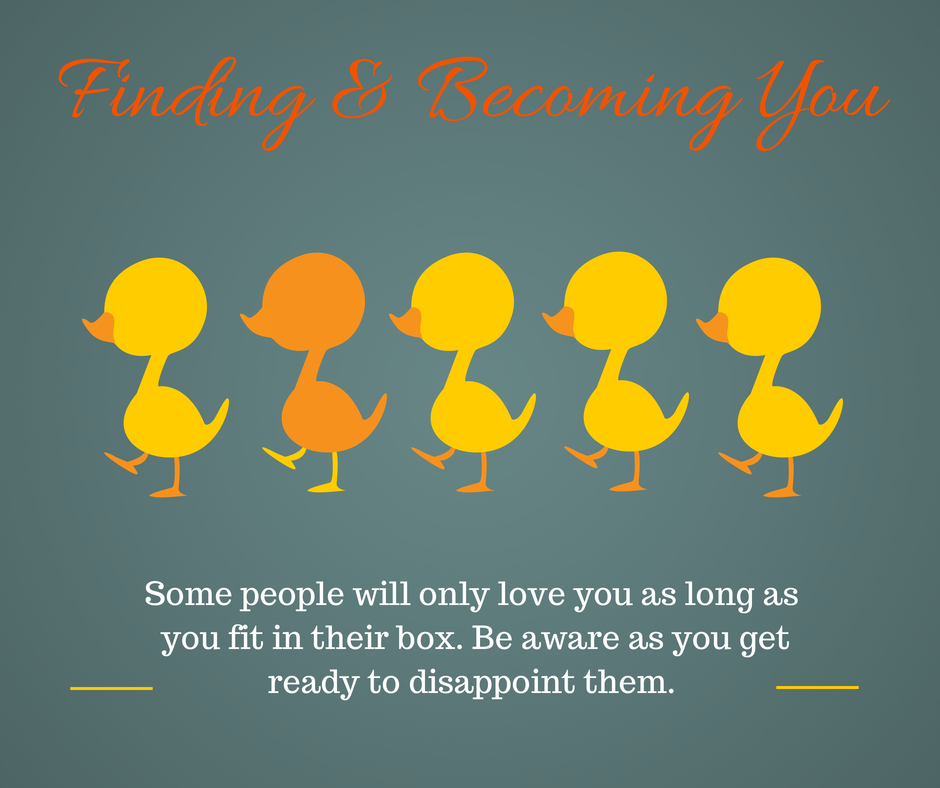
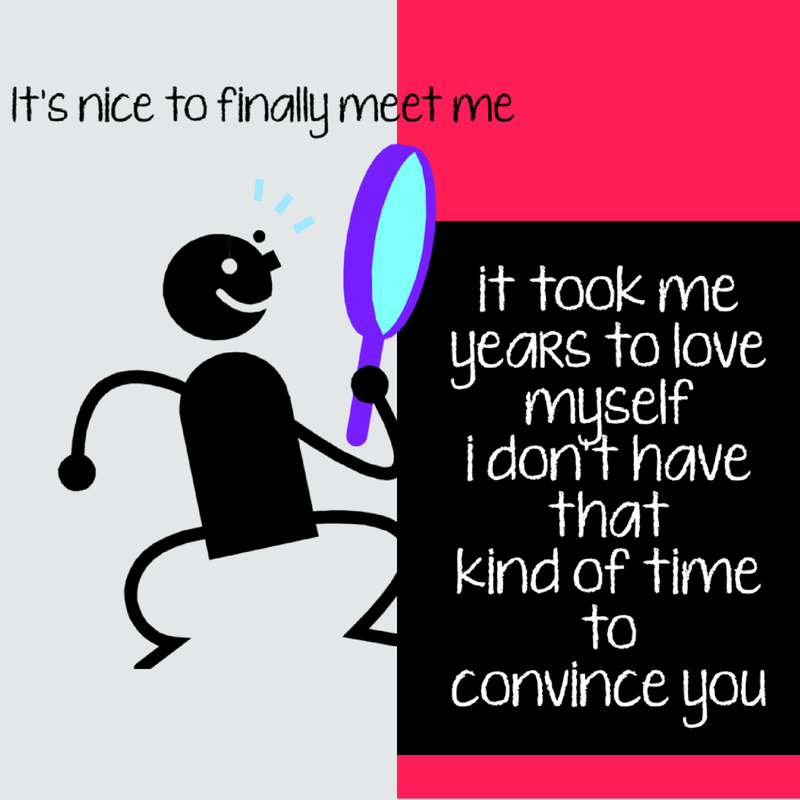
Finding and Becoming You

You

You start to write this post and your fingers hesitate over the keyboard. One part of your brain wonders when you bought a franchise for Oprah’s Life Class. You wonder about sounding like a preacher, roll your eyes like a teacher, and resume typing with a sigh. Authenticity on a personal blog is sometimes writing what matters to you with your style and in your voice.

The first time you realised you had a distinct writing voice was when you rewrote the foreword of a friend’s manuscript because she asked you to. You’d found it stuffy like a chemistry class about atoms without pictures. You thought that an inspirational book should make readers feel as though they were drinking coffee with the author and talking about life. You transcribed this photo, infecting your words with warmth that spreads from intimate conversation.

Your approach couldn’t have been more wrong for your friend read it, shook her head, and demanded, “Why didn’t you write like you write at work? That’s why I came to you in the first place!”

You stammered, “But that is my job. This is my heart.”


who am i


To write from your heart, you must first know your heart. What made your heart go va-va-voom at eighteen is not the same thing that makes your heart race at forty. The heart is always circulating blood throughout the body. You are a constant work in progress. Neutrality is for the dead, the ideas you encounter daily, shift you one way or the other. Oxygen-depleted blood enters the right side of the heart and exits through the left full of oxygen. Yet, the heart sits fixed in the chest cavity between your two lungs. Who you are at your core and the ideas which circulate in your mind will seep from your pen, whether black, blue, red, or green.


loving you


To become you, you must find you. Remember when you isolated your baby’s cry in a room full of crying infants or picked out a friend’s laughter in a noisy coffee bar? This is the magic of bonding, of spending hours with someone you love, you! You hear your cry and understand your pain. Healthy self-preoccupation may mean that you are the last to hear office gossip because your internal dialogue is louder and juicier. You are an active participant in the internal narrative of your life, listening, taking notes, sharing feedback, and steering the conversation.

Experimenting within boundaries may cushion failure on the way to discovery. I wrote poetry and gave drama a stint, before I settled on prose. Second chances are about reinventing yourself. You can gift yourself one anytime. If self-acceptance comes before change perhaps change has a better chance of stamping itself on you because your need is raw like desire.


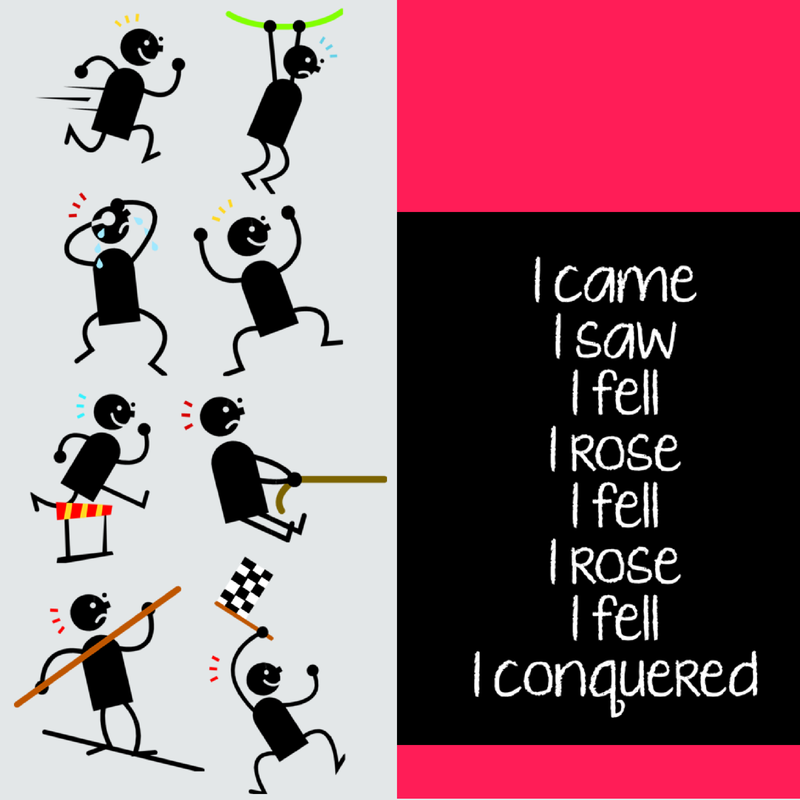
fall and rise


It takes courage to be yourself for when you finally meet yourself, you may not like who you are. When children unwrap gifts at Christmas, they look past their gift to ask others, “What did you get?” The value of the gift received grows or diminishes in comparison to what others received or how others perceive what they received. You also play this game. It is hard not to compare, after all, there is no tall without short. But you can learn to “uncompare,” that is, measure your good against your better, and aim for the best.

The high price of being you is the risk of being misunderstood or rejected. But even in that, there is value to be harnessed. The world isn’t tolerant of plastic bottles that don’t fit in the general assembly plant. Did you know it costs time and effort to create special assembly plants? You put in the time. You put in the effort. Give yourself the gift of you before you offer the world the gift of you. Then, whatever happens, the ground upon which you place your feet will hold you up.


©Timi Yeseibo 2014

Image credit: stick figures from Microsoft


Unauthorized use and/or duplication of this material without express and written permission from this blog’s author and/or owner is strictly prohibited. Excerpts and links may be used, provided that full and clear credit is given to Timi Yeseibo and livelytwist.wordpress.com with appropriate and specific direction to the original content.

 

A Few Good Men

a few good men

Movie previews vie for prominence in IMAX theatres as summer calls. The themes are the same though special effects vary. Whether resetting the day to secure a better future in Edge of Tomorrow or fighting for the survival of the species in X-Men: Days of Future Past, the protagonists are ‘ordinary’ men and women juxtaposed in extraordinary circumstances. They earn their place on the wall of fame in our hearts by navigating tough choices and taking the ‘high road’.

They may fall on the way eliciting groans from us or run with injured limbs drawing encouragement from us, but in the end, we discard popcorn cartons and nod to the beat of the song that accompanies the credits. We are looking for heroes and don’t even realise it. Year after year, Hollywood sells us this basic story of redemption, and we say, “Oh yes!” with our Dollars.

The big screen that typifies courage, honour, and integrity is a macrocosm of what a woman’s heart longs for. Sometimes political correctness, feminism, gender equality, etc., educate me to the point that when I place my hands on my chest, I no longer feel my heartbeat. Nevertheless, when darkness causes me to trip, I see clearly.

At nineteen, I chose love that devalued me. Dark alleys and groping hands crumble truth and leave broken hearts. I love you, should be said in daylight so the heat of the sun can scrutinize the lips from which the words pour. Then I met a man who did not kiss the girl and make her cry, although I was ripe for the picking. He said, “You mustn’t fall in love with me, you must reach for your dreams.” A man’s heart can be a safe place for your dreams, because if he believes in you, he will walk beside you and invest in your future.

If women declare unequivocally, “I want a man who will fight for my honour, yes, a knight in shining armour and baby, I’m no pushover, I can certainly hold my own,” then perhaps men will rush to borrow Superman’s cape! Heroism isn’t always glamorous. Countless choices refine what it means to be a hero. Every choice is a ripple in the river of time. Enough ripples, and you can change the tide for the future is never truly set.

Some men look at the dizzy neon lights of the casinos of life and remember that although they once hit jackpot at the slot machines, the house advantage in a game of roulette sets them up for long-term disappointment. They walk past so they can arrive home at six to ruffle Peter’s hair and read Anna a bedtime story; to watch reruns snuggled next to Mary.

They shove their hands into deep pockets when voices rise and tempers boil and even wave a white flag when it is their right to hoist a red one. They let the door click in place because a slam reverberates through the house instilling fear that clings to the occupants in its wake.

Others nurse battle wounds and walk with a limp, a gait at once laudable and laughable, but pay child support like clockwork. They embrace the dawn to polish their dull swords knowing that sheen comes from consistent practice and that just because someone loses his way, it doesn’t mean he’s lost forever.

Fathers, grandfathers, husbands, brothers, friends, sons, nephews, uncles, and cousins, although we do not see you featured in 3D saving the world, we need you to hope again. The curtain is lifted and the spotlight is on you. Don’t be a dying breed.


©Timi Yeseibo 2014


p.s. Ayonfe okon mi, olowo o rimi, this one is especially for you.


Unauthorized use and/or duplication of this material without express and written permission from this blog’s author and/or owner is strictly prohibited. Excerpts and links may be used, provided that full and clear credit is given to Timi Yeseibo and livelytwist.wordpress.com with appropriate and specific direction to the original content.
In Defense of Satire

“[I]n whatever department of human expression, wherever there is objective truth there is satire.” Wyndham Lewis in Rude Assignment


satire cartoons

To write this post, I read about the origin of satire, about Aristophanes (c. 446 BC – c. 386 BC ), a Greek comic playwright, and the Roman poet Horace (65 BC – 8 BC), whose works inspire and form the model for writing modern-day satire. But sha, na dem sabi, I know that I know that I know that satire originated in Nigerian culture. How do I know?

After I ran across a road without a zebra crossing or traffic lights or a pedestrian bridge, just missing that crazy driver who sped out of nowhere, a woman selling oranges by the roadside exclaimed, “You dey craze? You wan kill persin?” so I turned around to look at the yeye driver who’d almost cut my young life short, and then realised she was talking to me.

She could have blasted the government for not providing infrastructure. She could have cursed the driver for failing to observe common-sense speed limit. The irony was that she chose me as the subject of her satire. She exaggerated my role as a potential killer, exposed me to ridicule with her loud gesticulations, and criticized my lack of judgement. And the humour? Well, here I am writing this piece and laughing retroactively, twenty years too late.

You can describe the human condition with white chalk on a blackboard, spacing your letters evenly and clearly, but people may yawn and rub their eyes after a while. You can show how the problems of the world are at once “un”trivialized and brought into sharp focus by employing irony, exaggeration, and/or humour, and people may stay up late to watch the show. This is satire and provoking change, if only in a shift in thinking, is the endgame.

Satire’s overtness, sometimes camouflaged by its subtlety and silent sophistication, is blended into much of what we watch and read, but is often overlooked because we appreciate these works for their entertainment value only. Perhaps the authors want to make people laugh before they make them think.

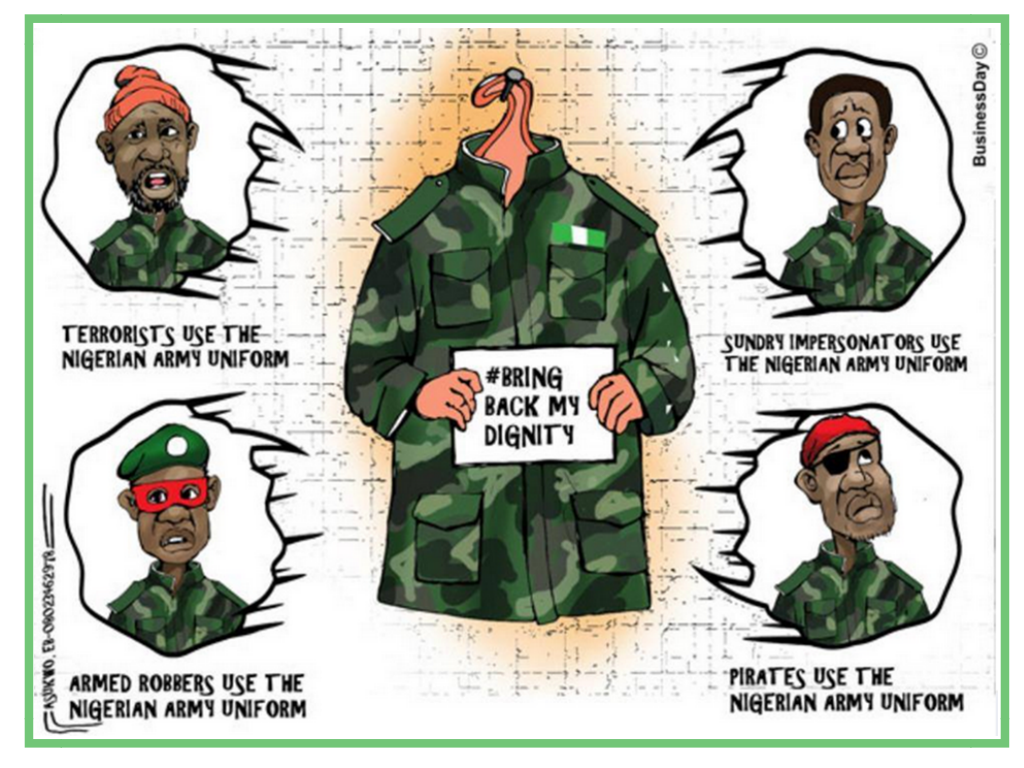
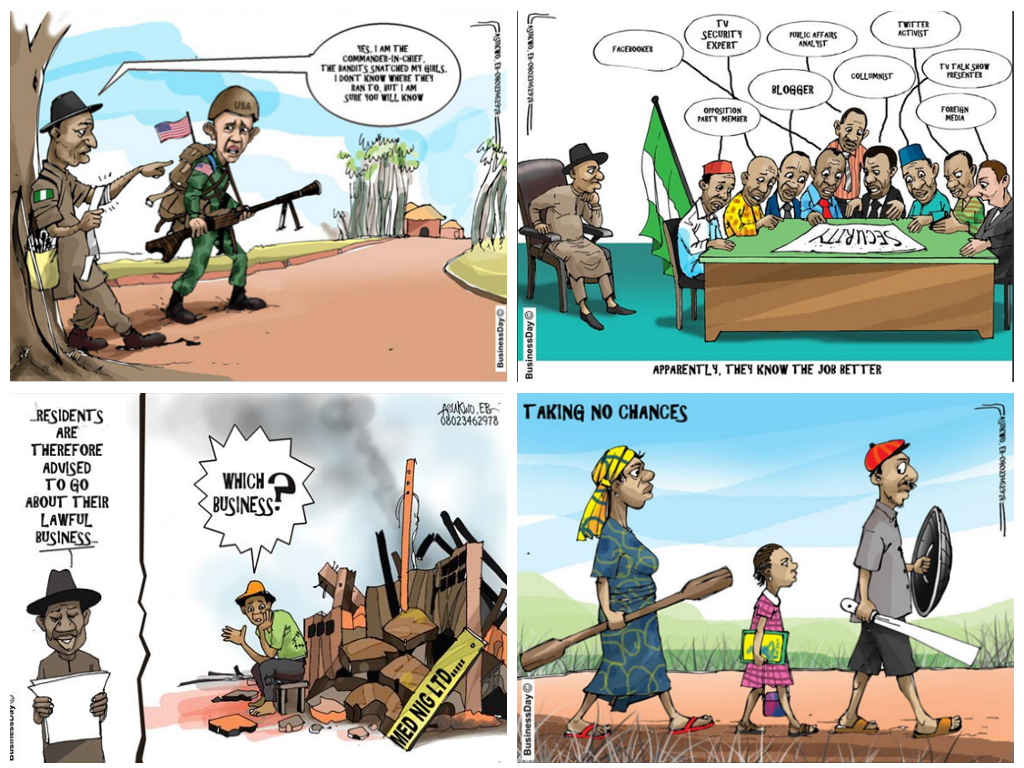
The #BringBackOurGirls campaign focuses on the serious business of finding and freeing the over 200 girls kidnapped from a Nigerian secondary school in Chibok. While we are still lighting candles for them, questions surrounding the culpability of Goodluck Jonathan’s administration, the legality of the first lady’s “tribunal” and the state of security in Nigeria, especially in the light of recent bomb attacks, continue to make rounds on social media.

It is the cartoons and videos, not the essays, expressing the general mood of the country that have captured my attention the most. I see these works as satires. Some of the media that zoom in on the Nigerian first lady’s perceived gaffes, have come under attack, because satire can be misunderstood when we view these works for their ridicule value alone. Perhaps the authors want to shock people first and then make them think.


“Satire is a mirror where beholders generally discover everybody’s face but their own.” Jonathan Swift

satire in cartoons

Politics and satire live on the same street. However, I cannot imagine that President Obama, or any other president pouts and refuses breakfast because of a political cartoon splashed on the front page of a newspaper. This is not to say that satire cannot be a demeaning and horrifying personal attack, the pendulum can swing to any extreme, but I’m referring to satire, which has as its greater purpose constructive social criticism to further dialogue and/or action.


Uneasy the head that bears the crown

politics 101


As a child, I had frequent bouts of malaria. At my mother’s insistence, not only did I have to wait until the smell of sheltox faded into the walls of my room, but I also had to sleep under a white mosquito net. Once every few months I would stand in front of her under the dim inquisition lights of our verandah, hands outstretched as she placed three tablets of Camoquin in my palm one after the other.

“Swallow it quickly with your Fanta,” she would goad.

I was never fast enough. After taking a sip of Fanta, the Camoquin would begin to melt in the fizzy oasis that was my mouth. I would shut my eyes tight as I swallowed the mixture. After I swallowed the third tablet, the half-empty bottle of Fanta was my reward. I rushed the orange liquid, willing it to eliminate every trace of the bitter Camoquin. After this ritual, my body would stave off malaria for a few months.

This in my view is satire at its best; mix the bitter with the sweet to move society to a better place. When this era is over and the dust settles, the videos, the cartoons, and slangs coined, will be reminders that truth was once too hard to swallow.


©Timi Yeseibo 2014


Cartoon credits:

Mike Asukwo

Mike Asukwo on Facebook: https://www.facebook.com/asukwo

Mike Asokwo on Twitter: @Asukwoeb


Khaki no be Leather http://t.co/MAWGvUpCeq

Business as Usual http://t.co/90N6BMfUqu

We, the Experts http://t.co/PeuA19Zsmg

The Eagle has landed https://www.facebook.com/photo.php?fbid=10203949665842578&set=pcb.10203949674762801&type=1&theater

JTF-Joint Task Family https://www.facebook.com/photo.php?fbid=10204006243536985&set=pcb.10204006243736990&type=1&theater


Unauthorized use and/or duplication of this material without express and written permission from this blog’s author and/or owner is strictly prohibited. Excerpts and links may be used, provided that full and clear credit is given to Timi Yeseibo and livelytwist.wordpress.com with appropriate and specific direction to the original content.
Six Degrees of Separation and Other Stories

secret of change

On a scale of one to ten, I was born with a six in writing, just as you were born with a six, or seven, or eight in something. This means that even if I don’t develop myself as a writer, anything I write would be better than what most people write. But talent is not enough. It can be a beginning.

I believe in six degrees of separation, the version I have heard, that you are only five people away from any one you want to meet. I could meet Barrack Obama if I want to. My family knows somebody who knows somebody who knows somebody that knows Goodluck Jonathan. Goodluck Jonathan can lead me to Obama. In theory.

I put this man know man to good use when I tried to publish my manuscript traditionally in Nigeria. It helped. In theory. I got an audience with every publisher I wanted to meet. In those days, I wrote creative non-fiction and dreamt about a coffee-table-style book with rich photos, that readers could leisurely leaf through. Two things stood in my way: money and a photographer to team up with.

After I butted my head against the wall several times, I used six degrees of separation, again, to get the attention of glossies and weekend papers. I received some offers. Two conditions made me decline. The publications demanded exclusivity and wanted me to write free of charge.

“Are you crazy?” asked my cousin who was number four in this particular six degrees of separation.

“What exactly do I get from this arrangement?”

“This is Naija, shine ya eye well well! You’ll get a platform to build your reputation as a writer, and before long, they’ll be calling you for speaking engagements. Then you can charge like 100k per engagement,” her eyes shone as she giggled and clapped.

Should I have taken the offer? In 2008, Michael Birch sold Bebo to AOL for $850M. In 2010, AOL sold Bebo for less than $10M, as the story goes. Birch said, “Obviously, the timing was good for us and bad for AOL.”

Was the timing good for me? I only know two things. One, that although I had about two months’ worth of articles on my laptop, deep down, I feared that I could not write engaging articles week after week. Two, that if you don’t know who you are or what you’ve got, people will remould you until you cannot recognise your reflection.

Once, a mentor asked me to pay a token for advice. He said, “What is given too cheaply is often despised.” I have found that humility is not being the doormat others step on because you don’t know your value. It is knowing your value, but choosing to be a doormat anyway.

Some of my missed opportunities are like Halley’s Comet while others have prepared me better for this time. Some people ‘wait’ for opportunity as though opportunity is passive, like something that happens to you, as in the sentence, I was hit by a truck. At night, I look at the sky and believe there are spaces in the universe for us to fill. We cannot rule out what some call luck and others providence, but in a sense, we call opportunity by our preparedness.

As I tried to get a writing gig going, people would say, “Your articles read like a blog post. Why not start a blog?”

I chewed the idea and spat it out, for the same reason that I never wanted to start a business. I have no entrepreneurial bone in my body. I’m a nine to five girl jare. Share your vision and I will actualise it; but don’t ask me to come up with my own.

Four years later, many unpublished articles and short stories later, miffed that I found one grey eyelash while looking in the mirror, I wrote an article about getting older and posted it on my Facebook Timeline. The responses surprised me. Not just the likes or comments, but the call to start a blog.

I had come full circle. I wrestled with the thought that I was moving away from my dream of being traditionally published. In truth, I had buried that dream under a big box labelled life. My sister told me, “When you’re down, you have nothing to lose and everything to gain.”

I started this blog with grit, a little knowledge, some research, plenty goodwill, confidence, trepidation, and a two-month content calendar.

One year later, this gift that chose me, feels like a solemn trust, like a platform to do my life’s work. When you read something and say it inspires you to do life better, I let my tears fall where they will.


path to your dream


©Timi Yeseibo 2014


Related posts from Livelytwist:

https://livelytwist.wordpress.com/2013/04/18/wordpress-101/

https://livelytwist.wordpress.com/2013/04/18/wordpress-102-no-pressure/  


Photo credit: Pensiero / Foter.com / CC BY-NC-ND

Title: Reading

Original image URL: http://www.flickr.com/photos/pensiero/70530914/

Unauthorized use and/or duplication of this material without express and written permission from this blog’s author and/or owner is strictly prohibited. Excerpts and links may be used, provided that full and clear credit is given to Timi Yeseibo and livelytwist.wordpress.com with appropriate and specific direction to the original content.

Share Your Story

share your story

“So, you would have been blogging for a year now this April?”

“Uh huh.”

“Wow how time flies! You don’t sound very excited.”

“I am.”

“But?”

“Well, it’s not like it’s such a big deal, people have been blogging like forever.”

“True, but you’re not people.”

“I know.”

“Why don’t you write about it?”

“Me? It’s not like I won Olympic gold or something.”

“You’re too hard on yourself. You keep waiting until you arrive. Learn to celebrate small successes on the way. Life has peaks—”

“And valleys. Every peak is a valid point for celebration, blah, blah, blah. Okay, how should I do it?”

“Share your story, what you learnt, why you started blogging, that kind of thing. Your writing voice lends itself to the personal essay.”

“Really?”

“What’s wrong with you? Where is your confidence?”

“Don’t! I don’t want to talk about it.”

“I am your mentor. If you want a cuddle, go to your friends. If you want to kick ass, you come to me!”

“Alright. But it’s not like I made money blogging, what exactly do I want to tell—”

“You of all people should know that money isn’t the only index of success—”

“You didn’t just say that?”

“Of course it’s a biggie, but writers like us console ourselves it’s not. As I was saying, haven’t you found fulfilment? Didn’t you achieve some of your goals?”

“Well . . .”

“And what is it you say again on your blog? ‘We’re all doing life together.’ And the other one that makes people think you’re sooo deep? Aha, ‘Because life happens to all of us—’”

“You’re an idiot and your advice ain’t worth two cents.”

“You can always go to the mall and buy a Gucci bag to celebrate  . . .”


I went to the mall. I didn’t buy a Gucci bag. Writing is so much cheaper.


For the rest of April, I’ll share about my experience blogging for a year because I feel proud of what we, you and I, have achieved on Livelytwist. I hope you’ll stick around. I hope you’ll locate yourself in my stories and maybe share parts of yours too. Thank you so much for your support.


Take lemons, make life, and then jump for joy!

timi signature wordpress


©Timi Yeseibo 2014


Image credits:

Photo by Rob Gros:  http://www.creationswap.com/media/3387


Unauthorized use and/or duplication of this material without express and written permission from this blog’s author and/or owner is strictly prohibited. Excerpts and links may be used, provided that full and clear credit is given to Timi Yeseibo and livelytwist.wordpress.com with appropriate and specific direction to the original content.
This is How We Do It

queue

Life is a series of waiting. From the doctor’s office to the travel agency, from the dentist to the foreign embassy, we queue, tapping our feet, until we are served. Smart businesses turn waiting into a pastime. Forget glossies and car magazines. Forget coffee, tea, sweeteners, and creamers. Nothing like free Wi-Fi to eat up fifteen minutes of eternal boredom.

Yet, at supermarkets or self-service restaurants, Wi-Fi, and even 3G or 4G seldom come to our rescue for transaction speed is paramount.  We depend on tacit rules of queuing to bear our collective suffering and for smooth passage. For example, the loud disapproval of waiting-weary law-abiding citizens dispenses instant justice to queue-jumpers while attendants uphold the  people’s verdict. Those in a hurry don’t have to be doomed to sighing, hissing, time watching, and eye rolling. They just need to approach the Queue Court of Appeal comprising all or some of the people they intend to bypass.

I returned to Nigeria with this mindset. So, when I went to a fast-food takeout, I ignored the people milling at the counter and joined what seemed like a funnel-shaped queue. It didn’t move. This was what happened: people walked in, went straight to the counter, placed their orders, were served, and walked away. Did they have a smirk as they strode out with their prize or was that my waiting-weary imagination?

Anyway, I queued on in faith, ignoring my daughter’s tug on my wrist. I glared at my son for daring to suggest that I muscle my way to the counter. I counted tiles on the ceiling when I noticed people looking at me as if I had dyed my hair lime green. But, the toughest battle by far was drowning out the soundtrack spinning in my head, “Mumu, mumu. Mumu, mumu. You are a big mumu.”

queue culture

I wore my long-suffering like a green-white-green badge until somehow, I found myself at the counter. Before I opened my mouth, a lady appeared and started placing her order. I expected the attendant to ignore Queue-jumper but she took her order instead.

“Didn’t you see me on the queue? It’s my turn.” I eyed the attendant and Queue-jumper.

“How was I to know that it’s your turn?” Queue-jumper replied, looking at me, and then at the attendant, “add moi-moi, three moi-moi . . .” She faced me again, “You’ve just been standing there slacking; I don’t know what you’ve been waiting for.”

Anger rose slowly from my heart to my mouth.

I went into a tirade about how long I had been queuing and why. I expounded on the demerits of organised disorganisation, dragging the name of the management into my argument and stating that they enabled people like her frustrate the system thereby killing any hope of excellence.

When I heard giggles behind me, I paused to view the effect of my words. Some people were snickering. My son was shuffling his feet and looking at the floor. My daughter was looking at me as if she didn’t know me. I forgave them instantly. What did they know about Nigeria besides the ogbono soup and poundo, which I regularly made while we lived abroad? And the objects of my wrath? One held a bag of fast food, the other, N500 bills, and an exchange was imminent.

Another attendant came to the counter, “Madam there’s no need to shout, if you want something, please just tell us.”

Anger left my mouth and lodged in my heart.

Days later, I saw a real queue in Shoprite at The Palms Mall, people waiting to buy bread. But a friend went to the corner and gave an attendant N200 to jump the queue. Holding his N200 loaf of bread, he winked at me and said, “This is how we do it.” As he sauntered to the till, he bumped into a trolley that crashed into an aisle, causing canned goods to tumble to the floor, while those on the queue shifted their weight, dodging rolling cans.

Is this how we do it?


©Timi Yeseibo 2014


Around the web: other perspectives

India: http://junaidkhalfay.wordpress.com/2014/01/29/indians-their-best/

Oh for the love of India: http://sunderv.wordpress.com/2014/03/07/the-ubiquitous-q-crashers/

Britain: http://prettyfeetpoptoe.com/2013/01/09/queuing-the-great-british-pastime/

Australia: http://infographiclist.com/2014/02/19/ever-lose-your-cool-in-a-queue-infographic-queue/

China: Hey! Can’t you see there’s a line here? Wait your turn! by Ryan Ulrich

http://www.globaltimes.cn/opinion/top-photo/2009-07/442510.html


Photo credits:

http://pixabay.com/en/bar-restaurant-feet-legs-people-238509/


Unauthorized use and/or duplication of this material without express and written permission from this blog’s author and/or owner is strictly prohibited. Excerpts and links may be used, provided that full and clear credit is given to Timi Yeseibo and livelytwist.wordpress.com with appropriate and specific direction to the original content.
Social Critics and the Human Face of Activism

Dennis Brutus poetry

This isn’t about Reuben Abati; it’s about you and me. He is just the ham in the sandwich, the one whose treachery, his becoming a mouthpiece for a government he once challenged, the spotlight’s beam has caught.

What makes a man leak from both sides of his mouth? I pondered this question and found it difficult to throw stones. Pebbles maybe, for I don’t want to excuse actions, but understand them.

So, I imagine that I am a writer with strong opinions who has nailed the art of persuading others with my words. My words are pregnant with love for my country, a sense of justice, and concern for the plight of the ordinary man. When published they give birth to a stream of followers whose voice I become.

This voice makes me a fly perching on the government’s egusi soup, small yet irritating. Knowing that spraying Shelltox is an overkill, the government places another bowl of soup on the table. Enter seduction: moving pleas from emissaries in babarigas and boubous, a call to arms for my country, not with an AK47, but with my words.

This seduction, more pleasurable than a woman’s fingers kneading coconut oil in my loins, causes my heart to race as visions of power, affluence, and a platform for greater influence fill my mind. Thoughts of Babangida’s offer to Tai Solarin surface. Does it matter? I know I will make a difference. I will no longer merely itemise our problems with lengthy editorials.

And so, I resume my new job in Aso Rock. The first thing that slaps me is the ineptitude of those I work with. The second is the indifference of those to whom I am accountable. All my lofty ideas, received with fist pumps, translated into memos that have been circulating in a hierarchical system that bemuses me, have reached the ceiling and died there.

In six months, only cosmetic changes like the framing and hanging of our work ethics in every office are visible. Money is changing hands, but mine are clean so far. I am preoccupied with change and our meeting minutes reflect this even if those that attend, now openly yawn.

Soon, I must sell a policy that smells like dead fish to the people whose voice I am or was; I am not sure for I am losing who I am or was. By this time, my children are in the best private school in Abuja, my wife has a thriving import business patronised by senator’s wives, and I have laid the foundation for my house in the village. My convictions have clashed with duty before, but this time, the stakes are higher.

I do what I must and then I read the outcry on social media. Haba! This longing for heroism, this cry for a saviour, did I put it in people’s heart? This search for credibility, is it because their lives are so untrue? At least, I answered the call. What about them? Useless people firing tweets in between replying emails in some god-forsaken cubicle!

I scratch my belly and the ten kilos I have gained causes it to wobble. I roll my tongue over canines that once drew blood, now blunt from lack of use. Look, I cannot sit on a pile of human praise anyway, such fickle things to base affirmation upon. Hands that tweeted me to the top show no mercy. I am a high-rise set to detonate. Before them, I crumble to the dust.

As elections draw near, I angle myself right. My loyalty may fetch a ministerial appointment. If not, I will offer media houses an exposé with names and lists. In the middle of the Twitter wars and Facebook debates, I will metamorphose into my old skin, a social crusader, a voice for all who forgive and forget.

The government needs human capital to build the Nigeria we dream of. When you are called, how will you serve?


I saw Reuben Abati once at a writing workshop where he was a keynote speaker. He must have delivered a good speech, I don’t recall. I remember that he was dark, average height, ordinary like you and me, yes, like you and me.


©Timi Yeseibo 2014


The poem by the South African activist, Dennis Brutus, addresses the conflict between love for one’s country and love for a woman. In it, I see also the conflict between heroism and self-preservation. African Soulja reviewed the poem here

Reuben Abati: Journalist and Special Adviser on Media and Publicity to President Goodluck Jonathan (2011 –  ).

Egusi soup: Popular soup made with melon seeds.

Shelltox: Brand of insecticide.

Babarigas and boubous: Traditional clothing. Used here to denote a custom where elders cajole one’s hesitant feet into a course of action.

Ibrahim Babangida: Military dictator (1985 – 1993).

Tai Solarin: Deceased. Social critic and secular humanitarian. Served as chairman of the Babangida Administration’s People’s Bank, but later resigned in protest of corruption within the bank.

Aso Rock: The residence and office of the Nigerian President.


Unauthorized use and/or duplication of this material without express and written permission from this blog’s author and/or owner is strictly prohibited. Excerpts and links may be used, provided that full and clear credit is given to Timi Yeseibo and livelytwist.wordpress.com with appropriate and specific direction to the original content.

The Benevolent Dictator Theory

You’ve done it and I’ve done it too—huddled with friends and turned a debate on which way Nigeria into a prayer meeting. The kind of prayer meeting where one person declares, “Only God can save Nigeria!” and the others inwardly chorus amen. Weep no more; the Messiah we’re hoping for could be closer than we think…

Scribe of the Tword's avatarThe Chronicles of Chill

When people gather to discuss the future of Nigeria, the consensus is usually 2-pronged. The first is that the brand of democracy we have now clearly is not working. The second is that we are probably screwed if we don’t address our fundamental deficiencies. The third (yes, I know I said two) is that we need a benevolent dictator to set us right.

The mind that proposes a benevolent dictator has probably considered that  returning to military rule would not be a bad option, given how slowly we have moved since 1999. However, that is not a thought that we are allowed to entertain, as constitutional law jingoists insist on drumming it into our heads that “the worst civilian regime is better than the best military rule”.

I think we can agree that the evidence suggests to the contrary. The world’s oldest democracies are in the middle of economic…

View original post 552 more words

Policing Ourselves: Imagine That!

policing ourselves

Three years ago, I read in a national daily that the sergeants-at-arms of the national and state assemblies were to be trained in crisis management and parliamentary combat control. They were to complete rudimentary physical drills and simulations that are adapted to tempestuous law-making chambers where members freely jab each other and often aim at the symbol of authority, the mace, to disrupt proceedings. I had a good laugh then even though it was a factual report written devoid of humour.

Beyond the hilarity, I wondered why we need to be policed all the time, why voluntary compliance is so lacking. We have thrown self-discipline out the window and need the brutal arms of uniformed men to coerce compliance out of us like malu congo, yama yama congo—a derogatory chant that I cried out as a girl. It was aimed at cows being driven with a stick by a herdsman intent on the cows doing his bidding. LASTMA, for example, has borne the ugly brunt of many-a-jokes, but its existence means the joke is on us.

There is a clarion call for visionary leaders, honest leaders, and accountable leaders. Bad leadership gets the blame for the ills that plague our communities. However, the present crop of leadership is drawn from the current population so, what you have is what you get. Like the computer, garbage in, garbage out. Or was it from watching violent American movies that those legislators learnt how to engage the opposition with punches?

One view of leadership postulates that leadership is ultimately about getting people to contribute to making something great happen. Rallying supporters to violently disrupt proceedings in the House of Assembly while stirring them up with we-no-go-gree-style chants is not what this view of leadership advocates.

Leadership also involves self-discipline. We would do well to imbibe the words of the ancient philosopher Lao Tzu, “Mastering others is strength. Mastering yourself is true power.”

The other day, I waited in the crowded hall of a bank to pay in a cheque and there were only two bank tellers at the counter.

Their supervisor sat in a glass-walled office, oblivious to the impatient crowd. Where was initiative? She could have risen from her throne to work out a way to dispel the crowd. But, why should she? It was the same scenario day after day, and the bank was not losing customers on account of it.

A gentleman and I bemoaned our fate. We prayed that the “system” would not “go down” before it was our turn to be served.

He said, “I could have been at the front of the queue. A friend offered me a space in front of him and the man behind him did not mind.”

“Why didn’t you take the offer, you could have been out of here by now?”

“I didn’t want to cause confusion, like that man.”

He drew my attention to a man with swagger.

“Excuse me,” Mr Swagger said to the man on the queue who was next in line to be served, “I just want to ask a question.”

Distrust shone through the other man’s eyes. Suspicion made him move slowly, but he made room for Mr Swagger to stand in front of him. Then wham bam before you could say leadership, cheque and money exchanged hands. Mr Swagger tucked his bundle in his pocket and sauntered casually out of the hall, toothpick in mouth, as if he had just finished eating bush meat. He had taken us for a ride. Tomorrow when he becomes local government champion, I mean chairman, he will take us for a longer ride and maybe outsmart the opposition with his fists.

Barack Obama inspired millions when he said, “Change will not come if we wait for some other person or some other time. We are the ones we’ve been waiting for. We are the change that we seek.” In other words, good leadership begins with me and leading others starts today not when I get to Aso Rock.

According to the report in the daily paper, after the police suppress a fracas in the Assembly, lawmakers always point out that the disgraceful event occurs not just in Nigeria alone. So, if I put my hand in the fire, will you too put your hand in the fire? We cannot continue to justify our bad behaviour on the bad behaviour of our neighbours. We are old enough to distinguish between good and bad.

Now, before you and I turn up our noses at the “fighters” for justice, we would do well to consider that the cloak of shame widens to engulf us all, whether living at home or abroad. And as long as we still need WAI, KAI, TimaRiv, LASTMA, and the likes, in addition to regular law enforcement, we will have bad leadership.

Ol boy eh, garbage in garbage out!

©Timi Yeseibo 2013

The original article, Policing Ourselves: Imagine That!, first appeared here on November 4, 2010. Nearly three years later, the contents remain relevant.


People illustrations by Microsoft

Design: ©Timi Yeseibo 2013


Unauthorized use and/or duplication of this material without express and written permission from this blog’s author and/or owner is strictly prohibited. Excerpts and links may be used, provided that full and clear credit is given to Timi Yeseibo and livelytwist.wordpress.com with appropriate and specific direction to the original content.


WordPress 103… Recruiting Followers

follow me

I log into my WordPress account to check my blog stats. One visitor; one view. Hmmm, Australians are asleep and Americans just woke up. I scroll down to community and click support. I search for how to increase blog traffic. And that’s what you should do because this post isn’t about SEO, publicize, or  WordPress plugins.  Me? I started blogging six weeks ago.

The initial response to my blog humbles me. That you would honour me, an Ijaw girl, whose only claim to fame is that I come from somewhere near Oloibiri  in the Niger Delta, where Shell first struck oil, by reading my posts, I thank you.

Around midnight six weeks ago, I began sending mails to friends on Facebook and Linkedin. If I missed you, I’m sorry. I was struggling to keep my eyes open as I copied and pasted the prototype mail, changing the recipient’s name and customising each mail to take into account the circumstances of our friendship for that personal touch. Ko easy rara!

I sent the original to Yinka first. Then I copied and pasted it on Afi’s mail. I clicked the send button before I realized that Afi’s mail read: Hello Yinka!

What’s in a name? Plenty. People deserve to know that they are important no matter the time and distance that separates you from them. I couldn’t afford any more gaffes. At 2 a.m., I was still jogging my elephant memory, remembering the small details of our friendship and adapting  each copy-and-paste mail accordingly.

Did it pay off? You tell me.

It got to the turn of a friend who is an award-winning writer. The last time I saw her was in 2010. As we exchanged pleasantries, she mentioned an event involving her grandmother. I planned to attend, but didn’t get round to.

I sent this customised copy-and-paste mail to her:

Hello K,

How are you doing? Long time. The last my sister and I saw you was in PH-ou mentioned your grandmother’s burial I think?

I’ve just started a new blog which I think may interest you. But, don’t just take my word for it, check it out for yourself! Leave a reply, share & spread the word! http://www.livelytwist.wordpress.com

Regards,

Timi

A few days later, I received this response:

Hello Timi, I am okay, thanks. I will check out the blog. My grandmother is still alive.

Cheers.

I wanted to enter a forest so the trees could bury my humiliation with their green leaves. To think that my mail may have hit K as ill-wishes; tufiakwa! K, I only meant well o! May your grandmother live to be 120!

In his book, Axiom, Powerful Leadership Proverbs, Bill Hybels says, “Leadership is a lot about asking. After casting bold visions, leaders ask people to help make them become reality.”1 He writes about projects where the stakes felt sky-high and he had to remind himself to be absolutely shameless in asking people to join him.

So, here’s what I’m doing:

  • Casting the vision – this blog is about us, because we’re doing life together and when we connect, we do life better.
  • Stating the value proposition – every post you read will entertain, inform, inspire, or provoke thought.
  • Inviting you to join me – the follow widget makes it easy to subscribe, so you’ll receive my posts instead of occasionally stumbling upon them.

Recruiting followers goes beyond blogosphere because we lead daily. In my experience, men tend to be hunters, aggressively going after what they want.  Women on the other hand, tend to tell their potential followers all the reasons they should say no, and then apologise for asking.

Man:  I just started this project (goes on to make it sound larger than life), and I want you to join me (exaggerates all the reasons it will be worth your while).

Woman:  I know you’re very busy (adds more reasons why you should say no), but I just started this project (promotes project in humble terms), and I’d like you to join me (gives even more reasons for you to decline).

Well, it’s a new day for me. I’m learning to speak up about what I need and pursue what I want, without losing my femininity. What about you, how do you campaign for what you want?


©Timi Yeseibo 2013


1. Bill Hybels, Axiom, Powerful Leadership Proverbs, (Michigan: Zondervan, 2008), 21.

All people illustrations, animes, avatars, vectors by Microsoft

design: ©Timi Yeseibo


Unauthorized use and/or duplication of this material without express and written permission from this blog’s author and/or owner is strictly prohibited. Excerpts and links may be used, provided that full and clear credit is given to Timi Yeseibo and livelytwist.wordpress.com with appropriate and specific direction to the original content.