
Small Spaces

SMALL


You pointed at the students outside the library and complained their chatter rose and filled the apartment like steam. I said the apartment had charm but did not say what we knew; you would not be around to hear the noise during the day. I swept my arm at the blue wall-to-wall carpet that flowed like an endless sea and goaded you to take in the view of the lake.

“It’s doable,” I whispered.

“But you don’t have a job . . .”

Those six words imprisoned my mouth.

Therefore, we rented the other apartment. The front door opened into the living area, which opened into the kitchen, which opened into the sleeping area. The bathroom was an afterthought of clever masonry, tacked to the right wall of the sleeping area and cordoned off with a curtain that reminded you of Joseph’s coat of many colours.

We squashed our belongings into the interstices the landlord called rooms, but we could not squeeze our personalities past each other. When I turned, I bumped into you. When you turned, you bumped into me. And so a hurricane brewed.

The problem with your invitation to that argument was not our disparate points of view, but my overwhelming desire to win at something, anything, and the knowledge that I could. You bade me sit, so that neither of us had comparative height advantage.

We had agreed that we would always start with bad news and end on a high note by delivering good news last. But you reversed the order. I hardly heard your praise because it was as short as a one-minute foreplay. Your accusations were long and resembled the leading questions attorneys ask in American soaps, stunning the defendant and then finishing with, no further questions, Your Honour.

I adjusted my frame on the narrow bed, one of two pushed together. Small spaces should have sparked chemistry not tension between us. Was it too late? I rehearsed my new strategy: be quiet, don’t try to win, acquiesce, and retreat. No matter what happens, do not win this argument.

“On the charge of not rinsing my teacup and plate after coffee and donut, I plead guilty Your Honour.” I smiled, “I am very sorry.”

I saw the dilemma in your eyes. You had not expected to win in this manner, closing arguments defused. So, I pled with you, “Let it go.”

Instead, you looked at the window, which we opened with fear because the broken glass mocked the sellotape that held it in place. You stood and stabbed me in the thighs and buttocks but excess flesh dulled your blade. Then you selected a garasuki knife, those six words, which imprisoned my mouth, and plunged it into my heart, twisting for good measure.

I reacted from the gut. My words were like arrows with poisoned tips. They were so many your shield gradually slipped. Then weak and bleeding, we both staggered to the ground.

“Words matter. You should know,” you coughed and spat.

I knew. My six hundred unpublished pages lay on the table.

“Bloody hell! No one should attend an argument after only three hours of sleep, two coffees, and paracetamol,” I gasped.

You laughed and I laughed.

But that summer, for the first time, you only paid your share of the rent.  Then you moved to the first-floor apartment opposite the library. The one you said we could not afford.


©Timi Yeseibo 2015


Photo credit: Unsplash/ https://pixabay.com/en/alley-pavement-houses-narrow-urban-336539/


Unauthorized use and/or duplication of this material without express and written permission from this blog’s author and/or owner is strictly prohibited. Excerpts and links may be used, provided that full and clear credit is given to Timi Yeseibo and livelytwist.wordpress.com with appropriate and specific direction to the original content.

An Unwanted Miracle


unwanted miracle

After she heard the prognosis, Mirembe obsessed over death, kindling a comfortable friendship. Each day, life bled out of her and the sterile white room adorned with monitors, pumps, and tubes became her new home. The secret she had kept for twenty-five years bounced in her chest and flirted with her tongue like fireflies in flight.

Mirembe wanted to share her secret before her speech slurred and she no longer recognized the people who came and went, like the nurse who lifted her and turned her from side to side. Tattoos of hideous things peeked from underneath his short sleeve, but she was too tired to care. Another nurse scurried around the room, busy with everything but eye contact as if she was afraid of catching death.

One afternoon Mirembe looked at the nurse and opened her mouth. She searched her head for his name while her heart worked twice as hard to quiet her panic. He quizzed his brow when she clutched his arm with weak strength.

“Dementia,” she blurted.

He nodded, but she knew he did not understand. It was time. “Any day now,” the doctor had said.

That evening, Ntare took her hand, smoothing his thumb over her veins. His touch was gentle for one so big. Husband and only child hushed her when she coughed and tried to begin.

Mugisha said, “Easy mum. Easy.”

When Mirembe looked at her son, her resolve fled. Would she not break his heart? Was the secret not the reason success had eluded him, causing him to flit from thing to thing like one who had no centre? His parent’s money meant he could continue to search for himself ad infinitum. Yes, it was her duty to bring closure.

And Ntare, her partner, lover, companion, and friend, what would it do to him? Ntare who had never doubted his place in the world, carved on the globe with his sure hands. No, she had forgiven him for past indiscretions. She was not seeking revenge.

Mirembe had read that when people are dying, dying being a present continuous activity, they have a compulsion to tell all. She concluded that in death, absolution is final; secrets lie stripped of power. Secrets are useless in the place where the dead go. They only retain value on earth.

“Ntare, you know that I love you?”

He answered with his eyes, his thumb still caressing her veins.

“Mugisha—”

“Easy mum, easy.”

Although Mirembe had acted this script out before, she could not find her voice. She flitted from topic to topic like fireflies in flight—morality, justice, forgiveness, impulses, wrong decisions, redemption. Dying conferred privileges. They let her hold the mic without betraying their impatience. When she could not arrive at her centre in spite of her rigmarole, she let the words escape in a whisper.

“Ntare, Mugisha is not your son. Mugisha, Ntare is not your father.”

What followed transpired quickly. Mirembe watched them, Ntare, Mugisha, and herself with detachment. Mugisha’s insistent, “Then who? Who mum?” brought her back. But her answer seemed to come from a distant place.

“Didn’t really know him . . . Germany. One evening . . .  long a . . .”

Frustration, anger, disbelief, and hate, bristled and circled the room like aeroplanes stacked in a holding pattern. However, dying put her in cruise control shielding her from all of them. Her eyelids began to close and she refused to fight.

Mirembe awoke with life creeping in her bones and looked around. “Am I in Heaven?”

The white wall, monitors, pumps, and tubes replied.

“It’s a miracle!” the doctor later proclaimed.

One by one, sometimes in twos, and other times in threes, doctors came to examine her. Once a large sea of white came. One peered over her charts, while the others took notes.

She tried to make the days go slowly by calling attention to pain in different parts of her body.

“Psychosomatic,” the doctor waved away her concerns as he surveyed another batch of test results.

The days kept racing. The nurse now wanted to hold her gaze, but Mirembe had forgotten her name and the nurse with tattooed arms had stopped coming. Maybe the novelty of her miracle wore off or they needed the room, one morning too soon, they shooed her warmly into the angry arms of Ntare and Mugisha.

Mirembe sat in the living room in the home they had built, kneading her fingers in her palm. Could one secret mixed into the foundation fracture concrete? Oh, death was so far away.

“Mum, I can’t believe you lied to me. You’re just a bloody hypocrite!”

“Where are you going?” Mirembe asked.

“I don’t know!” Mugisha brushed past Ntare to the front door and then out into the hot afternoon, leaving the door wide open.

“Ntare . . . Ntare, please go after him. Don’t let him go.”

Ntare did not move. “You should have left things the way they were.” His eyes were cold.

Then Ntare turned and was gone. He did not hear Mirembe say, “Wait.” He did not hear her say, “I love you.”

She picked up her phone.

“Dr Phil? Yes—yes, it’s me. Please tell me, I mean explain it to me again, why did I not die?”


©Timi Yeseibo 2015


Unauthorized use and/or duplication of this material without express and written permission from this blog’s author and/or owner is strictly prohibited. Excerpts and links may be used, provided that full and clear credit is given to Timi Yeseibo and livelytwist.wordpress.com with appropriate and specific direction to the original content.



The Conversation


The Conversation

“Stop! Wait, wait. Na wa. Which conversation are we having? This one or the one we had a few days ago?”

“This one!”

“Are you sure?”

“What do you mean are you sure? Am I a child? I hate it when you patronize me!”

“Sorry o . . . that was not my intention—”

“As I was saying, so what did you mean when you said what you said about Jimi’s—”

Ahn ahn, which conversation are we having now?”

“We’re having this one, the one we had a few days ago, and every single one we’ve ever had!”

Wahala dey—”

“What did you say?”

“I’m listening . . .”

“So what did you mean?”

“I . . . I meant what I said . . .”

“Meaning?”

“Ha, what I said na?”

“Please humour me, elaborate . . .”

Mehn, okay, I can’t remember what I said.”

“You said that what a woman brings to the table increases her value. That the assets Jimi’s wife brought to the table had diminished comparatively in the last several years. That for women, love and attractiveness were neither here nor there as they placed a higher premium on the combo—love and security but for men an inverse relationship holds—”

“Wow! I said all that?”

“Yes. I mean no . . . the magazine article put it that way, but yeah, in essence, it’s the same sentiment you shared, I guess . . .”

“Which magazine? I can’t remember saying—”

“How can you forget? That night we returned—”

“Okay, okay, if you say so.”

“So what did you mean?”

“Hmmm. Jimi loves his wife and he’s chosen to see other assets beyond what she first had to offer.”

“But she’s . . . she just . . . she doesn’t really take care. . .”

“She’s fat.”

“That’s not politically correct! She’s just on the big side!”

“Okay.”

“You were saying?”

“No, no. . . I’m done. Political correctness stifles conversation, don’t you think?”

“Just say what’s on your mind. It’s not as if you’re giving a TED Talk!”

“So, obviously, a man of his influence and means would be spoilt for options. Though people who’ve done business with him vouch for his integrity as well.”

“You didn’t say this part that day.”

“I’m not a parrot. These are just my thoughts—”

“But you said one of the things that put men off is unattractiveness. That after hooking the guy, some women just stop trying . . .”

“I did?”

“Yes! Remember? When we were dating?”

“That was like what? Years ago?”

“Three and two months to be precise.”

“Elephant mem— hey, where are you going? Why did you put on the light? Turn it off please!”

“I want you to see—”

“See what? Geez—”

“I knew it!”

“What?”

“You think my butt is too flabby!”

“But I didn’t say so!”

“You said geez!”

“Because of the light!”

“But when Patrick said that if he were married to Jimi’s wife, he would’ve taken off, you laughed.”

“Seriously? That’s just a guy thing. He didn’t mean it and we were joking.”

“A very mean joke about a woman who’s had kids. Do you know what having kids does to a woman’s body?”

“Em . . . em, which conversation are we having now?”

“What do you mean? We are just talking! Why do you keep saying, ‘which conversation are we having’?”

“Because—”

“Some women just manage to look great no matter what . . . like Angela. Four kids and she’s still tight. What do you think of Angela?”

“I haven’t thought of her. I have eyes for only you.”

“And Jimi’s wife obviously, since you noticed she’s fat! Are. . . are you listening?”

“Uhuh.”

“You’re sleeping?”

“No.”

“I think I’m pregnant.”

“That’s fantastic! We are pregnant! Come here!”

“Not sure . . . I’m late. I’ll buy a kit tomorrow . . .”

“We’ll do it together.”

“Okay, I’d like that.

“Good. Come to bed—”

“See? See? When I walk it just kinda wiggles all over the place!”

“Mmmm hmmm.”

“What?”

“Are you wearing anything under? Turn . . . walk again let me see . . .nice . . .very nice.”

“Gosh! Are you even looking?

“Oh yes! And even if your butt is as wide as Texas and lumpy like dough, I would still love you.”

“Lumpy like dough—”

“I didn’t mean it like that. Oya, please turn off the light and come back to bed.”


©Timi Yeseibo 2015


Unauthorized use and/or duplication of this material without express and written permission from this blog’s author and/or owner is strictly prohibited. Excerpts and links may be used, provided that full and clear credit is given to Timi Yeseibo and livelytwist.wordpress.com with appropriate and specific direction to the original content.

Skype Dad

shoes & tie

He promised us that everything would be okay. I was a child, but I knew that everything would not be okay.
That did not make my father a liar. It made him my father.
– Jonathan Safran Foer –

I was raised in a time when being a man included protecting and providing for one’s family as the primary breadwinner. This drive, not my alarm clock, is the reason I am out of the house before 8 a.m. Due to the changing economic landscape, I can no longer marry one job for life. My friends and I have changed jobs at least thrice, foraging for choice assignments on different continents.

I work 6000km away from where my family resides. Every other fortnight, at the end of a six-hour flight and one-hour cab ride, I turn my key in the lock of our home. Depending on the time of the day, the sound of “Daddy! Daddy’s home!” fills the hallway extinguishing any trace of weariness. Some months I spend more time with them because of national holidays or meetings, which are scheduled near the city where they live.

One evening, exasperated that my eight-year old wasn’t concentrating on his homework, I let out, “I’ll soon knock some sense into your head!” I didn’t mean it of course. He must have thought I did, because he replied, “No, you can’t,” and laughed while throwing his pencil in the air.

He was right. I could not have. We were on Skype.

Skype gives me the illusion that I am there for breakfast on weekends and dinner and bedtime on some weeknights. I am sometimes forgotten on the kitchen table, left staring at the white ceiling, when TV or something else captures my children’s imagination. Their vocabulary includes poor connection and weak signal and we have learnt to decipher the ‘omens’ of the Wi-Fi signal bars on our devices like fortune-tellers predicting the future.

This present-absence weighs on my heart. Am I a good dad? Am I missing my children’s growing years? Will they grow up resenting me? Have I exhausted the options for securing a job closer home? Beyond financial security for my family, what about my self-actualization and professional growth?

There are stretches of time when my colleagues, men and women who live with their families in the city where I work, hunch over spreadsheets and reports, late into the night. As I leave them behind and head to my small apartment, I contemplate the difference between 11km and 6000km. Is it the weekends?

Absence can make the heart fonder or ponder. If I am fully present when I am with my children, the memories we create as I drop them off at school or play with them in the park, might put paid to questions my absence creates. Nevertheless, their mum’s constant sacrificial presence, for which I am tirelessly thankful, reinforces the answers they seek.

One night after I read my daughter a bedtime story and kiss her goodnight, my lips leave a tiny film of moisture on my iPad screen. The sensation is cool, but my heart remains warm for a long time afterwards.


Skype Dad travels round the globe on business assignments, but is home at every opportunity. He shared his story with me in reaction to the post, A Man Just Like You and Me.

©Timi Yeseibo 2015


Photo Credit:  Unsplash/ https://pixabay.com/en/leather-shoes-boots-tie-laces-691609/


Unauthorized use and/or duplication of this material without express and written permission from this blog’s author and/or owner is strictly prohibited. Excerpts and links may be used, provided that full and clear credit is given to Timi Yeseibo and livelytwist.wordpress.com with appropriate and specific direction to the original content.

A Man Like You and Me

dad

It’s only when you grow up and step back from him–or leave him for your own home–it’s only then that you can measure his greatness and fully appreciate it.
– Margaret Truman –


Becoming Dad

Ha, mo de ma’ngbe e jo gan o . . .” my father replied, after some silence; his voice strained with regret.

His eyes were misty and distant as the words fell from his mouth a second time, “Ha and I used to dance with you in my arms a lot.”

I had just asked my father why he never played with me when I was growing up. It was a warm Tuesday morning and the sun’s glow outlined the Welsh mountains. We scoffed a lovely breakfast at The Melting Pot, my wife’s café. While resting our food, we talked about the meaningfulness of things done and left undone. The mood felt safe enough for me to explore territory I should have outgrown but which sometimes dragged me back to youthful despair, hence my question.

You see, he was visiting my family again after several years. We spent more time together during this visit than we’d ever done before. In recent years, we’d begun to discuss matters, from the deep and trivial to personal and philosophical. Each subsequent discussion stretched us, not apart, but closer, as we better understood one another’s worlds.

He leaned forward in his seat and explained that he had no such upbringing or peer influence. Moreover, he was usually away because of work. He reassured me that he loved me, but given his background, he’d only danced and played with me in my very early years. We were both sad that he had neither seen nor met what had been a big need for me.

I am now a proud father of two wonderful children. Ours is a joyful story of love and affection expressed through banter, wrestling, singing, cuddling, debates, work, travel, and discipline.

However, as a young married man I had angst about having children though I relished the prospect. I wanted to be the beautiful father I had carefully conceived, but there was no one to walk me down that road. Because I’d heard that hurt people hurt people and you can become the worst of what you hate, I feared that I would wreck my children.

I studied and I prayed. A major answer came through friendship with our pastors Rob and Sue. The intimacy they shared with their kids freaked me out at first, but I soon realised it was what I longed for. My wounds began to heal as they mentored my wife and me.

I believe every man has a wound or two that may hamper his display of love or calcify his heart towards his children. I also believe each man has enough desire, courage, and capacity to love his children and show it in edifying ways that buoy them into robust futures.

I’m still on the road to becoming a beautiful dad. However, I’m confident that my children are not archiving questions they plan to ask me when they are forty-four and I’m visiting!

Later that evening, my father watched me battle my children on the carpet for what seemed an eternity to him. He exclaimed with delight, “Ha, joo, ma se awon omo yen l’ese o! Please, don’t injure those children o!”

My children and I are enjoying the life my father couldn’t have with me. He treasures our lives because he is part of the reason I found a happy intervention and started a different story.

OluFemi Ogunbanwo lives in North Wales with his wife Margaret and 2 kids aged 21 and 15. He is a Pastor, Family Mediator, and Parenting Coach.


Seeing Dad Through Daddy Eyes

My best time with my dad was when I was about eight or nine. Dad was always the disciplinarian. He gets a bad rap in my memory, which is unfairly coloured by that one attribute, except when I focus on this period of my life.

Several defining incidents jump to mind. First was when I told Dad that our dog, Ricky, was run over by a car. My strong, Nigerian, macho dad turned to mush. He was visibly upset and I thought he would cry. I witnessed a sensitivity that I had never seen before.

My fascination with science started early. Dad got me a chemistry set and I had fun with it. I also spent many hours shoving dad’s tester into live sockets for the fun of seeing the light come on. I tried to create my own lamp once; armed with bulb, bulb holder, electric cable, and plug obtained from Dad’s supplies drawer. I put it all together but since I hadn’t learnt about proper wiring, I ended up with a mini explosion rather than a lit bulb when I plugged in my contraption. My ingenuity was rewarded with a tanned bottom.

I remember riding my Chopper bicycle with stabilizers down our crescent-shaped driveway, which ran for about 100 metres linking the entry and exit gates of our house. One day, Dad decided the stabilizers were coming off. He came close, real close, supporting my bike and me, running down the driveway with me, and then suddenly letting go. I went through a mixture of emotions: enjoying his tenderness yet embarrassed at being the focus of attention. I was afraid of disappointing him if I fell, but I relished the adrenaline-fuelled exhilaration of riding unsupported with the wind in my face. I was riding! I was riding!

As I grew older, I felt Dad should have done more, been more loving, paid more attention to me, disciplined me less, and better prepared me for life ahead. So I withdrew from him and moved forward, leaning on myself.

I realise now that even though he looked so big and mature then, he was younger than I am now. A man with five kids in his early forties, he held a mid-management government job. He clawed his way out of poverty with a technical school qualification to insulate his own family from every trace of his earlier life in a polygamous home. He never experienced the love of a father yet he displayed more than he’d ever received.

Have I done better with my son and daughters even though I started out with much more? Would I have done half as much as Dad did if life served me with what he was given?

Faced with my own pressures, my son is being relegated in my thoughts, more often than I’d like to admit, to a day in future when I will have time to be the dad I swore I would be. Remembering my youth brings home the truth that life is only lived in the present.

Dad, I have come to appreciate you more than I did back then. Thank you for giving me more love than you ever received. I hope I honour your legacy by doing the same with my kids.

Carlton Williams lives in Lagos with his wife Anita and has four children. His life mission, expressed in Christian ministry and business, is to help people discover and demonstrate their God-given magnificence. 


Photo Credit: Wokandapix/ https://pixabay.com/en/dad-father-tie-father-s-day-798086/


Unauthorized use and/or duplication of this material without express and written permission from this blog’s author and/or owner is strictly prohibited. Excerpts and links may be used, provided that full and clear credit is given to Timi Yeseibo and livelytwist.wordpress.com with appropriate and specific direction to the original content.
 

The One-Night Stand Conversation

conversations


Emma introduced us, but fate made us exchange phone numbers. Although I liked you and felt drawn to you—tenderness accompanied my memories of you—I did not expect to hear from you soon. When my phone rang at 10:33 p.m. and I saw your name, warmth tickled my face into a smile. To my “hello,” you responded with sobs and to “what is it?” with, “I’m leaving him.”

I knew who him was.

Two weeks prior to your call, you and I chatted that evening, as we stood near the balcony sliding doors. Bunched-up voile curtains escaped their brass holders, lilting whenever the breeze beckoned. Behind us, opinions on politics and football clamoured for superiority. If I had to pick a winner, it would have been the music, a persistent fusion of hip-hop and jazz. Fear of losing our voices propelled us outside.

It was as if we knew time was short. We dispensed with pleasantries and raced to your heart. The story you told had many holes and so I averted my eyes so you would not need to avoid mine. Did you know that I had once been fragile too?

When him came to check on you, you replaced your shadow with sunshine. You introduced us, listing my credentials first, and I saw what his approval meant to you. Him was impressed, just as you had hoped, and then he whisked you away to the music we feared.

I knew who him was.

That day, your sobs unleashed mine. But, I put ice in my voice and said sensible things like, are you alone? What about the kids? Don’t make decisions while emotions are high. Should I come over? I had my hair in huge rollers under a net and two white spots on my face marked my struggle with acne.

You did not want me to come over. Instead, we sampled the height, depth, and breadth of your anxieties until 1 a.m., when exhausted from reasoning, you let me go. But not before agreeing to check in later in the day.

I did not sleep. I turned your problems over in my mind. I prayed. All day long, I waited. I debated whether to reach out. I sent a couple of texts. I called. You didn’t respond. Later never came, not that day or the next or the next month.


I am watching you and him in the supermarket. He leans so you can whisper in his ear. His eyes light up and you both laugh at your secret. I choose this moment to bump into you and him, and I wear my surprise well. The three of us make small talk but you overcompensate for lull with details. Your voice is on display, bouncing off the shelves and rolling down the aisle. When him leaves us girls to catch up, awkwardness settles over us and silences you.

“How are you?” I ask.

“Everything is fine, very fine, and you?”

I believe you because you radiate sunshine. I wait for your explanation so I can stop editing your manuscript in my head, no in my heart. I have been reading it since that night. Question marks and ellipsis muddle its chapters.

Nothing.

Him bursts in and whisks you to even greater sunshine and I am left with the music I fear, strains of bewildered happiness.

Perhaps I was to escort you around your shadow and no further. Did I assume a role that wasn’t mine? Was shame the unintended consequence of our sudden intimacy? Or did you need to find your way yourself? No matter, every book deserves an ending, and you cheated me of my slice of the sun.

I should not have left things unsaid.


©Timi Yeseibo 2015


Photo credit: longleanna/ http://pixabay.com/en/talking-phone-mobile-telephone-560318/


Unauthorized use and/or duplication of this material without express and written permission from this blog’s author and/or owner is strictly prohibited. Excerpts and links may be used, provided that full and clear credit is given to Timi Yeseibo and livelytwist.wordpress.com with appropriate and specific direction to the original content.
The Hook

The Hook


“The first time . . .”

“Ahn-ahn, it’s enough, you’ve said it before.”

“Geez! The first time they invite us to their house—”

“Stop exaggerating, these things happen—”

“What were you even thinking?”

“How was I to know—”

“Ssssh! Ssssh . . . ssssh! Someone’s coming . . .”

“I think they’ve gone can I—”

“Ssssh!”

“Can I talk now?”

“Lower your voice, I think they’re still around. . . ”

“Why don’t we just ask them for help?”

“Are you crazy? I just wish I had something bigger . . . like a stick to push it down . . .”

“Should I go downstairs and look?”

“And leave me here by myself?”

“It’s not like I’m adding value—”

“You should have thought of that before dropping the bomb. Why didn’t you try to break your—”

“It’s not my fault! We’ve been here for twenty minutes, nothing is working. Maybe they have a handyman—”

“Do you know how much that would cost? At this time of the night? I just need something—”

“I still think we should ask for help.”

“Hmmmm . . .”

“But what’s the big deal about asking for help?”

“Move back! Move back! The water is rising! Is there a mop or rag?”

“I don’t know . . . no, I can’t see any—”

“Phew! Thank God! The water is receding . . .”

“I told you not to flush again. These American toilets are funny—”

“The tissue settles at the bottom . . . something is blocking . . . it can’t move . . . How can something so big come out from someone so small?”

“I’ll just pretend you didn’t say that.”

“Pretend all you want, that won’t make your shit disappear!”

“Peju, let’s just ask for help.”

“Can you imagine me going to say, ‘I’m sorry, my wife blocked the toilet, please can you call the plumber?’?”

“Yes, I can. Everyone uses the toilet!”

“Everyone doesn’t block it!”

“If you’re not comfortable with your friends, why did you accept their invitation to stay—”

“I have an idea . . . pass me the hanger.”

“Stubborn man.”

“What did you say?”

“Their bathroom is lovely. I love the way the ivory tiles and oak—”

“Please pass—”

“This one?”

“No, the wire one.”

“Here.”

“Thanks.”

“What are you doing?”

“Ssssh someone’s coming. Turn on the shower—”

“Why?”

“So they’ll think we’re taking a shower! Just do it!”

“We can’t stay here forever.”

“Turn it off. I think this idea will work. See as I’m sweating because of you!”

“Sorry, let me use a magazine to fan you, your highness! What are you doing?”

“I’m bending the hanger into a hook then I’ll use it to fish the tissue out. Pass the bin.”

“Here.”

“Goddamn! How much tissue did you use?”

“You’ve started again!”

“Damn! If we stretch them into sheets I’m sure we’ll make two rolls.”

Na you sabi. Please be careful—you almost dropped it on my feet!”

“Yes ma. Madam Bomber.”

“Night soil man!”

“I think I’ve got it all out. Flush—”

“Are you sure?”

“Yes . . . yes, yes!”

“Finally!”

“Please we’re only staying two nights. Hold yourself. Can you try not to shite until we leave?”

“You’re not serious!”

“First night at their house . . .  I’ve suffered! You and this your small yansh. Small but mighty!”

“Your mouth is sharp now abi? From now on, Small-but-mighty is closed for business!”

“Ahn-ahn, can’t you take a joke again . . .”

“Do not touch me with your shit hand!”

“Come, come, coooome, abeg stop forming jare, I’ve seen the size of your shit!”


©Timi Yeseibo 2015


Unauthorized use and/or duplication of this material without express and written permission from this blog’s author and/or owner is strictly prohibited. Excerpts and links may be used, provided that full and clear credit is given to Timi Yeseibo and livelytwist.wordpress.com with appropriate and specific direction to the original content.

The End of a Series

vintage envelope


I grew up in a close-knit family, a middle child, disciplined and socialized within the same context as my siblings. Our mannerisms were similar and we shared friends the way we shared hand-me-downs. However, if you had asked us, “What do you think about . . . ?” our views would have differed.

So after I approached nine guys to write this series,  my fear that I would end up with a monologue—each writer parroting the other, was perfectionist-phobia. They were to distil their opinions (in 300 words or less without preaching), about a phrase, think like a man, end up without one. The phrase might be a tongue-in-cheek response to Steve Harvey’s book on what men really think about love, relationships, intimacy, and commitment.

When I told one writer that his submission was controversial and would draw ire, he said in essence, “What do you want readers to do—smile, turn over on their sides, and fall asleep or frown, stay awake, and ponder what they read?” He reminded me of something I had heard, that those who are least like us, have the most to teach us about ourselves.

Maria Popova says that a great story is not about providing information, though it can certainly inform—a great story invites an expansion of understanding, a self-transcendence. More than that, the story plants the seed and makes it impossible to do anything but grow a new understanding—of the world, of our place in it, of ourselves, of some subtle or monumental aspect of existence.

Because I read with an open mind, I embraced each writer’s invitation to stack his opinion against my experience and preference. My beliefs about why I’m here and what follows death as well as my present cultural reality shaped the points of consonance and dissonance I found. The comments showed me mathematics makes sense:  3+6 and 4+5 and 1+8 and 2+7 all equal nine, but not when it comes to the heart. Tomi captures it best: Perhaps love is our different similarity. We love differently, but we love all the same.

The first time I liked a boy whom I thought liked me back, I told a friend. She had acquired a worldly veneer from eavesdropping on the conversations of her many older siblings. Thus her advice, play hard to get, went unchallenged by me. I must have looked like a toy atop the Eiffel Tower because, with no ladder in sight, the boy’s hands hung limp and he left. I suppose the moral of the story is life is art, more fluid than formulaic, and a variable presents an opportunity or a looming threat. As Tola reminds us, embedded in every story are endless possibilities.

It seems everyone wants love and yet, in the words of C.S. Lewis, to love at all is to be vulnerable[;] love anything and your heart will be wrung and possibly broken. What to do then? Dela wants the predictability of drama. Ife sighs at the two hunters in the jungle. Samuel unveils a game of thieves; Ifeanyi makes it about egos. Tonwa advocates for less brain and more heart and Seun stresses, a human brain, please! Brian hints at the delicate balance of pursuit and protection: We want to be loved for who we are, but we fear the risk that comes with disrobing to be known.


Love slays what we have been that we may be what we were not. – St. Augustine


Relationships are oxygen. The post views, likes, comments, and shares, do not lie. If I had any sense I would start a series (written by women), dance like Cinderella, end up with the Prince!

What about you, what do you think?


©Timi Yeseibo 2015


p.s. Thank you Tomi, Ifeanyi, Ife, Dela, Tola, Samuel, Tonwa, Seun, and Brian!


Unauthorized use and/or duplication of this material without express and written permission from this blog’s author and/or owner is strictly prohibited. Excerpts and links may be used, provided that full and clear credit is given to Timi Yeseibo and livelytwist.wordpress.com with appropriate and specific direction to the original content.


Think Like a Man, End up Without One [3]

gender

Game of Thieves

In the matter of love, men are thieves and women, treasure chests to be discovered. The thief braves thickets and thistles, his sharp eyes searching for the chest his heart desires. His ears, tuned to pick the jingle of gold coins, help decide which chests are true measures of the treasures within.

As the hunt begins, many chests rely on their bejeweled covering to attract the most skillful and dogged thief. So they stand immobile, waiting to be saved from true loneliness. These ones stick to the ancient wisdom that thieves judge a treasure chest by its cover.

But the woman who thinks like a thief waits not for the bandit of her dreams to steal her heart. She discovers his desires and then entices him, in small steps, to the place of her heart. When the thief’s eyes hit her trail of gold coins, the fires of his desire will burn bright keeping him in blind sight of the trail.

Time soon unwraps the thief in front of an open chest. Not a heap of gold he finds but a flight of gentle steps littered with more coins and precious stones. His curiosity will burn as forest fires. He will plunge in and the chest—hitherto open as a crocodile’s mouth awaiting prey—will then shut tight. The thief will keep descending unaware that his freedom and maybe loyalty to another has been stolen.

Perhaps he will find an abundance of gold, perhaps a nest of scorpions. No matter the find, the woman-thief finally would have caged the man’s heart in her chest as she had planned from the beginning.

© Samuel Okopi @ SamuelOkopi

If a woman doesn’t chase a man a little, she doesn’t love him.  ― E. W. Howe


Men think. Women think too much!

Let’s just get right down to the critical issue here, thinking. Men think. Women think too much, quote me on that. It’s not a bad thing until a man has had a single thought and moved on, and a woman is still having several thoughts about his single thought, long after.

Take for instance the following scenario. A young man and his girlfriend are enjoying a hearty meal and each other’s company at a fast food restaurant, when a stunning woman walks past. The man may think one of two things: what she’ll look like naked or what she’ll be like in bed. His girlfriend on the other hand may think many things including several variations of what her man was thinking about some seconds ago.

Paranoia could follow her dangerous thought process. His eyes lingered a little too long. He must like her. He said he likes women with assets and hers are bigger. Meanwhile the man has resumed munching his burger. His girlfriend on the other hand, has moved from paranoia to “casual” interrogation—“She’s very attractive isn’t she?” Wise men know this is a trap and the correct answer for peace to reign is, “I only have eyes for you, dear.” But if he loves you, why worry?

When it comes to love, less brain, more heart, or else a woman may just chase that man away. Men dislike wahala jo!

© Tonwa Anthony @ thecrazynigerian

Don’t be afraid to lose him, because if a man truly loves you, he’s not going anywhere.  ― Steve Harvey


A Bad Thing?

Think like a man, end up without one. The question that comes to me is: how do men think? I’m sure we all agree that pop culture doesn’t acknowledge that men even think at all. I mean, you have sayings like, all men are dogs, and memes like, in American football, the helmet was invented almost fifty years after the jock strap. So, why would a woman want to think like a man?

To expect a human being to think in terms of gender or sex is quite limiting. Once, at a friend’s place, I overheard his father telling his six sisters, “Don’t think like women. Think like human beings!” That pretty much sums my opinion on the matter.

I’m a bit uncomfortable with Steve Harvey’s book, Act Like A Lady, Think Like A Man, or at least the title, because it’s misleading. Moreover, the movie didn’t portray women “thinking like men” but women pushing the bar by going the extra mile to understand their men. And I think this is what makes relationships work—understanding the person you’re with.

It’s also better to establish clearly, roles and who-does-what since gender equality is quite the hot button these days. While I have my thoughts on the matter, I strongly believe two captains cannot drive a ship. There has to be one leader. Who says it has to be the man?

So, the quote says, “Think like a man, end up without one.” And I ask, “In today’s world, how is that a bad thing?”

© Seun Odukoya @ SeunOdukoya
Seun is the award-winning author of Saving Dapo


Live as though life was created for you. ― Maya Angelou


A Thin Line

Sometimes we struggle to find the thin line between being vulnerable and gullible.  We want to be loved for who we are, but we fear the risk that comes with disrobing to be known.  This is the board upon which the proverbial game of love is played.

Because women are more emotionally open than men are (generally speaking), they tend to see inwardly, and then project onto their surroundings. The opposite is true for us. Men are simple. We connect with our surroundings visually, and then project inwardly to process it all. This disconnect causes problems when women seek to understand how men think. We may like at first sight, but we love when we see ourselves in you.

Understanding what initially attracts a man is one thing; but knowing what makes a man fall in love is totally different.  For many women, this is where the need for strategy becomes apparent.  As with any effective strategy, one must think like their opponent. But should hearts be used as pawns? I believe that the game of love should always culminate in both players being free to be themselves without fear of rejection. Herein lies the delicate balance of pursuit and protection.

Secure women who possess values epitomize sexiness and class. There is nothing wrong with “thinking” like a man, as long as you properly defend who you are as a woman.

©Brian Evans @ Wisdom’s Quill

Between what is said and not meant and what is meant and not said, most of love is lost. ― Khalil Gibran


Unauthorized use and/or duplication of this material without express and written permission from this blog’s author and/or owner is strictly prohibited. Excerpts and links may be used, provided that full and clear credit is given to Timi Yeseibo and livelytwist.wordpress.com with appropriate and specific direction to the original content.

Think Like a Man, End up Without One [2]

couple


The Guy’s Girl

When Yetunde asked me where to meet up the following day, I didn’t hesitate before suggesting Babs, a sports bar. Calling Babs a ‘sports bar’ was dignifying the seedy, open-air joint in a backstreet in Surulere that sold cheap beer but also screened live football matches. I knew Yetunde wouldn’t have any qualms about hanging out at a beer parlour, surrounded by a crowd of raucous, sweaty, beer-guzzling men. I’d started giving her directions, when she cut in. She knew the place. I wasn’t surprised.

Yetunde was the quintessential guy’s girl. She loved video games, argued about politics and football and drank Guinness Extra Stout. But it was more than that. She understood men in a way that was uncanny. Whenever my girlfriend and I had a bust-up, Yetunde was my go-to-person. Majority of the time, she sided with me. I don’t think it was because we were friends. She would subject me to a grilling; she only wanted to hear the facts but didn’t want any important detail omitted. She would analyze the issues—a painstaking process that usually ended with her concluding that my girlfriend, Funmi was at fault.

Then she would laugh and say, “But you better go and apologize to Funmi. Forget about my analysis o; all that is English. I’m sorry, that’s what women want to hear.”

It was easier to apologize to Funmi after my conversations with Yetunde; that Yetunde agreed with me was enough vindication.

We had to raise our voices to hear each other above the din at Babs, but there was no lull in our conversation over the ninety minutes of the game. I couldn’t remember the last time I laughed so hard. I asked her, half-teasingly, if she now had a boyfriend.

“How can?” she laughed. “If I had a boyfriend, would I be here with you?”

“Come on, be serious. How about that tall, skinny dude I saw you with a couple of times at the cinema?”

“It’s always the same,” Yetunde replied, her voice dropping a notch. “He didn’t want a relationship.” The expression on her face suddenly became serious. She went on, “It doesn’t look like it would ever happen, Akin. I’ve started preparing myself for a lifetime of singleness.”

I faltered, unable to come up with an appropriate remark.

“Why are you looking so concerned?” Yetunde quipped. “Are you my father?”

I doubled over with laughter.

As I drove back home that night, light-headed from the beer and the euphoria of Arsenal’s victory over Chelsea, Yetunde’s remark about bracing up for a lifetime of singleness came back to me. It made no sense why a girl who got along so well with guys, shared our interests, and reasoned the way we did, seemed incapable of being more than just friends with any guy. Would I date her myself, I wondered, as I turned into my street. I chuckled. The thought was ludicrous. It was a question I had never considered, not even fleetingly.

It wasn’t that Yetunde wasn’t attractive. Far from it; boy, she nearly caught me staring at her behind on our way out of Babs that evening! I was also certain it had nothing to do with being friend-zoned or any such nonsense. Then why did the idea of dating Yetunde seem so incongruous? This was a girl I loved to hang out with, a girl who always cracked me up. Why would I not want to be with her?

Then it struck me with sudden clarity that defied the wooziness in my head, as I arrived at the entrance to my house: was it because Yetunde was too much like men that successful romantic relationships with them continued to elude her?

I haven’t been able to answer that question; neither that night nor in the six years that have passed. I am now married and I have two daughters. Yetunde is still single.


© Olutola Bella @ Bellanchi


Photo credit: SnapwireSnaps/ http://pixabay.com/en/couple-laughing-happy-people-598315/


Unauthorized use and/or duplication of this material without express and written permission from this blog’s author and/or owner is strictly prohibited. Excerpts and links may be used, provided that full and clear credit is given to Timi Yeseibo and livelytwist.wordpress.com with appropriate and specific direction to the original content.


Think Like a Man, End up Without One [1]

Think

In The Beginning

The story: Eve ate the forbidden fruit and seduced Adam into a bite, na so yawa gas. The origin of male-female dynamics is rooted in the creation of sin and chaos. If Adam had not eaten the fruit, if Eve had not convinced him to, the world would not be a revolving globe of horrors. The blame game has ensued since, with both sides keeping score like umpires at a game.

The joke: God created the world in seven days and rested. He then formed woman and has not rested since. The difficulties in male-female romantic relations are caused by gender complexities, sensitivities or the lack thereof, and hormonal activities. Mr Lagbaja will probably never cry while watching The Titanic. Ms Jane Doe will probably narrate an epistle of random events if you ask how her day went.

The Conclusion: Paralleling the thought patterns of the opposite sex probably has its advantages, but men exhibit varying levels of machismo and women varying levels of femininity.  Perhaps Love is our different similarity. We love differently, but we love all the same.

Think like man; end up with none, or with one, or two, if you’re into that kind of thing. Think like a woman? Well, you really can’t if you’re a man; you’re not that clever.

© Tomi Olugbemi @ Poetry is Peace


Although the man and his wife were both naked, they were not ashamed. – Genesis 1:25


Think like a Man? Think Again! 

Ladies are different, but most men are the same. When a lady starts thinking like a man, she begins to have a big ego and two (big) egos can be bad for relationships. I have seen many independent, smart, and successful ladies, who want to get married, end up single.

Generally speaking, the ladies who end up with men exude care and use the power of submissiveness to full effect—the ability to massage the ego, while making the mind see reason. They create the impression of vulnerability thereby increasing the protective instincts of a man.

The way a lady makes a man feel, more than anything else, determines if she’ll end up with him. If she respects him and makes him feel comfortable in her presence, he will want to spend the rest of his life with her

If a lady thinks like a man and then acts like him, she may end up without him. Men are designed to seek conquest and when two people seek to conquer, one will be devoured. A lady who lets a man lead the chase without making herself 100% available, will either inspire his consistency, strength of character, and responsible side, bringing him nearer commitment or inspire him to walk away.

© Ifeanyi Ukoha @ Moments with my Mind


 Male egos require constant stroking. Every task is an achievement, every success epic. That is why women cook, but men are chefs: we make cheese on toast, they produce pain de fromage. ― Belle de Jour


My Move, Your Move, Checkmate!

Do we even think when we fall in love? Can we solve the mathematics of our hearts with formulas in our brains? Or is the man supposed to be thinking because he’s expected to make the first move?

Ah! Make the move, here lies the problem: game-play language used to define the parameters of emotions and attraction aka love.

If the man is expected to make the first move, but he’s more interested in winding down the timer, the lady has to force his hand. Then he has to lie and deceive while keeping his eye on the prize—sex, exclusivity, friendship with benefits sans responsibility, etc. Then she has to counter his moves to checkmate him, that is, to get his money, his ring, his commitment, etc. Two hunters in the jungle.

Why don’t we ditch the games, no scheming and no faking? Forget about whether the other person is playing fair. Forget all you’ve been told: men are evil, women are gold-diggers, if you don’t manipulate him, he’ll dump you, yada yada yada.

Focus on being the best version of yourself. Have genuine affection for another and risk trusting them with your emotions. Will you get hurt? Probably. Letting go to love another and trusting them to return your love is not being naïve, it is learning to be human.

The thing about manipulating love like a game is this: nobody wins.

© IfeOluwa Nihinlola @ ifeOluwa’s rambles


We all think that this relationship thing is a game out here. All I’m saying to women is, ‘Okay. If it’s a game, here are the rules that we play by.’ – Steve Harvey


Dramatically Predictable 

There are many men. I have seen enough to know that when women state their preferences, a good number of short, fairly ugly, and poor men are left languishing on the wait list. Very little is said about the thinking of The Chosen and there is good reason. Every next man thinks differently.

Men don’t know how men think. We just shake hands, grunt, and pat our backs. But when men deal with women, usually we expect a game, a chase, a lot more drama. It’s rewarding when the curtains close and you’re both backstage. And even though men wish the drama did not persist sometimes, we like the certainty that we will get drama. I suppose many men want their women to stay dramatically predictable. It is what makes women interesting and keeps men interested.

For the sake of ourselves, let women not think like us, whatever that means, please. Women who try to think like the men in their world are adventurously boring and they will certainly find boring men for themselves.

The thought that a woman who thinks like a man will end up without one is condescending to women and a joke to be fair. No woman needs to think like the next woman, much more a man. What are you doing thinking like a man? Think like you! There is nothing more desirous in a woman than independent thought. Men crave it and nothing will change that. Because in truth, even we don’t know how we think.

© Delalorm Semabia @ African Soulja


A man’s face is his autobiography. A woman’s face is her work of fiction. ― Oscar Wilde


Photo credit: Hans/ http://pixabay.com/en/bottles-imprint-glass-think-yellow-60336/


Unauthorized use and/or duplication of this material without express and written permission from this blog’s author and/or owner is strictly prohibited. Excerpts and links may be used, provided that full and clear credit is given to Timi Yeseibo and livelytwist.wordpress.com with appropriate and specific direction to the original content.


Martians and Earthlings

That the book, Act Like a Lady, Think Like a Man, sold over two million copies1 lends credence to something I read: women spend more time thinking about what men think than men spend thinking. If you’re rolling your eyes, I’ll rephrase. That the book, Act Like a Lady, Think Like a Man, sold over two million copies lends credence to something we already know: men are from Mars, women are from Earth.

When a friend brought the poster2 that inspired the one below to my attention, “Hilarious!” was my response. But, I wondered what motivated the author to coin the words? Was it true? Was it a joke? Was it a barb aimed at Steve Harvey enthusiasts?


think like a man


I asked several brave men who saw the poster to let their thoughts roam and pen flow. I hope you’ll join the conversation beginning Sunday. Perhaps, if you keep an open mind, you might learn or disagree with a thing or two. Or you’ll share your laughter with a friend or three.

If you missed The Hunter Games, now might be a good time to catch up.


Take lemons, make life, & jump for joy!

timi


  1. Steve Harvey’s book rose to number one on The New York Times Bestseller list after its release in 2009. A feature movie, a sequel to the movie, and an expanded version of the book has since been released.
  2. The original poster: https://www.facebook.com/photo.php?fbid=10154257033455431&set=a.10151940356485431.878240.602760430&type=1&theater


Unauthorized use and/or duplication of this material without express and written permission from this blog’s author and/or owner is strictly prohibited. Excerpts and links may be used, provided that full and clear credit is given to Timi Yeseibo and livelytwist.wordpress.com with appropriate and specific direction to the original content.

The Promise of Spring

acting

The wind brushes my hair into a side part and I curl my fingers around my thumb. My hands dig deep in my pockets, pulling the fabric down, as far as they will go. My neck is warm, my feet are warm, the rest of me shivers. Every winter is the same; I ask myself, why am I still here.

A seven-minute walk separates the station from Chizanes. The harried strides of rush hour has given way to languid walks. I linger by the oldest statue in the city, the first mayor on a horse. Inscribed on the marble plaque is my answer: the promise of spring. The wind, kinder now, carries distant laughter past me. It is the sound of a man and woman in love. Even the stars twinkle in appreciation.

Inside Chizanes, after my eyes adjust to the dimmed lighting, he is easy to spot. He waves and rises to greet me, leaning forward. I hesitate then stretch my right hand to dissipate his confusion. He takes it.

“Thank you for meeting me. How are you?”

“Fine,” my falsetto is on, “how are you?”

“Good. Good to see you! You look good!”

“You too.”

We order drinks. I ask about his family. He asks about mine. We waste time on the menu, searching for our rhythm—this, no that; are you sure? I heard it’s good. What of the chef’s specialty? No, you decide.

He signals for the waiter.

He asks about my job. I tell him I left. He doesn’t pursue an explanation. We talk about the weather. I cannot believe that the passion we shared has fizzled to this: the temperature is expected to go below zero on Wednesday.

He clears his throat and begins. “The reason I left—”

“Fish?” The waiter looks at me, then at him. He places three more dishes on the table, naming them with flair. “Is everything okay?” He asks with a half nod.

We both nod.

“Enjoy your meal.”

We dish food on our plates. Raise bowls and pass them, careful not to touch. We eat like famished travellers.

“As I was saying I left because . . .”

He covers his eyes with his hands. I stop chewing.

“What can I say? I’m just a coward . . .”

“What?”

“I said, ‘I’m a coward.’ I . . . I—”

“Three years of my life and you tell me you’re a coward?”

“Sssh, sssh, lower your voice,” he whispers, reaching for my hand.

I snatch my hand and look around. More interested stares. Chizanes packs about thirty people in a circular arrangement. The walls are windows, which stretch and nearly kiss the high ceiling, an illusion of space. Our table is sandwiched in the centre.

“He left me three years ago,” my chair scrapes the ground protesting the sudden movement, “and now he says he’s a coward?” Standing, my voice booms and blankets all conversation. “Can you believe that?”

Quiet like the embarrassed silence after the president farts noisily.

I catch the man in a navy shirt before he averts his gaze like the others. “Sir, can you believe that? He’s a coward?” His girl whispers something to him and he examines his plate as if there’s gold in the soup.

“Ma’am, we’re gonna have to ask you to calm down and sit down.”

The man addressing me sounds important, like the manager.

“No, I won’t sit down with this coward!” I stand on my chair goaded by impulse.

“Ma’am . . .”

“Three years.” I try harder, “Three years people!”

“Ma’am we’re gonna have to ask you to leave.”

I get down slowly. Now they are watching. Cowards, all of them. Maybe someone is recording for YouTube.

“May I escort you? Sir . . .?”

“It’s okay, I’ll handle things from here,” my coward’s smile convinces the manager. He leaves us to organize our shame and repackage our dignity.

“Are you just going to let them walk me out?”

“Sssh, sssh. Let’s just go before they call security.”

Outside, he holds my bag while I don my gloves.

“Now that the world knows how you feel,” he gestures at the people watching from inside, “Have a nice life!”

He hands my bag over and walks away.

I run after him. “Don’t leave me!”

Out of view from Chizanes, he stops. “That used to be my line.” He lifts my chin and lets my tears wet his gloves. “Award-winning actress,” he whispers. “You were supposed to storm out. Wh . .  . what if—”

“Coward. You need to get a job, we can’t keep doing this.”

“In the spring when the quarries reopen, things will be better. This is great practice until we can afford acting classes. Wasn’t the food good though?”

Three years of doubts dissolve in laughter. The wind is harsher now, unforgiving, breaking tiny branches off stoic trees, sending twigs sailing across the sidewalk and freezing my tears. I nestle my head on his chest. Nothing is sure. Last year only a few quarries reopened. When his arms circle my waist, I close my eyes and count, December, January, February; three months until spring.

“Do you want dessert?”

“Do you have any money?”

“No, but I know another place where we can act . . .”


©Timi Yeseibo 2015


Author’s Note

The Promise of Spring is about anything you fancy. Me? I wanted to depict some challenges immigrants face in a country unlike the one they left.

The frequent references to the wind portrays how immigrants experience climate change and how the weather now becomes an important aspect of life in their adopted country. The story opens with a question immigrants may ask when disillusionment (winter represents foreign culture and systems as much as it does weather) sets in. Hope (spring) sees them through from year to year.

The author delves into the ingenious ways immigrants survive (some illegal), and plays with the idea that although immigrants are in plain sight they live on the fringes of society (in the restaurant, although she stands on the chair, she is ignored by other diners).

Acting is the ‘job’ of choice in the story because immigrants live at least two lives—a ‘glamourous’ one for friends and family in their native country, and a ‘grim’ one for their hosts.

The story ends with the suggestion that there is another place where they can act. This is a reference to the immigrants’ mindset about moving from region to region or country to country when perhaps immigration policies tighten or economic realities no longer favour them. Returning to their native country is not an option.

Why add love and romance? Because love is oxygen. And because I have done some foolish things for love. Haven’t you?

timi


Unauthorized use and/or duplication of this material without express and written permission from this blog’s author and/or owner is strictly prohibited. Excerpts and links may be used, provided that full and clear credit is given to Timi Yeseibo and livelytwist.wordpress.com with appropriate and specific direction to the original content.
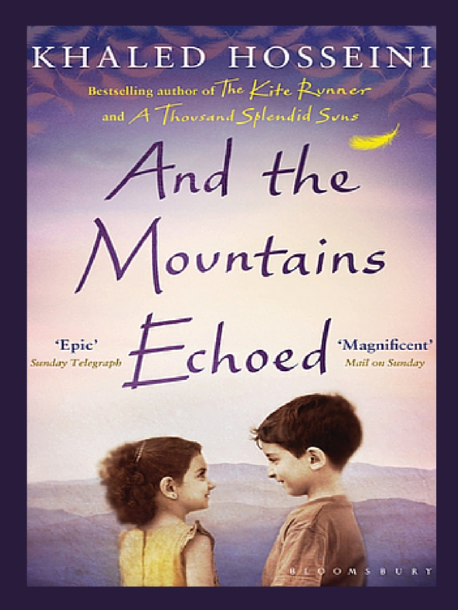
 

And The Mountains Echoed


and the mountains echoed


Out beyond ideas
of wrongdoing and rightdoing,
there is a field.
I’ll meet you there.

Khaled Hosseini’s book, And the Mountains Echoed, opens with this poem by Jelaluddin Rumi. When I finish reading, I think I know what informed his choice. But what do we really know about each other?

Two sisters, Masooma and Parwana, are sitting on a branch high up an oak tree, their feet dangling. Parwana has always lived in the shadow of Masooma’s exceptional beauty. Life is like that, we are not gifted equally. Beauty is an enormous, unmerited gift given randomly, stupidly1. Parwana is in love with a boy who is in love with Masooma. Life is like that, the heart often wants what it cannot have. Love isn’t always requited in the measure it is given.

When Parwana discovers that, the boy she secretly loves plans to marry Masooma, she shakes the branch and Masooma slips off it. In those seconds of clarity we all have after we set an impulsive destructive course in motion, Parwana tries to save Masooma. Too late. Masooma loses the use of her legs and becomes an invalid. Parwana’s penance is to care dutifully for her sister in rural Afghanistan in the forties. It is gruelling work. Her devotion is one long unspoken apology.

Betrayals play out in different forms in the book. There are tsunamis of cause and effect sweeping through generations. Hosseini, in my view, shows us what is in the human heart. He shows us that . . . human behaviour is messy and unpredictable and unconcerned with convenient symmetries2. I find myself suspending judgment each time. When I read these words, something clicks.

I have lived a long time, . . . and one thing I have come to see is that one is well served by a degree of both humility and charity when judging the inner workings of another person’s heart3.

In each scenario, I ask myself what I would have done. Without the pressure of the moment and with the benefit of hindsight, I weigh my options and choose noble actions. This game I play, read and reflect; it is easy. My life has not been a journey of reasonable actions. I understand every character’s dilemma. I understand their choices even when I don’t approve of them.

Eventually Masooma decides to give Parwana a gift, freedom. She decides to die in the desolate endless expanse of sand and mountains, abandoned on the ground under the darkened sky, cold, and drugged out on a potent mixture from the hookah, with Parwana’s help.

I ponder the nature of Masooma’s gift—freedom, at what cost to Parwana’s conscience? Although she presents it as self-sacrifice, I wonder if it is not self-serving. But such is Parwana’s devotion that she leads Masooma to her death. Of course, the man who Parwana loves, who was in love with Masooma, (but married someone else), is now looking for a wife, having been recently widowed. Can unspoken wishes twist the hand of fate or are we master chess players?

After Parwana reluctantly leaves Masooma to die, trudging back home, she hears something, maybe the wind calling, “Don’t leave me, sister. Come back.”

I tell myself I would go back. Parwana does not. She reasons that nobody will know, just as no one knew about the branch of the oak tree. She has lived with secrets all her life.

For nearly 500 pages, Hosseini shows us the subtexts of our hearts, the subplots that drive our actions, like an onion, he peels layer after layer exposing, in my opinion, our capacity for self-deception. Even with a moral compass, anyone can make black white. The characters are achingly familiar to me.

And the Mountains Echoed, is not about Parwana and Masooma alone. If I have made it seem so, I have done a disservice to Hosseini’s masterful story telling. It is about Saboor, Abdullah, Pari, Nabi, Suleiman, Nila, Idris, Timur, Roshi, Markos, Thalia, and many others, including you and me, a collage of stories linked by strong and weak threads. They have had their time. We have ours now. When the mountains echo, I hope we heed its silent meaning.

Out beyond ideas
of wrongdoing and rightdoing,
there is a field.
I’ll meet you there.

Does such a place even exist?


©Timi Yeseibo 2015


  1. Hosseini, Khaled, And The Mountains Echoed, (London: Bloomsbury, 2013), 378.
  2. Ibid., 378.
  3. Ibid., 124.


Unauthorized use and/or duplication of this material without express and written permission from this blog’s author and/or owner is strictly prohibited. Excerpts and links may be used, provided that full and clear credit is given to Timi Yeseibo and livelytwist.wordpress.com with appropriate and specific direction to the original content.
 

Collaboration: You and Me

collaboration

Collaboration. Holistic Wayfarer showed me how it’s done by inviting me to write a blog post alongside her and Nida S., another writer. An African proverb says if you want to go quickly, go alone, if you want to go far, go together. I went farther this year, because you journeyed with me.

I overcame fear of rejection and what-ifs to approach you, virtual stranger, virtual friend. I told you that I admire your writing and I would be honoured if you shared your perspective on a series I’m doing. And when that didn’t work, I pursued you—busy you, you that hadn’t written in a while, you that was between jobs, cities, homes. Determined not to say your no for you, I ‘harassed’ you until you said, “Yes, Timi!”

From each writer, I collected kernels of truth, after you wooed and wowed me with your words. Someone noted that humility is the common thread that runs through the Learning Series. Indeed, to learn, you must first admit that you don’t know.

The Learning Series was not the only collaboration I did this year. We wrote about age, the love languages of Nigerians, and love for country. The writers took my ideas and ran as far as Australia, danced above and below the Equator, and soared to Canada; yes farther than I could go. The result? A clash of hues softened by the spaces where we glimpsed your heart.

I opine that to write an effective personal piece, vulnerability must become like meat and potatoes. The writers delivered that quality, the ability to be open and yet closed, to be known and yet not known, to lie next to someone and yet not touch. Perhaps I reread your pieces and the comments that followed, to decipher your face in the dark that I might recognize you by light. These collaborations were shared over 150 times on social media, the power of your network not mine. You took me further.

In putting your stories and mine together, my joy at editing surpassed my joy at writing. I questioned if my writing was not merely a platform to pull other writers together to present the world with an anthology, all the stories of humanity in one place. I played with this notion until I met a ‘secret’ reader at an event. The usual pleasantries segued to the question of what I do.

“What do you blog about?”

I sized him up. Nigerian. Early thirties. “Let me show you.” I navigated to, Running in the Airport. “See,” I said, letting him read from my phone, “This kind of stuff.”

“Oh, I’ve read that before, hilarious! Someone sent it to me. So you’re the one who wrote that, he asked, looking at me. “You look . . .”

“Different,” I offered, aware that the photo on my blog was taken about three years ago.

“More beautiful in person.”

The charmer. If I were doing a sweepstake on my blog, I would skew the results so he would win.

“And you sound so . . .  so . . .”

“Ordinary?” I offered again.

“Yes,” he replied, shaking his head. “After reading all that big grammar you write . . .”

Right there, his laughter clambering over mine, I began to write a blog post in my head.

Our laughter reminded me that my collaboration with readers either through the comments or in real life has also taken me further than I dreamed possible. Writing gives me visibility. It is wonderful to meet and know people beyond the page.

Happiness is transient for me, until I celebrate every phase of my journey. It is true what they say; the grass is greener on the side where it is watered. In 2014, my blog was a beautiful place to be because of you.


If I have seen further it is by standing on the shoulders of giants.
 Isaac Newton


©Timi Yeseibo 2014

Unauthorized use and/or duplication of this material without express and written permission from this blog’s author and/or owner is strictly prohibited. Excerpts and links may be used, provided that full and clear credit is given to Timi Yeseibo and livelytwist.wordpress.com with appropriate and specific direction to the original content.


Did We Do Any Learning? [4]


know thyself


A Small Sacrifice to Make

I love December. Although I miss the sunlight of the longer summer days, I try to embrace the darkness of winter, because it forces me to re-focus; focus on me, my life, my house, my work, my family, and my friends. I see this month as an end and a beginning, a time to evaluate the past year and to think about the future.

This year has been very emotional with some considerable lows and some exhilarating highs. I fell for the wrong guy and was faced with the task of mending the pieces of my broken heart.

The most important thing I have learned this year is twofold. I saw a quote, I can’t remember where, but thankfully, it stuck in my head and in my heart: “Be strong enough to let go and be patient enough to wait for what you truly deserve.”

Repeating this mantra over and over gave me strength to make choices and say goodbyes that aided my wellbeing. It helped and is still helping me feel and truly believe I deserve the kind of stuff for which patience is a small sacrifice to make.


Gertie Janine Fransens makes her home in Amstelveen. When not working or enjoying books, movies, and music at home, she likes to go out, have a drink, get to know new people, and dance like nobody’s watching.


Table for One

The wind whipped my hair as I walked along the alleys of the Centrum. I smoothened my hair before I pushed the door open.

Poised, I said, “I have a reservation for two . . .”

“This way please.”

Twenty uncomfortable minutes followed.

The text came in after I sat: runin late b dere in 5.

When the third waiter asked if I wanted to order; if someone was joining me, I answered, “Yes, they’re coming!” and reminded myself to take the edge off my voice.

I refused to lose myself in Khalid Hosseini’s, And the Mountains Echoed. I refused to “smoke” my 21st century “cigarette,” that is, play with my smart phone. I sat, elbows off the table, admiring the oriental décor in the cozy setting. I played the which-couples-are-dating-married-fighting-game; and then watched the long and short hands of the clock.

Because I didn’t fill the void, (to prove what exactly?), I felt as though every eye was on me, every conversation was about me; my aloneness fingered with naan bread, forked and knifed with lamb tikka masala, and spooned with kulfi.

I had heard about a restaurant in Amsterdam, EENMAAL, billed as the first one-person restaurant in the world, and an attractive place for temporary disconnection. I had scoffed at the idea. Wouldn’t people rather eat alone in a normal restaurant? As I sat by myself, trying to be brave, I ate my words.

I write alone.

I create alone.

I think alone.

I can shop alone.

I can travel alone.

I can go to the cinema alone.

It catches me by surprise; I cannot eat dinner alone in a restaurant.

I am not as self-assured and independent as I thought I was. And, it’s okay.


Timi @ livelytwist


Unauthorized use and/or duplication of this material without express and written permission from this blog’s author and/or owner is strictly prohibited. Excerpts and links may be used, provided that full and clear credit is given to Timi Yeseibo and livelytwist.wordpress.com with appropriate and specific direction to the original content.



Hard pressed on every side

To understand Nigeria, you must appreciate how religion colours every aspect of our lives and infiltrates nearly every conversation. There is a god of Nigeria, he is the carrot and the stick, and the final bs, that’s bus stop, by the way.

“Like soap that glides through wet hands, we use religion to evade the grasp of accountability time after time. From Aso Rock to Ajegunle, religion is courted, invoked, and brandished as if it is a determinant of GDP and as if, according to Karl Marx, it is the opium of the people!”

Tolu Talabi aka Naijarookie, doesn’t get enough credit for making me laugh. I hope you’ll laugh as well, and if you’re like me, untangle the many levels of ‘spirituality’ unfolding in his tale. Enjoy!


Originally posted on Nigerian Newcomer

Most of the businesses in Nigeria have an office gofer. Someone who can run errands for the staff, pick up food, clean a spill, make a cup of tea. Usually this person has an official designation, they might be the security guard or the cleaner. But when they aren’t opening gates, they hang around and wait to be summoned.

The person who does this at my office is a girl called Esther who is always taking days off to write exams. She would say, “I won’t be around next week, I’m travelling to Ibadan to do WAEC.” Or “I have JAMB on Saturday, I have to attend lesson.” You’ll see her sitting in the corner reading Literature-in-English past questions, or squinting at an Accounting textbook. One day it was a Chemistry practicals textbook, I had to ask.

She laughed, “Haha, all these subjects? It’s not for me, I’m doing the exam for other people.”

View original 628 more words.


Related Posts on Lively Twist:

By God’s Grace

Your Enemies Shall Never Succeed

Mommie Dearest

Others:

The Business of Worship by Jide Odukoya: It is hard to reflect objectively on the proliferation of Churches in Nigeria. View original photo commentary with 192 more words.

Bus 281

Bus 281

The bus driver did not look at me when I entered the bus. I spared him a glance as he sped away from the bus stop and grabbed a red pole to steady myself before I flopped into my seat.

“Sorry,” I apologized to the man on the window seat when I regained my balance and saw what my lipstick had done to his sleeve.

He shrugged and smiled.

Whenever we approached a bus stop, we lurched forward as the driver braked, and we fell backwards as he accelerated again. No one got on the bus.

At the intersection between Park and Jacob Street, a grey Toyota on the opposite lane anxious to beat the red light, navigated a left turn. But it was caught in the middle of the road, in the path of our angry bus. The bus driver brought the bus within scratching distance of the Toyota. The Toyota driver inched further left. The bus growled and heaved. I felt the faltering bravery of the Toyota driver. Chatter climbed a few decibels.

Vroom, vroom, vroom! The bus driver’s impatience bellowed from the engine.

“Go! Go! Go!” the passengers cheered and clapped, with necks extended.

The lights turned green, and the Toyota rolled into Jacob Street just as the bus charged forward. I fell back in my seat and began to breathe again.

Five hundred metres before my stop, I pressed the button. The buzz pierced the chatter and the display flashed, STOP, in the monitor overhead. Moments later, I stood and held a red pole to brace myself, but the driver rode past the bus stop.

The passenger sitting beside me called out, “Chauffeur!”

More passengers called, “Chauffeur!” and then chanted, “Chauffeur! Chauffeur! Chauffeur!” stamping their feet to match the two syllables in the word.

Eventually the driver swerved towards the kerb. Passengers rose and shambled to the door like zombies. The driver lowered the belly of the bus, and the door puffed before opening. Twilight had bowed to a moonless night, and we were in the middle of nowhere.

“The world is full of crazy people. Get out while you can,” called the driver.

My feet developed roots, and I watched all the passengers except the man I sat beside, file out of the bus. They wore pale blue tops and trousers. He nudged me, and we got off together.

The passengers in pale blue led the way. Their voices floated and filled the night. In the absence of buildings and street lamps, the tree branches were monsters looking on. Reprieve from the darkness came from a dim signpost where the passengers melted into the shadows. I read the sign, National Psychiatric Hospital, and we quickened our pace. His presence by my side, kept me from running. The next bus stop was still ahead.

The bus stop, a pole with a twisted metal sign, offered no protection from the night. I checked my phone. The battery was dead.

“Mine too,” he shrugged.

Darkness stretched time like fitted sheets that are too small. I stifled the urge to pee. The wind whistled through the leaves.

“Did you hear?”

“What?” I replied.

“I thought I heard my name,” he turned in a semi-circle.

“Me t . . . t . . .  too.”

We huddled closer. Then he started singing, “Love is like two dreamers dreamin the exact same dream . . .”

“Nightmoves, Michael Franks,” I mumbled.

“Marry me,” he whispered.

The leaves answered the wind, “Whooosh!” and fell to the ground.

But the wind whistled back in hot pursuit gathering leaves in its arms and spinning them round and round. Some leaves broke free and circled our feet. Something in the pit of my stomach churned.

The music begins and the titles fade in, starrin’ you and me. The hero is struggling to say that his lady is far away in her prison of wishes . . . ,” he continued singing.

Headlights appeared in the distance. I moved as far out to the edge of the road as I dared and waved.

“Marry me!” his voice was urgent.

The thing in my stomach grew. My chest rose and threatened to pop the buttons of my blouse. I darted to the middle of the road and waved my hands with all my might.

Two yellow eyes flashed twice, cutting through the darkness. The sound of the engine grew louder. I ran to the side just as the bus screeched to a stop, lowered her belly, and the doors swung open. I clambered in and willed the driver to read my eyes.

“Close the door!” I screamed.

“Aha, the world is full of crazy people, get in while you can,” he smiled and sped away.

I turned and watched the passenger singing and dancing as his pale blue form retreated into the darkness, then flopped into my seat. I closed my eyes and opened them when I started breathing through my nose again, grateful for street lamps. By now, the bus was ambling over the cobblestones of the deserted shopping district. I saw our reflection on the floor-to-ceiling windows and squinted to read the inscription on the side of the bus, Bus 281: Property of The National Psychiatric Hospital.

“Honey, just marry the idiot already. One of these days he’s gonna tire of the game and find someone else,” the bus driver caught my eye in the rearview mirror and winked.

I looked at his shirt, pale blue. I looked down at my blouse, pale blue. I fainted.


©Timi Yeseibo 2014

——–

Michael Franks, Nightmoves, from the album, The Art of Tea.

Image credit: illustrations from Microsoft


Unauthorized use and/or duplication of this material without express and written permission from this blog’s author and/or owner is strictly prohibited. Excerpts and links may be used, provided that full and clear credit is given to Timi Yeseibo and livelytwist.wordpress.com with appropriate and specific direction to the original content.