Riposte: To Catch A Fly

quote men

Ife Nihinlola’s article follows from last week’s dialogue between two girlfriends about the ‘elusive’ boyfriend. He creatively presents the viewpoint of the said boyfriend. Read last week’s post here.


Riposte: To Catch A Fly


“So, talk to me. How did it go?”

“Fine.”

“What is fine? I said how did it go?”

“Fine na. What else do you want me to say?”

“Don’t even start. I didn’t cover for you so you can come back here with fine. Abeg, tell me the full story. What did you guys do?”

“We didn’t do anything, really. I headed to her place after leaving work and called her when I was close to their estate, telling her I was in their area.”

“Hmmm, smooth . . .”

“Not smooth anything. I just didn’t want her to think I’m desperate. You know how, at a certain age, a single guy in church is the symbol of desperation.”

Oga Christian, na you know that one. So were you telling her all these grammar, or did you ask her the main thing?”

“Well, her brother and I were discussing Messi and his tax, and it took a while before he finally left the living room. Then she offered me semo and edikang ikong.”

Chai! See better wife material.”

“But she didn’t cook the soup o. I asked and she started laughing, and I thought I really blew it by asking a stupid question. Then she continued to laugh and I joined her. It was a little weird sha . . .”

“After that?”

“We talked about everything and then nothing. Again, I didn’t want to appear too desperate.”

Oga, after inviting her to, how many seminars now, six, seven? You’re saying you don’t want to be too desperate? Have you even asked her out properly?”

“It’s not like that? The question is not whether I’ve asked her out properly. It’s if I’m ready to ask her out.”

“Are you kidding me? At twenty-nine, you’re not sure if you want to ask her out? Do you think she’s ugly? Are you preserving yourself for Agbani Darego?”

“What kind of question is that?”

“So what are you waiting for?”

“Remember the last time I went out with that girl from the 45th floor and she suddenly started to talk about children and houses and family?”

“Hahahaha!”

“There must be something about candlelight and soft music and wine that makes people think it’s okay to share everything. She doesn’t even greet me at lunch anymore, so that means I must have said something stupid that night.”

“True. Your mouth can be a loose canon.”

“I’m trying to avoid that, so let’s hope I’ll be able to invite her for a date at the seminar.”

“Another seminar?”

“Yes na. That’s my excuse to see her again before the week runs out. I don’t even know if I’m doing this because my mother is always reminding me that she’s seventy-eight and life expectancy is fifty-three and I’m her only son . . . What do you think?”

“Me? What’s my own in this matter? I already have a pregnant wife, and I’m just three months older than you. What do you think I think?”

“You’re not being of help right now.”

“My friend, ask the lady out properly and go and marry.”

“You’re assuming she won’t say no.”

“If you can’t tell that a lady who has survived seven seminars and a silly visit already likes you, maybe your case is just hopeless. I’m going to my cubicle!”


©Ife Nihinlola 2016 @ IfeOluwa’s Rambles


©Timi Yeseibo 2016

Unauthorized use and/or duplication of this material without express and written permission from this blog’s author and/or owner is strictly prohibited. Excerpts and links may be used, provided that full and clear credit is given to Timi Yeseibo and livelytwist.wordpress.com with appropriate and specific direction to the original content.
A Space Too Little Explored [3] P.S. I Love You

p.s. i love you

Every man is trying to either live up to his father’s expectations or make up for his father’s mistakes.

P.S. I Love You

I do not visit my dad often enough. I blame it on the terrible state of the road from Lagos to Ibadan. My dad and mum are sympathetic. “I know, it’s okay,” my dad usually says whenever I call on a public holiday to explain why I did not visit. Sometimes, I can tell from his tone that he is disappointed. When the reconstruction work on the Lagos-Ibadan express road is completed, I will no longer have an excuse. I hope I will not need one.

Last weekend, I made the 140km trip to Ibadan because my dad turned seventy. We had thanksgiving mass at church and a get-together at home afterwards for close friends and family. My dad had insisted he didn’t want a party. He has never been one for extravagance, and he deliberately avoids the spotlight. I watched with disbelieving eyes, his resplendent agbada[1] swaying in the gentle breeze as his deft footwork kept pace with the music. His smiles swallowed the years written on his face. I thought he would stop when my mum tired and left. He didn’t. I realised, at that moment, that we should have ignored him and thrown a big bash anyway.

Like his birthday party, my relationship with my dad has been full of contradictions. Growing up, I didn’t understand why he was so conservative, eschewing little luxuries and why his work was all that seemed to matter to him. We grew apart in my teenage years. I withdrew into my world and shut my dad out of it. He didn’t understand why I was insistent on doing everything my way, why I never shared my dreams with him.

I don’t have any fond childhood memories in which my dad features. He didn’t teach me how to ride a bike. We didn’t spend evenings playing video games together. If he gave me piggyback rides, I must have been too young to remember. My two-year old son often protests when I smother him with hugs and kisses. My wife says I overdo it. I have no intention of tempering it. Am I only clowning about or is the effusive physical affection I display for my son the antidote to the intimacy I have never had with my dad? It is easier to tell my son I love him than to say those same three words to my dad.

Even today, I am unable to reconcile how my dad and I can be so different. But my wife often reminds me that I overstate our differences and that there are more ways in which I am similar to him than I am willing to acknowledge. My dad is a medical doctor. I admire his work ethic and dedication to his patients. His love for God and compassion for others impress me. In these areas, I aspire to do better; I would be proud to equal his accomplishments.

Long after the last guests had left, I sat in the living room with my dad, our conversation laced with restraint. I realised, during the intermittent quiet spells, that I do not need him to be like me or to be the kind of dad I imagine perfect fathers are like, to appreciate that he has been a good dad. There and then, I cherished the opportunity to visit my dad.

The greatest distance between two people is misunderstanding. My dad and I are talking more than we have ever done. We cannot make up for the lost years, but we are finding our peace in the present.

Dad, I am proud to be your son, in other words, I love you.


Olutola Bella is a lawyer. He blogs @ bellanchi.wordpress.com

_____________________

[1] Agbada: A long, wide-sleeved flowing gown, often embroidered, worn by men in parts of West Africa, especially Nigeria. [Credit: Oxford dictionary]


©Timi Yeseibo 2016

Unauthorized use and/or duplication of this material without express and written permission from this blog’s author and/or owner is strictly prohibited. Excerpts and links may be used, provided that full and clear credit is given to Timi Yeseibo and livelytwist.wordpress.com with appropriate and specific direction to the original content.

A Space Too Little Explored [2] No Scorecards

no scorecard

Every man is trying to either live up to his father’s expectations or make up for his father’s mistakes.

No Scorecards

My father married my mother after the death of his first wife. That marriage produced a son I would know as my senior brother later in life. My father and mother moved to Lagos from his village in Yenegoa around the late 1930’s. They lost their first son, who would have been my elder brother.

My father joined the army and participated in the second world war of 1939 to 1945. I was born around the beginning of the war. After he came back from the war in 1945, I came to know him as my father. My two junior sisters were born in quick succession. Arrangements were made for me to attend primary school. My left arm was raised over my head to see if it could touch my right ear to determine my readiness for school.

Sometime later, we moved to my father’s village. There, my father built a house for my mother and her children. He did not live with us. He married another woman and from that point on, he neglected my mother. She moved to her village with my sisters because she could not accept the situation. Since I was in school and my father was paying my fees, I could not leave with my mother. I stayed with my grandmother, who cared for me. During the holidays, I went to the farm with her and I went hunting with an uncle.

After a few years, my father said he could no longer pay my school fees, so I left his village where I lived with my grandmother and went to live with my mother. During this period, my uncle who worked at UAC in Burutu requested someone to assist him at his home. I was chosen as the only suitable candidate. However, once I arrived Burutu, he left me with his mistress who was a trader. I again attended school and went to her shop in the market after school. My uncle spent weekends with her, which were the only times I saw him.

He moved from Burutu to Sapele and then to Warri because of his job, and his mistress and I moved with him. When I gained admission to Government College Ughelli, my uncle said he could not afford my tuition. His mistress, who had now become his wife, persuaded him to continue paying. He did. However, when I reached class 3, he stopped. I looked for sponsors to no avail. I wrote the resident, as governors where then called, in Warri intimating him of my plight. Although I did not receive a reply from him, the school asked me to return. That was how I completed my schooling in 1958 without paying any further fees.

Is every man trying to either live up to his father’s expectations or make up for his father’s mistakes?

So much time has elapsed that it is not now easy to put in proper perspective what my reactions were at the time and how they may have affected decisions I have had to make subsequently. I did not see my father after I left home. My uncle with whom I spent most of my adolescent years was a disciplinarian who was not easy to please. He was relieved when I finished school and did not hesitate to mention that my training up to that point was the legacy he was bequeathing to me.

In those days, not educating a girl child was normal. So a father’s decision not to send his son to school was regarded as his business and not subject to any misgivings. Polygamy features in Nigerian society, even today.

Against this backdrop, I want to accept that those who raised me, particularly my uncle, did their best. Because we lived in close-knit communities, role models were not difficult to find. In the twilight of my life, I am not keeping any scorecard. From a young age, I meant to take my destiny in my hands. The challenges I faced served as vehicles en route my destination.

At the time my wife and I had children, it was the vogue for parents to train their children to whatever level they could attain. We were reasonably well-off and ensured our daughters received a good education. Although I do not see numbered dotted lines linking the trajectory of my life as in a colouring book, perhaps, subconsciously, for I do not remember thinking this way, I was trying to do better than my father had done. Posterity will tell.


Aeneas carried his aged father on his back from the ruins of Troy, and so do we all whether we like it or not, perhaps even if we have never known them. – Angela Carter.


A.C. Yeseibo is a retired banker. He makes his home in Port Harcourt with his wife and enjoys spending time with his children and grandchildren.

P.s. I am honoured to share my blog stage with my dad. Years ago, he wrote me a letter that has frayed at the ends and torn at the fold. Reading and rereading the letter through the years, his writing style became my own.


©Timi Yeseibo 2016

Unauthorized use and/or duplication of this material without express and written permission from this blog’s author and/or owner is strictly prohibited. Excerpts and links may be used, provided that full and clear credit is given to Timi Yeseibo and livelytwist.wordpress.com with appropriate and specific direction to the original content.

A Space Too Little Explored [1] When I’m Gone

When I'm gone

Every man is trying to either live up to his father’s expectations or make up for his father’s mistakes.

When I’m Gone

My father was not what my kids refer to as the African dad. By that, I mean he knocked before entering the room I shared with my older brother when we were growing up and he never opened any letters addressed to my siblings or me. He took us out to play football regularly. My father said please before he sent us on errands and thank you when we returned. He called me, young man and all of this made me feel respected.

He was a disciplinarian who stuck to his words. While playing football in the living room one day, I broke a glass frame. He calmly said, “You will not be going with us on the trip tomorrow,” referring to the family trip to Yankari Game Reserve, Bagauda Lake, and Tiga Dam, which I had looked forward to for weeks. Because of his summary judgements, which we could not appeal, we jokingly called him commander-in-chief-with-immediate-effect.

The memories of his many when I’m gone sayings eclipse all others. One time, my mother said, “You keep going on about, when I’m gone, when I’m gone, are you very keen to die?” But so focused was he that he did not relent. He replied, “You all will remember everything I said when I’m gone.” There it was again, another when I’m gone saying! He was right. As I prepared to leave my previous job, a colleague told me, “I will miss you, but I will miss the stories about your dad even more.” I was surprised, as I could not recall saying that much about my dad.

I realize now that my father was not obsessed with death; he cared deeply about his legacy. Like a good leader, he was raising successors to advance what he believed in. At every opportunity, he passed on the baton of leadership.

I do not recall my dad ever calling in sick; he worked hard all the time. I am the same way. Although I have always had jobs I enjoy and never experience Monday morning blues, I wonder if I am just being me or if I inherited his work ethic. Is work my way of saying watch me daddy, I’m being just like you?

I am running my section of the relay race. Sometimes doubts crowd my lane. My father always seemed to know what to do or say in a situation. Am I being a well of wisdom my children can drink from? Am I still holding the baton or have I let it slip as I race through life? I hope my children see me the way I saw my dad. I desire to pass the baton to them too.

Reacting to my pragmatism about life especially material things, my wife once said, “You are just like your dad.” She compared me to a father-in-law she had never met. Like my colleague, she had seen him come alive in the stories I had unconsciously woven into the fabric of my life. It remains the best (unintended) compliment I have ever received.

William Shakespeare said, “All the world’s a stage, and all the men and women merely players: they have their exits and their entrances; and one man in his time plays many parts, his acts being seven ages.” My father has never left my stage. He has been there all along.

Before he passed on, dad gave us the words he wanted inscribed on his headstone: Here lies M O O, who in his own life, tried to serve humanity and make a part of the world a better place. I pray my family says the same about me, when I’m gone.

Ayo Ogunsanlu makes his home in Essex, UK with his wife and three kids. He enjoys microbiology, running, and housework. On Facebook, he describes himself as a faithful and loyal friend.


©Timi Yeseibo 2016

Unauthorized use and/or duplication of this material without express and written permission from this blog’s author and/or owner is strictly prohibited. Excerpts and links may be used, provided that full and clear credit is given to Timi Yeseibo and livelytwist.wordpress.com with appropriate and specific direction to the original content.
Stats, Guest Posts, and Audiences

stats, guest post & audiences


The quickest way to go where you have never been is to find someone who has gone where you want to go.


If what they say is true, that your potential audience reach spans people ten years younger and older than you are, most people who read Livelytwist are in their thirties, forties, and fifties. I do not know for sure. The implication for reaching broader audiences including people in their teens, twenties, sixties, seventies and beyond, may be a change in style.

An acquaintance signs off her emails with these words, star differs from star in splendor. I have thought often about what they mean. If our lives are our message to the world, then our vocation is our platform. I believe that our experiences, location, age, race, gender, talents, and so on, position us to reach certain audiences. That only some are able to cross the barriers that separate us, innately or through learning, and have, more mass appeal than others do.

This past blogging year, Livelytwist’s total number of blog views was lower than the previous year, but I witnessed a shift in the type of blog articles that received the highest number of views. In the past, articles, which I wrote received the most views. Last year, the top five articles viewed, apart from the ubiquitous Open Letter to Akpos—search engine terms must bring Akpos seekers to my blog—were articles that others wrote for my blog. In order of most views:

Hardwired For Sorry [3]
Think Like a Man, End up Without One [1]
Hardwired For Sorry [5]
Think Like a Man, End up Without One [2]
Shifting Gears [6]

Storytelling is an effective means of communicating with a diverse audience. As much as I enjoy writing, I do not possess the authority or authenticity to tell all the stories I want to and therefore reach as many people as I would like. As William Faulkner noted, “A writer needs three things, experience, observation, and imagination, any two of which, at times any one of which, can supply the lack of the others.”

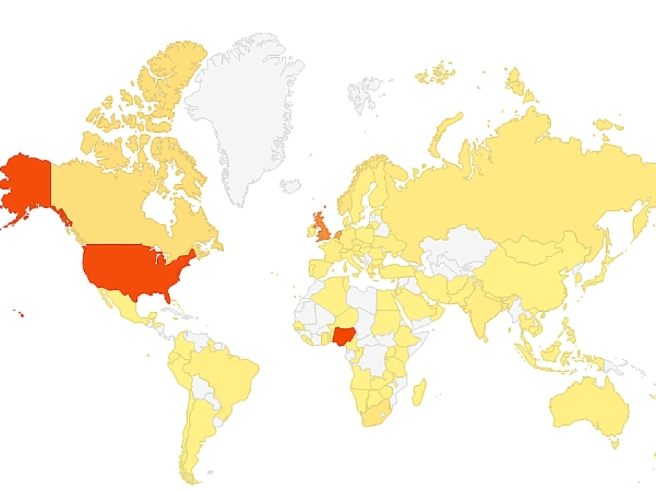
By sharing my blog stage with others, Livelytwist gained more universal appeal. At least one teenager and one writer in his seventies contributed an article to a blog series last year, as well as writers in every other age category in between. At least one person in every continent, in 125 countries, viewed Livelytwist in 2015, up from 115 countries in 2014. Guest writers shared the stories they wrote for Livelytwist on their social networks, engaging audiences I may never have reached.

world stats 2015


country stats 2015

After I ran a series on my blog that featured other writers, a reader scolded me for not writing my own stories. I understood her loyalty, the queasiness, which occurs when vision expands and threatens the status quo; as if I would abandon my blog. I explained that I conceptualized the series, handpicked the writers, and in some cases edited their stories. Then I sent her the links to a couple of stories I had written as part of the series.

What do my stats tell me? Numbers sometimes mean little. Perhaps they confirm something I wrote in my notebook years ago—I want to tell other people’s stories. I am getting closer to that dream, am I not? And it is because you said yes to sharing your story on my blog.

Thank you!


© Timi Yeseibo 2016


Unauthorized use and/or duplication of this material without express and written permission from this blog’s author and/or owner is strictly prohibited. Excerpts and links may be used, provided that full and clear credit is given to Timi Yeseibo and livelytwist.wordpress.com with appropriate and specific direction to the original content.

Choosing Motherhood [2] A Daughter of My Own

baby shoe

I scarcely told anyone about my decision to adopt a child. Although I felt the decision was right for me, questions gnawed at me. Moreover, I did not think people would react kindly to a forty-something-year-old unmarried female adopting a baby; Nigeria is a patriarchal society steeped in tradition. I shared the sentiments of whoever coined the saying: give me the benefit of your convictions if you have any, but keep your doubts to yourself for I have enough of my own.

A few years prior, I overcame my fear of surgery and finally scheduled an operation to remove the fibroids in my womb. After the myomectomy, my doctor gently told me, “Nature abhors a vacuum. You should get pregnant soon.” His words stirred buried desire. I wanted to be more than the best-aunt-ever or best-godmother-ever, two roles I cherished. I longed to be the best-mum-ever.

Two years after my myomectomy, I was no closer to realising my dream of having children under the conventional umbrella of marriage. My anxiety over not having a family increased.

Do sperm banks exist in Nigeria? I don’t know, but a couple of friends offered to father my child. I weighed the complications such an arrangement may present in future and declined. I went to a fertility clinic to enquire about IVF treatment. They asked, “Have you and your partner been trying consistently for up to a year?” I laughed, as I did not have a partner. They recommended I return after my partner and I had tried unsuccessfully for a year.

As time rolled by, all I heard was tick tock ringing in my ears. Even the most self-assured woman would be tempted to ask, “What is wrong with me?” About twenty years earlier, my friends at university had tipped me as the one most likely to marry and have kids first. Life, it seems, did not get the memo. Nevertheless, I still believe I owe myself better than settling with just any partner for marriage sake.

During a holiday abroad, my sister suggested adoption. The idea was novel to me and I toyed with it until I accepted it. I returned to Lagos, thinking of all the babies in orphanages who need parents and rushed to one to find my child.

However, it wasn’t that simple. Lagos state government has an adoption process and a screening procedure. There is also a long waiting list and I had no idea what number I was on the list. While the waiting period can seem long for anxious parents-to-be, I appreciated the forward thinking of the state ministry of youth and culture in preparing parents and adopted children for a new life.

Months later, I was invited to meet baby Folasade. She was a few days old, beautiful, light complexioned, and long-limbed. I fell in love with her immediately. She smiled at me each time I spoke to her as I held her in my arms. Later the orphanage staff explained that babies do that when they are experiencing stomach gripe!

Due to the Lagos state doctor’s strike at the time, she had not undergone medical check-up. She barely opened her eyes and mucus oozed from one eye. I arranged private medical care. The doctors confirmed she was born HIV-positive. I refused to leave her side. The social workers, doctors, and psychologists cautioned me about attachments, which form while bonding and advised me not to set my heart on Folasade because of her condition. I could not; to my mind, she was already my daughter. That weekend they moved her to an undisclosed orphanage where she could get special care. My heart broke.

During my visits to the orphanage, a three-year-old boy always ran to meet me and we became close. He had two sisters. Lagos state has a policy of not separating siblings where possible. I prayed that a family would adopt them all. He was not attending school because he didn’t have sponsors so I organized a successful charity campaign to pay for his schooling.

My heart still bled for Folasade and I wondered what became of her and other babies like her. Should I have fought harder for her, disregarding professional counsel and insisting on an exception to policy as the state would not put her up for adoption? Biological parents do not get to ‘pick’ their kids, but in a sense, parents of adopted kids do.

Sometime later, I was called to meet a two-week-old baby girl, Alison, who appeared shy and reserved. We did not bond immediately. Maybe she sensed part of my heart was still with Folasade. During the three-month bonding period when I spent every spare moment at the orphanage changing her diapers, feeding her, and talking to her, she avoided making eye contact. Was she testing me? Did she think I would bail?

As I persisted in bonding with Alison despite my confusion, I understood a mother’s fierce love—she loves whether her child responds or not. Coincidentally, I was allowed to take Alison home on my birthday, what a gift!

I was nervous as I gave her a bath, fed her, and cuddled her to sleep. I worried she would miss her regular carers and judge me for the novice I was. Instead, she was patient with me as I navigated our first few days. She barely cried.

Tended gardens blossom. Alison and I learnt to relax. Before long, her eyes followed me everywhere I went. She rewarded me with her beautiful smile more and more and we drew closer still, clinging to each other.

My daughter is now one and a half and it’s a privilege and pleasure to raise her. When I held a welcome party to introduce her to my close friends and family, they showered us with understanding and warmth. I was overwhelmed. Does love differentiate? Could they love my biological child, when I have one, any more than they love Alison?

Tentatively, I posted our photos on Facebook. My friends responded with resounding support, surprising me.

Alison’s birth certificate bears my surname. When people ask about her dad, I smile and reply, “I’m her mum and dad.” I realise that soon, she will ask questions. The pre-adoption counselling organised by Lagos state prepares parents for this inevitability. I still cherish hopes of getting married and having a family like the one I grew up in, with a mother and father.

Alison’s facial features now resemble mine and she displays my zest for life—or has love blinded me? Often, friends look at her and comment that she’s very lucky to have me. I shake my head and say, “No, I’m the lucky one. I am the lucky one.”

Ogo Williams is a banker by day and a mother 24/7. She is an avid Chelsea fan who enjoys meeting interesting people, travelling, and reading.


© Timi Yeseibo, 2016

Unauthorized use and/or duplication of this material without express and written permission from this blog’s author and/or owner is strictly prohibited. Excerpts and links may be used, provided that full and clear credit is given to Timi Yeseibo and livelytwist.wordpress.com with appropriate and specific direction to the original content.

Choosing Motherhood [1] Learning to Dance

Dance

Learning to Dance

I got married at twenty-one. Our first son was born a year later when I was in my second year at the University of Nigeria, studying radiological science. My Parents tried to make me see reasons to wait before starting a family, but the day I stopped breastfeeding my son, I became pregnant with my second son. My husband, Ben, at twenty-nine had lost his job before our first son was born and was still unemployed by the time our second son was born.

My Parents harboured us, providing emotional and financial assistance. Ben was studying for an MBA, while I combined schooling with business, selling anything to support my growing family.

One day on campus, I cried in frustration from exhaustion. I practised exclusive breast-feeding so I breastfed all night while studying. Then I slept for less than five hours and drove to the university every morning. A lecturer tried to talk me into moving to campus and leaving my boys in the care of my parents and their nannies. I declined. I told him being a mother came first. Motherhood had chosen me because every family planning method I tried had failed.

I had few friends because I was the only married girl among my peers. They left me alone to work out my new challenges. I was not socially aware. I never partied and didn’t have fashion sense. Ben and I couldn’t afford to go out like other unmarried couples. I was devoted to my family and I wanted to prove to my parents and everyone else that I knew what I was doing.

By my final year, I was looking forward to moving out of my parent’s home. My dream came true when I landed a job in Lagos using my mum’s connections. Ben and the boys joined me shortly. After a while, I fell sick. To my dismay, I found out that I was pregnant for the third time. I was twenty-six.

I was depressed. We still faced financial pressures and I resented this intrusion to my dreams. I scheduled an abortion although it was against my values. On the day of my abortion, a doctor who is also a family friend disclosed my plan to my mum and she called to discourage me. I cancelled the procedure.

After my only daughter was born, my husband found his bearing. He got a job that enabled us move to our own house in Lagos. I also started a cleaning company that became very successful in no time. While we prospered in career and business, our marriage suffered.

From the beginning, Ben only wanted one child and he had not even wanted a child so early in our marriage. He came from a large family while my family was small and I had always looked forward to having many children. Four years after our daughter was born, we had another son. This put more pressure on our strained marriage. When we moved to South Africa, Ben eventually left me and the children.

It takes a village to raise a child. I could not have navigated my motherhood journey without support from family and friends. Looking back, I see that although I have always wanted to be a mother, I did not plan to be one. Children are precious gifts from God and deserve a home with parents who have lovingly considered the ramifications of their presence. Given another chance, I would choose motherhood in a heartbeat, but would wait until I finish school before starting a family.

My children are now 22, 20, 17, and 13. There is no time for regret only gratitude to God as I watch them mature into adulthood. I tell them that there is time for everything under the sun. We need to give ourselves time to grow and allow school to pass through us instead of just passing through school before settling down.

Motherhood cannot be distilled to a formula. It is a privilege to be embraced and it requires determination and wisdom. I grew up with my children, teaching them respect, compassion, responsibility, and love. They in turn gave me lessons in patience and hope. I am learning about fashion and music from them, practicing the latest dance steps and cool moves with them. We laugh together like siblings, when I go off beat.


Ada Obi-Okafor makes her home in South Africa. She’s a licensed radiographer who enjoys soccer, movies, a good book, and a clean house.


© Timi Yeseibo, 2016

Unauthorized use and/or duplication of this material without express and written permission from this blog’s author and/or owner is strictly prohibited. Excerpts and links may be used, provided that full and clear credit is given to Timi Yeseibo and livelytwist.wordpress.com with appropriate and specific direction to the original content.

A Tale of Two Cities

a tale of 2 cities

I was born in the USA and for as long as I can remember I’ve always felt like an alien who didn’t quite fit in. This is partly to blame, I suppose, on the fact that I was raised in a military family and was constantly pulling up roots and moving every year or so, while growing up. As an adult, I kept up this pattern. I’ve lived in or near some of the largest cities in the U.S.—Houston, Philadelphia, and the New York City area.

I feel comfortable in large cities because they afford me the anonymity that I, an alien, crave. No one looks at you “funny” and as long as you don’t hold a stare for too long, you are left alone.

I recently visited London and Paris. I had long dreamed of visiting these places as they have lived in my imagination for years from reading books. Using the subway systems of Philadelphia and New York City, primed me for the London Underground and the Parisian Metro system.

On one of my many excursions around London, I descended the steps into the underground, and encountered a smiling, red-faced uniformed attendant.

“Hello!” I said.

“Hello!” he returned.

I inquired about the best route to get to my destination.

“Take the Circle Line to Baker Street, transfer to the Jubilee Line. Get off at Southwark and it is only a short walk to the Globe.”

“Thank you!”

“Cheers!”

This was typical of my experience in the London Underground— easy to navigate with friendly attendants and patrons who were willing to answer questions.

When I arrived Paris, I approached a Parisian Metro booth and spoke to one of the attendants.

Bonjour, parlez-vous anglais?”

Un peu.”

Although I did not speak the language, I was able to communicate well enough to find my way using a few words and hand gestures. Perhaps the incongruity of being in a strange land made my existence in Paris somehow congruent. I felt at home at last.

On one of my last days in the city, I sat outside the Café de Flore on Boulevard Saint Germaine, enjoying a glass of red wine. A Frenchman, who took the table next to mine, lit up a cigar, and then glanced in my direction to ask if the cigar smoke offended me.

“Oh, no,” I said, “I understand that people who sit outside often smoke and I am not offended.”

He nodded and smiled. He puffed on his cigar a couple of times and we began chatting, he in perfect English. We talked for a long time about a wide range of events including the recent terrorist attacks. I mentioned the increased security around the metro. He shared that he had just spoken to his daughter who lives in the neighbourhood where the attacks occurred and she felt safe using the Metro System.

“Yes,” he cautioned, “but the police and soldiers cannot be everywhere. You have to be vigilant. In effect, we have to be responsible for our own security.”

While sitting outside, we watched many police vehicles drive by with sirens blaring.

“Something’s going on,” he said. “If a car were to pull up in front of us right now and gunmen alighted and started shooting, what could we do about it? Nothing!”

He was right of course. So I concluded that the French are a little fatalistic about such things.

C’est la vie?

I travelled to London and Paris by myself because I needed time to think about my life and my absurd existence. With only myself for company, I walked the cobblestone streets of Montmartre and the rain-swept pavement of Trafalgar Square in London The encounters I had helped me believe in the possibility of happiness and hope for humanity. A big smile and a hello or bonjour broke down the normal barriers humans erect, especially in urban areas.

You can be anonymous, but by using the universal language of a smile followed by a greeting, you can touch and be touched by the human heart.


A smile is a curve that sets everything straight.
– Phyllis Diller


©Benn Bell 2016 @ Ghost Dog


Unauthorized use and/or duplication of this material without express and written permission from this blog’s author and/or owner is strictly prohibited. Excerpts and links may be used, provided that full and clear credit is given to Timi Yeseibo and livelytwist.wordpress.com with appropriate and specific direction to the original content.

I Hope Someone Calls Them Beloved


oworonsoki by Logor

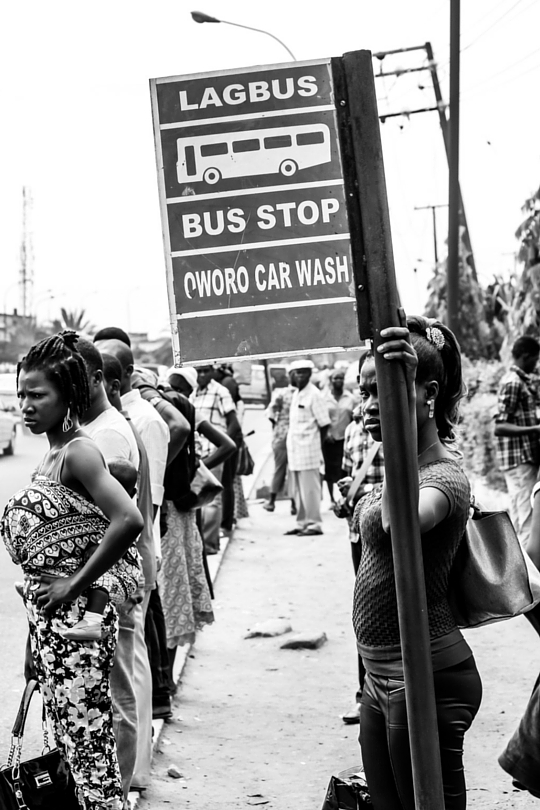
There is something about Lagos, about this human chaos, about entering danfos and crawling into kekes and jumping on okadas and pushing against bodies reeking of sweat while dancing between pungent puddles that makes me wish I could read minds.

Not all lives interest me. Some people are just derivatives of other people, stock personalities coming out of the human conveyor belt, uninteresting in the way I imagine I must be. But a few stand out: fascinating humans who compel me to observe, like the three girls who piled into the bus at Obalende and sat behind me on Saturday.

They wore clothing that strained against their youth. One sat and two lapped themselves. One pleaded with another in Yoruba, telling her she was sorry.

“Let us go to Alhaji’s place,” she said.

The friend replied, “You can go, I’m not going.”

She pleaded again, “I am sorry.”

They repeated this sequence as more people hauled their bodies into the bus. I took a bite of Gala and a swig of Lucozade Boost.

“I said I’m sorry,” she began again.

The third friend was silent throughout this exchange.

The reluctant friend finally gave in, “Okay, we can go.”

Who is Alhaji? Why is the need to visit him this strong a few minutes past 6pm? It bothers me that there is a whole swathe of human experience and emotions I do not have access to. It bothers me that this bothers me.

As we sped along Third Mainland Bridge, the girl who had been pleading so she could visit Alhaji received a call and spoke to a guy who, from what I could gather, was expecting her.

“I’m at home now,” she told him.

She spoke in heavily accented English with some hesitation, which shows the speaker has the basic vocabulary for fluent communication in English, but is actively translating from Yoruba in her mind.

At Oworonsoki, the trio started a Yoruba Christian song, the kind that choristers in long robes chant enthusiastically to the rhythm of gangan. There was so much cheer in the girls’ voices, and they giggled intermittently as we moved on to Oshodi. There, I alighted from the bus and took the overhead bridge. I looked down and saw the three girls walk towards Ilupeju.

I hope one day to have the courage to ask these people for their stories. I want their stories told with care and empathy, in a way that will make me see them, as they are, not just as the world labels them. I hope, somewhere at the end of their journey, there is someone waiting for them who calls them Imzadi* in a way that is not predatory.

____________

*In Star Trek: The Next Generation, Will Riker, Deanna Troi’s love interest, calls her Imzadi, which translates roughly, in the Betazed language as Beloved. It is what she called him the first time they met.

Alhaji: a Muslim (man) who has been to Mecca on pilgrimage; often the title connotes that the bearer is wealthy.


©Ife Nihinlola 2015 @ IfeOluwa’s Rambles
Ife is an avid observer of life in metropolitan Lagos, which he translates into rich ruminations on his blog. Read the unabridged version here.

Photo credit: Owonronsoki by Logor Olumuyiwa


Unauthorized use and/or duplication of this material without express and written permission from this blog’s author and/or owner is strictly prohibited. Excerpts and links may be used, provided that full and clear credit is given to Timi Yeseibo and livelytwist.wordpress.com with appropriate and specific direction to the original content.


Along Came Fences

fences

We lived in a compound of three flats and a boys’ quarter in Ago Okota, Lagos. Ours was a fenced compound, sort of in the middle of nowhere, last on the street and separated from other buildings by an expansive gulf of undeveloped plots of land overgrown with weeds.

A single mother and her three kids lived in the boys’ quarter. Her first son was my age-mate and friend. When I think back to those formative years, I remember the resolute cooperation of two nine-year-old boys who decided to make a bench from abandoned formwork lying about an uncompleted building close by.

For days, we slaved to make a three-legged bench that a parent bought for N10. My friend and I always watched with pride as our siblings and parents sat on the bench in the evenings. We made another, which I marketed to a relative, selling it for N5. I walked for half a kilometre with the bench on my head to deliver it. While making those benches, a rusted nail pierced through my left foot. My mom took me to a nearby clinic to have me treated. The bill was N200.

When we moved to Kaduna, only two houses on our street were fenced—ours and another one down the lane. Our gate was the opaque border bounded by four high walls decorated at the top with broken bottles.

Despite my love for accessing that side of solitude that engages with written words, the part of me forever enslaved to fantasy fed fat on cartoons and I hungered to bring the adventures scripted in them to life. So, during my teenage years, the call of the streets drew me past our gate, to a circus of street hockey, boris, hunting traps, bangers, suwe , and games of catcher with many other children. As dusk fell, I would reluctantly retreat from the big compound that was our street to the confines of the opaque gate.

In the space of two decades, every house on my street has grown a fence. The ‘big compound’ has shrunk away from the backyards, front yards, and trees, which were common property supporting the imaginative expressions of every kid. The evening bustle of legs and screams have vanished. Moreover, kids have now been tamed by big and small screens that keep nagging them, demanding every bit of their attention.

My village is different. Even today, there are no fences. Solitude is alien and greetings and communal assistance are prized. People do not distance themselves from the identity and stories of others who live around the corner.

Fenced houses and gated communities are the norm in cities. We insulate ourselves to feel secure. However, I maintain the premise of one of my favourite lecturers who is a past president of the Nigerian Institute of Architects: the best form of security is communal and that happens when there is a sense that anyone could be watching a thief from a nearby window.


© Samuel Okopi 2016
samuelokopi.com


Unauthorized use and/or duplication of this material without express and written permission from this blog’s author and/or owner is strictly prohibited. Excerpts and links may be used, provided that full and clear credit is given to Timi Yeseibo and livelytwist.wordpress.com with appropriate and specific direction to the original content.

Shifting Gears [6]

Marilyn Monroe

A Leggy Affair

As a teenager, I imbibed ideas about acceptable body shapes from the people around me. So, I believed that a girl’s legs were beautiful only if they were straight like bamboo stems from the knees to the ankles, with no protruding muscles aka yams interrupting the flow.

Well, I inherited my father’s footballer legs, so during my years at university and for years afterwards, I hid my legs underneath trousers and maxis to escape mockery. My insecurity over what I deemed a flaw was like a thing around my neck, choking self-approval out of me.

Like a child force-fed by her determined grandmother, I spent my twenties swallowing popular beauty ideals of the society where I lived. They became the yardstick for measuring myself. I felt inadequate whenever I spotted a pair of bamboo legs. I considered the owner a lucky winner of the anatomy lottery because to me, having straight legs made one outstanding, special even.

In retrospect, that was laughable because straight legs do not shield their owners from life’s troubles. It is not as though those with straight legs can flash their exclusive Bamboo Club gold membership card and Life would say, “Aww, perfect pins, move along then, no troubles for you today. Next!”

Bamboo legs conferred no special advantages that I could see.

Still, at my old gym, when someone complimented my well-defined calves, I had to stop myself from peering at my legs, with lips turned downwards and eyebrows arched, as if to ask, “Me?”

I don’t know how I finally adjusted my beliefs regarding what is acceptable or not acceptable as far as my body is concerned. I suppose that as I approached my thirties, I began to ponder the whys of life even more stubbornly. Moreover, I realized that my legs would never change their shape; in fact, they would become even more muscled due to my new-found love for exercise.

My epiphany hit me like a clap of thunder. I woke up one day and suddenly every leg-concealing piece of clothing seemed revolting. Out went the trousers and maxis, and in came the short girly dresses and skirts that I’d always looked at longingly but felt I shouldn’t wear.

Recently, the instructor at my new gym praised my toned leg muscles; he wished he could devote more time to Leg Day as he assumed I did. I stifled a cheeky chuckle and in my head I sang, baby I was born this way.

Does clarity come with age? Or is this delicious comfort I have found in my own skin, this assuredness, my way of sticking my middle finger at my overdependence on external validation? Perhaps, I now understand that my quest for courage to set my personal ideals begins with embracing the things I am powerless to change.

These days, when I walk into the gym I spend a few minutes at the mirror-panelled walls, looking at my legs and smiling. I’ve come to love my legs especially the yams, which lend character to them. Not unlike the multiple perspectives that the angled mirrors provide, I can see either flaws or two healthy limbs to walk and dance with. Gratefully, I choose the latter.

I have one life to live and only this body with which to live it. The warmth of the sun and fresh air brushing my legs is wonderful; the prospect of a Marilyn Monroe dress-flying-in-the-wind moment is even more wonderful.

© ’Nedu Ahanonu, 2015
’Nedu blogs @ Nedoux.com


Unauthorized use and/or duplication of this material without express and written permission from this blog’s author and/or owner is strictly prohibited. Excerpts and links may be used, provided that full and clear credit is given to Timi Yeseibo and livelytwist.wordpress.com with appropriate and specific direction to the original content.

Shifting Gears [5]

adrift

Adrift

For the most productive parts of my year, Marilynne Robinson’s words were my Mantra: “Frankly, you get to a certain point in your life where you can do unusual things with your mind. So then, I think, do them.”

What Marilynne doesn’t explain is that doing stems from being; that our being is tied, irrevocably, to our interactions, our relationships; that in reinvention, we shed our pasts and people in them to emerge into new forms of ourselves. There is something visceral, violent even, in leaving friends to gain new frontiers.

In August, I was added to a WhatsApp group of my secondary school classmates. My first comment was a rant. Someone asked why I was speaking as though I did not attend the same school like everyone else. Even I am a stranger to the boy they used to know.

It was easy to severe secondary-school ties. I used to be good at that. The secret is to avoid nostalgia, excise memories, and dull the mind with new experiences. I did this without guilt. I often say I am content in solitude and enjoy being an island, but when I entered university, I made new friends who showed me friendships are not just bridges that can be burnt at will and reconstructed. They are anchors that prevent me from drifting.

Trying to describe the loss of friendship, Murakami wrote of the titular character in Colorless Tsukuru Tazaki and His Years of Pilgrimage:

“The pain he felt was, if anything, more intense, and weighed down on him even more greatly because of distance. Alienation and loneliness became a cable that stretched hundreds of miles long pulled to the breaking point by a gigantic winch. And through that taut line, day and night, he received indecipherable messages. Like a gale blowing between trees, those messages varied in strength as they reached him in fragments, stinging his ears.”

Towards the end of the year, my life began to imitate art; Tsukuru’s story came alive with vivid intensity. In striving to be the kind of person who can do the things I now think my mind is capable of, I was drifting away from my friends.

Last month, I spoke to one of my best friends. I asked her about work.

“You are so out of date,” she said with laughter in her voice.

We spent hours trying to fill the yawning void between us, trying to get back to the way things were (the way they should be?).

Time is the tie of friendship, affection its strut, and these I do not possess in infinite quantities.  Having severed, at will, friendships in secondary school and anchored myself to friends in university, I’m learning as a young adult that it is okay to drift away from some friends without angst or guilt.  To build new bridges some of the old ones have to be dismantled.

I walk through the phantom space where bridges used to be, hoping there is enough muscle memory to take me past the awkwardness of encountering old friends; you know, matching faces to places and names to dreams. Nonetheless, I am grateful for friends—past, present, future—who anchor me to reality and to whom I owe bountiful debts of love.

© IfeOluwa Nihinlola, 2015

Ife blogs @ ifenihinlola


Unauthorized use and/or duplication of this material without express and written permission from this blog’s author and/or owner is strictly prohibited. Excerpts and links may be used, provided that full and clear credit is given to Timi Yeseibo and livelytwist.wordpress.com with appropriate and specific direction to the original content.

Shifting Gears [4]

unashamed

Unashamed

I was born under the twin towers of shame and pride.

My mother prided herself on rising up from the dilapidated shack on the Hudson River across from New York. Her rise from second-hand clothing and no running water was her badge of honor. My father hid with shame, the quiet emotional poverty of a childhood spent reacting to the mercurial moods of an alcoholic parent. He never thought he was quite good enough to take us to nice restaurants.

Before the age of three family members died one after the other and though I don’t remember any of them, the awareness of death and separation plagued my young mind. Inherited pride led me to believe I was captain of my ship, yet with shame, I noted how rudderless and shaky my travelling vessel was. All the while I asked myself was there any point. Death loomed.

Before I wrote my first novel, I drifted uninspired and crippled with doubt into many ports always with an eye on the storms that might lead to shipwreck. The novel grounded me. I thought I wanted to play the hipster author smug and ironic, but my characters had hearts and souls. How could they take grace, love, and redemption seriously? How could they believe in an un-hip God? They refused to be cool.

Fifteen years passed. The grounding was an illusion. I was still on a boat but no longer at the helm. Conversion stories abound on the internet. Mine happened searching scripture to put hypocritical words in my characters’ mouths.

Recently I realized I still live under the towers. My characters (and I suspect God), try leading me, but I tend to cry shipwreck and jump into the sea or hide deep in the hull of life.

A few weeks ago, a fellow blogger invited me to give answers to a Q&A series about reading habits. My shelves sag with history, literature, and how-to books (maybe I keep some to impress people), and for most of the questions I kept my head above water until I was asked which single book I would recommend to another.

I hesitated . . . for days. I considered lying. I had a hidden crutch, a new-found yet semi-secret belief in what some considered an offensive savior. When I hit the send button with my answered questions, I had a sinking feeling I’d lost all standing with this faraway internet acquaintance. I recommended the Bible. I suddenly realized how easy it was for Peter to deny Christ.

My hipster novelist thing shattered. I’d often sold my book as a story about a morphine addict because I wanted faraway people to think it was edgy—but I lied to get “likes.” The real story is about a family on a difficult journey, as we all are. In the end, they figure out who’s at the helm. There’s no shame in that any longer for me.

© Adrienne Morris, 2015

Adrienne blogs @ Middlemay Books


Unauthorized use and/or duplication of this material without express and written permission from this blog’s author and/or owner is strictly prohibited. Excerpts and links may be used, provided that full and clear credit is given to Timi Yeseibo and livelytwist.wordpress.com with appropriate and specific direction to the original content.

Shifting Gears [3]

gear shift

Not The Comic Book Hero

As a young man, I had no understanding of stiffness after exercise. I had no idea of the pain that came with the arthritic joints of unsteady elderly folk.  This would never happen to me.

In the 1940s, I happily skinned my knees in South London streets devoid of motor cars. During the ‘50s, I was introduced to cricket and rugby, two sports I continued regularly to play until, aged forty-five, I moved to Newark on Trent and considered it a little late to join new clubs.

From thirty-five to forty-five, I undertook weight-training three times a week. Throughout my forties, I ran 25,000 miles on roads, including participating in eighteen marathons. Having covered nine miles to work with a knapsack on my back, I showered in my workplace, and then breakfasted in a nearby cafe. On the day I ran fifteen miles before completing a rugby training session, I felt smugly comfortable with the epithet ‘Superman’, bestowed somewhat facetiously, I’m sure, by a group of Social Work students.

I shrugged off sporting injuries, notably tying a broken finger to its neighbour with a bootlace before completing a match. That joint has never bent since, rendering picking up coins rather difficult.

As I entered my sixth decade, a recalcitrant calf muscle forced me to concede that my daily mileage would need to be walked, not run.

During a game of touch rugby at the end of Sam’s December 2007 stag day in the Margaret River wineries, a seventeen-stone friend of the prospective groom, forgetting the rules, tackled me to the ground. I leaped to my feet and tackled him back at the first opportunity. The father of the bride halted the game soon afterwards, saying that ‘someone’ would get hurt.

The best way to overcome the wall—the point in a marathon at which your body tells you that it cannot go on—is said to be to run through the pain until it subsides. When, towards the end of 2008, my left hip developed severe discomfort, I applied that belief. Sometimes I couldn’t sit down afterwards.

About three months after receiving a prosthetic joint in October 2009, I was back to an average of two hours a day of undulating perambulation.

When we began reclaiming our neglected garden in April last year, both Jackie and I spent about six hours a day throughout the summer engaged in heavy tree work, removing stumps, and shifting substantial rocks and concrete.

Abruptly, this March, I shuddered to a halt. My right knee was in such pain that when I visited the GP, I was offered a wheelchair, which I declined.  After some improvement, I can walk an occasional two miles and my gardening is somewhat restricted.  Were I to be tackled today, I would need helping to my feet.

Exercise is now required to reduce stiffness. It has happened to me.  I am not the comic book hero.

That is what I have learned in 2015.

© Derrick Knight, 2015.

Derrick blogs at derrickjknight.com


Unauthorized use and/or duplication of this material without express and written permission from this blog’s author and/or owner is strictly prohibited. Excerpts and links may be used, provided that full and clear credit is given to Timi Yeseibo and livelytwist.wordpress.com with appropriate and specific direction to the original content.

 

For The Love of Poetry

poetry


If Galileo had said in verse that the world moved, the inquisition might have let him alone.  – Thomas Hardy  


My English literature teacher confused me, but my sister taught me to appreciate poetry. She explained symbolism, alliteration, onomatopoeia, personification, and the difference between metaphor and simile. I got it but I did not get it. I mean what kind of person writes:

Hirsute hell chimney-spouts, black thunderthroes
Confluence of coarse cloudfleeces—my head sir!—scourbrush
In bitumen, past fossil beyond fingers of light—until . . .!

Sudden sprung as corn stalk after rain, watered milk weak;
As lightning shrunk to ant’s antenna, shrivelled
Off the febrile sight of crickets in the sun—

THREE WHITE HAIRS! frail invaders of the undergrowth
Interpret time. I view them, wired wisps, vibrant coiled
Beneath a magnifying glass, milk-thread presages 
1


Say what? Who in their right mind reads and understands this stuff? And yet, not comprehending, I fell in love with the cadence of the words of poets.

My first recall of writing poetry was in my late teens, when I was angry at the world. I acted out behind demure verses like the girl who leaves home wearing a knee-length skirt only to fold the waistband and transform it to a mini skirt once out of sight. I flirted with nuance, condensing meaning into short lines. Ambiguity meant I could write about everything and nothing. I created word puzzles in which every interpretation fit. Words like:

His silence reverberated with rage from now to eternity

I learnt the economy of language. Still, I wasn’t very good. The story I wanted to tell balked at stanzas and writing in free verse was caged freedom. Prose enabled me to soar. My sentences rambled beyond set margins instead of stopping around the middle of the page and I welcomed breaking them up into paragraphs.

Prose is my husband ‘til death do us part, but my affair with poetry continues. When sentences come to me, they bounce with the cadence of the words of poets.

Timi @livelytwist
© Timi Yeseibo 2015


A poet looks at the world the way a man looks at a woman. – Wallace Stevens


My first poem was a disaster. It is only a disaster now after enough years have passed for me to look back on it. I forgive myself for it because my sister liked it. And since it was the poem I wrote in a blank card meant to wish her success in her final exams, I breathe easy.

“Why would anybody prefer poetry to prose?” my study group mate once asked me.

“Because that’s where murderers go to hide dead bodies.” I answered.

We laughed together for a bit and then he stopped midway, leaving me to see the laughter to the end of a minute.

“I don’t get it,” he said.

I expected him to get it. We were returning from a study group meeting of chemical engineers who had to fulfill a one-credit literature course. As the one who knew a thing or two about poems, I had spent the entire afternoon explaining a brilliant poem about a contract worker in colonial southern Africa.

To the rest of the world, poets go to poetry to hide things. To my cousin, every poet is a fussy genie, hiding plain language in plain sight with difficult words, like magic. Maybe it is true. After my first poem, I spent years playing detective, investigating hidden meanings in all manner of poetry.

Poetry is sensual word craft, as painting is to photography or music is to speech. A word, a sound, a sight, a smell, a breeze, the rain, any of these can trigger a poem. If a poet catches that trigger, the poem will lead them to a place where its gems are found and where everyone else will need to be a detective if they will find the poet again.

I wrote poetry long after I had written much prose. When I write poetry, I do not write with the intention to mystify. To me, writing is as much an attempt to discover a theme as I hope reading the poem will be for my readers. I stack a word after a word, speaking not to the entire poem, but speaking in that instance to the next word, the next line, and maybe eventually to the entire poem.

For example, I fell in love with Somali poetry in 2013. Due to the country’s difficult history, Somali writing is in a phase that births literature with heart. Triggered by romance and tempered by distance, the product of that literary love was poem after poem after poem. One day I shall sit on the shores of Mogadishu. We will forget all that has been. There, we shall talk about love.


I think about you, Mogadishu    

You star in my nightmares
You seduce in my temple
You challenge my sleep.

You keep me up till 11:30
Then you wake me at midnight
You should leave in the morning
You should leave in the afternoon
But by evening you’re still here
Strange damsel of my dreams
I think about you.

You hide many secrets in your hijab
I cannot unravel nor understand
Your smile is brighter, embarrasses the sun
You frown darker than night.
When you turn and walk away, I know you want me to follow
You tell me nothing; only in your eyes I see everything
Strange damsel of my dreams
I think about you.

Read the rest of the poem

Dela @ African Soulja
© Delalorm Semabia 2015


  1. Soyinka, Wole, To My First White Hairs, Poems of Black Africa, ed. Soyinka Wole (London: Heinemann/AWS, 1975), 282.

Photo credit: JovanaP/ https://pixabay.com/en/reading-old-newspapers-dusty-888864/


Unauthorized use and/or duplication of this material without express and written permission from this blog’s author and/or owner is strictly prohibited. Excerpts and links may be used, provided that full and clear credit is given to Timi Yeseibo and livelytwist.wordpress.com with appropriate and specific direction to the original content.


Rethinking Motherhood

Rethinking Motherhood

I

She volunteered at an orphanage in Lagos, driven by her need for a baby. It was symbiotic; the babies also needed a mother. She changed diapers, fed, and held them. She sang quietly to them, tears welling up in her eyes as it receded from theirs. The way they hungered for her touch and cocked their heads to make eye contact with her legitimized her hunger for a child. Her time with them pacified but did not satisfy her hunger. She wanted her own child.

As a single woman in her thirties, legal adoption isn’t an option for her. According to the Family Law code in Lagos State, women below forty-five years don’t meet the criteria for adoption. The law is not her only constraint: culture frowns on single motherhood and her religion is negatively silent about it.

She gave up volunteering after a few visits because a couple adopted the child of her heart.  Although she knew they would do well by the girl, she was heartbroken and reported ill at work the next Monday. She spent the day wetting her pillows, stung by the loneliness that comes with being single and the childlessness that compounds it.

She is not alone. There is a growing demography of single women in their forties and fifties who may never marry or may be past their reproductive years before they get a chance at motherhood.  Should marriage or a steady male presence always be the precursor to motherhood without exception?

The absence of marriage does not take away the longing for motherhood. Ask the forty-five-year-old woman who never married and woke up to the onset of menopause or the thirty-eight year old who found out she has endometriosis.  Ask your friend who was married for fifteen years and lost her husband three weeks to their IVF procedure. Ask your grand-aunt who is divorced from a childless marriage and never remarried.

While adoption laws tend to restrict eligibility for single women, assisted reproductive options are more open towards them. For instance, a woman in her thirties can elect to have a child through ICSI or IVF. But often she won’t. Culture and religion make this taboo for her. Should they?

If we dare think beyond what we have always known, even within the confines of religion and culture, we may find space in our hearts for the unconventional mother.

Ideally, children need a mother and father figure to strengthen their socialization, but our world is far from ideal. We wouldn’t think of taking away a widow’s children because they would grow up without a father figure. We applaud the man who raises his child alone because his wife left him. We recognize that their children brighten their worlds.

Why then do we think less of a mature single woman who chooses to be a mother on her terms? Will motherhood through assisted reproductive options make single women lesser mothers or does it challenge our thinking about motherhood and families?

Step back and look a little closer.

Perhaps if these women were to choose between marriage and motherhood, motherhood would trump.

Abiodun Baiyewu is a lawyer and a human rights activist with a strong interest in medical jurisprudence and reproductive health. She is married and the mother of rambunctious toddler.


II

From childhood, many girls are programmed for nurture and they role-play motherhood with their dolls and toys. Their maternal instinct heightens as they grow older and wish to have families. Having children is a dream realized which brings them happiness. Anguished longing therefore afflicts the woman whose dream hasn’t come true as the end of her best reproductive years come into view.

But, is the purpose of having children to quiet the legitimate cry of a woman’s womb? Is it to assuage the loneliness that accompanies being a single woman? Then married or single women who have children would have ceased to grapple with loneliness and be living in contentment utopia by now.

In ‘rethinking motherhood’, two words raise concerns: longing and choice. Longing as a precursor to choice can be a shaky foundation. Longing is usually sustained by focus. If focus changes, what then? If we exercise our choice to satiate every longing, where would that leave us? Which yardstick do we validate or invalidate longing by?

Longing ebbs and flows. Longing that gathers momentum and threatens to overflow its banks one day, is the calm river that grants many boats safe passage the next. Like you, I have longed for something or someone until I thought my heart would burst. And like you, I have learnt to live and thrive with longing unmet.

Some have called ours, the ME generation. My life; my choice, are four words, which can be reduced to one: selfie, because the underlying assumption is that I am the only one in the picture. But choice reverberates like ripples. Our decisions have consequences we may not perceive because the time differential between choice and outcome prevents us from connecting the dots.

For example, can we rethink motherhood without rethinking fatherhood? What about the forty-year-old man who wants to adopt a twelve-year-old girl because he could not find a woman to marry and build a family with? Or the older man who wants a surrogate womb to carry his own child? Does maternal instinct trump paternal instinct? Society is evolving and choice experiments, driven by longing are giving birth to what was once considered unconventional families around the world.

Law, culture, and religion have been put forward as impediments to being a single mother by choice in the Nigerian context. Nigerian culture, steeped in patriarchy and communal living, seems to be antithetical to what at first glance appears like an independent and individualistic lifestyle for a woman.

Religion may pose the question: what is the optimal order for family regardless of the conditions that exist in an imperfect world like sickness, spousal death, or abandoned children? It may argue that it is one thing to accommodate a less than ideal situation; it is another to create one deliberately through choice.

In democratic societies, the law of the land is the will of the majority. In a sense, democratic institutions are custodians of choice. Democracy necessitates an educated citizenry for informed choice. This means asking even more questions and researching answers.

Should we rethink motherhood?

Timi@ Livelytwist
© Timi Yeseibo 2015


Photo Credit: gilprata/ http://pixabay.com/en/baby-shoe-maternity-girl-child-666355/


Unauthorized use and/or duplication of this material without express and written permission from this blog’s author and/or owner is strictly prohibited. Excerpts and links may be used, provided that full and clear credit is given to Timi Yeseibo and livelytwist.wordpress.com with appropriate and specific direction to the original content.
Portraits of Motherhood [2]

Motherhood 2

An Undulating Journey 

I had no burning desire to be a mother. It was one more thing to tick off my life’s to-do list.

Medical School – check.
Become a doctor – check.
Get married – check.
Have children – check.

But my journey was to be an undulating one.

It was two years into my marriage before I realized ‘have children’ wasn’t just going to happen. There was a problem. The day I sat across a colleague, as a patient, and was told our hopes of having children naturally would never materialize, I died a little.

I understood the diagnosis and the limitations of medical science from a doctor’s stance. I would need to go through series of infertility treatments. Nevertheless, our faith in God held us steady.

As the years turned like the pages of a book, my longing to have a child became stronger. Each day seemed like a year, every menstrual cycle, a thousand years. I established myself as a general practitioner in that time. I examined mothers and their babies while aching for mine. Everywhere I looked someone had a baby in her arms except me.

Almost ten years later, during which time I had three failed IVF treatments and we leaned towards adoption, I held my son on my birthday. We had received a miracle. I cannot put the emotions I felt on paper. At my son’s Dedication Service, I rolled on the floor at the altar—all my yearning, hoping, waiting, crying congealed into worship.

My journey into motherhood began when the magnitude of the responsibility to guide this little person from childhood to adulthood hit me. Two precious daughters have joined the fold. It’s an honour and a privilege to be called mum.

Taye Umole enjoys sharing uplifting stories about how medical science and faith can complement each other. Running is a passion she and her husband share.


A Mother to Those Who Matter

From a young age, I mothered my siblings. My dad was present but absent while my mom was absent, not by choice, but present by proxy. From her phone calls, I learned to parent, nurture, discipline, and correct on the go.

So, by my mid-twenties I was certain I didn’t want kids of my own; biological, adopted, borrowed, or otherwise. However, when my siblings and best friends started to pop out little humans, cute and fair, my heart trembled and betrayed me.

Last Christmas, I met my nieces Tara, Didi, and Edikan for the first time. They hugged and kissed me as if they have known me all their lives. My nephew, Jedd, and I are yet to embrace, and I can’t wait to hold him.

I never went back to not wanting kids. Well, when the ones in my life start acting out, for a minute, I’m thankful they aren’t mine. Although I am older, I haven’t given up on having kids. I’m not paralyzed by fear of my biological clock falling apart from ticking for so long. Nor do I care about societal expectations. In the serene peripherals of my mind, I yearn for mine. But, I will not let this desire so consume me that I forget to enjoy living in my now.

My friends are gracious and let me share their kids. Like Elim, who is five going on seventeen. He still calls me Sunshine even though he says I’m not as bright as the sun. Did I already say he is five?

Sometimes, I lose myself in the lives of ‘my kids’ until their mums walk in and reality gives me a big slap. For me, contentment is knowing that I am loved as much as I love.

Every Mother’s Day I get phone calls and kisses from kids who add vibrant color to my life. Because in wiping tears and snot, kissing boo boos, clipping nails, giving baths, braiding hair, doing laundry, and in every other sense of the word; I am a mother.

I just didn’t get to push. Not yet.

Elaine Otuije loves media production, TV, movies, and film. She shares her opinion about most things on her blog.


The Bikini Cut

My eyes were glued to the monitor in the private hospital room. Why would my body not go into labour? What had the doctor said? Your contractions are too weak. The excitement that followed my water breaking sixteen hours ago was giving way to worry.

Waiting. Whispers. Deliberations. Phone Calls. Then: we’re going to deliver your baby by caesarean section. The ‘sentence’ sounded awful. I began to cry.

“Can we wait a little?” I had been praying, faithing, confessing, I am like the Hebrew women . . .

“We can’t take any chances Timi; it’s been over twenty-four hours already.”

“But I want to have my baby like normal women . . .”

I sobbed all the way to the OR. I sobbed while the nurse wiped the nail polish from my toes—bye bye pretty red toes. I sobbed until they held the gas mask over my nose.

When I came to, they brought him to me. Long, fair, a riotous mass of black curly hair. “Pretty like a girl,” the nurse said. He latched onto my breast and I latched onto his heart.

I was happy but ashamed that I had been less than a woman. I lied and painted sketches of a vaginal delivery whenever I found myself trading birth stories with other women.

This shame, where did it come from?

For my next pregnancy, I elected for a CS. I could not, would not, go through the trauma of trying for a vaginal delivery and be denied last-minute. Time had not healed my disappointment.

My friend shares a similar story. She would gaze at her preterm baby, a minuscule wonder lying in a glass spaceship, and feel gratitude and guilt and shame.

This shame, where does it come from?

Watching kids play in the park, I cannot tell which one was preterm or which one came by CS or birth canal. Does it matter? They are healthy. The doctor said my scar healed beautifully. He is right. After all these years, I hardly see it. I cannot feel it. I must look for it.

Bikini cut without choice. Bikini cut by choice. My scar of love, my bikini cut.

Timi@ Livelytwist
© Timi Yeseibo 2015


Unauthorized use and/or duplication of this material without express and written permission from this blog’s author and/or owner is strictly prohibited. Excerpts and links may be used, provided that full and clear credit is given to Timi Yeseibo and livelytwist.wordpress.com with appropriate and specific direction to the original content.


Portraits of Motherhood [1]

motherhood 1

Bye Bye Guilt

Working forty hours a week means I’m the mom who can’t always be there. Quite often, I miss school events and after-school activities. Sometimes I have to sacrifice evenings and weekends with my family.

I felt so guilty but I shouldn’t have because during the summer months with long, light evenings, I made an effort to get home early. However, my reward upon returning home was lots of kisses. Then off my kids went to play with other children on the street, coming back only to eat when darkness fell.

That they didn’t ‘have time’ for me was my wake-up call to make time for myself.

I went to Paris with a friend who was leaving Europe for India, her home. I did miss the little darlings, but upon my return home, I realised they had survived without me, and I without them.

My children make choices to be with their friends at certain times yet I often pass up opportunities to go out with mine because I worry about leaving them. And so guilt swarms and swamps, as though my having a life lessens my love for them. They, on the other hand, go away with friends but I never doubt their love for me.

So now, taking care of Number One is top of my list. Shortly after this dawned on me, I began writing a food blog, chronicling my kitchen escapades. Through it, I have found me in the leaves of green vegetables and the pages of cookbooks. For you it may be gardening, walking, or Zumba. Whatever it is, do it, because nothing liberates the spirit as much as finding personal purpose, over and above being everything else, even if it doesn’t pay the bills.

For if you aren’t full, how can you fountain? 

Read full article

Ozoz is passionate about food in its entirety – cooking, eating, dreaming, writing and photographing it @ Kitchenbutterfly


Milk Milk Milk

At the airport, shiny floors, blinking signs, and morning-rush people captivate my daughter, even though she hasn’t slept enough. She points at everything and says, “Wow! Pretty!” before letting go of my hand and breaking into a run. Her giggles drown in the orderly mayhem.

I grab her and we sit down to wait for our 10 a.m. flight to Italy.  Opposite us, a couple neck as if it is their last time together. When he gropes her breasts, I imagine they will soon pop out from her low-cut blouse.

“Mummy, what’s that?” my daughter taps me and points at them.

I look around. People calling, texting, and iPad-ding.

“It’s nothing.”

“No, mummy what’s that?” She is still pointing.

How do I explain? The man’s face has lowered; it is closer to the woman’s blouse now.

“Mummy look, milk! I want milk!” She tugs at my top.

“No, not now, later okay?”

“Milk! Milk! Milk!”

I look around. People still calling, texting, and iPad-ding. So I cradle her in my arms, undo my nursing bra strap, and pop my nipple in her mouth, no flesh exposed. As she suckles, I feel as though I’m being watched. I look up to meet cold stares from all directions.

I should be used to it, but this time I will not let them get away with it. I lock eyes with one woman and say, “This is my two-year-old daughter and yes I still breastfeed her! Do you have a problem with that?”

She looks away and so do the others.

Women are the ones most offended with people like me—mothers who breastfeed in public, mothers who breastfeed longer than six months, mothers who still breastfeed toddlers. They tell me, “You’re actually the one enjoying it and not the child. Oh your poor husband, how is he coping? Once the child can walk up to you and help themselves, you are abusing the child because God made your breasts for your husband.”

I’m giving my child milk for sustenance and that man is sucking the life out of his partner. Why am I the one getting the evil eye? Are a woman’s breasts for sexual pleasure or breastfeeding or both?

Afi Boboye is a wife and a mother who is passionate about breast-feeding.


The Aliens in Your Nest

We have five children, eleven grandchildren, and seven great-grandchildren. Each child is incredibly different. And while nurture has some impact, they come into the world as varied as wildflowers. The key to the fine art of mothering is recognizing and valuing their differences.

Every personality trait has an upside and a downside. The stubborn child that drives you to anger management class by resisting any parental authority may well persevere to become your hero. In our family, that child and I had the most conflict, because he was the one most like me. It was a case of irresistible force meeting immovable object.

This beautiful child, who charmed the world, knew unconsciously how to push all my buttons. It took some years, but we can finally relate without being like two porcupines trying to dance. In fact, he is my hero. He currently teaches at an orphanage for children born HIV positive, in Cambodia. Got to love God’s sense of humor.

I am sure my mother thought I was an alien. Sadly, our dissimilarities were barriers to close connection.  Learning about personality differences opened my eyes and heart to her gifts. While caring for her during her years of struggle with Alzheimer’s, I recognized her language of love. We never got a chance to enjoy each other, but I learned how to love her unconditionally.

My only daughter and I are also opposite personality types and although we express our spirituality through different religious preferences, it is our deepest shared value. Because of this, we have a much better relationship than I had with my mother.

Our family is a sapling with variegated leaves spread around the world. Each Christmas, thirty-plus of us gather. Love, and our warped sense of humor—one trait we all share, make it a high point. At seventy-seven, I take delight in all the ‘aliens’ in my nest.

Eileen O’Leary Norman is a consultant on the Myers-Briggs Type Indicator. She blogs at Laughter: Carbonated Grace


Unauthorized use and/or duplication of this material without express and written permission from this blog’s author and/or owner is strictly prohibited. Excerpts and links may be used, provided that full and clear credit is given to Timi Yeseibo and livelytwist.wordpress.com with appropriate and specific direction to the original content.