Riposte: To Date A Fly

riposte to date a fly

They went on a date. Ife Nihinlola tells us what happens while the guy is taking her home …

Riposte: To Date A Fly

“So, madam how did you find that restaurant? Is that the place where big babes like you go on the reg, or you’ve just always gone there for birthdays? Like, your twenty-first with the ladies eating plantain and coconut fritters, hashtag living?”

“Very funny Mister. Just face the road and drive. You almost hit that keke.”

“No I didn’t . . . I know what I’m doing.”

“If you say so—”

“I really want to know. Their food was good, so I want to know if you found the place after sampling other exotic restaurants or, you know . . . just tell me.”

“One of my boyfriends actually took me there for our first date . . . hmmm and now that I think about it, he probably knew the best spots for everything in this city. From night clubs to restaurants to the asun guy that can give you a peppery mouthgasm.”

“Cool. So, what happened? What happened with this guy?”

“Now you’re asking too many questions, and we’re not going to talk about my exes today.”

“But I want to know. I really do. I want to know how a beautiful woman like you made it to your thirties without a man putting a ring on your finger.”

“You do realize that’s not a nice question to ask me, right?”

“Why? What’s wrong with it?”

“It’s not exactly fair to ask me that particular question in that manner.”

“How is it not fair?”

“How is it not fair? Well, let me see. What if I asked you about all the exciting twenty-something-year-olds you’ve been seeing and why one of them isn’t sitting next to you in this car, right now? Why run after a thirty-six-year-old woman when you have the money and charm to get any young sexy babe fresh out of uni? Are you open to discussing that with me? Is it that you have a dark side? Is it the sex? Are you that bad in bed?”

“What?”

“Exactly my thought!”

“No, no. Not that. How did this become about sex? What sex?”

“Aha! Don’t even start the church-boy act. We both know none of us is exactly celibate so we might as well add that to the conversation we’re having, right along with age and money and—”

“But I am—”

“You’re what?”

“Celibate.”

“Like temporarily? Hmmm. That’s cute. How many months now?”

“No. Not months. I’ve actually never, you know . . .”

“Oh. Oh! Oh my god! You mean you’re a virgin?”

“Well . . . Y . . . ye . . . ahem, yes—”

“Wait. For real, if we’re actually going to start going out, you mean sex is off the table?”

“Don’t even laugh. How about we don’t make this about that? How about—”

“Hahahaha! What else can we make this about? This is unbelievable! Junior, are you joking right? You’re celibate at twenty-nine and you had the guts to talk about my eggs? Do you even have any idea what that does to your prostrate glands? Are you actually sure those things can swim?”

“W . . . what are you even saying?”

“Am I going to have to give you sex education . . . along with everything else?”

“I . . . I  . . . I don’t even know what you’re going on about.”

“Wow! This is a little too much for me. You know what? Let’s just forget about this whole ride.”

“F . . . forget what?”

“See, it’s a good thing we’re finally at my place. Thank you for the ride and the evening.”

“Thank you too . . . f . . . for the food. We’ll see on Sunday?”

“Sunday? Really? Is that how it is?”

“Well, yeah. Sunday. Or I’ll call you . . .”

“Hmmm. Do whatever you want Junior. It’s been great getting to know you. Bye.”


————————————————————————————

Keke (keke napep) – a covered tricycle used as taxis in some major cities.
Asun – spicy smoked goat meat


©Ife Nihinlola 2016 @ IfeOluwa’s Rambles


©Timi Yeseibo 2016


Unauthorized use and/or duplication of this material without express and written permission from this blog’s author and/or owner is strictly prohibited. Excerpts and links may be used, provided that full and clear credit is given to Timi Yeseibo and livelytwist.wordpress.com with appropriate and specific direction to the original content.

 

To Date A Fly

to date a fly

Follow the story, read: To Not Catch A Fly


To Date A Fly

“Is there something wrong?”

“No, eh nothing.”

“You’ve been frowning . . .”

“I’m just looking at the menu that’s all.”

“Oh? I think you’ll like the plantain and coconut fritters served with peppered ginger sauce and sautéed prawns with herbs and seasonal vegetables. You could do a side order of—”

“Well I don’t see why they have to decorate fried plantain and stew and call it by a fancy name. Dodo is just fine.”

“It’s fine dining cuisine. It’s not just about frying plantain, it’s about the textures and flavours—”

“Are those codes for the food? Those numbers on the side of the menu?”

“Ha ha ha! You’re joking right? Duh, that’s the Naira code, the price.”

“Whew! Wow that’s one expensive plantain. Did they import it from the Amazon rain forest?”

“What’s the problem? This is my treat. They should have given you the menu without—”

“I’m taking you out. There’s no way I’ll let you pay—”

“Point of correction. I am the one who asked you out—”

“Okay, it doesn’t really matter who invited who. We’re here now and I’ll be handling the bill—”

“Then stop moaning please . . .”

“Sorry about that.”

“Shall we order? Are you ready to order drinks now?”

“Y . . . yes.”

“The wine selection is excellent. This special occasion calls for a—”

“Th . . .Tho . . . Those begin from N13,500 for a bottle?”

“Actually that’s like. . . what’s today’s exchange rate . . . $13 for a glass, if we just go for two glasses, which is why . . . anyway, what do you fancy?”

“I think I’ll have water. Whew! Em . . . this water, is it from a mountain in Israel?”

“You’re joking right? You’ve started again . . .”

“It’s it’s—”

“What is the matter now?”

“Look let me just be honest. I don’t spent this kind of money on meals. It can feed many starving kids in Ethiopia!”

“Your car . . . You have a car, right?”

“Of course!”

“Why haven’t you sold it and used the money to buy bicycles for the suffering in India?”

“B . . . But—”

“And for your information, don’t buy into that poverty porn narrative. What Africa needs is solid capital inflow to the real sectors—”

“Okay. Okay already! I’m just not used to places like this . . .”

“Well I don’t come here everyday either. Since it’s the first time we’re going somewhere other than a seminar, I just thought . . .”

“I’m not blaming you or anything. But I don’t want to disappoint you because what if I can’t keep up . . .?”

“Can I ask a personal question? Don’t you work in oil and gas? How much do you earn?”

“Em, that’s a bit invasive don’t you think? On a first date?”

“After eight seminars, no I don’t think so. In fact let’s even address the elephant in the room.”

“Sigh! The age thing is tricky—”

“That’s like the second elephant—”

“Oh?”

“What are we doing? I mean where’s this thing headed?”

“Well we are getting to know each other better—”

“Is that it? Is that all?”

“I . . .I . . .I  have an undeniable need to stare at your DP on WhatsApp ever so often and I lie awake wondering if midnight is too late to chat with you. I want to call you first thing in the morning because I wonder how you are but also because I like the way you sound and the memory of what you sounded like the day before is no longer enough. I want to lace my fingers with yours and watch you add color to my world as you laugh at something silly I said . . . When I’m with you, I feel ten feet tall—”

“Oh . . .”

“Say something. Have you fallen for me like I’ve fallen for you?”

“I’m six years older! By the time I started developing breasts you were learning that one plus one equals two!”

“And I grew up to be excellent at maths—”

“Be serious!”

“I’m serious. I’ve thought of nothing else . . . I even watched a programme on Al Jazeera about the viability of eggs in older women—”

“Excuse me? What did u say? Thirty-six is not menopause!”

“I didn’t mean it like that—”

“We don’t even know if your sperm can swim!”

“Ah-ah is this how it’s going to be?”

“How can you say something like that?”

“Do you want me to be lying to you?”

“At least you could have been diplomatic . . .”

“I’m sorry that my honesty is unbecoming. I promise to lie through my teeth to satisfy your vanity, so help me God!”

“Ha ha ha!”

“I worry that I need to make more money to satisfy your taste for this exotic plantain—”

“Ha ha ha! That’s it! I’m paying for dinner!”

“Give me your hand—”

“Why?”

“Woman stop fighting me at every turn! Give . . .  yeah, that’s better. Listen, six can be the number that conquers us or it can be our special number. I don’t have all the answers, but neither do you. I’m willing to work with you to check all the boxes. And when we come to a difficult one we’ll work on it together. Deal?”

“Hmmm. Okay.”

***

“The food wasn’t bad was it?”

“Plantain from the Amazon rain forest, prawns from Gambia, virgin cocktails from Mars . . . no, no, it could not be bad at all. It had to be good!”

“Ha ha ha! Please pass the dessert menu.”

“You … You’re having dessert?”

“Geez! Junior you look like you’re going to faint.”

“I am!”

“Ha ha ha! There are going to be many boxes to check under finances—”

“I can see that already . . .”

“Okay let’s skip dessert. I know this great ice cream place—”

“Ice cream from Jupiter?”

“Ha ha ha! From Earth, so pretty affordable—”

“What are you doing? Pass the bill—”

“No, it’s okay, I’m the one that brought you to Venus—”

“Stop! What are you doing? Stop! Waiter! Don’t do this—”

“Done. Paid with my card. That’s settled then. Ready?”

“You shouldn’t have—”

“Let’s not make a big deal out of this please?”

“Babes, two of us can’t wear the pants in this relationship—”

“Meaning?”

“Let me be the man.”

________________________________________

Dodo: Deep-fried ripe plantain


©Timi Yeseibo 2016


Unauthorized use and/or duplication of this material without express and written permission from this blog’s author and/or owner is strictly prohibited. Excerpts and links may be used, provided that full and clear credit is given to Timi Yeseibo and livelytwist.wordpress.com with appropriate and specific direction to the original content.


To Not Catch A Fly

To not catch a fly

You’re interested in a serious relationship that ends in marriage, would you date a man six years younger than you are or a woman six years older than you are?

Read the backstories: To Catch A Fly & The Riposte;
To Catch A Fly . . . Again & The Riposte


To Not Catch A Fly

“It’s not the way I pictured it . . . you know, I always saw myself with someone older. . . I don’t know if I want to catch this fly.”

“I know—”

“I mean, my dad is older than my mum . . . my sister’s husband is older than her . . . the man is always older . . .”

“Well there was Demi Moore and Ashton Kutcher—”

Puhleeze! Let’s talk about real peopl—”

“Gabriel Union and Dwayne—”

“I so love Gabriel Union! She’s so cool! Bad choice though . . . Anyway, I can wrap my mind around one or two years, but six!”

“Eva Mendes and Ryan Gosling are six years apart—”

“Can you blame her? If Ryan Gosling was knocking on my door—”

“Keeping it real please! I can’t think of any real couples right now, but I’m sure many people must have done it successfully—”

“I need a man not a baby to look after for crying out loud!”

“Funny, eh, stop being dramatic. Before you knew his age, he was okay. He didn’t seem immature. He has a good job, rents his own place, car . . . you never said he behaved like a baby—”

“But maybe that explains his slow coach. Don’t you see? He’s young, maybe he’s not ready for marriage . . . you know, he’s just checking out the field—”

“So he didn’t react when he found out your age?”

“I don’t know o! I was busy having tantrum like a drama queen while he was cracking jokes.”

“Hmmm . . . you guys sound right for each other—”

“I watched this movie once . . . em, I’ve forgotten the name. Older woman, younger guy. So, they’re like lying in bed. She’s reading something serious like The Economist, he’s playing Nintendo—”

“Hmmm Hisssss! In your case more like he’s reviewing seminar materials and you’re eating shawarma!”

“Ha ha ha! Your head is not correct! But what will people say? What will my family say? Abeg joor, I can’t.”

“People will always say, it’s your family that counts. To convince your family, you must first convince yourself. Last time I checked, he met your specs—”

“No, no, no. Oh no, last time you checked he was a seminar-inviting slow coach!”

“But you like him?”

“Yeah, I do. I like talking to him and I enjoy his company. . . a couple of his shirts need to be donated to Red Cross, but he’s not bad . . . there’s good chemistry in the works . . .”

“You see . . .”

“Yeah, I mean I was going to just ask him point blank where all this is headed you know, and then bam! The age thing. Maybe it’s a sign?”

“Sign of what?”

“That it isn’t meant to be . . .”

“Nonsense. I’ve learnt that love can come when we least expect it from unexpected people and from unexpected places. Don’t blow your chance at love. Give him a chance—”

“And can you imagine I’ll start greying first. Oh dear, I’ll grey down there first and look like his mother!”

“Nonsense! A brazillian can fix that. Did you hear anything I said?”

“Is this dude paying you to do PR for him?”

“I just want you to not let conventions limit your chances. This guy may be younger but he has potential and he is solid.”

“Let me just call him—”

“W . . . What are you going to say?”

“Listen, I’ll put it on speaker.”


***

“Hello? Hello? Junior, it’s me.”

“Ah Senior, how are you? I ate my vegetables and brushed my teeth before going to bed.”

“Ha ha ha! Seriously, I’d like to ask you out—”

“A date?”

“Yes, like dinner and a movie . . . no seminar . . .”

“Of course I know what a date is. I wanted to ask you out—”

“That’s okay, I’m asking you. So shall we do dinner this Friday say around seven-thirty-ish?”

“Yes, that’s well before my curfew, I can swing that—”

“Ha ha ha. This boy, you’ve started o.”

“No o, you started it.”

“I’ll whatsapp you details ok?”

“Ok.”

“Bye now.”

“Wait!”

“What?”

“You have a lovely smile and rich laughter.”

“Thanks. Did your English teacher teach you that at school today?”

“No, actually it was my literature teacher . . . today we did poetry . . .”

“Touché! See you Friday.”

“Can’t wait.”

“Bye bye.”

“Bye.”


©Timi Yeseibo 2016


Unauthorized use and/or duplication of this material without express and written permission from this blog’s author and/or owner is strictly prohibited. Excerpts and links may be used, provided that full and clear credit is given to Timi Yeseibo and livelytwist.wordpress.com with appropriate and specific direction to the original content.

 

Riposte: To Catch A Fly . . . Again

aging


Ife Nihinlola’s article follows from last week’s dialogue. The question is: when it comes to romance, does age really matter?


Riposte: To Catch A Fly . . . Again

“Hey, someone did not sleep well today. So are we celebrating?”

“Celebrating what? See, we have work to do this morning, let’s just focus on that.”

“Wow. Did she curve you that badly?”

“No one curved anyone, okay? I’ve not even asked her anything yet.”

“Okay. This is becoming a problem. Talk to me. Is this psychological?”

“How do you feel about marrying someone older than you?”

“I see what is happening here. How old is she?”

“Answer my question first. Would you have married your wife if she was older than you?”

“Of course I would. She’s a great woman. Age is just a number, you know?”

“What if that number is thirty-five?”

“Ermmm, are we talking about the same person you showed me her picture on your phone?”

“Yes. And this universe is a cruel one. Just last week, I watched this thing on Al Jazeera about women who tried to get pregnant later in life . . .”

“Slow down, slow down. Now you’re thinking of kids.”

“My friend, focus. I’m talking about something I watched and how that was all I could think of when I heard her age. Do you know women are often advised to freeze their eggs when they’re young so they can have better chances of conception later in life?”

“What are you talking about? Who wants to freeze eggs in Nigeria? All I want to know is what went down between you two yesterday.”

“There’s actually nothing to know. All that happened is that I heard her age and my brain hasn’t stopped doing calculations ever since. Do you know she actually thought I was thirty-eight?”

“You’ll soon be thirty-eight and single at this rate. So what did you guys do when you found out your ages? This is actually good you know—knowing this early so you can get the awkwardness out-of-the-way?”

“How is this a good thing? I’m actually trying to move on right now. That’s the goal of the next two weeks.”

“But she has great genes sha o. That is how I want my wife to look at thirty-five. You know, one of my aunties gave birth to her first son at forty last year, and he’s a very healthy boy. Very healthy.”

“What are you saying, this man? You think I should go ahead?”

“I’m not saying anything, but at least take her out on a date, just one date to make up for all the seminars you’ve made her endure.”

“Isn’t that stringing her along? Because I don’t see how she is even interested in me anymore. You should have seen her face when she realized I was twenty-nine. It was like she wanted to faint.”

“Doesn’t mean she still won’t appreciate you making an effort. Let me tell you something about women: no matter how old they get, they still appreciate a guy treating them decently.”

“So you get married now and suddenly become a girl whisperer?”

“Trust me on this one. I know it because I read my wife’s WhatsApp. You should see how much they rate young men who know how old they are and still pay them attention like they’re twenty-one year olds.”

“It won’t be bad to take her out on a date sha. You know she likes Sade too.”

“What is my own with whether she likes Sade or Emile Sande. All I know is that you should call her now and ask her out on the way you should have done yesterday.”

“Okay Sensei.”

“And put it on speaker; there’s no one in this office yet.”

“Yes Sensei.”

***

 “Hello. Hello? Hello?”

“Hello, can you hear me? It’s me.”

“Of course Junior, I know it’s you. Ha ha ha! I hope you made it home before your curfew last ni—”

 ***

 “Why did you cut the call?”

“I . . .I—”

“Never mind, Did she just call you junior? My God. Wife this woman abeg.”

“I can’t do this.”

“Of course you can, and you will. You’re going to call her again and ask her out properly and live happily ever after. That’s a fact. I’m going to my cubicle.”


©Ife Nihinlola 2016 @ IfeOluwa’s Rambles


©Timi Yeseibo 2016

Unauthorized use and/or duplication of this material without express and written permission from this blog’s author and/or owner is strictly prohibited. Excerpts and links may be used, provided that full and clear credit is given to Timi Yeseibo and livelytwist.wordpress.com with appropriate and specific direction to the original content.

To Catch A Fly . . . Again

To catch a fly again


Part 1: boy meets girl; two girlfriends dissect the relationship – To Catch A Fly
Part 2: the male perspective; boy and his mate dissect the meeting – Riposte: To Catch A Fly


To Catch A Fly . . . Again

“I—”

“Can—”

“Sorry, please, you were saying?”

“I interrupted you, please go ahead.”

“Ladies first—”

“I insist. I know you’re trying to be a gentleman, but I insist . . . please go ahead.”

“Ahem! Excuse me.”

“Bless you dear. Oh sorry, that’s not the right thing to say, is it?”

“Than— ahem!”

“Are you okay?”

“Ahem! Yes, yes. Er, I wanted to ask you if—”

“Sorry. I have to take this call . . . it’s important . . . Hello? Hello?”

“No worries.”

****

“Hi, I’m back. Really sorry—”

“That’s okay . . .”

“You wanted to ask . . .”

“Oh, yes, that . . .  what did you think of the seminar?”

“Well, this is the best one so far. I thoroughly subscribe to the professor’s argument about the lack of succession planning. How many Nigerian businesses have outlived their founders abi owners?”

“True, true. And the proliferation of techpreneurs . . . that one caught my attention. Guys just learn how to code and next thing want to launch out  . . . no experience—”

“Yes o. Don’t you just hate it when people use Mark Zuckerberg as an example? I mean since when does an outlier experience become mainstream?”

“Yeah yeah, if the model cannot be replicated, it isn’t applicable. But the problem with Nigeria, no feasibility studies, no business plan . . . one person starts Pure Water business, next thing all the neighbours are digging their own boreholes! Copy, copy!”

Ha ha ha! I had a good time tonight. Thanks for inviting me.”

“My pleasure. Me too!”

“I’ve been meaning to ask—”

“Ahem . . . Ahem! Ahem! I—”

“Are you okay?”

“Yes. I—”

“Hold that thought, I have to take this please. It’s an important call. Hello? Hello? You can’t see my date of birth? What—”

***

“So sorry, I needed to sort that out—”

“That’s okay . . . but I couldn’t help overhearing your conversation—”

“No biggie, my medical forms should have been submitted yesterday—”

“D . . . di . . . did you say you were born in 1981?”

Ah ah, a lady doesn’t reveal her age, but since the cat is out of the bag—”

“Yo . . . you’re thirty-five?”

“Technically, thirty-four years and seven months. My birthday is in a few—”

“Thirty-five?”

“Well, I guess you’re one of those people who always round up num—”

“Thirty-five? How?”

“Ha ha, my mum and dad did it in ’80. I don’t look it right? People always think I’m like twenty-five, twenty-six-ish.”

“You certainly had me fooled . . . with that face and body!”

“I hope that’s a good thing . . . you look sick . . . is everything—”

“I . . . I’m . . . I’m fine. Do you mind if we go sit in the car?”

“No not at all. Lead the way . . . so how old are you?”

“Er . . . old. I mean old enough.”

“Let me guess . . . come to think of it, you went to school with Lola’s brother right?

“Yes . . .”

“Andy is three years older than us. Mehn, you wear thirty-eight well! I’ve always thought we were age mates—”

“I . . . I—”

Ah ah you’re so sweet and thoughtful . . . you don’t have to open the car door for me all the time jare.”

“I aim to please.”

“Is that Sade? Do you mind increasing the volume? I looove Sade! Hmm . . . this is no ordinary love, no ordinary love, baby . . .”

“I . . . I . . . I was saying I went to school with Bobby.”

“Bobby? Which Bobby? How can? Bobby! Wait . . . wait . . .”

“Yes—”

“Bobby? Lola their last born?”

“Yeah, that Bobby—”

“Please lower the music. Lower the music!

“Is this okay?”

Haba! Just turn it off abeg!”

“Sorry. Okay.”

“I can’t breathe! Wind down—”

“But the AC is on—”

“I said, ‘Wind down!’ Wind down now!”

“Okay, okay . . . cooli temper!”

“Hisssss!”

“Is this better? Please say something . . .”

“Hmmmm!”

“Look, this is awkward for me too . . .”

“Hmmmm!”

“Okay, em . . . em . . . the next track is . . . drum roll . . . Age ain’t nothing but a number—”

“Hisssss! Ye ye boy! And my name is R. Kelly! Ha ha ha!”

“Ha ha ha! At least I made you laugh abi?”

“Juvenile delinquent! Please take me home before it’s time for your curfew!”


©Timi Yeseibo 2016


For Afi, Ayo, Busola, and everyone who wanted a sequel to To Catch A Fly & Riposte: To Catch A Fly. Thank you for helping me improve my dialogue writing skills.


Unauthorized use and/or duplication of this material without express and written permission from this blog’s author and/or owner is strictly prohibited. Excerpts and links may be used, provided that full and clear credit is given to Timi Yeseibo and livelytwist.wordpress.com with appropriate and specific direction to the original content.

Riposte: To Catch A Fly

quote men

Ife Nihinlola’s article follows from last week’s dialogue between two girlfriends about the ‘elusive’ boyfriend. He creatively presents the viewpoint of the said boyfriend. Read last week’s post here.


Riposte: To Catch A Fly


“So, talk to me. How did it go?”

“Fine.”

“What is fine? I said how did it go?”

“Fine na. What else do you want me to say?”

“Don’t even start. I didn’t cover for you so you can come back here with fine. Abeg, tell me the full story. What did you guys do?”

“We didn’t do anything, really. I headed to her place after leaving work and called her when I was close to their estate, telling her I was in their area.”

“Hmmm, smooth . . .”

“Not smooth anything. I just didn’t want her to think I’m desperate. You know how, at a certain age, a single guy in church is the symbol of desperation.”

Oga Christian, na you know that one. So were you telling her all these grammar, or did you ask her the main thing?”

“Well, her brother and I were discussing Messi and his tax, and it took a while before he finally left the living room. Then she offered me semo and edikang ikong.”

Chai! See better wife material.”

“But she didn’t cook the soup o. I asked and she started laughing, and I thought I really blew it by asking a stupid question. Then she continued to laugh and I joined her. It was a little weird sha . . .”

“After that?”

“We talked about everything and then nothing. Again, I didn’t want to appear too desperate.”

Oga, after inviting her to, how many seminars now, six, seven? You’re saying you don’t want to be too desperate? Have you even asked her out properly?”

“It’s not like that? The question is not whether I’ve asked her out properly. It’s if I’m ready to ask her out.”

“Are you kidding me? At twenty-nine, you’re not sure if you want to ask her out? Do you think she’s ugly? Are you preserving yourself for Agbani Darego?”

“What kind of question is that?”

“So what are you waiting for?”

“Remember the last time I went out with that girl from the 45th floor and she suddenly started to talk about children and houses and family?”

“Hahahaha!”

“There must be something about candlelight and soft music and wine that makes people think it’s okay to share everything. She doesn’t even greet me at lunch anymore, so that means I must have said something stupid that night.”

“True. Your mouth can be a loose canon.”

“I’m trying to avoid that, so let’s hope I’ll be able to invite her for a date at the seminar.”

“Another seminar?”

“Yes na. That’s my excuse to see her again before the week runs out. I don’t even know if I’m doing this because my mother is always reminding me that she’s seventy-eight and life expectancy is fifty-three and I’m her only son . . . What do you think?”

“Me? What’s my own in this matter? I already have a pregnant wife, and I’m just three months older than you. What do you think I think?”

“You’re not being of help right now.”

“My friend, ask the lady out properly and go and marry.”

“You’re assuming she won’t say no.”

“If you can’t tell that a lady who has survived seven seminars and a silly visit already likes you, maybe your case is just hopeless. I’m going to my cubicle!”


©Ife Nihinlola 2016 @ IfeOluwa’s Rambles


©Timi Yeseibo 2016

Unauthorized use and/or duplication of this material without express and written permission from this blog’s author and/or owner is strictly prohibited. Excerpts and links may be used, provided that full and clear credit is given to Timi Yeseibo and livelytwist.wordpress.com with appropriate and specific direction to the original content.

To Catch a Fly

to catch a fly


“So, tell me, what happened?”

“Nothing.”

“What do you mean nothing?”

“My dear, nothing happened o.”

“So you mean to tell me that he stopped over at six, left at midnight, and nothing happened?”

“Well my brother was in the living room. All of us talked about general stuff, then he and my brother started talking about football—”

“Oh no—”

“They talked and talked. I left them and came back. They were still talking. So I cut eye for my brother—”

“Okay—”

“Then he left us alone.”

“Finally! And then?”

“I asked him if he was hungry abi if he wanted to eat, I don’t know again. He said yes. So I went and warmed some edikang ikong and made semo for him.”

“Did he like it?”

“Yeah, I mean he asked who made it, and we both started laughing.”

“I hope you told him it was you—”

“Why should I lie? You know it was my sister who made it—”

“Jesus! For crying out loud, the guy was checking if you know how to cook! If you’d be good wife material!”

“But I know how to cook—”

“How will he know when you invite him to your house and give him your sister’s food to eat?”

“I didn’t invite him! He said he was in the area and asked if he could stop—”

“Same difference! Then what happened?”

“I don’t appreciate your tone. Quite frankly, I am getting tired of all these your matchmaking schemes. I’m not desperate—”

“Who said anything about desperation? See yourself? This is a nice church boy—”

“Maybe that’s the problem . . .”

“Come again?”

“Nothing. I didn’t say anything.”

“So?”

“So what?”

“After he ate . . . did you eat too?”

“Well I wasn’t hungry . . . but I ate a little so he wouldn’t think I jazzed the food.”

“Good move.”

“Then we sha talked.”

“About?”

“You know, police shootings in America, coup in Turkey, gunman in Nice, Dino Melaye and Tinubu, church, you know . . .”

“So you were just talking until midnight?”

“Well it wasn’t midnight, after eleven.”

“Same difference. The gist must have been sweet . . .”

“Well he’s an interesting conversationalist.”

“At least he will know you have brains.”

“You make me laugh.”

“I’m serious. I overhead him saying that most girls nowadays can’t even hold a decent conversation.”

“Well, I’m not most girls—”

“I know na. So when are you seeing him again?”

“I don’t know . . . He invited me for another seminar—”

“Great! When? What are you wearing?”

“I’m not going—”

“Ah ah! Why not?”

“He keeps inviting me for these seminars. I’ve gone for seven joor, I’m tired. This one is during the week. I won’t close early enough—”

“What’s wrong with you sef? Can’t you even make small sacrifices for love?”

“Love my foot! The guy can’t even take me out for dinner! Common shawarma, he can’t even buy!”

“Shawarma? So shawarma is your problem? If you want to eat shawarma, can you not buy shawarma for yourself?”

“You don’t get it—”

“Wait, wait, wait, is there no food in the seminar?”

“You’re not getting—”

“Here we are trying to catch a fly and you’re talking about shawarma! Common shawa—”

“For your information, I am not trying to catch anything!”

“Ok sorry. I know he’s operating like slow coach. You just have to encourage him a little. He’s spoilt—”

“I think I’m just going to ask him straight up what his game plan is.”

“No o! I heard him saying he doesn’t like girls who are too direct—”

“Direct my foot! So I will just be following him to seminar?”

“Ah ah, is it because of shawa—”

“No! The problem is that if you even catch him now, you’ll be chasing him for the rest of your life. Do I look like a fly swatter?”

“Look let’s just catch the fly first—”

“Hmmm! I’m so done!”

“Ok calm down. You hear? Just calm down . . . and get ready, I’m coming over.”

“Why?”

“To buy you the shawarma . . . and strategize.”


©Timi Yeseibo 2016

Unauthorized use and/or duplication of this material without express and written permission from this blog’s author and/or owner is strictly prohibited. Excerpts and links may be used, provided that full and clear credit is given to Timi Yeseibo and livelytwist.wordpress.com with appropriate and specific direction to the original content.

Forty is the New Forty

sign-speed limit

When you’re twenty, you listen to popular music. When you’re thirty, you discover different kinds of music. When you’re forty, you listen to the music you grew up with. – Galanty Miller

When a friend turned forty, she posted photos of herself of Facebook. She looked great, for her age— a euphemism for women with flabby Brazilian butts and men sporting four-and-a-half packs, which in our youth-obsessed culture, is a compliment women and men alike covet. The photo, which garnered many likes and complimentary comments was captioned, forty is the new twenty. Is it?

My twenties were a time of finishing school, getting my first job and navigating the workspace, getting married and raising a family, and defining and redefining who I was according to the roles I played. In retrospect, I was finding myself, although I did not then know it; did not know there were still plenty heartbreaks and joys to experience. In my twenties, mortality was far, invincibility near. This is as it should be, I think. Life is a series of experimentation, and my twenties was peak season.

Done right, the experimentation of the twenties lead to consolidation around the forties where finally one accepts that just because it is fashionable does not mean that it is right for me. Twenty is a marketer’s dream, the landscape fluid and accommodating undergirded by credit cards. Forty is like marrying a man who squeezes toothpaste from the middle of the tube. If his hands slip to the end, more often than not, they find their way back to the middle. He has come to know, there are no prizes for pressing the tube, only clean teeth.

I understand that when we say forty is the new twenty we mean that the person in question does not look forty. But what does forty look like? Old? What is old? Grey hair, wrinkled skin, poor sight, and an abbreviated gait? The fountain of youth begins in our minds not our bodies. Forty is confidence, and confidence is attractive. Forty is finding the balance you sought for in your thirties. For me, forty is peace brought on by my faith.

My twenties were great; I will not pass that road, littered with people pleasing and tangled apron strings, again. I do not want to. Older is not automatically wiser, but in my forties I see the link between the choices I made in my twenties and the fall out in the years since. Making the connection enables me make informed choices for the years ahead.

Experience is not the best teacher. It can be a good teacher, but an expensive one. If forty were to be the new twenty, then it should be twenty with experience and then the real twenty somethings can learn from the future, from those who have gone ahead of them.

The only thing I want from my twenties? My super fast metabolism, and that only on days I feel vain. The view from my forties is great. I hear it gets better in the fifties, until then, I am wearing my forties like a badge.


©Timi Yeseibo 2016

Unauthorized use and/or duplication of this material without express and written permission from this blog’s author and/or owner is strictly prohibited. Excerpts and links may be used, provided that full and clear credit is given to Timi Yeseibo and livelytwist.wordpress.com with appropriate and specific direction to the original content.

To Live in America

American flag

At the height of a restless phase in my life, I lived in The Netherlands at the time; a friend asked if I would be interested in relocating to The States. I replied that I had a teenage son and he is black. It had been years since I visited America. Where did I get the idea? Think of a country that you have heard of but never visited. What picture comes to mind? Now, ask yourself why.

Yesterday morning, during my ten-kilometre trek, S, who is black American talked about the recent racially motivated police shootings in her country. There were times we slowed our pace subconsciously to match the heaviness in her heart. She made the stories more than news I followed on social media, still they were not near enough. I shared her sorrow the way I do when I hear of bombings with casualties somewhere in the world—pain, anger, helplessness, and resignation.

My plan was to rest after the walk and then complete the short story I had been working on for my blog. However, when I sat at my desk to finish the story about two women and a boy called Yellow Pawpaw, desire had fled from me. Since writing is 80% discipline and the plot lay pencilled on post-its around my desk, desire was inconsequential. I battled feelings of irresponsibility. Do you sleep when your neighbour’s house is on fire? At least not with both eyes shut because fire is greedy for oxygen, sucking oxygen wherever it finds it.

But I had not written about the fire in my backyard either. Is it not hypocritical to write about what you do not know, a phenomenon miles and miles from you?

Here is what I know. I think about America the way I do because of what I see, hear, and read. Despite the negative portrayal of Nigeria in the news, I do not buy into all the hype because I have lived in Nigeria and interacted with Nigerians.

I write in general terms, why do white people feel threatened by black men and why do black men feel anxious around the police? Is it not unreasonable to tell people to overcome their fears when we keep feeding them fearful images?  The notion of independent thought is a fallacy. You believe what you see or hear all the time and under pressure, act it out.

So, would I relocate to America?

I should know better because I am familiar with the power of the pen or images to shape opinions and the insidious ways narratives are concretized. But fear is an irrational thing.

Perhaps, it is time for a new kind of summer blockbuster. Aliens can take a break from invading the earth; they have not succeeded so far anyway. Humans can take over IMAX screens to confront problems in our communities that resemble chewing gum stuck to the heel of shoes—messy, sticky, and tricky, and we should make superheroes of the men and women who bridge the divide.

Am I for real? Will such films require jaw-dropping special effects or guarantee millions at the box office? Why change a winning formula?


©Timi Yeseibo 2016

Unauthorized use and/or duplication of this material without express and written permission from this blog’s author and/or owner is strictly prohibited. Excerpts and links may be used, provided that full and clear credit is given to Timi Yeseibo and livelytwist.wordpress.com with appropriate and specific direction to the original content.


A Space Too Little Explored [5] The End

coffee end

Every man is trying to either live up to his father’s expectations or make up for his father’s mistakes.

The End

Wetin make you cry?” I asked the six foot two gruff security man.

A mattress leaned on its side against one wall and a spare blue uniform hung from a nail on the opposite wall. A small desk and chair on which he sat and lay his head completed the furnishing in the gatehouse.

After prompting him for a while, he replied, “My papa  . . . e die before I fit show am wetin I be.”

When im die?” I asked.

E don tay.”

A tender moment that never repeated itself. It was the second time I had seen a man cry. The second time was like the first. Both men were crying over loss of something that they had never shared with their fathers because death came too soon.

I have wanted to explore the relationship between sons and fathers for a long time. Finding men who were willing to tell their stories was difficult then as it is now although this time, I offered anonymity.

Two years ago when I approached a friend to contribute to a series on fatherhood, he said, “Do you know I live down the street from my parents and I hardly drop by? When I do, it’s because of my mother. My father, too much stuff going on there.” 

When I pressed, he said, “I’m just not ready to go there.” 

He is in his thirties now.

A writer I admire said, “We just discovered we have another brother who is twenty-eight! Don’t ask me about my father right now,” before going AWOL on me.

A recent conversation I had contained elements of estrangement I have come to know.

“I didn’t talk to my father for nine years. Well I wanted to, but he wouldn’t speak to me because I disappointed him.”

“How?”

“All my siblings followed the path he carved out for them based on what he perceived as their strengths. He read me wrong. I tried. I really tried not to waste the money he’d spent on tuition, but flunked the first year of school and then quit to do my thing.”

“Let me tell your story,” I urged. It will help someone.

“Dad and I just started talking again, it’s still too fresh.”

I understood and respected that.

When fathers don’t speak their sons’ love language, internal bleeding occurs on both sides. I am suspect of sons who proclaim that they don’t need their father’s affirmation. Sons, who admit that they need and would love to have their father’s affirmation, but have come to terms with not having it and the man they call father, feel real to me.

However, not all stories are punctuated with grief or trauma. There are many stories of afternoons playing ball at the park, evening conversations about what it means to be a man, and long-distance phone calls seeking advice on pressing matters.

Is every man trying to either live up to his father’s expectations or make up for his father’s mistakes? I think so. The dots were obvious to me as I read or listened to stories, even when the narrators were oblivious of the sub-plot of their lives.

Maybe one day I will author a coffee-table book with elegant photos of sons and fathers on one page and the story of their relationship on the other. I hope to paint an accurate picture, editorialized through the soft lens of a son who has received grace for his own mistakes and so better understands the shortcomings of his father.

To me, it remains a space too little explored.


Forget Batman: when I really thought about what I wanted to be when I grew up, I wanted to be my dad. -Paul Asay

P.s. Special thanks to Ayo, Tola, and A.C. for sharing their stories. I thank everyone who also shared their story by commenting on the series.


©Timi Yeseibo 2016


Unauthorized use and/or duplication of this material without express and written permission from this blog’s author and/or owner is strictly prohibited. Excerpts and links may be used, provided that full and clear credit is given to Timi Yeseibo and livelytwist.wordpress.com with appropriate and specific direction to the original content.

A Space Too Little Explored [4] Broken

broken

Every man is trying to either live up to his father’s expectations or make up for his father’s mistakes.

Broken

When I look back on my childhood, one word sums the hours spent playing football, riding my bicycle up and down our street, studying for exams, wincing as iodine was dabbed on a grazed knee, wrestling with friends, and fighting with my two brothers and only sister; carefree. My childhood was carefree because my parents, my father in particular, were careful to make it so.

Although he travelled a lot, my father always spent time with us whenever he was home. He was fun, rolling on the carpet with us, not a disciplinarian like my mother. I am the last-born. Deemed my father’s favourite by my siblings, I was the emissary who always obtained from him the favours they made me present to him as my idea. I wanted to be just like him when I grew up.

When I was sixteen, I returned from school to find my mother sitting atop a trunk box, as we called those silver rectangular chests with black trimmings, not attempting to hide her tears as she welcomed me home. A couple of my aunts cooed encouragement to her like mourners. My heart raced. Had someone died?

At my prodding, in a moment of weakness I suppose, my mother spilled the details of my father’s affairs. Nearly every family in our neighbourhood lived with the evidence of polygamy or infidelity: half-brothers, half-sisters, second and third wives, and aunties, who were really girlfriends. Although these educated and wealthy families had a veneer of sophistication and cohesiveness, their children, my friends, let me know that the glue that held their blended families together gave often.

I took pride in my family of six, one father and one mother and four children. The glue that held us together did not give way, until that day, that day when my dad stopped being my hero.

My childhood was no longer carefree.

My mother’s belongings were in the trunk box. She had been waiting to say goodbye to my older brother and me, the only children who still lived at home, before she left.

“Who will look after you?” She asked when I insisted that I, her last son, could take care of myself so she should pursue her happiness.

In the end, my mother decided to stay. Life at home was routine again with one change, I stopped talking to my father. I could barely look at him talk less of greeting him. The ball of anger in my heart grew larger and larger. To keep from hitting him, I avoided him altogether.

I felt betrayed by my mother. As she served my father’s food and they laughed at the dining table, I could not understand how she forgave him. But I could not hold a grudge against her for she reached out to me and asked me to forgive her for involving me in something that was not my business. Still I could not do the one thing she wanted from me: forgive my father and reconcile with him.

My father stopped paying my tuition or giving me pocket money because he said that he would not support any child who disrespected him. I still lived at home, and my mum and older siblings picked up where he left off so I was never in need. I grew to resent my father even more.

At nineteen, I met a youth counselor who took an interest in me and we grew close as we talked about various subjects including my father. He nudged me to forgive my father. I said that I could not forgive my dad, the hypocrite. To the charge of hypocrisy, he gently insisted that I was no better, pointing to the evidence in my hostel room of days and nights spent with different girls. I was in the university, changing girlfriends the way I changed my clothes.

“But,” I protested my innocence, “I’m not married to any of them!”

Yet, his words haunted me. Was I no better than my dad? Had I become what I despised?

It took three years of encouragement from the counselor, three years in which I left university and moved out of my parent’s home, for me to forgive my dad and accept that I would have to be the one to reach for reconciliation.

“Yes,” my dad answered, the first time I called him, “who is this?”

Had he forgotten my voice or was he pretending? I told him I just called to say hello and then he said okay. I listened to his breathing, heavy as though he was waiting for something more. Or was it my own breathing? My heart, beating rapidly, obscured my hearing. I hung up, exhaling euphoria like a deflating balloon.

But, the next phone call was easier as was the next one after that. Eventually we settled into a routine without awkwardness, conversing about the present and the future. We do not talk about the past, that five-year window when we became strangers. When you bury something and pack dirt on it, then stamp it with your feet, sometimes plants grow above and you cannot tell where you buried it.

The only reference we have made, if I may call it that, to the past, was when my wife and I needed a babysitter to fill in for our nanny’s three-month absence. My dad, who was visiting at the time, mentioned that his friend’s daughter, just out of secondary school and waiting to gain admission into the university, could help. We welcomed the offer.

My dad said, “Please she’s my friend’s daughter. I don’t want any stories . . .,” his voice trailed off but his eyes did not waver from mine.

I was tempted to share some wisecrack about his philandering days. Instead, I said, “Dad, you don’t have to worry.”

There were no stories three months later.

Discovering that underneath my father’s superman cape lived an ordinary human broke me. Forgiveness mended me.


Broken pieces actin’ like we ain’t cracked
But we all messed up and can’t no one escape that
… Broken hearts inside of a broken soul
… And we all need grace in the face of each other

– Broken, LeCrae feat. Kari Jobe


Broken, is an amalgamation of conversations I had with people who were willing to tell me their stories but reluctant to write for this series.
©Timi Yeseibo 2016


Unauthorized use and/or duplication of this material without express and written permission from this blog’s author and/or owner is strictly prohibited. Excerpts and links may be used, provided that full and clear credit is given to Timi Yeseibo and livelytwist.wordpress.com with appropriate and specific direction to the original content.

A Space Too Little Explored [3] P.S. I Love You

p.s. i love you

Every man is trying to either live up to his father’s expectations or make up for his father’s mistakes.

P.S. I Love You

I do not visit my dad often enough. I blame it on the terrible state of the road from Lagos to Ibadan. My dad and mum are sympathetic. “I know, it’s okay,” my dad usually says whenever I call on a public holiday to explain why I did not visit. Sometimes, I can tell from his tone that he is disappointed. When the reconstruction work on the Lagos-Ibadan express road is completed, I will no longer have an excuse. I hope I will not need one.

Last weekend, I made the 140km trip to Ibadan because my dad turned seventy. We had thanksgiving mass at church and a get-together at home afterwards for close friends and family. My dad had insisted he didn’t want a party. He has never been one for extravagance, and he deliberately avoids the spotlight. I watched with disbelieving eyes, his resplendent agbada[1] swaying in the gentle breeze as his deft footwork kept pace with the music. His smiles swallowed the years written on his face. I thought he would stop when my mum tired and left. He didn’t. I realised, at that moment, that we should have ignored him and thrown a big bash anyway.

Like his birthday party, my relationship with my dad has been full of contradictions. Growing up, I didn’t understand why he was so conservative, eschewing little luxuries and why his work was all that seemed to matter to him. We grew apart in my teenage years. I withdrew into my world and shut my dad out of it. He didn’t understand why I was insistent on doing everything my way, why I never shared my dreams with him.

I don’t have any fond childhood memories in which my dad features. He didn’t teach me how to ride a bike. We didn’t spend evenings playing video games together. If he gave me piggyback rides, I must have been too young to remember. My two-year old son often protests when I smother him with hugs and kisses. My wife says I overdo it. I have no intention of tempering it. Am I only clowning about or is the effusive physical affection I display for my son the antidote to the intimacy I have never had with my dad? It is easier to tell my son I love him than to say those same three words to my dad.

Even today, I am unable to reconcile how my dad and I can be so different. But my wife often reminds me that I overstate our differences and that there are more ways in which I am similar to him than I am willing to acknowledge. My dad is a medical doctor. I admire his work ethic and dedication to his patients. His love for God and compassion for others impress me. In these areas, I aspire to do better; I would be proud to equal his accomplishments.

Long after the last guests had left, I sat in the living room with my dad, our conversation laced with restraint. I realised, during the intermittent quiet spells, that I do not need him to be like me or to be the kind of dad I imagine perfect fathers are like, to appreciate that he has been a good dad. There and then, I cherished the opportunity to visit my dad.

The greatest distance between two people is misunderstanding. My dad and I are talking more than we have ever done. We cannot make up for the lost years, but we are finding our peace in the present.

Dad, I am proud to be your son, in other words, I love you.


Olutola Bella is a lawyer. He blogs @ bellanchi.wordpress.com

_____________________

[1] Agbada: A long, wide-sleeved flowing gown, often embroidered, worn by men in parts of West Africa, especially Nigeria. [Credit: Oxford dictionary]


©Timi Yeseibo 2016

Unauthorized use and/or duplication of this material without express and written permission from this blog’s author and/or owner is strictly prohibited. Excerpts and links may be used, provided that full and clear credit is given to Timi Yeseibo and livelytwist.wordpress.com with appropriate and specific direction to the original content.

A Space Too Little Explored [2] No Scorecards

no scorecard

Every man is trying to either live up to his father’s expectations or make up for his father’s mistakes.

No Scorecards

My father married my mother after the death of his first wife. That marriage produced a son I would know as my senior brother later in life. My father and mother moved to Lagos from his village in Yenegoa around the late 1930’s. They lost their first son, who would have been my elder brother.

My father joined the army and participated in the second world war of 1939 to 1945. I was born around the beginning of the war. After he came back from the war in 1945, I came to know him as my father. My two junior sisters were born in quick succession. Arrangements were made for me to attend primary school. My left arm was raised over my head to see if it could touch my right ear to determine my readiness for school.

Sometime later, we moved to my father’s village. There, my father built a house for my mother and her children. He did not live with us. He married another woman and from that point on, he neglected my mother. She moved to her village with my sisters because she could not accept the situation. Since I was in school and my father was paying my fees, I could not leave with my mother. I stayed with my grandmother, who cared for me. During the holidays, I went to the farm with her and I went hunting with an uncle.

After a few years, my father said he could no longer pay my school fees, so I left his village where I lived with my grandmother and went to live with my mother. During this period, my uncle who worked at UAC in Burutu requested someone to assist him at his home. I was chosen as the only suitable candidate. However, once I arrived Burutu, he left me with his mistress who was a trader. I again attended school and went to her shop in the market after school. My uncle spent weekends with her, which were the only times I saw him.

He moved from Burutu to Sapele and then to Warri because of his job, and his mistress and I moved with him. When I gained admission to Government College Ughelli, my uncle said he could not afford my tuition. His mistress, who had now become his wife, persuaded him to continue paying. He did. However, when I reached class 3, he stopped. I looked for sponsors to no avail. I wrote the resident, as governors where then called, in Warri intimating him of my plight. Although I did not receive a reply from him, the school asked me to return. That was how I completed my schooling in 1958 without paying any further fees.

Is every man trying to either live up to his father’s expectations or make up for his father’s mistakes?

So much time has elapsed that it is not now easy to put in proper perspective what my reactions were at the time and how they may have affected decisions I have had to make subsequently. I did not see my father after I left home. My uncle with whom I spent most of my adolescent years was a disciplinarian who was not easy to please. He was relieved when I finished school and did not hesitate to mention that my training up to that point was the legacy he was bequeathing to me.

In those days, not educating a girl child was normal. So a father’s decision not to send his son to school was regarded as his business and not subject to any misgivings. Polygamy features in Nigerian society, even today.

Against this backdrop, I want to accept that those who raised me, particularly my uncle, did their best. Because we lived in close-knit communities, role models were not difficult to find. In the twilight of my life, I am not keeping any scorecard. From a young age, I meant to take my destiny in my hands. The challenges I faced served as vehicles en route my destination.

At the time my wife and I had children, it was the vogue for parents to train their children to whatever level they could attain. We were reasonably well-off and ensured our daughters received a good education. Although I do not see numbered dotted lines linking the trajectory of my life as in a colouring book, perhaps, subconsciously, for I do not remember thinking this way, I was trying to do better than my father had done. Posterity will tell.


Aeneas carried his aged father on his back from the ruins of Troy, and so do we all whether we like it or not, perhaps even if we have never known them. – Angela Carter.


A.C. Yeseibo is a retired banker. He makes his home in Port Harcourt with his wife and enjoys spending time with his children and grandchildren.

P.s. I am honoured to share my blog stage with my dad. Years ago, he wrote me a letter that has frayed at the ends and torn at the fold. Reading and rereading the letter through the years, his writing style became my own.


©Timi Yeseibo 2016

Unauthorized use and/or duplication of this material without express and written permission from this blog’s author and/or owner is strictly prohibited. Excerpts and links may be used, provided that full and clear credit is given to Timi Yeseibo and livelytwist.wordpress.com with appropriate and specific direction to the original content.

A Space Too Little Explored [1] When I’m Gone

When I'm gone

Every man is trying to either live up to his father’s expectations or make up for his father’s mistakes.

When I’m Gone

My father was not what my kids refer to as the African dad. By that, I mean he knocked before entering the room I shared with my older brother when we were growing up and he never opened any letters addressed to my siblings or me. He took us out to play football regularly. My father said please before he sent us on errands and thank you when we returned. He called me, young man and all of this made me feel respected.

He was a disciplinarian who stuck to his words. While playing football in the living room one day, I broke a glass frame. He calmly said, “You will not be going with us on the trip tomorrow,” referring to the family trip to Yankari Game Reserve, Bagauda Lake, and Tiga Dam, which I had looked forward to for weeks. Because of his summary judgements, which we could not appeal, we jokingly called him commander-in-chief-with-immediate-effect.

The memories of his many when I’m gone sayings eclipse all others. One time, my mother said, “You keep going on about, when I’m gone, when I’m gone, are you very keen to die?” But so focused was he that he did not relent. He replied, “You all will remember everything I said when I’m gone.” There it was again, another when I’m gone saying! He was right. As I prepared to leave my previous job, a colleague told me, “I will miss you, but I will miss the stories about your dad even more.” I was surprised, as I could not recall saying that much about my dad.

I realize now that my father was not obsessed with death; he cared deeply about his legacy. Like a good leader, he was raising successors to advance what he believed in. At every opportunity, he passed on the baton of leadership.

I do not recall my dad ever calling in sick; he worked hard all the time. I am the same way. Although I have always had jobs I enjoy and never experience Monday morning blues, I wonder if I am just being me or if I inherited his work ethic. Is work my way of saying watch me daddy, I’m being just like you?

I am running my section of the relay race. Sometimes doubts crowd my lane. My father always seemed to know what to do or say in a situation. Am I being a well of wisdom my children can drink from? Am I still holding the baton or have I let it slip as I race through life? I hope my children see me the way I saw my dad. I desire to pass the baton to them too.

Reacting to my pragmatism about life especially material things, my wife once said, “You are just like your dad.” She compared me to a father-in-law she had never met. Like my colleague, she had seen him come alive in the stories I had unconsciously woven into the fabric of my life. It remains the best (unintended) compliment I have ever received.

William Shakespeare said, “All the world’s a stage, and all the men and women merely players: they have their exits and their entrances; and one man in his time plays many parts, his acts being seven ages.” My father has never left my stage. He has been there all along.

Before he passed on, dad gave us the words he wanted inscribed on his headstone: Here lies M O O, who in his own life, tried to serve humanity and make a part of the world a better place. I pray my family says the same about me, when I’m gone.

Ayo Ogunsanlu makes his home in Essex, UK with his wife and three kids. He enjoys microbiology, running, and housework. On Facebook, he describes himself as a faithful and loyal friend.


©Timi Yeseibo 2016

Unauthorized use and/or duplication of this material without express and written permission from this blog’s author and/or owner is strictly prohibited. Excerpts and links may be used, provided that full and clear credit is given to Timi Yeseibo and livelytwist.wordpress.com with appropriate and specific direction to the original content.
Stats, Guest Posts, and Audiences

stats, guest post & audiences


The quickest way to go where you have never been is to find someone who has gone where you want to go.


If what they say is true, that your potential audience reach spans people ten years younger and older than you are, most people who read Livelytwist are in their thirties, forties, and fifties. I do not know for sure. The implication for reaching broader audiences including people in their teens, twenties, sixties, seventies and beyond, may be a change in style.

An acquaintance signs off her emails with these words, star differs from star in splendor. I have thought often about what they mean. If our lives are our message to the world, then our vocation is our platform. I believe that our experiences, location, age, race, gender, talents, and so on, position us to reach certain audiences. That only some are able to cross the barriers that separate us, innately or through learning, and have, more mass appeal than others do.

This past blogging year, Livelytwist’s total number of blog views was lower than the previous year, but I witnessed a shift in the type of blog articles that received the highest number of views. In the past, articles, which I wrote received the most views. Last year, the top five articles viewed, apart from the ubiquitous Open Letter to Akpos—search engine terms must bring Akpos seekers to my blog—were articles that others wrote for my blog. In order of most views:

Hardwired For Sorry [3]
Think Like a Man, End up Without One [1]
Hardwired For Sorry [5]
Think Like a Man, End up Without One [2]
Shifting Gears [6]

Storytelling is an effective means of communicating with a diverse audience. As much as I enjoy writing, I do not possess the authority or authenticity to tell all the stories I want to and therefore reach as many people as I would like. As William Faulkner noted, “A writer needs three things, experience, observation, and imagination, any two of which, at times any one of which, can supply the lack of the others.”

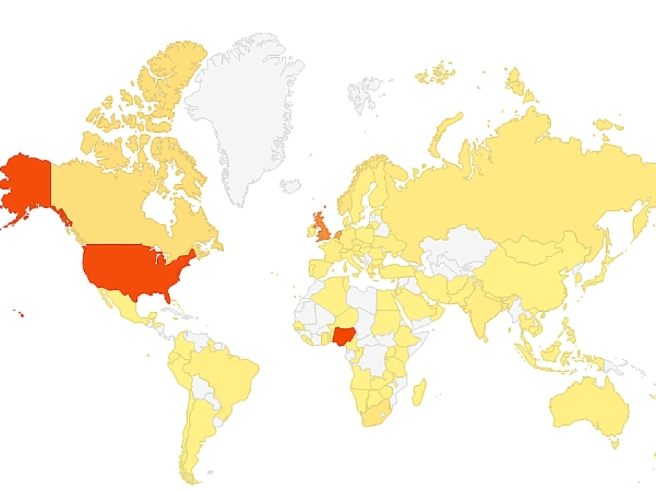
By sharing my blog stage with others, Livelytwist gained more universal appeal. At least one teenager and one writer in his seventies contributed an article to a blog series last year, as well as writers in every other age category in between. At least one person in every continent, in 125 countries, viewed Livelytwist in 2015, up from 115 countries in 2014. Guest writers shared the stories they wrote for Livelytwist on their social networks, engaging audiences I may never have reached.

world stats 2015


country stats 2015

After I ran a series on my blog that featured other writers, a reader scolded me for not writing my own stories. I understood her loyalty, the queasiness, which occurs when vision expands and threatens the status quo; as if I would abandon my blog. I explained that I conceptualized the series, handpicked the writers, and in some cases edited their stories. Then I sent her the links to a couple of stories I had written as part of the series.

What do my stats tell me? Numbers sometimes mean little. Perhaps they confirm something I wrote in my notebook years ago—I want to tell other people’s stories. I am getting closer to that dream, am I not? And it is because you said yes to sharing your story on my blog.

Thank you!


© Timi Yeseibo 2016


Unauthorized use and/or duplication of this material without express and written permission from this blog’s author and/or owner is strictly prohibited. Excerpts and links may be used, provided that full and clear credit is given to Timi Yeseibo and livelytwist.wordpress.com with appropriate and specific direction to the original content.

Three Years On

three

The first time I met Lanre, I told him about my blog. He says it must be my passion, the subject of my blog snakes into every conversation. He wonders, as others do, why I do not monetize my blog. I sigh. As if money is everything; as if money isn’t everything.

I asked a friend to write an article for my blog. His article although well-written lacked that something I look for before I publish a post, but he did not think so, he being an accomplished writer. We reasoned back and forth, threatening our friendship, as when friends mistakenly become lovers, solid lines become indistinct; the ease of communication replaced by silent awkwardness.

It should have been easy to reject a submission that did not meet my criteria except that doing so felt like losing a friend. In the end, I chose my blog and after weeks of reaching out won a version of my friend back. The subject of writing for my blog is taboo. We do not speak of it. Maybe one day we will.

If I did not monetize my blog, I at least learnt what it means to be human. This is what it means to write a blog every Sunday for three years—you become aware of your strengths and limitations; how far you will go for what you believe in.

Three years ago, Maurice, Mayura, and I waited at Holendrecht Station for the metro, cold air whipping through our hair and slapping our coats while trains sped by. I recited a list of possible blog names. When Mayura said Livelytwist reminded her of lemons, my sign-off was born: Take lemons, make life! I can recount incidents like this for every stage of the life of my blog; the people whose input helped me along the way.

Friends sometimes ask about the number of stories I’ve written ostensibly to check if I have a collection large enough for a book. Some days I want to write a book. Some days I do not. Three years on, the relationships, I have forged because of my writing matter more. Each article I’ve published has a behind-the-scenes story—where I was, my state of mind at the time, and who helped make it happen.

I have evolved since my tentative beginning in April 2013. The stories I did not write the way I had wanted to tell me so. You see, when you keep friends up until 1 a.m., seeking their opinions, it seems unfair to discard their recommendations at 2 a.m., when you realize your story no longer resembles you.

I’ve been tempted to revisit the stories, you know, to remove this, and to add that, to make them fully my own. But I leave them as they are, wincing every time I read through, as reminders of a time when although I knew what I wanted I did not have sufficient courage to articulate and execute. I leave the stories on my blog to remind me how people-pleasing distorts what I sound like.

Writing consistently for three years has made me a better writer; I am more skillful with my pen. But skills do not keep you warm, people do. At the heart of every story on this blog is a person or group of people who believed in me. None more so than you who read this blog Sunday after Sunday; you who I fight for with my pen, jeopardizing friendships. If I make it to a fourth year, it will be because of you.

Thank you!

© Timi Yeseibo 2016


Unauthorized use and/or duplication of this material without express and written permission from this blog’s author and/or owner is strictly prohibited. Excerpts and links may be used, provided that full and clear credit is given to Timi Yeseibo and livelytwist.wordpress.com with appropriate and specific direction to the original content.



Choosing Motherhood [2] A Daughter of My Own

baby shoe

I scarcely told anyone about my decision to adopt a child. Although I felt the decision was right for me, questions gnawed at me. Moreover, I did not think people would react kindly to a forty-something-year-old unmarried female adopting a baby; Nigeria is a patriarchal society steeped in tradition. I shared the sentiments of whoever coined the saying: give me the benefit of your convictions if you have any, but keep your doubts to yourself for I have enough of my own.

A few years prior, I overcame my fear of surgery and finally scheduled an operation to remove the fibroids in my womb. After the myomectomy, my doctor gently told me, “Nature abhors a vacuum. You should get pregnant soon.” His words stirred buried desire. I wanted to be more than the best-aunt-ever or best-godmother-ever, two roles I cherished. I longed to be the best-mum-ever.

Two years after my myomectomy, I was no closer to realising my dream of having children under the conventional umbrella of marriage. My anxiety over not having a family increased.

Do sperm banks exist in Nigeria? I don’t know, but a couple of friends offered to father my child. I weighed the complications such an arrangement may present in future and declined. I went to a fertility clinic to enquire about IVF treatment. They asked, “Have you and your partner been trying consistently for up to a year?” I laughed, as I did not have a partner. They recommended I return after my partner and I had tried unsuccessfully for a year.

As time rolled by, all I heard was tick tock ringing in my ears. Even the most self-assured woman would be tempted to ask, “What is wrong with me?” About twenty years earlier, my friends at university had tipped me as the one most likely to marry and have kids first. Life, it seems, did not get the memo. Nevertheless, I still believe I owe myself better than settling with just any partner for marriage sake.

During a holiday abroad, my sister suggested adoption. The idea was novel to me and I toyed with it until I accepted it. I returned to Lagos, thinking of all the babies in orphanages who need parents and rushed to one to find my child.

However, it wasn’t that simple. Lagos state government has an adoption process and a screening procedure. There is also a long waiting list and I had no idea what number I was on the list. While the waiting period can seem long for anxious parents-to-be, I appreciated the forward thinking of the state ministry of youth and culture in preparing parents and adopted children for a new life.

Months later, I was invited to meet baby Folasade. She was a few days old, beautiful, light complexioned, and long-limbed. I fell in love with her immediately. She smiled at me each time I spoke to her as I held her in my arms. Later the orphanage staff explained that babies do that when they are experiencing stomach gripe!

Due to the Lagos state doctor’s strike at the time, she had not undergone medical check-up. She barely opened her eyes and mucus oozed from one eye. I arranged private medical care. The doctors confirmed she was born HIV-positive. I refused to leave her side. The social workers, doctors, and psychologists cautioned me about attachments, which form while bonding and advised me not to set my heart on Folasade because of her condition. I could not; to my mind, she was already my daughter. That weekend they moved her to an undisclosed orphanage where she could get special care. My heart broke.

During my visits to the orphanage, a three-year-old boy always ran to meet me and we became close. He had two sisters. Lagos state has a policy of not separating siblings where possible. I prayed that a family would adopt them all. He was not attending school because he didn’t have sponsors so I organized a successful charity campaign to pay for his schooling.

My heart still bled for Folasade and I wondered what became of her and other babies like her. Should I have fought harder for her, disregarding professional counsel and insisting on an exception to policy as the state would not put her up for adoption? Biological parents do not get to ‘pick’ their kids, but in a sense, parents of adopted kids do.

Sometime later, I was called to meet a two-week-old baby girl, Alison, who appeared shy and reserved. We did not bond immediately. Maybe she sensed part of my heart was still with Folasade. During the three-month bonding period when I spent every spare moment at the orphanage changing her diapers, feeding her, and talking to her, she avoided making eye contact. Was she testing me? Did she think I would bail?

As I persisted in bonding with Alison despite my confusion, I understood a mother’s fierce love—she loves whether her child responds or not. Coincidentally, I was allowed to take Alison home on my birthday, what a gift!

I was nervous as I gave her a bath, fed her, and cuddled her to sleep. I worried she would miss her regular carers and judge me for the novice I was. Instead, she was patient with me as I navigated our first few days. She barely cried.

Tended gardens blossom. Alison and I learnt to relax. Before long, her eyes followed me everywhere I went. She rewarded me with her beautiful smile more and more and we drew closer still, clinging to each other.

My daughter is now one and a half and it’s a privilege and pleasure to raise her. When I held a welcome party to introduce her to my close friends and family, they showered us with understanding and warmth. I was overwhelmed. Does love differentiate? Could they love my biological child, when I have one, any more than they love Alison?

Tentatively, I posted our photos on Facebook. My friends responded with resounding support, surprising me.

Alison’s birth certificate bears my surname. When people ask about her dad, I smile and reply, “I’m her mum and dad.” I realise that soon, she will ask questions. The pre-adoption counselling organised by Lagos state prepares parents for this inevitability. I still cherish hopes of getting married and having a family like the one I grew up in, with a mother and father.

Alison’s facial features now resemble mine and she displays my zest for life—or has love blinded me? Often, friends look at her and comment that she’s very lucky to have me. I shake my head and say, “No, I’m the lucky one. I am the lucky one.”

Ogo Williams is a banker by day and a mother 24/7. She is an avid Chelsea fan who enjoys meeting interesting people, travelling, and reading.


© Timi Yeseibo, 2016

Unauthorized use and/or duplication of this material without express and written permission from this blog’s author and/or owner is strictly prohibited. Excerpts and links may be used, provided that full and clear credit is given to Timi Yeseibo and livelytwist.wordpress.com with appropriate and specific direction to the original content.

Choosing Motherhood [1] Learning to Dance

Dance

Learning to Dance

I got married at twenty-one. Our first son was born a year later when I was in my second year at the University of Nigeria, studying radiological science. My Parents tried to make me see reasons to wait before starting a family, but the day I stopped breastfeeding my son, I became pregnant with my second son. My husband, Ben, at twenty-nine had lost his job before our first son was born and was still unemployed by the time our second son was born.

My Parents harboured us, providing emotional and financial assistance. Ben was studying for an MBA, while I combined schooling with business, selling anything to support my growing family.

One day on campus, I cried in frustration from exhaustion. I practised exclusive breast-feeding so I breastfed all night while studying. Then I slept for less than five hours and drove to the university every morning. A lecturer tried to talk me into moving to campus and leaving my boys in the care of my parents and their nannies. I declined. I told him being a mother came first. Motherhood had chosen me because every family planning method I tried had failed.

I had few friends because I was the only married girl among my peers. They left me alone to work out my new challenges. I was not socially aware. I never partied and didn’t have fashion sense. Ben and I couldn’t afford to go out like other unmarried couples. I was devoted to my family and I wanted to prove to my parents and everyone else that I knew what I was doing.

By my final year, I was looking forward to moving out of my parent’s home. My dream came true when I landed a job in Lagos using my mum’s connections. Ben and the boys joined me shortly. After a while, I fell sick. To my dismay, I found out that I was pregnant for the third time. I was twenty-six.

I was depressed. We still faced financial pressures and I resented this intrusion to my dreams. I scheduled an abortion although it was against my values. On the day of my abortion, a doctor who is also a family friend disclosed my plan to my mum and she called to discourage me. I cancelled the procedure.

After my only daughter was born, my husband found his bearing. He got a job that enabled us move to our own house in Lagos. I also started a cleaning company that became very successful in no time. While we prospered in career and business, our marriage suffered.

From the beginning, Ben only wanted one child and he had not even wanted a child so early in our marriage. He came from a large family while my family was small and I had always looked forward to having many children. Four years after our daughter was born, we had another son. This put more pressure on our strained marriage. When we moved to South Africa, Ben eventually left me and the children.

It takes a village to raise a child. I could not have navigated my motherhood journey without support from family and friends. Looking back, I see that although I have always wanted to be a mother, I did not plan to be one. Children are precious gifts from God and deserve a home with parents who have lovingly considered the ramifications of their presence. Given another chance, I would choose motherhood in a heartbeat, but would wait until I finish school before starting a family.

My children are now 22, 20, 17, and 13. There is no time for regret only gratitude to God as I watch them mature into adulthood. I tell them that there is time for everything under the sun. We need to give ourselves time to grow and allow school to pass through us instead of just passing through school before settling down.

Motherhood cannot be distilled to a formula. It is a privilege to be embraced and it requires determination and wisdom. I grew up with my children, teaching them respect, compassion, responsibility, and love. They in turn gave me lessons in patience and hope. I am learning about fashion and music from them, practicing the latest dance steps and cool moves with them. We laugh together like siblings, when I go off beat.


Ada Obi-Okafor makes her home in South Africa. She’s a licensed radiographer who enjoys soccer, movies, a good book, and a clean house.


© Timi Yeseibo, 2016

Unauthorized use and/or duplication of this material without express and written permission from this blog’s author and/or owner is strictly prohibited. Excerpts and links may be used, provided that full and clear credit is given to Timi Yeseibo and livelytwist.wordpress.com with appropriate and specific direction to the original content.